Awesome Things I’ve Learned Today

Image compression.

In the Machine Learning class, we just learned the k-means clustering technique. Sounds complicated but, as always, the jargon is harder to learn than the concepts in computer science and math.

The idea here is that you express each color in an image as a combination of red, green and blue. Now you can plot each of the colors on a 3d graph so that similar colors will be plotted near each other. Dark red and light red will all be in the high-red, low green, low blue part of the graph.

Now pick a number of colors that you want to compress the image to. I’ve picked 16.

Nett you randomly drop 16 points into that plot of all the colors used. Each of the colors used will be close (in 3d space) to one of the dropped 16.

Here comes the clever part.

Now you have 16 groups of colors based on their closest random point. Find the mid-point (or average, or whatever you want to call it) of the colors and move the one of 16 to that mid point, then recalculate. Here is an image of it working in 2d space.
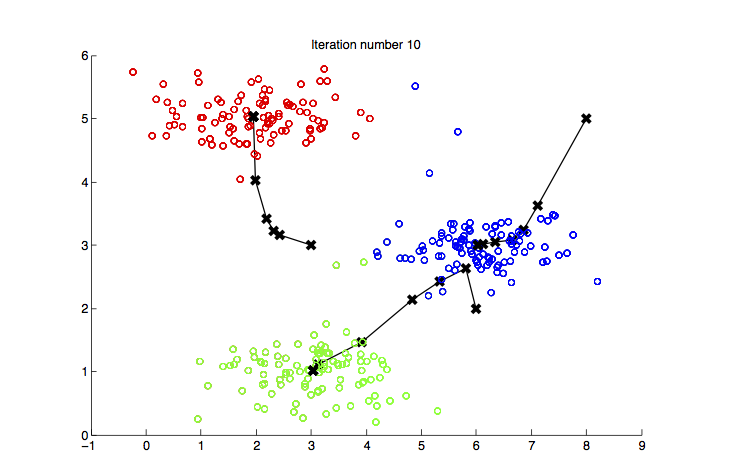
Eventually you wind up grouping all of the original colors into ‘likeness’ groups. The midpoint of this likeness group is your new color and the imagine is compressed!

Here’s an imagine of my dog Max I just compressed in this fashion.

Keys To Success

I love great graphs and this is a great graph:

h/t IA.

This reminds me of one of the best posts I’ve ever read:

using intimate knowledge of an industry and the specific pain points within an industry is a perfectly legal unfair advantage for a startup.

Here’s a real-world example of how this advantage manifests. Adriana has been a psychiatrist for 10 years; she understands the ins and outs of that business. During a lull in her practice she got a serendipitous opportunity to shift gears completely and ended up leading software product development teams.  (Turns out that for big-business project management it’s more valuable to be a sensible thinker and counselor than to be an expert in debugging legacy C++ code.)

Now Adriana has an epiphany: Traditional practice-management software for psychiatrists totally sucks; she knows both the pain points and the existing software first-hand. But now she has the vision and ability to design her own software, capitalizing on modern trends (e.g. a web application instead of cumbersome installed applications) and new interpretations of HIPPA regulation (which allows web-based applications to store medical records like patient histories).

Adriana holds a unique position: Expert in the industry, able to “geek out” with her target customer, yet capable of leading a product team. Even if someone else saw Adriana’s product after the fact, it’s almost impossible to find a person — or even assemble a team — who has more integrated knowledge. At best, they could copy. Of course by then Adriana has moved on to version two.

Everyone has awesome information about something. Mix it with other awesome information in a unique way and you’ve got yourself a competitive advantage.

Sovereignty Shall Reassert

I tend to numbly flick through any Euro analysis that chances across my screen, but yesterday I stopped and actually read a James Hamilton post and thought about it for a sec. It’s a good discussion.

The paths are simple: break the Euro or everyone climb into bed with each other and start making out (my metaphor for fiscal integration). Well, I think this isn’t going to work.

Think of this as a voter: would you vote for a head of state that raises taxes to give BILLIONS of dollars to Greece?

Now think of the flipside. Will Greek voters be all happy-clappy that a bunch of Germans are going to tell them how to run the show? Meh, the Germans aren’t so bad, right? Well, Germany ain’t above rigging itself a good deal at others’ expense.

Let me mess with your xenophobia a bit and ask this: would you accept a bailout from China or Russia if they would assert some fiscal control over your government for the next 20 years?

Yeah f#$!ing right.

The conventional view right now is that nothing is going to happen until the Germans wake up and realize shit is being fed through the fan. Tyler pushes back and so do I, but harder.

This sucker is going down.

Today in Useless Aggregates

The economist reproduces one particularly unhelpful graph/table:

I hate this aggregate analysis. Regional variations in most of these countries completely invalidates the analysis. How do you  make sense of the magnitude of the US housing problem with this kind of regional variation?

You don’t, is how. And even the Case-Shiller doesn’t comment on the economic importance of the various cities.

Have a care when drawing conclusions from gigantically rolled-up economic aggregates. They’re way too easy to fudge in favor of bias.