They Are Among Us

And they don’t need to sleep.

Not only are their circadian rhythms different from most people, so are their moods (very upbeat) and their metabolism (they’re thinner than average, even though sleep deprivation usually raises the risk of obesity). They also seem to have a high tolerance for physical pain and psychological setbacks.

“They encounter obstacles, they just pick themselves up and try again,” Dr. Jones says.

“Typically, at the end of a long, structured phone interview, they will admit that they’ve been texting and surfing the Internet and doing the crossword puzzle at the same time, all on less than six hours of sleep,” says Dr. Jones. “There is some sort of psychological and physiological energy to them that we don’t understand.”

Beware. N = 20:

To date, Dr. Jones says he has identified only about 20 true short sleepers …

There is currently no way people can teach themselves to be short sleepers.

Peddling Trifles

Here’s Suster and Wilson on “Mobile First”.

Wilson’s post is the original, but Mark Suster does a better job on the discussion. Here’s what makes Mobile (capital ‘M’) so interesting to a tech VC:

Mobile has many attributes that are critical:

  • The devices are individual, not shared
  • They are location aware, which is important in personalizing the service offering
  • They are more likely to be the “bottom end of the sales funnel” or in other words close to “point of purchase.” If I am looking at movies on my mobile phone there is a higher chance I’m out-and-about and ready to buy tickets. I have talked with people in the industry who tell me that mobile movie sites convert ticket sales much higher than desktop websites.
  • They are limited in size. In some senses this might seem like a disadvantage. BUT … I’ve talked to a number of eCommerce sites that also report much higher conversion rates than standard web. The hypothesis is that the limited real estate forces less choice and therefore less distraction. This increases conversions of items shown to you.
  • They are often one click away from buying. It’s not pleasant handing over 30% margin to Apple when you sell stuff through the App Store. But on the other hand if you have a product with a very high gross margin (software, virtual goods, etc.) then this is often more than made up by higher conversion rates versus asking somebody for a credit card.
  • They occupy a lot of people’s leisure time. Therefore if your app is geared toward leisure activities (games, communications with friends, etc.) then mobile is awesome.

There’s a trend there and it captures quite a lot of the exciting, consumer-driven advances today: make it easier to consume products while consuming leisure. Mobile works best when exploiting people’s incredibly high discount rates. If you can be there at exactly the moment impulse strikes you’ve got a sale.

Eventually, mobile will mean the everlasting checkout snack line.

But that means mobile only works for trivial products and momentary experiences. Nobody is going to make any kind of big purchase on a whim like that.

And as a result, aside from map tools, I find the whole thing really uninteresting.

It’s About Saving Political Keister, Not Astronaut Lives

This story has been making the rounds:

Starting with near zero space capability in 1961, the National Aeronautics and Space Administration (NASA) put men on our companion world in eight years. Yet despite vastly superior technology and hundreds of billions of dollars in subsequent spending, the agency has been unable to send anyone else farther than low Earth orbit ever since.

Why? Because we insist that our astronauts be as safe as possible.

Keeping astronauts safe merits significant expenditure. But how much? There is a potentially unlimited set of testing procedures, precursor missions, technological improvements, and other protective measures that could be implemented before allowing human beings to once again try flying to other worlds. Were we to adopt all of them, we would wind up with a human spaceflight program of infinite cost and zero accomplishment. In recent years, the trend has moved in precisely that direction, with NASA’s manned spaceflight effort spending more and more to accomplish less and less.

That’s about the gist of it, though the article goes on and on (I skipped most of it) about how much money programs spend on safety while not getting much scientific bang for the buck.

The author is looking at this from a rather more utilitarian ethic than politicians use when setting budgets and objectives for NASA. Here’s how they decide what to focus on.

They just look at this picture:

Then ask themselves, “another one of those on my watch?”

“Nuh-uh”

Engineers and geeks all over the world cry foul and plead, with articles like the one above, for sanity to return, for society to take a bit of risk for a bit of reward.

“Sorry, what was that about reward?” our intrepid politico glances up from his latest pork-ridden bill. Ok, here’s our chance for the big pitch. Take it away, poindexter…

[a bunch of complicated talk about long-dated options on future prosperity]

“Meh, get in line”

Some Links

First, some whining about Siri. I take pleasure in being a Siri contrarian for some reason.

Next Scott Sumner links us to a paper on the old school banking systems of the late 19th century. Also here.

Never forget that the downside of switching to a banking system in which moral hazard isn’t insured by the government (a noble aim, surely) is one which costs a LOT more for customers. Say goodbye to free checking, for example.

It’s not just reckless ibank risk managers who have gotten something for nothing. You have, too.

Stats Status: Too High

Their star course, called “Modern Applied Statistics: Learning,” started a decade ago with 30 students. Its current enrollment just closed off at 190. “We try to give them long and difficult homework assignments,” Mr. Hastie says. “Nothing works.”

More here.

Now read that last sentence again and ask yourself this question: “is this how we get people into STEM?” I think not.

Two more quotes:

The two men also teach a two-day course for businesspeople called “Statistical Learning and Data Mining” that costs $1,450 and attracts a broad range of data-laden people. “We had two guys from Hong Kong who taught a course in horse race prediction,” Mr. Tibshirani says. “One of them came back and told us they’re making $10 million a year by modeling the last-minute betting.”

Are the only people who ever get to learn something like statistics from a teacher that is designing the course for educational impact (as opposed to status-affirmation) those that spend an enormous amount of money or those that spend nothing at all? How weird is that?

About half of the Stanford stat professors have joint appointments with other departments, including economics, human biology and environmental science. “Statistics is unusual,” Mr. Hastie notes. “It’s a service field to other disciplines. It doesn’t rely on its own work. It needs others.”

This last quote is interesting. Statistical techniques are tools and are not particularly useful without domain knowledge. But they still need to be taught by a specialist, probably.

But these guys/gals get down and muck it up with real data every day and for that they need to join forces with others. It’s an applied discipline.

via Jim Lynch

Where Chickens Roost

Home:

Households, in other words, typically clean up banking messes.

That’s Michael Pettis with another great post. Some more great bits (all on China):

For years China bulls have been arguing that because the Chinese save so extraordinarily much money, there is plenty of room to stimulate consumption – just get them to save a little less.  The problem with this reasoning is that consumption is not low because Chinese households save a lot (they save in line with other Asian countries as a share of their income, and less than some).  It is low because household income is such a low share of GDP.

The only way to boost household consumption is either to redistribute income from the low-consuming rich to the high consuming poor, or, better yet, to redistribute wealth from the state to households. 

Earlier he pointed out a paper that discusses the waste inherent in infrastructure projects.

In the paper Flyvbjerg looks at infrastructure projects in a number of countries (not in China, though, because he needed decent data) and shows how the benefits of these projects are systematically overstated and the costs systematically understated. More important, he shows how these terrible results are simply the expected outcomes of the way infrastructure projects are typically designed and implemented.

It is not a very happy paper in general, but I am pretty sure that many people who read it probably had a thought similar to mine: if infrastructure spending can be so seriously mismanaged in relatively transparent systems with greater political accountability, what might happen in a country with a huge infrastructure boom stretching over decades, much less transparency, and very little political accountability? Isn’t the potential for waste vast?

This is one of those depressing pieces that makes you wonder how on earth anything can go right in the world. I’m reminded of a stat I once heard somewhere that something like 60% of all investment is completely wasted. On the one hand, you might think: “wow, that’s a lot of waste, how do we make any progress”. On the other hand, you can look around and realize the power of that 40%.

On the third hand, pause a moment and appreciate the magnitude of the mismanagement that goes into a REAL crisis. Waste is the norm in an economy (an ironic label if there ever was one, I suppose) so sufficient waste to blow away a substantial portion of NGDP in a year or two is staggering. And probably has a multitude of contributing factors.

Amazon Studios: Would You Pay to Watch?

That’s always the key question. Here’s Amazon’s mission:

We think this will be an effective way to develop commercially viable feature films. There are four things we think can make the Amazon Studios process valuable:

The power of the people. Amazon Studios will give artists and film fans around the world the chance to create and evaluate potential movies. We believe that feedback from a large number of people will be a helpful indicator of what is working and what is not.

Evaluate test movies, not scripts. With today’s inexpensive production and editing tools, it’s easier than ever to produce a visual expression of a script. People might find it easier to evaluate a story’s prospects as a movie by seeing it in movie form (even primitive movie form) rather than reading the script and imagining the movie.

Experiment. Complex problems often require a lot of experimentation to solve. Amazon Studios is designed to be a flexible environment where experiments are encouraged.

Collaborate. When a motivated group works together, openly experimenting and responding to feedback, it can make the most of everyone’s talent.

All well and good, but would you pay for this? If not, then how does it make sense? Consider this:

One interesting thing that I’ve always found about the film business from an economic point of view is that unlike in any other business I can think of, the cost of manufacturing the product has no affect on the purchase cost to the consumer. For example Honda can make a cheaper car with less features and cheaper finishes than BMW without losing all of their customers to the superior car because they sell their product for less. You spend less to make something, you charge less for it. Makes complete and obvious sense.

Not so in the film business. I am an independent film producer and I make films that typically cost somewhere between $5M and $10M. But when I make, say, an $8M film it has to compete at the same price level as the studios’ $80M or $100M film. It costs the consumer the same $12 at the multiplex (and whatever it costs to rent a DVD from Blockbuster these days) for either film. There is no price advantage to the consumer for choosing to see a less expensive film. This naturally makes it terribly difficult for smaller films to find an audience.

One possibility here is that the biggest value-add in the filmmaking process isn’t actually the film, it’s the promotional campaign. Most independent filmmakers desperately want to get picked up by the studios for one simple reason: distribution. As soon as the studios have you they buy ads.

Advertising creates demand. Unless Amazon has a way of kickstarting positive awareness feedback loops, the quality of the films on their site is irrelevant.

This kind of thing shines a slightly different light onto the whole SOPA thing. It has nothing to do with defending IP but everything to do with defending a distribution model that people say is dying, but maybe actually isn’t.

An Andean, Tibetan and Ethiopian Walk Into A Bar

The Bar is at the top of a mountain.

Who has the most highly optimized genotype?

The Tibetan (probably):

You probably are aware that different populations have different tolerances for high altitudes. Himalayan sherpas aren’t useful just because they have skills derived from their culture, they’re actually rather well adapted to high altitudes because of their biology. Additionally, different groups seem to have adapted to higher altitudes independently, exhibiting convergent evolution. But in terms of physiological function they aren’t all created equal, at least in relation to the solutions which they’ve come to to make functioning at high altitudes bearable. In particular, it seems that the adaptations of the peoples of Tibet are superior than those of the peoples of the Andes. Superior in that the Andean solution is more brute force than the Tibetan one, producing greater side effects, such as lower birth weight in infants (and so higher mortality and lower fitness).

How To Be Ignored

Apple came out with a product yesterday called iBook Author. Is this the textbook killer that everyone’s been waiting for? Who knows.

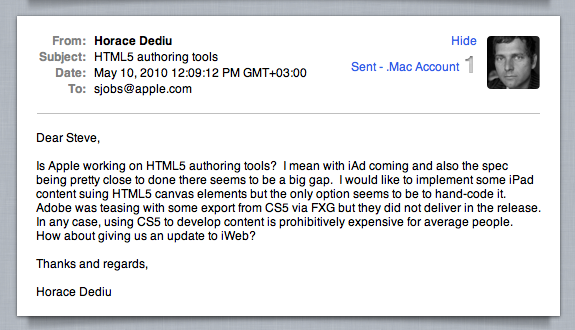
But I noticed something interesting in Horace Dediu’s post crowing about how how he emailed Jobs on something like this a while ago. Here’s  his post:

My thoughts were expressed 20 months ago in a private email.

I did not get a response.

No kidding he didn’t get a response. I’m a sympathetic, interested reader and I had a hard time following that email. Everything about it is hard work, even the subject line.

It’s an excellent example of how to get someone to ignore whatever you’ve written. As my boss once told me about presenting something to busy people (no matter how intelligent): it’s got to be simple enough for a 5-year-old to understand.