However, Farkas and Wetlaufer (1996) found when studying 160 chief executives that the explicit leadership styles of management were not a reflection of personal style. In effective companies the CEOs did not simply adopt the leadership approach that suited their personalities, but instead adopted the approach that would best meet the needs of the organization and the business situation at hand (Farkas and Wetlaufer, 1996, p. 111). Farkas and Wetlaufer (1996) emphasize that they do not see leadership as a generic trait or that a person’s approach to leadership is solely a function of personality. Their research suggests that somevery good leaders repress certain personality traits, or develop ones they were not born with, in order to run their organization effectively(Farkas and Wetlaufer, 1996, p. 114). Farkas and Wetlaufer (1996) hold that until scientists discover a gene for leadership the debate about personality will persist. This is unlikely to occur. Their research indicates that leaders are not driven by what they are like inside but by what the outside demands (Farkas and Wetlaufer, 1996, p. 114). Hartman (1999, p. 31) also found that personality factors could not predict and did not correlate with leadership practices. In fact, studies of leadership behavior show profound differences between leaders in areas like leadership style, decision-making style, conflict behavior, motivation and creativity to mention a few areas. Vinkenburg et al. (2001) focused on decision-making processes behind overt managerial behavior trying to find out why managers do things the way they do. Most academics agree that behavior is a function of both individual and situational factors. However, which of the two factors explains the most variance in behavior is still a topic of heated polemics (Vinkenburg et al., 2001, p. 218). Vinkenburg et al. (2001, p. 234) found that, in general, situational factors have a larger impact on the behavior choices of managers than personal factors.
Missing the Point
HBR has a few interesting pieces on IT, which got me thinking.
Here are 8 reasons you should hate IT. And and here are 8 reasons in response for why you should love it.
To me the discussion from Harvard misses the point. IT, when it is purely devoted to infrastructure, like internet connections and telephony, is fine. When IT suddenly gets thrust into the spotlight as a key cost-cutting or revenue-generating project, it isn’t IT anymore.
I think that a lot of the frustration over IT happens when managers look for a free lunch from their IT department. Oh, I heard that there’s some new technology that will let me do my job with fewer people or at a lower cost. Hm… I’ll just tell the IT department to build some gigantic customized software suite that takes advantage of this.
Projects like that are not infrastructure, they’re technology-related competitive advantages. You don’t win by outsourcing your competitive advantage.
The PC Is Dead. Big Whoop.
There’s always a Debbie Downer:
The PC is dead. Rising numbers of mobile, lightweight, cloud-centric devices don’t merely represent a change in form factor. Rather, we’re seeing an unprecedented shift of power from end users and software developers on the one hand, to operating system vendors on the other—and even those who keep their PCs are being swept along. This is a little for the better, and much for the worse.
Why?
The fact is that today’s developers are writing code with the notion not just of consumer acceptance, but also vendor acceptance… Both put the coder into a long-term relationship with the OS vendor. The user gets put in the same situation: if I switch from iPhone to Android, I can’t take my apps with me, and vice versa. And as content gets funneled through apps, it may mean I can’t take my content, either—or, if I can, it’s only because there’s yet another gatekeeper like Amazon running an app on more than one platform, aggregating content. The potentially suffocating relationship with Apple or Google or Microsoft is freed only by a new suitor like Amazon, which is structurally positioned to do the same thing.
Reminds me a bit of the Michael Mandel paper (via) on how innovation requires large corporate investment. Here’s Mandel with his similar but sunnier version:
The second part of the Schumpeterian Hypothesis is the observation that companies with more market power might also be more willing to invest in innovation. The argument is that if a firm in an ultra-competitive market innovates, the new product or service is quickly copied by rivals, so that the gains from innovations are quickly competed away. Conversely, a firm with market power has the ability to hold onto some of its gains from innovation, so it may pay to invest in product or other improvements.
Back to the Harvard conclusion:
If we allow ourselves to be lulled into satisfaction with walled gardens, we’ll miss out on innovations to which the gardeners object, and we’ll set ourselves up for censorship of code and content that was previously impossible.
You can imagine how many articles like this were written about IBM in the 60s and 70s and Microsoft in the 80s and 90s.
Besides, both of choose to deemphasize the point that with each turn of the generational wheel, the real innovation (the programs we use every day) is being done in a progressively more distributed manner. Mainframes, PCs, mobile.
I could write an app on my own and sell it to the world. Couldn’t do that with a PC. DEFINITELY couldn’t do that with a mainframe.
Wishing it were even more distributed is fine, but put your whining in context, please.
Paying College Athletes
Here’s a video of a top-ranked high school football player choosing his college on live tv. The upshot is that he is from Louisiana and his mom voices discontent of his choice of Alabama over LSU.
Ben Casnocha says: “pay the athletes”
I say that impossible:
To get paid, the players will immediately form a union. Here is going to be their list of demands:
1. Pay us (fine).
2. Don’t make us go to school (uhhhh).
3. Let us play longer than 4 years (what?)
Here’s the student body response:
1. These aren’t students
2. I want to play football (or basketball) for my alma mater
3. Set up a parallel system for me to play in
The problem with this system isn’t that student athletes aren’t getting paid. The problem is that the NBA and the NFL don’t have a feeder league system like every other major professional sport. This means that the NFL and NBA are less popular than they otherwise would be.
Think about the difference between fan followership of college football and basketball vs all the other lower-tier sports leagues on earth. Orders of magnitude larger. Why? Because they’re piggybacking on college support. These are fans that would otherwise pay more attention to the pros.
The winners in today’s arrangement are, first, sports administrators and, second, sports fans. The losers are the NFL, NBA and lower-tier college athletes.
One interesting possible externality of sports administrators winning so big is that sports administration and so sports itself probably wins. Gigantic sports facilities support more than football. I bet you that the quality of the US Olympic team would decline demonstrably if you killed the college sports money machine.
And paying the athletes would kill it.
No Controlling This!
The US economy has no hope.
From Robin Hanson:
A randomized insurance experiment found that on average people who thought they had a higher health risk bought more insurance. But they didn’t actually have higher risk:
[In] a large-scale randomized field experiment in Mexico … [in ’04 on] a voluntary health insurance option [=SP] … ‘high risk’ agents are, ceteris paribus, more likely to opt into SP—although the insured are not more ‘risky’ on average. That is, despite the absence of a positive raw correlation between agents’ insurance status and proxies of risk, this paper presents evidence of the systematic selection predicted by theory. In particular, individuals who rated their health as “bad or very bad” before SP became available are 6.9 percentage points more likely to sign up for SP than those in “good or very good” health (compared to an overall treatment effect of 29 percentage points).
Curiously, however, agents in the experiment sort only on pre-period medical expenditures and subjective well-being. There appears to be no selection on objective measures of health—possibly because individuals are less aware of the latter. … [Regarding] preventive care decline with insurance coverage, the effect of SP on the utilization of these services is negative and non-trivial in size. Given the positive price effect, such a decline is likely due to ex ante moral hazard. (more)
This supports the idea that medicine is less about health than health-related feelings. If medicine were more about the reassurance that comes from being taken care of medically (because medicine is a standard way for others to show that they care about us), it makes sense that we want more insurance when we feel more vulnerable to illness, but that sense of vulnerability would have a lot more to do with the social assurances we desire than our state of health.
Since moving to the US from Canada, I can definitely tell you that there is an order of magnitude more supply of health care here. Wouldn’t surprise me if that explains all of the cost differential (as % of GDP).
No silver-tongued politician is going to talk voters into less health care. This is a wiring problem in the human mind.
I’d invest in health care and health care-related industries*. However, we’ll have to watch out for attempts at regulating costs, which means providers will be more concerned with lobbying and rent-seeking than building profitable businesses. An unpleasant investment environment, but perhaps not an unprofitable one.
Every other polity in the world will probably find this human wiring problem too powerful to control. Two-tier for all! International expansion of health care companies from the US is going to be a gold mine.
*Insurance is a funny case here because its costs are driven by liability claims related to medical care. Its performance will probably be like heavy consumers of resources during a price spike.
When Borrowing Dominates
David Merkel has another thought-provoking post. I like when people put real data up. Here is his chart:
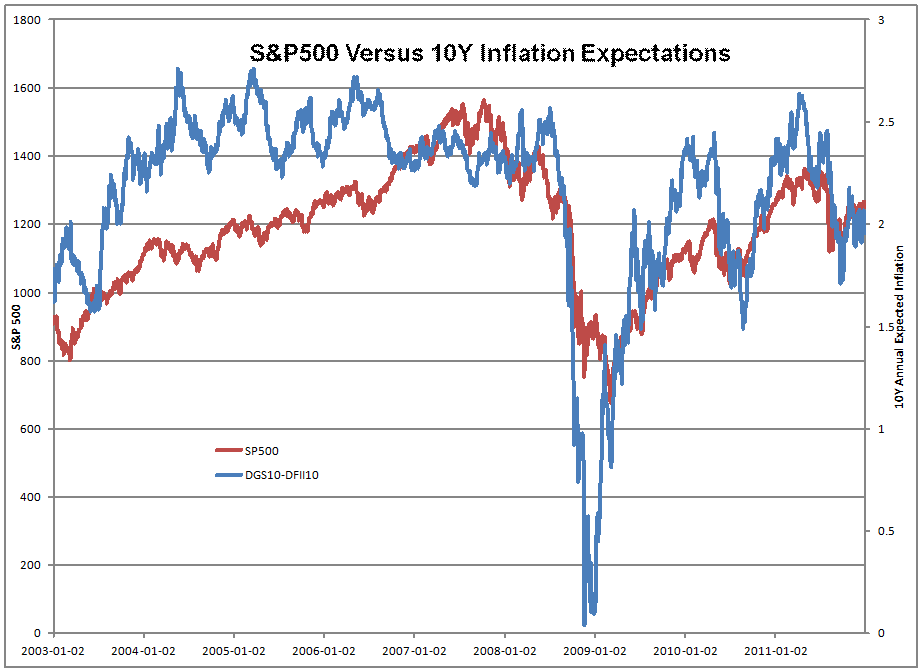
So the stock market is being driven by inflation expectations. Hm… Let me put on my Monday Morning QB hat and think about this.
I think this is normal behavior in bad times. If things are healthy, the boom should rise for far longer than inflation expectations coming out of a recession. You need healthy demand to fuel inflation and the series really never had a chance to decouple from the early 2000s slodown.
My second point is that the series really link up in 2007 when subprime hits the headlines and investors probably start seriously thinking about worst case scenarios. Worst case scenario here meant a debt-deflation spiral.
Deflation KILLS borrowers by making the real burden go up. This makes the borrowers less likely to pay back their loans, which means, ironically, that the banks lose big time.
And the market tells us what happens when the banks lose big time:

How to Be Heard
from Krugman:
I realized that I also wanted to say something in response to the concern trolling, the “if you were more moderate you’d have more influence” stuff. Again, this amounts to wishing that we lived in a different world. First, there is no such thing in modern America as a pundit respected by both sides. Second, there are people writing about economic issues who are a lot less confrontational than I am; how often do you hear about them? This is not a game, and it is also not a dinner party; you have to be clear and forceful to get heard at all.
If I were Tyler Cowen (to whom Krugman is sorta responding), I’d ask: ok, but at what margin does confrontation detract from your message? Surely there is a limit.
Krugman is very confrontational. Pundits, as they are normally called, are supposed to be confrontational because that is what moves newspapers and attracts eyeballs. That is NOT necessarily what moves policy, though they are no doubt related.
Krugman has been listening to the whispers of his NYT editors (who would much rather Krugman attract eyeballs than policy clout).
Hockeynomics
Much as I am on board with more Canadian hockey teams, I’m not convinced these half–analyses. Here’s the point:
“A secret National Hockey League report detailing the ticket revenues of its 30 teams provides additional ammunition for those suggesting more struggling U.S.-based teams should be relocated to Canada.”
Then this paragraph invalidates much of the whole point:
Unlike other pro sports leagues such as the National Football League, which generates billions of dollars in revenue from huge TV and sponsorship contracts, the NHL is a so-called “gate-driven” league where ticket revenue accounts for close to half of the league’s total revenue.
WCI adds the effect of FX rates:
While there are other revenue streams other than gate revenue, it would appear that a new team in Canada could survive all but the most extreme of exchange rate fluctuations.
So we conclude everything from and analysis of half the revenue? Take any financial statement, cut out half the revenue and EVERYTHING else. Now pick a company to invest in.
Look, I’m not saying that it isn’t a good idea. I’m biased towards it, if anything. But this is sports writing, not financial journalism.
N = 1 Studies are BS
The Finnish education system is great and a lot of people are making a lot of money pretending to know how this country of white people* can get away with it.
There’s something called culture working here and you aren’t going to change the subcultures that destroy education in some American areas. There is a (very low) limit of how much you can learn/copy from another culture.
Here is a list of DW-approved initiatives on this subject:
1. Pay Finnish administrators to come here and set up a private school system in a city of their choice. Compare results. And set up a betting market so I can make a ton of money on the failure of this initiative.
2. Compare the performance all of the countries that share whatever features you’re saying matter.
(What? There’s only one? What does that tell you?)
*sorry to play the race card. I know it’s crass but let’s face it, when it comes to phenomena too complex to understand, we tend to get stupid. Why all the attention to Finland over Singapore?
From an Economic History Perspective, I Hate the 50s
Krugman LOVES invoking the 50s:
First, instead of a hypothetical example, let’s talk about a real case: US debt after World War II. The government emerged from the war with debt exceeding 100 percent of GDP; because there was almost no international capital movement at the time, essentially all that debt was owned by domestic residents, with a sizable fraction consisting of savings bonds bought by individuals.
Now, here’s the question: did that debt directly make America poorer? More specifically, did it force America as a whole to spend less than it would have if the debt hadn’t existed?
The answer, clearly, is no.
But have a read of MR’s link to this paper:
The statistical trend for growth in total economy LP ranged from 2.75 percent in early 1962 down to 1.25 percent in late 1979 and recovered to 2.45 percent in 2002. Our results on productivity trends identify a problem in the interpretation of the 2008-09 recession and conclude that at present statistical trends cannot be extended past 2007. For the longer stretch of history back to 1891, the paper provides numerous corrections to the growth of labor quality and to capital quantity and quality, leading to significant rearrangements of the growth pattern of MFP, generally lowering the unadjusted MFP growth rates during 1928-50 and raising them after 1950. Nevertheless, by far the most rapid MFP growth in U. S. history occurred in 1928-50, a phenomenon that I have previously dubbed the “one big wave.”
The 50s, when we last had a gigantic debt burden to work off, was right smack in the middle of the most extraordinary burst of productivity the world has ever seen. Life changed more slowly before and after. How can you derive policy recommendations for today from this datapoint? You can’t!
And here’s a graph from Krugman:

Now that’s something that I have NO intuition for. Borrowing from foreigners and buying their assets with the proceeds? WTF?
 Not Unreasonable