What’s The Point of a Designation? (With a Venn Diagram!)

This is a fairly weak challenge to the pursuit of technical certification, but let’s start with it anyway:

I have come across a lot of my friends who aquired very nice percentage and received certificates though they have very minimal knowledge, or they have never worked on that particular technology. How crap is that, and now they are the proud owner of certificate, showcasing it proudly over their work desk. Ask them a very simple question on the technology that they have got certification, they would be for sure struggling to give answer to it. This is quite common, Certifications are being done only to get an extra point during their salary appraisals or job interviews. And I pity these corporate giants who would consider certification to be something remarkable.

How many out there would say, Yes certification is worth doing and it must be done to prove that you are good in a particular technology?

First point: if you’re an aspiring entrepreneur, stop right here. Stop reading, stop everything and go start building stuff. The longer you wait the harder it will be.

Second point: certifications are often required to work in a chosen field. That’s called occupational licensing and it’s often ridiculous. I’m going to concentrate on what real benefits certifications offer (in my experience) to the risk averse, hard working and ambitious. Doctors and lawyers need not read further.

I mentioned at the top the argument above is pretty easy to dismiss. Knocking something you haven’t actually tried? Striking down the straw man of heavily credentialed morons? Here’s a Venn diagram:
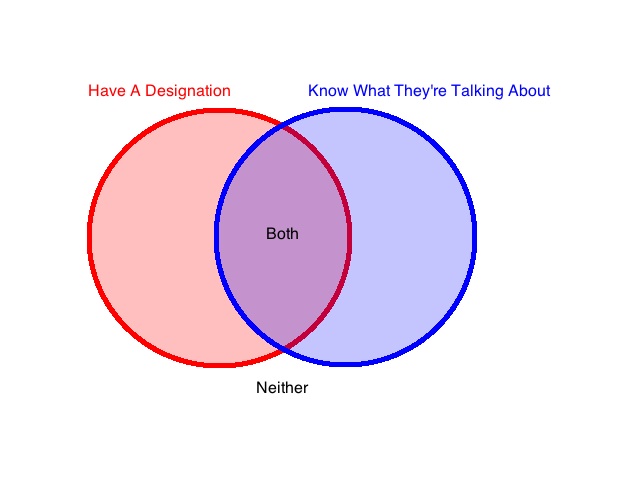
I did a fairly terrible job of scaling the image. The Red-only zone should be pretty tiny, the smallest of them all, really. Most people who spend the time and energy studying a topic do come away with some competence.

The deeper question is something anyone who spends a lot of time studying for tests should struggle with: is it worth your time? What does it get you?

Once upon a time I was at a dinner with a client who gave me some offhand advice: take some courses, they’ll teach you something, you’ll get an initialism for your business card and you’ll advance your career.

What terrible advice. I followed it, which I’ll get to later, but here’s what he should have said:

  1. Education is good, but remember its two functions: to teach you practical skills and signal your intelligence.
  2. Many certifications, unfortunately, are completely useless. By that I mean they teach you nothing useful and don’t signal a damn thing of any use to strangers.
  3. Most skills that will actually improve your job performance are best learned on the job. There is usually no good substitute for experience. Go help domain experts solve problems and effing pay attention. Study them.
  4. The most important skill of all? Check out this paper, which I’m actually reviewing for another blog post:

    In this study, measures of interpersonal and task-related skills were obtained from two groups of engineers: those nominated as “stars” by their managers and those nominated as “average”. Interestingly, the researchers found that the only distinguishing difference between the two was the stars’ interpersonal and affective skills. Specifically, the stars were better at developing rapport with coworkers and building extensive, loose networks of reliable problem solvers.

    Interpersonal skills. No certifications for that.

  5. Depressed yet? Well you should be. There is no reliable way to accelerate your career except to experience more. The only other possibility is to perhaps the change the trajectory of your career by changing the what kind of experience you get and how you respond to it.

NOW let’s talk about certifications.

Certifications work best as an introduction to a body of knowledge. Your goal should be enough understanding to follow a conversation between experts. Doesn’t sound like much, but this is incredibly important.

Imagine your mind dragging a net along behind it everywhere you go in life. You actually don’t have enough knowledge to properly interpret a lot of the experiences that pass through the net. Think of a certification as a way of shrinking the mesh of your net.

The second thing certifications can offer is the opportunity to work your ass off. Some certifications are really challenging to complete. Following my client’s advice I took a softball course, which has proven useless. The last module in it, however, was an introduction to finance which I really enjoyed (I was shocked – I HATED finance in undergrad and nearly failed it).

So next I tackled the CFA exams, then moved onto the CAS exams. Some would look at the amount of time I spent on these (over years and years) and shudder. Good. This makes them a fantastic signal of all kinds of qualities employers love.

But even the most grueling course yields nothing in isolation. What you want is the holy grail: high-value experience. By that I mean working with and learning from the best.

You see, the skills of the most incredibly skilled have afforded them prestige (always), wealth (often) and an extraordinary demand for their skills (always). They need help. And who are they going to pick? Putting nepotism to one side, they’re probably going to pick the highest status recruits, which means those with the strongest signals of quality.

I’m pretty fortunate to have a challenging certification available I can sink my teeth into. But programmers have an enormous expanse of open source projects they can attach their names to. And writers can always write, artists can, um, create, etc.

Certifications are ideal in mature industries where innovation is slow and the canon of skills relatively stable. In others, go online, the Internet has enabled quality signaling in just about any worthwhile pursuit.

But remember the iron law of education: if you don’t have to work hard for it then it probably isn’t worth your time.

Debunking Dr. Oz (Or: How Charlatans Do Science)

…when the sign in front of my local pharmacy started advertising “Green coffee beans – as seen on Dr. Oz” [as a weight loss wonder drug -DW], I tracked down the clip in question.

That’s Scott Gavura of Science-Based Medicine (SBM), who then goes on to drilling into a (the?) piece of evidence that could possibly support this supplement manufacturer’s claims. I have to admit I love reading the occasional holy smackdown of crackpot science. And today I got my fill:

…Green coffee extract (the brand “GCA”) was used in the study. The authors note that GCA has a standardized content of 45.9% chlorogenic acid, which is purported to be the active ingredient. Now contrary to what was said on the Dr. Oz show, chlorogenic acid is also in roasted coffee in significant amounts, so you don’t need to take green coffee extract to get a good dose.

…The study is entitled Randomized, double-blind, placebo-controlled, linear dose, crossover study to evaluate the efficacy and safety of a green coffee bean extract in overweight subjects. The lead author, Joe A Vinson, is a chemist at the University of Scranton, Pennsylvania. None of the three authors appear to be clinicians or medical professionals, and none appear to have published obesity-related research before, according to PubMed. The study was funded by a supplement manufacturer, Applied Food Sciences.

To start — this is a very tiny trial — just 16 patients (8 males, 8 females) with an average age of 33 years. The research location was a hospital in Bangalore, India. How these patients were recruited was not disclosed. Normally a trial would list detailed inclusion and exclusion criteria, and then describe how many patients were considered and the reasons for exclusion. This paper just reports the final number, and there is no information provided on why 16 was felt to be the desireable number. The average weight was 76.6kg (168 lbs) and the average body mass index (BMI) was 28.22. While the BMI on an individual basis may not be informative, when looking at a population, a score between 25 and 30 is usually accepted to mean overweight, but not obese. The details on how these measurements were taken were not well described — which is surprising, given this is a this is a pretty important part of the study.

And on and on it goes. Science lovers and crackpot-haters, do feast your eyes on the whole article.

The Twilight of Catastrophe Modelers

One interesting idea in Kevin Kelly’s *What Technology Wants* is that technologies undergo a life cycle where they are at first specialized and poorly designed (they just don’t effing work right) and progress to the point where they are ubiquitous.

I am reminded of that by this article on cat models (via Jim Lynch):

Speakers at several recent insurance conferences stressed the need for property insurers and reinsurers to develop their own independent views of catastrophe risk, rather than outsourcing their risk views to third-party vendors. But they differed on exactly how to get to there.

While experts observed that reinsurers and insurers are increasingly using multiple models to inform their views of cat risks (with the smallest insurers enlisting the help of reinsurance brokers to accomplish this), Peter Nakada, managing director of RMS, a Newark, Calif.-based firm, suggested that a multi-parameter view is preferable to a multi-model view…

“Pick one of the giant simulation things and then force the modeling firms to give you the secret sauce from inside the models,” he advised, suggesting that users can then select “multiple points of view on the parameters that run the model” to develop a range of estimates.

Nakada is fighting a serious rearguard action here. RMS overreached with their last update and modeled claims costs skyrocketed. Instead of recanting on their update (unthinkable), they instead downplay the importance of their technical view of the risk. And they’re right. But I wonder if they realize how much pushing the commoditization of their black box will fundamentally change their business.

Kelly would phrase it like this: what happens when open sourced cat models are ubiquitous? How does that affect the industry?

The day may well come when the ‘secret sauce’ of the cat models goes open source and the state of the art is free to all. In that world RMS goes from R&D shop to industry consultant. They’ll provide outsourced analysis and data cleaning services.

They’ll fight like rabid dogs to avoid the billable hour revenue model, since nobody gets rich in businesses that don’t scale, so they’ll need products. Maybe they’ll look to compete with ISO and offer some kind of master database of property values in the US, who knows.

Their heyday, though, is perhaps ending.

Bernanke Failed In The 90s. That’s Why He Fails Today

I find Ben Bernanke endlessly fascinating. This is a guy that built his entire academic career around studying the exact situation we now find ourselves in.

Seriously, and by all accounts this was a first rate career, too.

Yet now he finds himself in a position where he is dismissing the most important conclusions of his most important research. I think it is hard to overstate how mind boggling this is.

Here is Scott Sumner:

Bernanke keeps insisting that the Fed is never really out of ammo.  I know that some people think he’s lying, but he also passionately believed that as an academic.

…The Fed’s newly transparent forecasts make it quite clear that we will fall short of almost anyone’s definition of a desirable level of demand growth over the next few years.  And yet the Fed holds back from doing more.  Reporters are beginning to probe this inconsistency at press conferences.  He answers the queries the only way he can—mysterious “costs and risks” of aggressive unconventional stimulus.  That basically means that if they bought up a large chunk of the national debt, they might later have to sell it at a loss.

Does Bernanke actually believe these costs and risks are more important than millions of unemployed?  Based on his work on Japan as an academic, almost certainly not.  But other people at the Fed certainly do worry about this, and he must speak for the entire Fed at the press conferences.  What else could he say?

I figure that Bernanke’s research may have convinced him (and some others) but it has not convinced enough of the rest of society (median economist, median politician, median voter, whatever) for it to make a difference in policy. The idea of the fed as an independent institution is complete BS. Bernanke is forced to give voice to a consensus he believes is totally wrong.

So Bernanke was a failure as an academic. Which means he will fail as a central banker.

Big Deal In Physics Today

Today CERN announced that they have probably found the Higgs Boson. I read this last night so I was expecting it:

They’re very likely going to announce that the 5-σ threshold, the “gold standard” for discovery, has been reached, and that we’ve discovered the Higgs boson.

Assuming things go as we expect, the speculation will turn to the question of what does it mean, and I’ve got some early analysis for you.

For a Higgs right around 125 GeV, which is where all preliminary analysis points, we expect that the Higgs will be produced at a certain rate, and that it will decay into various other particles at particular rates. What are those rates? There’s an excellent analysis in this paper, that shows what the standard model rate is for various possibilities, and what the preliminary data is for each detector, thus far.

If this is, in fact, where the Higgs appears to be, and the rates observed are consistent with the standard model predictions, and there are no other “new particle” announcements that come out on the 4th, then this is an amazing victory for the standard model.

And a nightmare scenario for everything else, including supersymmetry, extra dimensions, and string theory.

Here’s a bit more:

The great nightmare of people interested in particle physics is that the standard model works toowell. That the Higgs exists somewhere between 120 and 140 GeV, that there’s no supersymmetry or extra dimensions or composite Higgs or technicolor or anything surprising.

And this would mean that we’d never understand why the Higgs couples the way it does, or whythe particles in the Universe have the masses that they do; the best we’d be able to say is, “They just do.”

So I’m hopeful that they don’t find only the Higgs, because if they do, we could be living through the last hurrah of particle physics, and there’s too much that we still need to know! Here’s hoping…

I haven’t seen anything in any of the press releases commenting on whether this nightmare scenario is true or not.

The Staggering Genius of Taco Bell

Warning: I’m being pretty generous with over-the-top superlatives today.

I think Taco Bell is the most innovative company on earth. Honestly.

Some might look at what this company offers and think them a bit pedestrian, but remember, this may be the most mature industry conceivable. Innovation is NOT supposed to happen in mature industries.

First is a unique offering which exploits the only true competitive advantage Taco Bell has, the ability to offer texture in its food. To the uninspired, it’s the usual hamburger formula: carb, veg, cheese, beef carb. But, come on, crunch in your burger? Nobody makes it like this!

And the grand triumph is a co-branding strategy that I think is possibly the most extraordinary work of marketing genius ever committed on earth.

These are its best selling products of all time and no surprise.

Now consider this: anyone with half a brain figured out smartphones were coming, tablet computers were coming and… wedge laptops? Puh-leeze. Easy.

Taco Bell has come up with two complete breakthroughs which I’m convinced would otherwise never exist. And in commodity fast food! I’m so impressed.

Barclays Scandal – It’s the Stupidity That Shocks Me

So LIBOR and EURIBOR are these benchmark interest rates. They’re calculated by surveying a (large) panel of banks and taking the average of their *reported* borrowing rates.

We use them as crediting rates for holding accounts on various deals. The point here is that people ACTUALLY USE these rates because they’re viewed as a neutral estimate of risk-free (-ish) borrowing costs. Everyone gets that they’re sorta BS, but they’re probably not THAT bad, so we use them anyway.

Well…

58. Barclays’ Derivative Traders would request high or low submissions regularly in emails, for example on 7 February 2006, Trader C (a US dollar Derivatives Trader) requested a “High 1m and high 3m if poss please. Have v. large 3m coming up for the next 10 days or so”. Trader C also expressed his preference that Barclays would be “kicked out” of the average calculation. Trader C’s aim was therefore that Barclays’ submissions would be high enough to be excluded from the final average calculation, which could have affected the final benchmark rate.

…At least 14 Derivatives Traders at Barclays made these requests. This included senior Derivatives Traders.

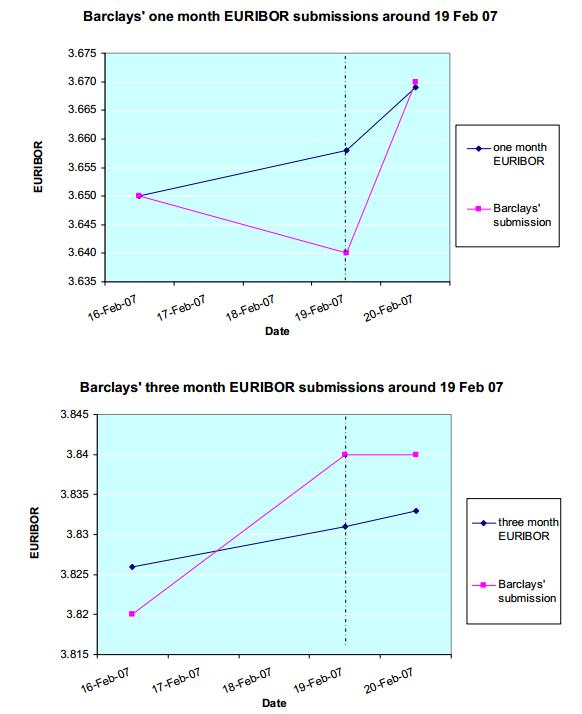
That’s about all you need to know about the Barclays EURIBOR fixing scandal. Here are some graphs from the pdf:

I find this fascinating reading, though. Here’s more:

59. On Friday, 10 March 2006, two US dollar Derivatives Traders made email requests for a low three month US dollar LIBOR submission for the coming Monday:

i. Trader C stated “We have an unbelievably large set on Monday (the IMM). We need a really low 3m fix, it could potentially cost a fortune. Would really appreciate any help”;

ii. Trader B explained “I really need a very very low 3m fixing on Monday – preferably we get kicked out. [DW- LIBOR and EURIBOR are calculated by clipping the highest and lowest rates submitted by the banks. I wish I understood why having the Barclays submission kicked out helps their trade…] We have about 80 yards [billion] fixing for the desk and each 0.1 [one basis point] lower in the fix is a huge help for us. So 4.90 or lower would be fantastic”. Trader B also indicated his preference that Barclays would be kicked out of the average calculation; and

iii. On Monday, 13 March 2006, the following email exchange took place:

Trader C: “The big day [has] arrived… My NYK are screaming at me about an unchanged 3m libor. As always, any help wd be greatly appreciated. What do you think you’ll go
for 3m?”

Submitter: “I am going 90 altho 91 is what I should be posting”.

Trader C: “[…] when I retire and write a book about this business your name will be written in golden letters […]”.

Submitter: “I would prefer this [to] not be in any book!”

60. The number of requests and the period of time over which they were made indicate that the Derivatives Traders made requests on a routine basis. Specific emails also indicate the requests were made regularly. For example, the following email exchange took place on 27 May 2005:

Submitter: “Hi All, Just as an FYI, I will be in noon’ish on Monday […]”.

Trader B: “Noonish? Whos going to put my low fixings in? hehehe”

Submitter: “[…] [X or Y] will be here if you have any requests for the fixings”.

And this!

67. On 6 August 2007, a Submitter even offered to submit a US dollar rate higher than that requested:

Trader F: “Pls set 3m libor as high as possible today”
Submitter: “Sure 5.37 okay?”
Trader F: “5.36 is fine”

Are these the stupidest people on earth? This is SNL-worthy idiocy.

Short Cramer’s Picks

According to a detailed analysis published in October 2010, viewers who bought the stocks Cramer recommended the previous night lost money relative to the market overall. Even people who held those stocks for as long as fifty days lost an average of nearly 10 percent relative to the market. For those stocks with the highest overnight returns after Cramer’s recommendations, the fifty-day performance was even worse: negative 29.54 percent for the top quintile. In other words, according to this study, if you watch Mad Money and follow Jim Cramer’s top recommendations, you will lose almost one-third of your money in less than two months. Not very many people can afford to follow that kind of advice. The study also found that an investment in the stocks Cramer recommended significantly underperformed the market over the longer term.

That’s Barker. So just short his picks. Can it possibly be that easy?

Entreprenempathy

Let’s start with this assumption: entrepreneurs are the best leaders/managers a company can have. Most importantly, the entrepreneur that founded a company is the best leader that company will ever have, probably. Why is that?

Entrepreneurs come up with things that sell, they’re product people. For some reason, large companies can often come to be run by people who are good at many of the other things large companies do other than sell products: raise money, deal with regulation, institute internal processes, fire people, hire people, etc. Sometimes these skills need to be the focus over some time horizon. But be not fooled: these are secondary functions.

At best, an entrepreneur is a product person that views the company as an extension of his/her personal self. It’s not just the financial alignment that investors spend all their time worrying about, but an alignment of identity. Because of that, many of the secondary functions simply fall into place: you run the company’s finances like you’d run your own, which makes you (more) risk averse, which is basically good. You run the brand like you run your personal relationships, which, assuming you’re mostly normal with your own quirks (which everyone is) makes the brand accessible yet interesting. Et cetera.

Seeing a company as an extension of your self seems to me to be a kind of empathy. You feel pain when the company is hurt, you feel joy when the company grows. The pressure of having to care for this thing you created, which includes its people (think about the word company), provides a motivating force unlike anything else in our society.

So that’s what an entrepreneur is to me: a person with deep empathy for his/her firm and relentless focus on the #1 priority of any business organization: customers’ needs. Which, of course, is another form of empathy.