Trump Evolving

The most prescient of Trump commentators in my little bubble has been Scott Sumner. His point all along has been that Trump doesn’t care about anything and is just saying whatever it takes to win. He willl, Scott predicts, reverse every single position he’s ever taken.

No, this is not from The Onion:

Presumptive Republican presidential nominee Donald Trump said on Saturday that he wouldn’t characterize his immigration policies as including “mass deportations,” drawing a sharp retort from the campaign of Democrat Hillary Clinton.

Trump, in an interview at his golf course in Aberdeenshire, Scotland, said that rather than a blanket ban on Muslims coming to the U.S., a position he took in late 2015, he’d focus on those from countries with links to terrorists. The Republican also said he would start from scratch on the sweeping Trans-Pacific Partnership trade pact.

Trump said his immigration policies would have “heart,” suggesting he may be shifting tone to transition into general-election mode after the bruising primary season.

“President Obama has mass deported vast numbers of people — the most ever, and it’s never reported. I think people are going to find that I have not only the best policies, but I will have the biggest heart of anybody,” Trump said.
Pressed on whether he would issue “mass deportations,” Trump answered: “No, I would not call it mass deportations.”

I’m sure my neo-Nazi commenters will be thrilled to learn that on immigration Trump will have an even bigger heart than Obama.

The reckoning proceeds.

His opponents (ie everyone I know) could easily draw all of the wrong lessons from this of course by dismissing the success as being deeply fraudulent. It was not. Trump legitimately appealed to many and to the evil side of many more.
Brexit and The Allure of the Sith

Brexit is about preserving the English Nation. Cowen is at his best when chenneling the darker sides of humanity. In the end this is what makes him the best commentator out there. He knows that instinctive reactions, baser reactions, are not always wrong, even if they are usually wrong.

I’ve always felt that insight comes from a deep connection with ones own failings. The Cass Sunstein podcast where they discuss the dark side of the force is an awesome exchange:

SUNSTEIN: Thank God for libertarian paternalism, that Luke has a choice. The Sith, by the way, like the Jedi, respect freedom of choice. In the crucial scene in Episode III where the question is whether Anakin is going to save the person who would be emperor, he says, “You must choose.” And so there’s full respect for freedom of choice. Nudgers have that. Good for them.

COWEN: Bad guys always tell you the deal, and then they say, “Choose evil.” It seems the good guys always mislead you.

The good guys spend too much time pretending that evil doesn’t exist. What a waste of time. It does exist and it exists in all of us and by pretending it isn’t there we become far less wise about the world. Tyler’s contribution is to frame evil in its best possible light and then reject it anyway.

Or not. Sometimes it feels good to be bad because badder is better.

What Trump is, In the Best Possible Light

From MR of course. One bit:

Liberalism isn’t actually an automatic emotional default for most people on this planet, so being a scold is in the longer run a losing strategy.  I believe many current “democratic mainstream” thinkers genuinely do not understand how boring and unconvincing they are, as they live in bubbles filled with others of a similar bent.


Pick The Best Stocks and Fail

here is John Cochrane reporting from the NBER Asset Pricing conference:

Robert Novy-Marx presented  Testing Strategies Based on Multiple Signals, discussed by Moto Yogo. We’re all familiar with the phenomenon that if you try 10 characteristics and pick the best few to forecast returns, t statistics are biased and performance falls out of sample.

Robert pointed out that if you put those best 3 in a portfolio, they diversify each other, reducing the in-sample variance of the portfolio, and boosting Sharpe ratios and t-statistics even further.

Many “smart beta” funds are doing this, so the fall-off in performance from backtest to real money is relevant beyond academia.

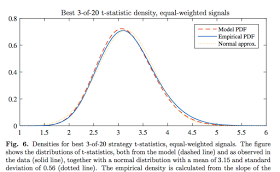
The extent of this bias is impressive. Here is the distribution of t statistics that results when you pick the best three of 20 completely useless signals, and put them in a portfolio. Critical values of 4 and 5 show up routinely in Robert’s calculations.

image

If you pick the three best of a bunch purely average performing stocks you will have a portfolio that looks amazing but is, in fact, crap. This is going to work for all kinds of variable asset or liability prices, including insurance.

Beware ststiatics, folks.

David Bowie in 2002

From here.

I don’t even know why I would want to be on a label in a few years, because I don’t think it’s going to work by labels and by distribution systems in the same way. The absolute transformation of everything that we ever thought about music will take place within 10 years, and nothing is going to be able to stop it. I see absolutely no point in pretending that it’s not going to happen. I’m fully confident that copyright, for instance, will no longer exist in 10 years, and authorship and intellectual property is in for such a bashing. Music itself is going to become like running water or electricity. So it’s like, just take advantage of these last few years because none of this is ever going to happen again.

A federation

Though frequently thought of as centralized monoliths, most major national Chinese corporations are relatively divorced from the operations of the same company in other provinces.  For instance, rather than China Telecom being run as a centralized entity throughout China, a better way to conceptualize what takes places is that the Beijing office of China Telecom sits on top of the Guangdong head office, the Fujian head office, and so on.  This means that Beijing has much less control over the head offices throughout China than is frequently believed, with local bosses making their own decisions about what to do.

That’s Christopher Balding. This is consistent with what I learned reading *The Search For Modern China*. Like all large countries, it is an intensely regional (my autocorrect keeps putting in tribal, maybe a better word?) place. A part of me is excited to learn of all the nuance hidden away in China that we well learn about in the coming decades. It will take us by surprise.

Big box was biggest

Although online retail will surely continue to be a force shaping the sector going forward and may yet emerge as the dominant mode of commerce in the retail sector in the United States, its time for supremacy has not yet arrived. We discuss evidence indicating that the warehouse clubs/supercenter format has had a greater effect on the shape of retail over the past 15-20 years

.

From the Journal of Economic Perspectives, Fall 2015 issue.

I suppose I’m surprised by this. Big box was bigger than the web for the retail experience?

On Brain Stimulation

(1) We have no fucking clue how to simulate a brain.

We can’t simulate the brain of C. Elegans, a very well studied roundworm (first animal to have its genome sequenced) in which every animal has exactly the same 302-neuron brain (out of 959 total cells) and we know the wiring diagram and we have tons of data on how the animal behaves, including how it behaves if you kill this neuron or that neuron. Pretty much whatever data you want, we can generate it. And yet we don’t know how this brain works. Simply put, data does not equal understanding. You might see a talk in which someone argues for some theory for a subnetwork of 6 or 8 neurons in this animal. Our state of understanding is that bad.

More here. I suppose I’m a bit if a ‘strong AI’ skeptic. I look at my kids and see how long a road it is to train a real live human supercomputer and think: can we even manage a project that takes decades did reach iteration to mature to see how we’ve done?

In other words, can the development of something like human intelligence, which took billions of years to make the first time be created faster than, what, thousands of years?

Who Matters Less Than Where, When, Why, with Whom…

I didn’t pay too much attention to this post from Tyler Cowen but wow am I having trouble getting it out of my head:

This position can be seen as a variation on the theme of the “strong situation hypothesis” (Cooper and Withey, 2009).  This hypothesis, based on the work of Mischel (1977), proposes that personality differences are especially like to be outwardly expressed in “weak” situations offering no clear situational clues and a wide range of possibilities as to how to behave.  Conversely, individual differences are expected to have less room for expression in “strong” situations where the choice of behavioral outcomes is severely limited and where everyone is bound to behave in a similar way.…Thus, individual risks could play a magnified role in highly disadvantaged neighborhood contexts.

That is from Tama Leventhal, Véronique Dupéré, and Elizabeth A. Shuey, “Children in Neighborhoods,” In Handbook of Child Psychology and Development Science, edited by Marc H. Bornstein and Tama Leventhal. New York: Wiley, 2015, p.520, academically gated link here, an excellent and consistently interesting survey piece complementing the recent economic studies by Chetty and others.

Ungated Cooper and Withey is here (pdf), also worth your time.  Here is a related Wikipedia entry, perhaps not as clear as it might be.

Circumstances drive actions. Most people behave the same when driving down the highway. I like to think that presidents of the United States are all mostly interchangeable with defeated hopefuls.