Two Quotes of Quotes

Galvan noted that the response pattern of teen brains is essentially the same response curve of a seasoned drug addict. Their reward center cannot be stimulated by low doses—they need the big jolt to get pleasure.

and…

Then Axe faced another big problem. Insecure high school students had been so convincingly persuaded that Axe would make them sexually appealing that they began completely dousing themselves in it. After all, if Axe = sex, then more Axe = more sex, right? According to CBC News, “Some boys have been dousing themselves in Axe, apparently believing commercials that show a young man applying the deodorant and being immediately hit on by beautiful women.” It got to the point where the students were reeking so heavily of it that it was becoming a distraction at school. So much so that in Minnesota, school district officials attempted to ban it, claiming that “the man spray has been abused, and the aerosol stench is a hazard for students and faculty.” The principal of one Canadian school started actually confiscating bottles of Axe. “They spray it all over their heads and their necks,” one teacher said. “They don’t realize how powerful the odor is. . . . They have no idea how much it takes to be a walking stink bomb [which is] basically what they are.”

All from Eric Barker.

Underdogs Are The Elite. And They’re Mean About It

Everybody thinks they are countercultural rebels, insurgents against the true establishment, which is always somewhere else. This attitude prevails in the Ivy League, in the corporate boardrooms and even at television studios where hosts from Harvard, Stanford and Brown rail against the establishment.

As a result, today’s elite lacks the self-conscious leadership ethos that the racist, sexist and anti-Semitic old boys’ network did possess…

The best of the WASP elites had a stewardship mentality, that they were temporary caretakers of institutions that would span generations. They cruelly ostracized people who did not live up to their codes of gentlemanly conduct and scrupulosity.

…If you read the e-mails from the Libor scandal you get the same sensation you get from reading the e-mails in so many recent scandals: these people are brats; they have no sense that they are guardians for an institution the world depends on; they have no consciousness of their larger social role.

That’s David Brooks.

I’m intrigued by the idea that we live in a world where people who adopt the underdog mentality run the show. It sure helps to feel that way when you’re competing hard, so maybe this is necessary. Maybe without the buzz of existential threat, nobody would ever work hard enough to fuel economic growth?

Ugh. I struggle with this kind of moralistic commentary. I get the narrative objective here but I’m rarely convinced by any of it, particularly when someone is foolish enough to justify policy with these arguments. If Brooks is right, what the hell are we supposed to do about it? Interesting observations, sure, but that’s all they can be.

Is it plausible that there were there middle aged white guys in 1915 writing about how “the kids these days don’t have any respect for the things that matter! It was all better in the old days when people cared about their work!”? Sure is. And that really takes the heat out of this argument for me.

We all want to feel like dad is out there doing the right thing for us. But human society ceased behaving like a collection of families thousands of years ago.

Medicine, *BIG* Data and $$$

Another tour de force from SBM. How does one summarize? I almost blogged this NYT article about treating Leukmia last week but felt I had nothing to add (go read it!). I should have known SBM would deliver the goods, though.

Here’s the big data part:

Taking the results of the sequencing of the entire genome and RNAseq data and analyzing them allows scientists to probe the genome and transcriptome of cancers in a way that was never before possible. It produces an enormous amount of data, too, terabytes from a single experiment. At cancer meetings I’ve been to, investigators frequently refer to a “firehose” of data, petabytes in magnitude.

I’ll offer comment on this part:

There’s no doubt that “individualized” medicine will become increasingly a part of modern medical care, with the individualization based on sequencing the genomes and transcriptomes of patients. In just a few years, the price of a complete genome sequence has fallen from hundreds of thousands of dollars to around $15,000. True, that doesn’t count all the analysis and that’s $15,000 per genome, which means at least $30,000 to sequence a normal and cancerous genome. There are, however, lots of things we do in medicine that cost $15,000. The price doesn’t have to come down much more before whole genome sequencing starts to look doable for individual patients. After all, gene tests like the OncoType DX cost on the order of $3,000 to $4,000, and we now order this test fairly routinely for patients with estrogen receptor-positive, node-negative breast cancer because in the end it saves a lot of patients from unnecessary chemotherapy.

The bottom line is that at some point every single person is going to get their genome sequenced. That’s about 4m newborns per year after the backlog of 330m+ people. But here’s the thing with cancer, it’s a genetic disease, which means that the cancer itself has a different genome than yours. Finding those differences is the entire point of genetic therapy.

So $3,500 per genome x 35,000 leukemia patients per year = $122m of new health care costs per year. No big deal, right? Well how about the 1.5m people who get diagnosed with all cancers per year?

Genome sequencing is going to be a gigantic business very, very soon. The health care cost curve is bending, all right.

Dear Geeks of Sport and Science: Feast On THIS

What would happen if you tried to hit a baseball pitched at 90% the speed of light?
– Ellen McManis
Let’s set aside the question of how we got the baseball moving that fast. We’ll suppose it’s a normal pitch, except in the instant the pitcher releases the ball, it magically accelerates to 0.9c. From that point onward, everything proceeds according to normal physics.:

The ideas of aerodynamics don’t apply here. Normally, air would flow around anything moving through it. But the air molecules in front of this ball don’t have time to be jostled out of the way. The ball smacks into them hard that the atoms in the air molecules actually fuse with the atoms in the ball’s surface. Each collision releases a burst of gamma rays and scattered particles.

That’s xkcd‘s new blog. And there’s this incredible illustration:

And much much more.

The most exciting blog idea I’ve come across in years? Yep.

Banks And Insurers: Full of Fail?

This is a neat little paper: How Complex Systems Fail. It is short, it is simple and it is absolutely PACKED with insight. Here is are some excerpts:

5. Complex systems run in degraded mode.
A corollary to the preceding point is that complex systems run as broken systems. The system continues to function because it contains so many redundancies and because people can make it function, despite the presence of many flaws. After accident reviews nearly always note that the system has a history of prior ‘proto-accidents’ that nearly generated catastrophe. Arguments that these degraded conditions should have been recognized before the overt accident are usually predicated on naïve notions of system performance. System operations are dynamic, with components (organizational, human, technical) failing and being replaced continuously

7. Post-accident attribution accident to a ‘root cause’ is fundamentally wrong.
Because overt failure requires multiple faults, there is no isolated ‘cause’ of an accident… The evaluations based on such reasoning as ‘root cause’ do not reflect a technical understanding of the nature of failure but rather the social, cultural need to blame specific, localized forces or events for outcomes.

One thing that strikes me about the paper is that the author (probably deliberately) does not try to define what a complex system is. In a sense the paper is a definition of a complex system, which is to say that they are defined by how they fail. Or, perhaps like with pornography: you know it when you see it.

I can see two ways that a complex system can develop and operate: top down or bottom up. Bottom up systems get to be much much more complex, yet I would say that they are much less prone to failure. Perhaps that last sentence is saying the same thing twice.

I think of this in terms of risk management at insurance companies or banks. You can imagine that a weak grasp of how systems fail could be financially ruinous: for example, by an executive believing he/she has a better grasp for the ‘root cause’ of why failures occur.

To run a complex system perhaps requires humility in the face of something you simply cannot understand.

One Trade To Rule Them All And In the Darkness Bind Them

David Merkel analyzes LIBOR submissions from the crisis.

My initial diagnosis is this: whether formally or informally, you have two groups of banks submitting rates for LIBOR.  One group is trying to pull LIBOR up, the other is trying to pull LIBOR down.  Statistically, if I add up their intercept terms from the first table, they both sum to 0.23%, one positive, the other negative.  Even if LIBOR were a simple average, which it is not, this is a colossal game of tug of war, with two equal teams.

As it is, LIBOR excludes the outliers, and calculates an average off of those that remain.  It’s a difficult measure to manipulate.  There may have been attempts to manipulate LIBOR, and even two groups of banks trying to pull LIBOR their own way, but successful systemic manipulation of LIBOR is unlikely in my opinion.

One thing I didn’t fully understand when I was reading about the scandal was what would motivate these traders to want to influence the submissions. How could they benefit?

Could it be that half of these banks were on one side of a giant credit trade and half on the other? Talk about a zero-sum game!

What’s The Point of a Designation? (With a Venn Diagram!)

This is a fairly weak challenge to the pursuit of technical certification, but let’s start with it anyway:

I have come across a lot of my friends who aquired very nice percentage and received certificates though they have very minimal knowledge, or they have never worked on that particular technology. How crap is that, and now they are the proud owner of certificate, showcasing it proudly over their work desk. Ask them a very simple question on the technology that they have got certification, they would be for sure struggling to give answer to it. This is quite common, Certifications are being done only to get an extra point during their salary appraisals or job interviews. And I pity these corporate giants who would consider certification to be something remarkable.

How many out there would say, Yes certification is worth doing and it must be done to prove that you are good in a particular technology?

First point: if you’re an aspiring entrepreneur, stop right here. Stop reading, stop everything and go start building stuff. The longer you wait the harder it will be.

Second point: certifications are often required to work in a chosen field. That’s called occupational licensing and it’s often ridiculous. I’m going to concentrate on what real benefits certifications offer (in my experience) to the risk averse, hard working and ambitious. Doctors and lawyers need not read further.

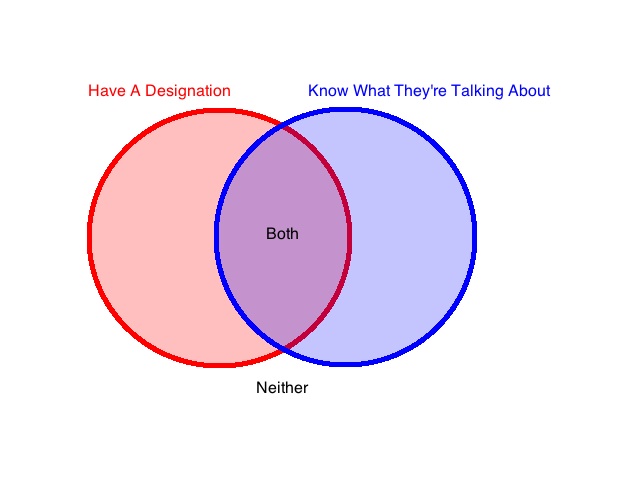
I mentioned at the top the argument above is pretty easy to dismiss. Knocking something you haven’t actually tried? Striking down the straw man of heavily credentialed morons? Here’s a Venn diagram:

I did a fairly terrible job of scaling the image. The Red-only zone should be pretty tiny, the smallest of them all, really. Most people who spend the time and energy studying a topic do come away with some competence.

The deeper question is something anyone who spends a lot of time studying for tests should struggle with: is it worth your time? What does it get you?

Once upon a time I was at a dinner with a client who gave me some offhand advice: take some courses, they’ll teach you something, you’ll get an initialism for your business card and you’ll advance your career.

What terrible advice. I followed it, which I’ll get to later, but here’s what he should have said:

  1. Education is good, but remember its two functions: to teach you practical skills and signal your intelligence.
  2. Many certifications, unfortunately, are completely useless. By that I mean they teach you nothing useful and don’t signal a damn thing of any use to strangers.
  3. Most skills that will actually improve your job performance are best learned on the job. There is usually no good substitute for experience. Go help domain experts solve problems and effing pay attention. Study them.
  4. The most important skill of all? Check out this paper, which I’m actually reviewing for another blog post:

    In this study, measures of interpersonal and task-related skills were obtained from two groups of engineers: those nominated as “stars” by their managers and those nominated as “average”. Interestingly, the researchers found that the only distinguishing difference between the two was the stars’ interpersonal and affective skills. Specifically, the stars were better at developing rapport with coworkers and building extensive, loose networks of reliable problem solvers.

    Interpersonal skills. No certifications for that.

  5. Depressed yet? Well you should be. There is no reliable way to accelerate your career except to experience more. The only other possibility is to perhaps the change the trajectory of your career by changing the what kind of experience you get and how you respond to it.

NOW let’s talk about certifications.

Certifications work best as an introduction to a body of knowledge. Your goal should be enough understanding to follow a conversation between experts. Doesn’t sound like much, but this is incredibly important.

Imagine your mind dragging a net along behind it everywhere you go in life. You actually don’t have enough knowledge to properly interpret a lot of the experiences that pass through the net. Think of a certification as a way of shrinking the mesh of your net.

The second thing certifications can offer is the opportunity to work your ass off. Some certifications are really challenging to complete. Following my client’s advice I took a softball course, which has proven useless. The last module in it, however, was an introduction to finance which I really enjoyed (I was shocked – I HATED finance in undergrad and nearly failed it).

So next I tackled the CFA exams, then moved onto the CAS exams. Some would look at the amount of time I spent on these (over years and years) and shudder. Good. This makes them a fantastic signal of all kinds of qualities employers love.

But even the most grueling course yields nothing in isolation. What you want is the holy grail: high-value experience. By that I mean working with and learning from the best.

You see, the skills of the most incredibly skilled have afforded them prestige (always), wealth (often) and an extraordinary demand for their skills (always). They need help. And who are they going to pick? Putting nepotism to one side, they’re probably going to pick the highest status recruits, which means those with the strongest signals of quality.

I’m pretty fortunate to have a challenging certification available I can sink my teeth into. But programmers have an enormous expanse of open source projects they can attach their names to. And writers can always write, artists can, um, create, etc.

Certifications are ideal in mature industries where innovation is slow and the canon of skills relatively stable. In others, go online, the Internet has enabled quality signaling in just about any worthwhile pursuit.

But remember the iron law of education: if you don’t have to work hard for it then it probably isn’t worth your time.

Debunking Dr. Oz (Or: How Charlatans Do Science)

…when the sign in front of my local pharmacy started advertising “Green coffee beans – as seen on Dr. Oz” [as a weight loss wonder drug -DW], I tracked down the clip in question.

That’s Scott Gavura of Science-Based Medicine (SBM), who then goes on to drilling into a (the?) piece of evidence that could possibly support this supplement manufacturer’s claims. I have to admit I love reading the occasional holy smackdown of crackpot science. And today I got my fill:

…Green coffee extract (the brand “GCA”) was used in the study. The authors note that GCA has a standardized content of 45.9% chlorogenic acid, which is purported to be the active ingredient. Now contrary to what was said on the Dr. Oz show, chlorogenic acid is also in roasted coffee in significant amounts, so you don’t need to take green coffee extract to get a good dose.

…The study is entitled Randomized, double-blind, placebo-controlled, linear dose, crossover study to evaluate the efficacy and safety of a green coffee bean extract in overweight subjects. The lead author, Joe A Vinson, is a chemist at the University of Scranton, Pennsylvania. None of the three authors appear to be clinicians or medical professionals, and none appear to have published obesity-related research before, according to PubMed. The study was funded by a supplement manufacturer, Applied Food Sciences.

To start — this is a very tiny trial — just 16 patients (8 males, 8 females) with an average age of 33 years. The research location was a hospital in Bangalore, India. How these patients were recruited was not disclosed. Normally a trial would list detailed inclusion and exclusion criteria, and then describe how many patients were considered and the reasons for exclusion. This paper just reports the final number, and there is no information provided on why 16 was felt to be the desireable number. The average weight was 76.6kg (168 lbs) and the average body mass index (BMI) was 28.22. While the BMI on an individual basis may not be informative, when looking at a population, a score between 25 and 30 is usually accepted to mean overweight, but not obese. The details on how these measurements were taken were not well described — which is surprising, given this is a this is a pretty important part of the study.

And on and on it goes. Science lovers and crackpot-haters, do feast your eyes on the whole article.

The Twilight of Catastrophe Modelers

One interesting idea in Kevin Kelly’s *What Technology Wants* is that technologies undergo a life cycle where they are at first specialized and poorly designed (they just don’t effing work right) and progress to the point where they are ubiquitous.

I am reminded of that by this article on cat models (via Jim Lynch):

Speakers at several recent insurance conferences stressed the need for property insurers and reinsurers to develop their own independent views of catastrophe risk, rather than outsourcing their risk views to third-party vendors. But they differed on exactly how to get to there.

While experts observed that reinsurers and insurers are increasingly using multiple models to inform their views of cat risks (with the smallest insurers enlisting the help of reinsurance brokers to accomplish this), Peter Nakada, managing director of RMS, a Newark, Calif.-based firm, suggested that a multi-parameter view is preferable to a multi-model view…

“Pick one of the giant simulation things and then force the modeling firms to give you the secret sauce from inside the models,” he advised, suggesting that users can then select “multiple points of view on the parameters that run the model” to develop a range of estimates.

Nakada is fighting a serious rearguard action here. RMS overreached with their last update and modeled claims costs skyrocketed. Instead of recanting on their update (unthinkable), they instead downplay the importance of their technical view of the risk. And they’re right. But I wonder if they realize how much pushing the commoditization of their black box will fundamentally change their business.

Kelly would phrase it like this: what happens when open sourced cat models are ubiquitous? How does that affect the industry?

The day may well come when the ‘secret sauce’ of the cat models goes open source and the state of the art is free to all. In that world RMS goes from R&D shop to industry consultant. They’ll provide outsourced analysis and data cleaning services.

They’ll fight like rabid dogs to avoid the billable hour revenue model, since nobody gets rich in businesses that don’t scale, so they’ll need products. Maybe they’ll look to compete with ISO and offer some kind of master database of property values in the US, who knows.

Their heyday, though, is perhaps ending.