Links today

A Barker tour-de-force on negotiating. Here’s a summary list:

  1. Be warm
  2. Be optimisitc
  3. Be polite
  4. Offer them something to eat or drink
  5. Be funny
  6. Don’t assume the other guy is out to get you

The whole thing is pretty short and highly recommended. Think of a negotiation as two parties figuring out what the best course of action is. It’s an immensely gratifying experience when done properly.

Now two posts on startups.

First Steve Blank puts together a fantastic summary of what, exactly a startup is. He asks this question:

When does a new venture focus on customer development and business models? And when do business planning and execution come into play?

Then does this:

One of the things startups have lacked is a definition of who they were. For years we’ve treated startups like they are just smaller versions of a large company. However, we now know that a startup is a temporary organization designed to search for a repeatable and scalable business model.  Within this definition, a startup can be a new venture or it can be a new division or business unit in an existing company.

I just think that’s brilliant. Lots more at the link.

And here’s Jason Cohen drilling home one of those lessons that needs to be drilled constantly (I reproduce a hacked summary below with apologies to Jason):

Almost all founders I encounter are leery about discussing their product plans. Now with the Social Network movie promulgating this fear, I expect it will worsen.

It’s silly, for two reasons.

1. Either you have a defensible competitive advantage, or you don’t.
2. The roadmap is not as useful as you think.
A Couple Links

Here is a look at algorithms that group similar sounding words together. Neat idea for searching dirty data.

The manufacturing fetish explained?

A rich and rewarding human life neither comes from nor depends on consumption, even lots of consumption; it comes from producing goods and services of value through the integration of technique with a vision of social and personal meaning. Being fully human is about doing good work that means something.

I haven’t read the pieces Mandel links to. I read the above and thought: ok, the data should be interesting. Then Mead lost me big time:

A consumption-centered society is ultimately a hollow society. It makes people rich in stuff but poor in soul. In its worst aspects, consumer society is a society of bored couch potatoes seeking artificial stimulus and excitement.

No idea what any of that means. How about this from Barker instead?

Bedouins Don’t Need Chainsaws, But You Need Programming

Great post out there called “Nobody Wants To Learn To Program.”

It’s true of course. Programming is a tool, and tools are defined by the problems they solve. And I see unsolved programming problems all around me. If more people understood what power it had, they would solve those problems for themselves and for me.

But it’s difficult to learn something unless it’s framed by an immediate use. The worst teachers don’t tie their lessons to things that matter. So often in school I felt like a Bedouin in a chainsaw course: WTF am I doing here?*

(That’s what’s so neat about Scott Adams’ idea of a school curriculum built (HA!) around building a house)

Anyway, I only started learning programming when I realized writing macros in excel would make my work life easier. This past year I found a few more uses for it and have massively expanded my programming toolkit.

So now I’m a programming dork, by which I mean that learning about something for its own sake is interesting to me. But ‘regular’ teachers (who are also dorks) teaching beginners from that perspective is ridiculous and boring.

*In that Bedouins (which I know is an incorrect pluralization) live in the desert and there aren’t any trees there and a chainsaw course would be entirely concerned with cutting trees.

The Value of College

I agree with Tyler Cowen too much. But here I go again:

It’s now common that a fire chief has to have a master’s degree. That may sound silly and it would be easy to think that a master’s degree has not very much to do with putting out fires. Still, often it is desired that a firefighter is trained in emergency medical services, anti-terrorism practices, fire science (such as putting out industrial fires), and there is a demand for firefighter who, as they move into leadership roles, can do public speaking, interact with the community, and write grant proposals. A master’s degree is no guarantee of skill in these areas, but suddenly the new requirements don’t sound so crazy.

Some people focus on the signalling benefits of of college. For me college was about integrating into a Charles Murray culture, I think. Much of that is social and to get in the front door of the Charles Murray class you’ve got to have really good communication skills.

I once heard of a series of English proficiency tests at, I think, the FBI (or some similar organization). Most of these were the usual vocabulary and grammar quizzes but the last test was weird: candidates had to watch clips of late night TV monologues and explain why the jokes were funny. Ultimately, communication is about culture.

Tyler didn’t have me in the quote above until the grant writing and public speaking parts. Each of those requires the higher-class communication skills colleges are best at delivering.

From the Front Lines

The iPad 3 cometh:

While digging through our logs in preparation for our monthly browser stat report, we found 346 visits from a device with a screen resolution of 2048×1536—the exact resolution rumored for the “retina” display in the next-generation iPad. Although a screen resolution by itself isn’t much to go on, a quick search around the Web indicates that there are very few devices in current use that have this same resolution. (There is a $5,000 NEC display for medical use with that resolution.)

Some Links For Today

In books to watch out for: we have The Benefit and The Burden about taxes. Here is an interesting David Brooks review:

The U.S. does not have a significantly smaller welfare state than the European nations. We’re just better at hiding it. The Europeans provide welfare provisions through direct government payments. We do it through the back door via tax breaks…

David Bradford, a Princeton economist, has the best illustration of how the system works. Suppose the Pentagon wanted to buy a new fighter plane. But instead of writing a $10 billion check to the manufacturer, the government just issued a $10 billion “weapons supply tax credit.” The plane would still get made. The company would get its money through the tax credit. And politicians would get to brag that they had cut taxes and reduced the size of government!

Next we have a follow-up to this (linked to a few days ago) which is Grace Hopper visualizing a nanosecond. Great communicators are awesome. Sends a tingle up your leg, right, Chris?

China’s legislators are shockingly, shockingly rich.

Merkel on Buffett, part 1 and part 2. I haven’t bothered reading the whole letter this year and settled for David’s analysis.

Robin Hanson contemplates turbulence.


Heroes Of Innovation

Big article in the NYT previewing a biography of Bell Labs.

Michael Mandel rightly recognizes his own work in the agenda of the author, which is to establish a strong link between these fathers of many of today’s technologies and the alleged absence of such breakthroughs today.

I like stories of heroes building THINGS like real men do. You know, in factories and stuff. But in the rush to mood affiliation, nobody seems to want to confront two critical counter-factuals:

1. If Bell Labs hadn’t existed, would none of these technologies have existed today?
2. If Bell Labs still existed, would we have any different technologies today/tomorrow?

I hope that this book tries to delve into the scientific context of these researchers’ work. I’m reminded of a line about Einstein that went something like this: “most of his breakthroughs would have been discovered a few months or years after him by someone else: the world was ready for it. General relativity was different. We’d probably still be scratching our heads if he never came along.”

It’s a counterfactual, so who knows if that could be true. Regardless, I’d say it takes a serious shove to put these Bell Labs guys up on that pedestal.

P&C Stocks

David Merkel has an analysis out on insurance stocks. By the way, I deeply respect anyone willing to put original analysis out on the web, as David does frequently. That’s the stuff that drives the blogosphere.

His understanding is way broader than mine on theis business. He begins by dismissing Title and Credit insurers are no longer relevant stand-alone categories, which is great because I know nothing about them. He spends a few minutes on life and health insurers, which I also know nothing about.

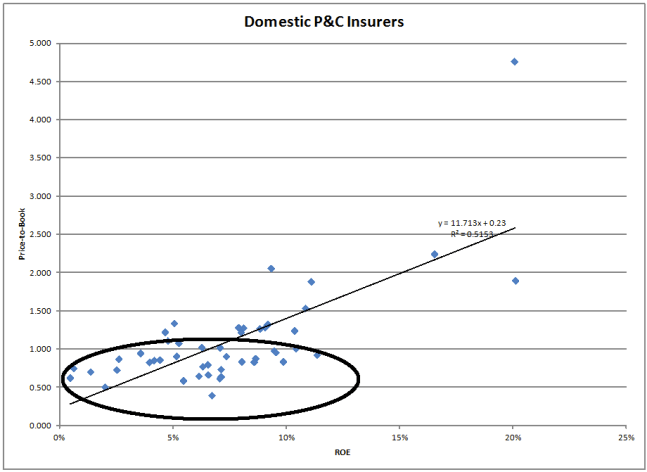
I’m a P&C guy and haven’t had any training or experience in anything else. One thing Merkel didn’t get to is the P&C cycle. The best way of talking about this is through his graphs.

You can clearly see how tough it is for that group of insurers to break out past the 1.0 BV line. The market is very skeptical of the profits of those on the right side of the line.

Insurance is a cyclical business and right now we’re approaching the trough. The typical company below 1.0 BV and to the right of the line is probably only performing so well because they are releasing redundant reserves from prior years (translation: business a few years ago is proving more profitable than predicted, so offsets poor results today). Can’t go on forever.

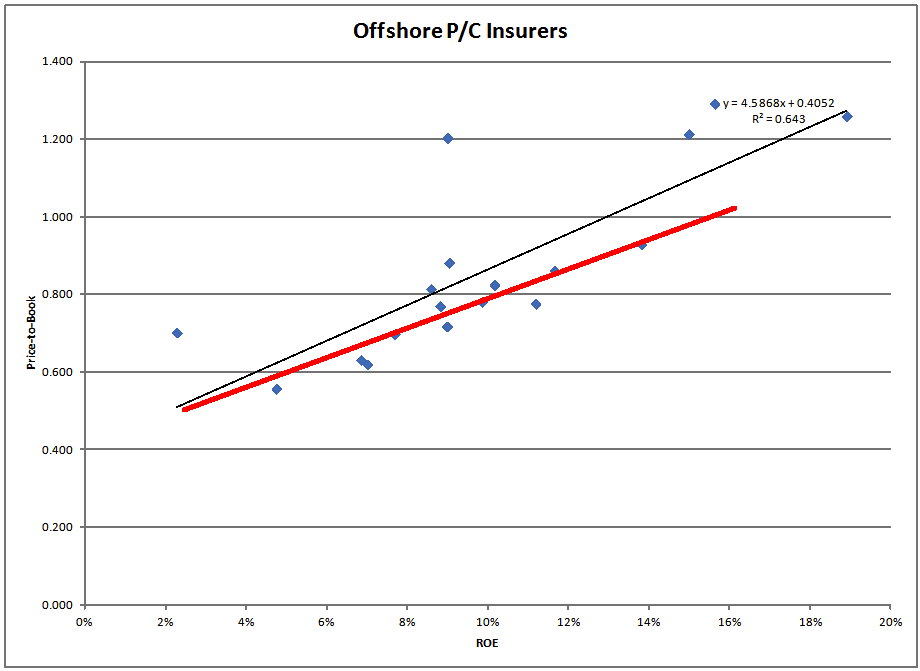
The offshore businesses have a similar problem but the scale of the y axis obscures things a little bit. Almost all of these companies are below the 1.0 BV and the ROE band is shifted out. They’re more profitable and lower-value. Weird!

My gut feel for why this is has to do with the breakdown of business mix. Most insurance companies do two things: they originate/distribute insurance risk and they keep insurance risk. The first business is much more valuable than the second because the infrastructure of distribution is valuable.

Contrast this with reinsurers, who only hold insurance risk and probably dominate this offshore group. Their barriers to entry are super low (three guys, an office in Bermuda and a rolodex full of Reinsurance Brokers!). New entrants are kept away by the spectre of measly profits.

I was still in the reinsurance nursery for the last market turn. I’m looking forward to seeing that it’s like.

Oil Prices and Sumner’s Standing Order

Looks like oil prices are climbing again. If the economy keeps recovering, this increase is going to last a big longer than the last few. Calculated risk looks to James Hamilton in these situations. I’ll swipe a quote from an old Hamilton post via CR:

In my 2003 study, I found the evidence favored a specification with a longer memory, looking at where oil prices had been not just over the last year but instead over the last 3 years. My reading of developments during 2011 has been that, because of the very high gasoline prices we saw in 2008, U.S. car-buying habits never went back to the earlier patterns, and we did not see the same shock to U.S. automakers as accompanied some of the other, more disruptive oil shocks. My view has been that, in the absence of those early manifestations, we might not expect to see the later multiplier effects that account for the average historical response summarized in the figure above. If one uses the 3-year price threshold that the data seem to favor (e.g., equation (3.8) in my 2003 study), the inference would be that we’ll do just fine in 2011:H2, because oil prices in 2011 never exceeded what we saw in 2008.

Great stuff. We’re in a world where oil prices have stayed up long enough that the economy is adjusting to a new level of scarcity.

The other day we are treated to some more analysis:

The first question to be clear on is which crude oil price we’re talking about. Two of the popular benchmarks are West Texas Intermediate, traded in Oklahoma, and North Sea Brent. Historically these two prices were quite close, and it didn’t matter which one you referenced. But due to a lack of adequate transportation infrastructure in the United States, the two prices have diverged significantly over the last year.

Interesting stuff. Here’s a lot more from Hamilton on the Keystone XL pipeline. He’s definitely the best authority I know of on this stuff.

Anyway, now that it’s high oil price season again, I’m reminded of something Scott Sumner has taught me to watch out for, which he always talks about. I’m calling it his standing order: Never reason from a price change.

So what does this mean? Start with this quote:

One factor that’s been driving Brent and WTI up over the last few weeks has been rising tensions with Iran. But why should threats or fears alone affect the price we pay here and now? Phil Flynn, a senior market analyst at PFGBest Research in Chicago, offered this interpretation…

Ok, pop quiz: what happens to oil consumption in the US?

Think about what happens to consumption as the oil price rises and you’d say that consumption goes down. But you’d probably be wrong.

Sumner teaches us to ignore the price change when talking about its effects. Focus on the cause of the price change. What does a big problem in Iran mean for the US economy, other than oil? Not much.

The right answer, then? Oil consumption doesn’t change.