Any time Paul Krugman cites Milton Friedman honestly and favorably, I’m probably in complete agreement.
Review of David Merkel’s Analysis of ROE During the GFC
Abstract:
From 2005-2010, the change in public company returns on book equity [ROE] was wrenching during the financial crisis. The results were uneven by sectors, and even by geography, for stocks traded in US equity markets. This paper looks at the differences, and attempts to explain why there was so much variation by sector and geography. After that, the paper attempts to explain the correlation between changes in ROE and stock returns, by year, sector, and geography.
In a world in which I didn’t have only 20 minutes to read, analyze and write about this paper, I’d like to think through his model choices. I would feel much more comfortable on this point if he accepted the Russ Roberts Science challenge and have a section discussing the process by which he arrived at the process by which he arrived at his conclusions.
Aaaanyway, the paper is interesting in that it identifies some interesting countries (Mexico? Israel?) that had companies that did very well during the crisis. Another interesting thing is that he decomposes the performance of individual US States but immediately discounts the conclusion by saying that the location of these corporates are due to historical accident:
To some degree, historical accidents help explain why some states have high contributions to returns on equity, and others low contributions. Washington State has Microsoft, Amazon, and Costco, all of which started out there. Michigan has General Motors, Ford, and Chrysler; the automobile industry has long been a big part of the state economy.
The contribution to ROE of Arkansas can be entirely attributed to Wal-Mart. Washington, DC can largely be attributed to Danaher, though Fannie Mae pulled the contribution to ROE down considerably as it failed in 2008.
The results of Kansas are dominated by Sprint Nextel, which has been a weak competitor in wireless telephony, though YRC Worldwide also had some impact on the low contribution to ROE as it was too acquisitive heading into a major recession. Virginia has many strong companies, but Freddie Mac pulled the contribution to ROE down with it failure in 2008.
Companies don’t move often, so attributing the differing contributions to ROE to state policies is unlikely. In the extreme cases listed above, all of the companies listed had been headquartered in their respective states for a long time, and most had been started there
I’d have two comments:
1. What’s the point of decomposing them, then?
2. Can’t you just attribute ALL variance of corporates to ‘historical accident’? Can there be no policy implications?
On point #2, I’d defend Merkel by saying that policy implications need a big enough sample that you can reasonably hold other factors constant. You’d need a dataset of every industry in every state over every conceivable macro-economic environment, then control for those other factors. Same applies for analyzing different countries.
But, you might say, every industry isn’t in every state! Yep, that’s why this kind of analysis is probably better classified as ‘interesting’ than ‘science’.
He probably should have left the geographical component out if he (rightly) concluded that there aren’t any policy implications. Or at least chose a different basis than political geography: how about companies on coasts vs inland? High vs low altitudes? Near vs far geographically from ‘bad’ industries (like financial services)?
Anyway, none of the criticism is a knock on Merkel who is a first class analyst with a first class blog.
Wisdom of Tyler Cowen [enough to be dangerous?]
From his talk on stories:
The link and pointer come from Ben Casnocha, here is one excerpt (emphasis is from Ben):
…as a general rule, we’re too inclined to tell the good vs. evil story. As a simple rule of thumb, just imagine every time you’re telling a good vs. evil story, you’re basically lowering your IQ by ten points or more. If you just adopt that as a kind of inner mental habit, it’s, in my view, one way to get a lot smarter pretty quickly. You don’t have to read any books. Just imagine yourself pressing a button every time you tell the good vs. evil story, and by pressing that button you’re lowering your IQ by ten points or more.
One interesting thing about cognitive biases – they’re the subject of so many books these days. There’s the Nudge book, the Sway book, the Blink book, like the one-title book, all about the ways in which we screw up. And there are so many ways, but what I find interesting is that none of these books identify what, to me, is the single, central, most important way we screw up, and that is, we tell ourselves too many stories, or we are too easily seduced by stories. And why don’t these books tell us that? It’s because the books themselves are all about stories. The more of these books you read, you’re learning about some of your biases, but you’re making some of your other biases essentially worse. So the books themselves are part of your cognitive bias. Often, people buy them as a kind of talisman, like “I bought this book. I won’t be Predictably Irrational.” It’s like people want to hear the worst, so psychologically, they can prepare for it or defend against it. It’s why there’s such a market for pessimism. But to think that buying the book gets you somewhere, that’s maybe the bigger fallacy. It’s just like the evidence that shows the most dangerous people are those that have been taught some financial literacy. They’re the ones who go out and make the worst mistakes. It’s the people that realize, “I don’t know anything at all,” that end up doing pretty well.
The talk itself is here on video.
Higgs and Stats
Every time there is some science news, I always hold my breath until SWAB comments. And on this issue Ethan Siegel does not disappoint. I highly recommend reading him if you’re interested in great science writing.
Anyway, I’ve been pretty confused about a lot of the statistics around the evidence of the Higgs Boson. I’ll set this up, first, though. Here’s Ethan:
Back in 1976, there were only four quarks that had been discovered, but suspicions were incredibly strong that there were actually six. (There are, in fact, six.) If you look at the above graph, the dotted line represents the expected background, while the solid line represents the signal published here from a E288 Collaboration’s famous Fermilab experiment. Looking at it, you would very likely suspect that you’re seeing a new particle right at that 6.0 GeV peak, where there ought to be no background. Statistically, you can analyze the data yourself and find that you’d be 98% likely to have found a new particle, rather than have a fluke. In fact, the particle was named (the Upsilon), but when they looked to confirm its existence… nothing!In other words, it was a statistical fluke, now known as the Oops-Leon (after Leon Lederman, one of the collaboration’s leaders). The real Upsilon was found the next year, and you shouldn’t feel too bad for Leon; he was awarded the Nobel Prize in 1988.
But the lesson was learned. It takes a 99.99995% certainty in order to call something a discovery these days.

6 sigmas?! WTF?! That’s humongous. That says to me that they’re either using the wrong distribution or the number of observations is immensely higher than any dataset I’ve ever seen. Considering these are probably the most competent statisticians on earth, I have to assume the latter, but… seriously?! SIX standard deviations?
I’d love to see the data.
The Leap of Faith
Economics has this problem with a few of its most powerful ideas: they just SEEM wrong. The toughest of these is the idea of comparative advantage. But another is the idea that destroying jobs is good.
Here’s Alex Tabarrok about how India has too many jobs:
What India needs is fewer jobs; fewer jobs in retail, fewer jobs in apparel and, most of all, fewer jobs in farming. India cannot become even a middle income country if most of its workers, for example, are farmers. To improve its standard of living, India must use fewer people to produce more agricultural output.
The politics of growth are difficult because those who lose from change are always present and are often more numerous and perhaps even more deserving than the present winners, the capitalists, the business people, the international mega corps; but today’s losses and gains are fleeting, the permanent winners are the workers and consumers of the future who will know only the benefits of productivity.
There’s another group of people whose losses strongly influence public policy. Always remember Mancur Olsen’s idea: diffuse gains are at a substantial disadvantage when they come at the cost of creating a focused, specific group of losers. The losers will always be more motivated, vocal and effective because they have so much to lose.
Democratic systems are terrible at creating losers.
Expertise vs Scale
A little background:
I’ve dabbled a bit in web development and making your page doing look the same in different browsers is a pain. Most browsers, luckily, tend to ‘behave’ in similar ways when given instructions and even the differences eventually get ironed out in later versions.
But until they do, you’ve got to detect which browser your user has and call one of a few parallel (ie duplicated through hours of extra effort) implementations of your web page depending on the answer.
When you have not just a few different browsers, but also many many old versions of browsers out there, making a web page that substantially all web citizens can see and use is a time-consuming challenge.
Anyway, the worst offender in this respect is Internet Explorer 6. It’s notorious for interpreting instructions in a radically different way from other browsers and also for being incredibly long-lived.
So this announcement from Microsoft, that they’re auto-updating their browsers, is welcome. But what’s interested me is that this probably won’t solve the problem. To HN:
The article points out that MS will still provide blocking tools for companies. Corporations are the major source of IE6 browsers and I’m not sure this will have any impact on them. The best we can hope for is that high consumer adoption rates will force many more sites to drop IE6 support which might spur companies to finally test and upgrade.
One of the things that really blew my mind this year was a large ($40MM) software development project I became familiar with (a worldwide internal system for a multinational corporation) that concluded — in 2011 — and required MSIE 6. MSIE 6! Doesn’t even run on MSIE 7, much less any modern browser.
While I personally think that’s insane — if you are that specific (not to mention antiquated) with your browser requirements, why don’t you just code a native app? — I’ve also never developed software with a team larger than five, and certainly don’t know the nitty-gritty details about spreading the work over a dozen countries and hundreds of developers, the vast majority being low-cost Chinese and Indian coders. So I’m not judging (or at least I’m trying not to).
But my point is that Big Corporate just wants their freaky “web-based” apps to run predictably for the projected 6-year deployment timeframe and does not give one flying fuck about whether their staff can access the new hip and way-superior version of . Unless said had real business value to large enterprise, but then, if it did… it would probably support MSIE6.
I am persuaded by some of the recent arguments (John Siracusa’s maybe?) that both the innovation and the money in general-purpose computing industry have moved over to the consumer side of the equation, and that this change has put MS in a worse position than they’ve traditionally been in.
Very very interesting thread. The idea is appealing: that corporate customers who have built their own internal web-apps and aren’t interested in updating something that works just so their employees can use fancy new websites.
I don’t think that last point is on, though. I’ve tried to find the original material he’s mentioning but failed. I think that it is the case that consumer software are leaping ahead of corporate software, but I think it’s because of scale. Corporations build small-scale, customized solutions. These are going to always move slowly. It takes just as much effort to build something for 100m users (in the general Internets) as it does for 10,000 (in your little company).
Badass
X-Men movies have furthered the confusion, for, despite steel claws and generous fur, Hugh Jackman’s character is simply too wimpy when measured against the real deal.
For starters, wolverines – like all their mustelid brethren, including marten, ermine, minks, ferrets, badgers, fishers and otters – tick at a higher metabolic rate than other animals. They keep on the move both day and night whether raiding eggs in the nest, gobbling ripe berries or taking down a big-horn sheep, patrolling the landscape at will. One travelled 800 kilometres, and visited three American states, in 10 days. Another climbed the near-vertical face of Mount Cleveland in January. Notably, it completed the 1,500-metre technical climb – which would have taken experienced alpinists the better part of a day – in a heart-bursting 90 minutes.Their strength is off the chart, capable of crushing bones grizzlies have given up on, and tearing apart solid logs in search of grubs. One was recorded taking down a full-grown (although probably sick) moose.
“They may just be the toughest animal in the world,” Douglas H. Chadwick says in his book The Wolverine Way. “When you weigh 15 kg and can back a full grown grizzly off a kill, that is just plain badass.”
“If wolverines have a strategy, it’s this: Go hard, and high, and steep, and never back down, not even from the biggest grizzly, and least of all from a mountain. Climb everything: trees, cliffs, avalanche chutes, summits. Eat everybody: alive, dead, long-dead, moose, mouse, fox, frog, its still warm heart or frozen bones. Whatever wolverines do, they do undaunted. They live life as fiercely and relentlessly as it has ever been lived.”

When I was a kid I heard of a story of a wolverine that was shot six times and barely broke stride as it ran away. No doubt survived and lived as long a life as such a being can.
Nature’s original experiment in super-heroism.
The Culture of Hard Markets
In insurance, a hard market is when carriers can exert extraordinary pricing power. I spend an embarrassing amount of time discussing whether the market is hard or soft or hardening or softening and when the hardening or softening will change, etc.
It’s tiresome and really distracting, in my opinion. The business model that relies on timing the market is necessarily volatile and limited in scope, which are things that public equity markets (ie permanent capital bases) don’t like. They like consistency and reliability. A hard market strategy is anything but.
Anyway, I’ll stop my rant there and focus a bit on what hard markets do to the CULTURE of a business.
You see, if you can properly identify a hard market, you have properly identified a free lunch. In such a case, making lots of money is easy: you just have to show up with a minimum of skill. Put your kids in the chair, says my boss, and in a hard market you still get rich.
What would happen if a hard market was the norm? What would happen to an institution if the degree of difficulty for profit suddenly dropped? [edit: what I’m really asking is what happens when a hard market lasts a long time and then suddenly reverses. Like a bubble, you never know you’re in a hard market until you leave one]
Well, luckily we have a case study.
I’d say that this is what happened in the investment industry in the Great Moderation period, up until the wrenching (ongoing) financial crisis we’re living through right now.
We recently reviewed our pension scheme and we were astonished at the terrible menu of choices presented to us. In a book of 500 different mutual funds, there were very few index funds and even these only got as cheap as 0.72% of assets per year.
Expensive, but we’re a small company so our costs will be higher. Fine.
But how about the rest of the funds, with expense ratios of 1-3% per year? Maybe the managers can justify this when they’re beating the index funds reliably, but we know that’s simply not possible for the VAST MAJORITY of funds to do, right? And run-of-the-mill mutual fund managers?
Puh-leeze. They’re 30th percentile at best.
Eventually, when the market turns, they get found out. As Tyler Cowen says, we aren’t as wealthy as we thought we were. Well, banks weren’t as smart as they thought they were. And that’s WITH bailouts protecting them from the realization of exactly how stupid their high leverage business models were.
When the music stops and you look back, here’s what I’d bet you realize was happening when you suffered the illusion of a prolonged hard market:
- Lesser talent being paid like it’s higher talent
- Aspects of Scott Adams’ confusopoly, where the money is so plentiful everybody starts taking little cuts from all over and it becomes really hard to compare options.
- The market rewarding ex-ante status, power and wealth (ie status, status and status) as opposed to real value-creating activity.
- Astonishingly stupid pseudo-science to explain what is going on
So if I may caricature: the median firm/employee becomes richer per point of IQ*, higher status (child of or former celebrity/ politician/professional athlete), employed in obfuscation rather than productive activity and unable to distinguish between luck and skill.
*I don’t like using IQ here because I tend to think its predictive power as an exogenous factor in success is vastly overstated. But it works as a placeholder for ‘units of ability’.
Why DON’T Owners Require Visors?
Interesting article on the Hockey Visor Debate, written by an anonymous, active NHL’er. Here’s an important quote:
Not once have I been told that the League is pressuring the players for a rule change. Is that what the League would like the media and the fans to believe? I don’t know. I’ve never heard Gary Bettman suggest that if it weren’t for the players there would be a mandatory visor rule in place. Although in fairness, I do tend to tune out when he starts talking.
The whole thing is interesting and mostly establishes that some players choose visors and others not and that they’re safer with possibly a penalty in performance (limiting vision). The Player comes down marginally in favor of the freedom to choose, I’d say.
But the thing that confuses me is why on earth there ISN’T an owner mandate for visors. If they actually limit injury, they’re protecting an owner investment, right?
If that’s the case, I’d definitely be in favor of visors if I were an owner. I realize there’s a debate about whether helmets and other protection increases injuries because the feeling of safety actually inspires more reckless play. I’m willing to be convinced of this empirical point.
But visors? Surely they don’t make people more reckless. Why DOESN’T Bettman make this a bigger deal?
Canelo?
This is jr. Middleweight Mexican boxing sensation Saul ‘Canelo’ Alvarez:

That’s right, that guy’s Mexican. A very Northern European-looking Mexican, isn’t he.
I grew up in a town with a prominent minority of light-skinned, light-haired Mexican people. I have no evidence that Canelo Alvarez is of the same tribe, but the likeness is vivid.
These were a branch of Mennonites (who speak a strange hybrid language*) that originally fled the borderland between the Netherlands and Germany to Russia when they were going to be forced to enter the draft. They redoubled their exodus when Revolutionary Russia’s political climate threatened some of the privileges they negotiated (in exchange for populating farmland) and took off again.
Some, like those that run this awesome awesome restaurant, wound up in colonies in Bolivia. Many went to the Canadian prairie. Many went to Mexico.
And many of those that went to Central/South America wound up moving to my home town in Canada. Always looking for farm work, always looking to be left alone.
They dress a bit funny (yes, they brought and kept this fashion sense with them into Canada)
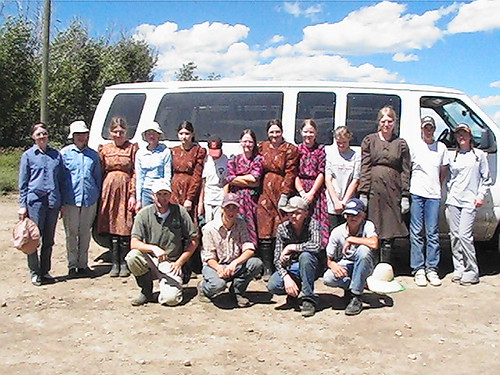
I mostly went to school in another town so I didn’t have any of these kids in my classes at first. By the time I went to high school back in town I was 16 and many/most of my Mennonite contemporaries had dropped out to, presumably, start on the farms their families moved there to work.
Of those that were left, some were later-generation products whose families had assimilated. The others, though, had more in common with the other small minorities (SE Asians, Middle-Easterners, other Central Americans – a very diverse town of 25,000, Leamington) than they did with the local kids, physical appearances aside (and this is a powerful lesson: race and discrimination have nothing to do with skin color).
Now, given that Mexicans are huge boxing fans, maybe Canelo IS a mennonite?
So I asked the patrons of the restaurant I linked to above whether they had heard of him. Blank stares. Hm. You sure? (holding my hands up like an idiot, mimicking a boxer) Boxing? Nope.
So is Canelo a Mexican Mennonite? I doubt it, I suppose, much as I’d relish the coincidence with my past. When you’re a people that keeps apart (and farmers always have this inclination, in my experience) you aren’t about to send your kids to the boxing camps.
* I remember this language from my childhood. I never spoke it, but noticed all these strange-looking people speaking it. My dad mentioned that it was called ‘low German’, which to my young ears meant ‘low-class German’. Not even close. It turns out that ‘low German’ is ‘low’ in the sense of literally lower altitude, as in the ‘Low Countries’ (Netherlands) and this language is from the area between Holland and Germany. During my last trip back home (for Thanksgiving) my more mature and worldly ear overheard a bit of conversation in Low German and I definitely picked up on the German part but also a serious whiff of something that wasn’t German, English, Russian or Polish (and definitely not any Latin-based language). It almos sounded Swedish. Turns out what I was hearing was the Flemish influence.
 Not Unreasonable