I’d like to just quote the whole thing

Here’s David Brooks:

 one could distinguish between actions that are done expressly to raise self-esteem (like buying a fancy car) and events that are done for other reasons that obliquely raise self-esteem (like writing a great symphony).

Along these lines, Crocker described the tension between self-transcendence and self-affirmation. Self-affirmation is about being proud and powerful and in control. Self-transcendence is about being engaged in activities in which the self is melded into a task or a relationship. According to various studies Crocker cited, people who have experienced self-transcendence are more open to evidence that counters their own views, and feel more connected to others.

read it all.

Armageddon Bank

Here’s the FT once and twice:

Making things tougher for surviving banks “was not the idea” when they allowed a state guarantee of bank liabilities to lapse two years after it was introduced – like in the rest of Europe – to contain fallout of the Lehman bankruptcy.

What is the upside to credibly removing the TBTF guarantee? Easy, no bailouts.

What’s the downside? Hm.

Well, what do you think happens when risk goes up?

Costs go up, silly.

For EVERYONE.

If Only We Could Sell Placebos

Big takedown of depression and mental illness in some books reviewed here.

Here’s what a casual reader will take away from this article:

Psychiatric drugs were first used in the 50s as tranquilizers to combat the unpredictable high-energy behavior of patients in mental hospitals. Subsequent research revealed that the drugs had an effect on brain chemistry and, prodded by Big Pharma, everyone concluded that brain chemistry must have been the problem all along. In reality, the patients were just stoned.

Fast forward to today and we have an unholy collusion between psychiatrists, who need the drugs to run a profitable business, and Big Pharma, who sells them. The research is all biased because studies that validate the Golden Hypothesis are cherry picked. Those that dissent are shuttered away, never to be read, save for by one redoubtable psychiatrist who threw the book at the FDA and got the data.

Bottom line?

Putting all this together, writes Kirsch, leads to the conclusion that the relatively small difference between drugs and placebos might not be a real drug effect at all. Instead, it might be an enhanced placebo effect, produced by the fact that some patients have broken [the] blind and have come to realize whether they were given drug or placebo. If this is the case, then there is no real antidepressant drug effect at all. Rather than comparing placebo to drug, we have been comparing “regular” placebos to “extra-strength” placebos.

Ok. This kind of article terrifies me. The evidence, the conspiracy theory, the baddest boogeyman of them all. It’s all here. How can skepticism possibly survive this attack?

The most bizarre effect of this kind of publicity is to reduce the effectiveness of psychiatric drugs. If these books convince everyone that everything is a placebo, the placebo effect goes away.

And, presumably, mental health deteriorates. Is there such a thing as a virtuous lie?

As Robin Hanson asks:

when exactly is it important to emphasize truth, relative to other belief functions?

A better question: is it even possible for a society to collectively self-deceive given ANY level of reward?

Standardization Begets Innovation

This is starting to seem quite important to me.

For the weekend project, I’ve been delving deeper and deeper into Python and have come across a distinction between “1998 HTML” and “2003 to today HTML”.

In 1998 there was much less standardization for coding websites. The HTML was poorly written or written by programs that produced sloppy code. An interesting consequence of this is that many older websites are harder to analyze with scraping programs.

The code today is massively improved. Today’s websites benefit from standards that get updated with ‘best practices’, which can spur automation of all kinds of functions.

The upshot is that information is becoming much easier to find, analyze and publish. And no new technology, just old technology maturing.

And we’re just getting started. A lot of websites now have something called an “API“, which is just a web address you can point your computer to and fling requests for information at. The idea is that regular browser websites are great for people, but computers don’t need all that stupid formatting. They just want data.

Well, for some reason, lots of websites will have different content offered on their API from the website.

It’s bizarre, particularly because, with minimal-to-moderate effort, any industrious programmer can build a simple scraping routine and pull the data out of the ‘human’ interface. Why the hurdle? It’s just wasting time.

The hurdle’s there for cultural reasons having nothing to do with technology. These cultural blocks are preventing the sharing of information and so are preventing innovation.

And they’ll change, I think.

Much of my job is concerned with translating one system’s way of recording insurance information into another system’s ‘language’. There is no standardization for the way information is stored in insruance management systems. This makes for lots of people with jobs like mine, which are basically wasting time and money. My business isn’t about analyzing information, after all.

Standardizing data formatting is going to be the next dislocation in the economy. We already pity those poor suckers in the back office wrestling with legacy systems.

Eventually they will go the way of the typing pool.

Healthcare Holy War

It rages on.

This post was interesting, though, for this graph:

I moved to the US from Canada six months ago and obviously the system is quite different. No wait times, etc. But there was one change that I didn’t expect:

Doctors are nicer here.

And I think I know why.

In Canada, doctors are higher status. I’ll exaggerate the difference and call Canadian Doctors Gods of Medicine and US Doctors Counselors of Medicine.

Gods of Medicine have appointment calendars stretching off into infinity. They have the POWER to bestow HEALTHCARE upon worthy or unworthy as they see fit.

Counselors of Medicine are more like accountants or lawyers. They have a business and have clients they want to retain. Your health is a bit more important than your taxes, sure (maybe), but these folks are happy for your business just the same.

Gods of Medicine bow to no man or worman. Their will is absolute and they control your access to the entire healthcare system.

Counselors of Medicine are in business. They can be jerks, but they’ll lose customers. They can be sued and go out of business. Mostly, though, they want to assist you in getting what you want from the healthcare system.

Life is harder as a Counselor of Medicine. Maybe that’s why ‘Gods’ are more satisfied with their jobs?

Hellbanning and Identity

Here’s an interesting crowd control mechanism for discussion forums:

hellbanned user is invisible to all other users, but crucially, not himself. From their perspective, they are participating normally in the community but nobody ever responds to them.

Neat. No point in rebooting with a new ID because nothing appears to be amiss. In the comments there’s this interesting tidbit, too:

You’d be surprised at how little of your identity is made up of login/OpenID/e-mail/IP/etc and how much of it is made up of behavior. Duplicate identities are very easy to spot in the vast majority of cases.

I’m reminded the brouhaha surrounding Scott Adams’ pseudonymous self-defense over some controversial article he wrote or something. Apparently, he was all over the web on all kinds of forums sticking up for himself. At the time it was pretty easy to find the stuff he was writing as ‘PlannedChaos’ (it still is).

The point is, to anyone familiar with his writing, it is brutally obvious that PlannedChaos is Scott Adams.

It seems that the moment there is some value to unmasking someone, pseudonyms are mostly useless.

Another way of saying that is: the only time they’re supposed to work, they don’t.

Do Goaltenders Age Better?

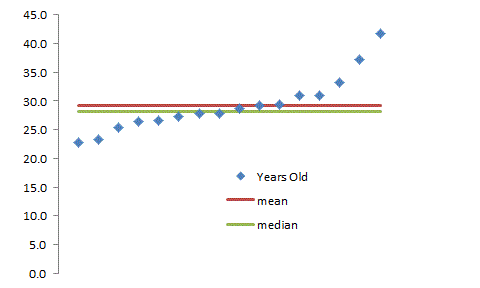
I bet the average age of ice hockey goaltenders is the highest of any position in any sport outside of NFL field goal kicker. And if you adjust for some kind of ‘importance measure’ (say, share of team salary), they surely blow everyone else away.

Now, they don’t break ‘oldest athlete’ records and so have a smaller absolute range of ages than other sports, but the best seem (to me) to hit the performance wall much later.

I put together a spreadsheet of the ages of playoff goaltenders. Average age?

29 1/4 years old!

Median is a year younger.

Wow. Surely the highest.

Data is here. I did ages as days /365. Not perfectly accurate but I’m hardly about to start effing around with leap years.

I’m watching the game forchrissakes!

Suck it, IT!

Here is Celent:

…the use of Python and other scripting languages have long been used to clean up and prepare data. In both cases the question arises – is this an IT job or not?

The problem with insurance data is that it is often inputted into a system that isn’t built to help insurers manage risk, but rather to pass financial audit.

Questions like: “did you measure you income, cash in, cash out and claims liabilities correctly” matter.

Questions like: “how much money can I lose in scenario x” don’t matter.

It’s bizarre to think that an industry entirely concerned with risk management doesn’t introduce systems to manage risk.

The core issue is related to the quote above: systems are an “IT thing”, not a core competency of an insurance professional/risk manager. They’re tantalizingly close, though, and getting closer.

I’ve found myself desperately building skills once reserved for IT people. They’re effing useful.

The rest of this post describes my latest project (to help me think through the process).

Insurance management systems are really accounting systems with fields added in to record some extra policy data. Typically, the only field audited thoroughly is the premium field. For one thing, it’s the easiest one to audit because you have an independent data source (actual cash received) to check it against.

So we get these listings which have very accurate premium transaction numbers (hopefully those data aren’t scrubbed using a DIFFERENT system) and try to answer these kinds of questions:

  • How big are the limits offered by this company for different covergaes?
  • What are the distributions of these limits?
  • What limits does this company offer to a single insured?
  • How many insureds does this company insure?
  • How many separate policies does this company write?
  • How many coverages does this company write per policy?
  • Can we link all the claims (separate database) to the policies?

A very important step is to establish what is an insured, what is a policy and what is a transaction. A mentor of mine drilled me with the mantra: “count everything once and ONLY once”.

So, one project I’m working on is to build a database analysis tool that fixes mistyped insured names.

The key concept is Levenshtein Distance.

The idea behind LD is to measure the number of edits a word would need to undergo to turn it into another word. Useful for weeding out garbage in search engine terms, which is its most common use.

In my case, because these insured names are sometimes made up words or strange spellings of words (names of people or businesses), I want to run a LD analysis against the listing itself and tell the program to ask me when it thinks it’s found a mistake.

So what I want is a routine that builds a dictionary of all the separate words in the listing and tells me which words would get wiped out to build a more ‘efficient’ policy listing name.

I need to make sure I know how the original listing was structure so I can put it back together again, of course.

So here is the process:

  1. Build a database of each unique word in the file
  2. Discard one letter words (‘a’ and such)
  3. Arrange the words in alphabetical order
  4. Depending on how the words are arranged, compare each word to the last.
  5. … this is as far as I’ve gotten.


Finance is High Status Welfare

At my alma matter, the students lived in a ‘ghetto’ of run down houses ripe for trashing right next to the University. This ghetto abutted an actual somewhat poor neighborhood.

I spent my first year off campus living in this actual poor neighborhood and have vivid memories of obese porch monkeys bitching into the phone about their petty social conflicts. Get a #$%$ job, I silently scoffed.

Little did I know…

-=- Continue reading Finance is High Status Welfare