Heroes Of Innovation

Big article in the NYT previewing a biography of Bell Labs.

Michael Mandel rightly recognizes his own work in the agenda of the author, which is to establish a strong link between these fathers of many of today’s technologies and the alleged absence of such breakthroughs today.

I like stories of heroes building THINGS like real men do. You know, in factories and stuff. But in the rush to mood affiliation, nobody seems to want to confront two critical counter-factuals:

1. If Bell Labs hadn’t existed, would none of these technologies have existed today?
2. If Bell Labs still existed, would we have any different technologies today/tomorrow?

I hope that this book tries to delve into the scientific context of these researchers’ work. I’m reminded of a line about Einstein that went something like this: “most of his breakthroughs would have been discovered a few months or years after him by someone else: the world was ready for it. General relativity was different. We’d probably still be scratching our heads if he never came along.”

It’s a counterfactual, so who knows if that could be true. Regardless, I’d say it takes a serious shove to put these Bell Labs guys up on that pedestal.

P&C Stocks

David Merkel has an analysis out on insurance stocks. By the way, I deeply respect anyone willing to put original analysis out on the web, as David does frequently. That’s the stuff that drives the blogosphere.

His understanding is way broader than mine on theis business. He begins by dismissing Title and Credit insurers are no longer relevant stand-alone categories, which is great because I know nothing about them. He spends a few minutes on life and health insurers, which I also know nothing about.

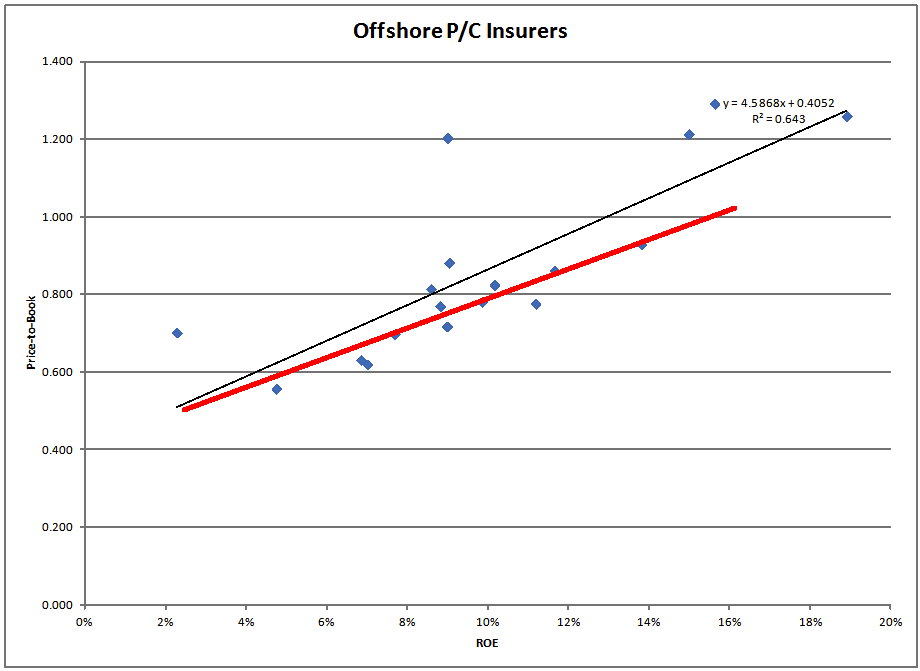
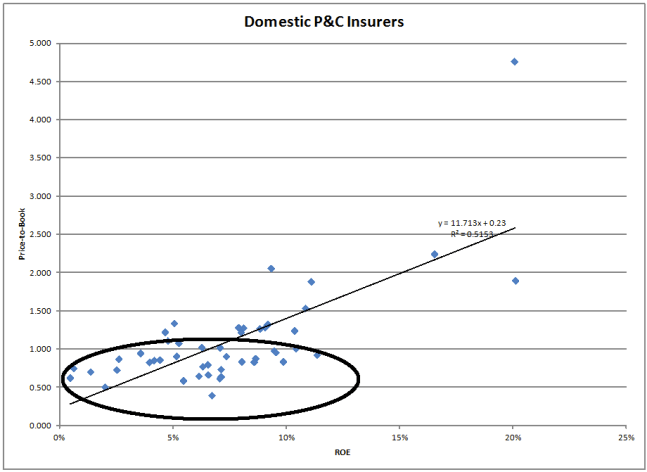
I’m a P&C guy and haven’t had any training or experience in anything else. One thing Merkel didn’t get to is the P&C cycle. The best way of talking about this is through his graphs.

You can clearly see how tough it is for that group of insurers to break out past the 1.0 BV line. The market is very skeptical of the profits of those on the right side of the line.

Insurance is a cyclical business and right now we’re approaching the trough. The typical company below 1.0 BV and to the right of the line is probably only performing so well because they are releasing redundant reserves from prior years (translation: business a few years ago is proving more profitable than predicted, so offsets poor results today). Can’t go on forever.

The offshore businesses have a similar problem but the scale of the y axis obscures things a little bit. Almost all of these companies are below the 1.0 BV and the ROE band is shifted out. They’re more profitable and lower-value. Weird!

My gut feel for why this is has to do with the breakdown of business mix. Most insurance companies do two things: they originate/distribute insurance risk and they keep insurance risk. The first business is much more valuable than the second because the infrastructure of distribution is valuable.

Contrast this with reinsurers, who only hold insurance risk and probably dominate this offshore group. Their barriers to entry are super low (three guys, an office in Bermuda and a rolodex full of Reinsurance Brokers!). New entrants are kept away by the spectre of measly profits.

I was still in the reinsurance nursery for the last market turn. I’m looking forward to seeing that it’s like.

Oil Prices and Sumner’s Standing Order

Looks like oil prices are climbing again. If the economy keeps recovering, this increase is going to last a big longer than the last few. Calculated risk looks to James Hamilton in these situations. I’ll swipe a quote from an old Hamilton post via CR:

In my 2003 study, I found the evidence favored a specification with a longer memory, looking at where oil prices had been not just over the last year but instead over the last 3 years. My reading of developments during 2011 has been that, because of the very high gasoline prices we saw in 2008, U.S. car-buying habits never went back to the earlier patterns, and we did not see the same shock to U.S. automakers as accompanied some of the other, more disruptive oil shocks. My view has been that, in the absence of those early manifestations, we might not expect to see the later multiplier effects that account for the average historical response summarized in the figure above. If one uses the 3-year price threshold that the data seem to favor (e.g., equation (3.8) in my 2003 study), the inference would be that we’ll do just fine in 2011:H2, because oil prices in 2011 never exceeded what we saw in 2008.

Great stuff. We’re in a world where oil prices have stayed up long enough that the economy is adjusting to a new level of scarcity.

The other day we are treated to some more analysis:

The first question to be clear on is which crude oil price we’re talking about. Two of the popular benchmarks are West Texas Intermediate, traded in Oklahoma, and North Sea Brent. Historically these two prices were quite close, and it didn’t matter which one you referenced. But due to a lack of adequate transportation infrastructure in the United States, the two prices have diverged significantly over the last year.

Interesting stuff. Here’s a lot more from Hamilton on the Keystone XL pipeline. He’s definitely the best authority I know of on this stuff.

Anyway, now that it’s high oil price season again, I’m reminded of something Scott Sumner has taught me to watch out for, which he always talks about. I’m calling it his standing order: Never reason from a price change.

So what does this mean? Start with this quote:

One factor that’s been driving Brent and WTI up over the last few weeks has been rising tensions with Iran. But why should threats or fears alone affect the price we pay here and now? Phil Flynn, a senior market analyst at PFGBest Research in Chicago, offered this interpretation…

Ok, pop quiz: what happens to oil consumption in the US?

Think about what happens to consumption as the oil price rises and you’d say that consumption goes down. But you’d probably be wrong.

Sumner teaches us to ignore the price change when talking about its effects. Focus on the cause of the price change. What does a big problem in Iran mean for the US economy, other than oil? Not much.

The right answer, then? Oil consumption doesn’t change.

The App Economy

Michael Mandel’s article on the app economy is up. My initial comments here, though they now sound off mark against Mandel’s Atlantic piece.

My favorite bit:

Historically, industries that are job leaders during recessions tend to drive the expansion that follows. Once again, we confirm that innovation creates jobs in ways that cannot be anticipated beforehand. This is the future of industrialized countries.

It’s interesting to imagine what a world with a more substantial app economy would look like. More distributed, more virtual. This would probably be an economy marginally less dependent on large capital deployments and more dependent on open-source projects to upgrade infrastructure.

I’d be very interested to hear Tyler Cowen speculate on the implications for the app economy on TGS.

Some earlier comments of mine on the app economy.

Good Jobs

Here is David Pogue on the everlasting Foxconn saga. He is writing on the side of “our definition of sweat shops is a bit weird in the context of China”. Here is a salient quote:

The second enlightening twist, for me, was a note sent to me from a young man, born in China and now attending an American university.

My aunt worked several years in what Americans call “sweat shops.” It was hard work. Long hours, “small” wage, “poor” working conditions. Do you know what my aunt did before she worked in one of these factories? She was a prostitute.

And the article goes on with lots of interesting anecdotes. It’s good for my bias and all, so I post it here.

But the thing that intrigues me is a contradiction (hypocrisy?) in the way many in our culture look at manufacturing. We revere it, of course, but why? These don’t look like the kind of jobs that I want my kids to have.

It didn’t look like a sweatshop, frankly. The assembly-line work was certainly mind-numbingly repetitive — one woman files the burrs off the iPad’s Apple-logo hole 6,000 times a day — but that’s the nature of assembly-line work. Meanwhile, this factory was clean and modern.

More tellingly, the broadcast showed 3,000 young Chinese workers lining up at the gates for Foxconn’s Monday morning recruiting session.

Now, these workers know about the 2010 Foxconn suicides. They know that the starting salary is $2 an hour (plus benefits, and no payroll taxes). They know they’ll have 12-hour shifts, with two hourlong breaks. They know that workers sleep in a tiny dorm (six or eight to a room) for $17 a month.

And yet here they are, lining up to work! Apparently, even those conditions, so abhorrent to us, are actually better than these workers’ alternatives: backbreaking rural farm work that doesn’t prepare them to move up the work force food chain.

Isn’t a rich society one that is free from such toil? I still don’t really ‘get’ the manufacturing fetish.

Boxing’s Great Weakness

In every other sport, we see the best vie with the best for props and trinkets. In boxing, the best control their own fate.

The downside? No champs.

Here is Kevin Iole interviewing Manny (via BLH):

Mayweather, it was suggested to Pacquiao, is winning the public relations contest handily, at least in the U.S. At that, Pacquiao looked up from his plate and put down his fork. His eyes widened and he leaned forward, staring intently across the table.

“He talks, he says all this, but you know what: He doesn’t want the fight,” Pacquiao firmly told Yahoo! Sports in an exclusive interview. “I want the fight. I’m the one who has wanted this fight all along.”

Not long after he was granted a conditional boxing license by the Nevada Athletic Commission to fight Cotto, Mayweather made a big deal of Pacquiao turning down a $40 million guarantee to fight him.

But Pacquiao said that was simply a bluff, a public relations stunt that didn’t bear any semblance to reality.

“He offered me $40 million, and no pay-per-view [money],” Pacquiao said, breaking into a laugh. “No pay-per-view. Can you believe that? Would you do that? Come on. What would he say if I offered him $50 million – not $40 million, $50 million – and said ‘No pay-per-view. Take this money and be happy, but no pay-per-view.’ He wouldn’t do it, either.”

This song has been on repeat for three years.

I’ll spare you the effort, here are your likely responses:

  • Why not just fight for the money? That’s so much money!
  • That blood test thing made me think Manny was scared (or worse) and wanted an excuse. Now I think maybe Mayweather does!
  • The fans want this fight! Don’t they want to see who is the best?
  • These prima donnas are so greedy. That’s so much money!
  • etc…

Unfortunately, you’d be missing the point.

It’s a old lesson, but Mike Tyson made me think of the psychology of ultra-high performance. He believed you can literally intimidate another fighter into folding under your knockout blow. One’s confidence must be unshakable to be champ.  In any sport.

Now consider Mayweather. He prides himself as much on escaping from Top Rank boxing to self-promotion as his boxing ability. He’s endlessly talking about his negotiating triumphs.

He’s so into it that taking a 50-50 deal means stamping a big ‘L’ on his own forehead. And if he loses at the negotiating table does that dent his confidence in the ring?

Tiger teaches us that a champ’s sense of invincibility must be complete. Would a wiser champ not expose himself to failure in so many arenas? In the mind of a champ, perhaps such admission of fallibility is just as deadly.

Manny, newer to the uber-champ game, probably feels this less keenly. He does sense, just like Haye and Chisora in that video, that the other guy is trying to push him around. And he’s pushing back. It’s the blood testing thing all over again: Mayweather’s mind games and Manny calling BS.

So now we have two alpha dogs angling for initial advantage. A 50-50 deal is a Manny victory, so Mayweather will happily never take the fight at those terms.

This is why you employ third parties to negotiate, by the way. These two have probably locked themselves into classic no-back-down positions. Their intermediaries should be ashamed of themselves. This is the richest opportunity on the table and they effed it up.

A caveat, of course, is that this fight becomes irrelevant the minute one or both of these guys loses his edge. Ironically, that’s all that will make it happen.

There’s plenty of precedent suggesting it’s just a matter of time.
Resistance is Futile

Here’s a story on the Federal reserve of the 70s. Stagflation. Worst episode ever.

The upshot is that some guy named Arthur Burns got called to his doom as chair of the fed at the beginning of that era. Going in he was a VERY Bernanke-esque ‘best candidate available’. He understood monetary policy. Milton Friedman was a buddy and sang his praises. He espoused cutting-edge views on the drivers of inflation and these views are held as correct thirty years later.

Then he got assimilated.

Suddenly the rhetoric changed. Suddenly HE thought it was a good idea to keep those purse strings pulled wiiiide open. Suddenly he conjured up the demons that lie in wait under the beds of inflation hawks everywhere and set them loose upon the land.

Those boogeymen were real back in those olden days. And they were worse than Voldemort and they were ARTHUR BURNS’ fault.

Except that they weren’t, of course. Burns lost his soul and free will when he assumed the mantle of great status. He is no more an author of 70s stagflation than Bubba was of the Internet bubble or Dubya of the Afganistan war. These things are bigger than the personalities ‘in charge’ who, in societies like ours, merely reflect the median view as faithfully as possible.

Sumner then nails it:

Over the last few years I’ve occasionally argued that macroeconomists as a class are mostly to blame for the global economic crisis, not bankers or regulators. Seeing what happened under Burns makes me even more convinced that we macroeconomists are to blame.

Those who criticize Bernanke would do precisely what he has ‘done’ in his place, which is to hold up a small candle of influence to the fusion reactor of policy direction. He is a high status observer and were he out in the wild, the Bern-ank’s blog would be just as exasperated as the next.

Perhaps.

And part of it is looking the other way; part of it is this claim I make that there’s over 100 economists in the United States that think they are in the top 10 of economists, right? So they think they are in the running for Chair of the Fed or the Council of Economic Advisers or the National Economic Council, and so they hold their fire. I think we are a little bit captured.

Agents

By 1999, Goldman’s reputation had recovered to its previous zenith–to the point that a public offering again was possible. Its partners had debated the merits of such a change for years, and, even when the decision was made to go forward, the decision was reached only after vigorous debate and much disagreement. In favor of going public were those partners who saw a need for a larger capital base to allow the firm to compete in the increasingly globalized economy with the larger players both in the U.S. and overseas. Furthermore, once a public market was established for its shares, Goldman would have a currency other than cash with which to acquire other businesses and grow into financial services it could not afford to enter as a private partnership. On the other side of the argument were those partners who were worried about the impact that transition to a public firm would have on the firm’s culture. Heretofore, the firm had been known for its low ego and gang-tackling ethos, with aggressive personalities kept in check by the partnership potential that was strongly linked to both productivity and cultural fit.

What neither the firm’s partners nor outside observers were able to foresee was the resulting change in the firm’s risk tolerance. Goldman Sachs was the last of the major Wall Street houses to go public. (Donaldson, Lufkin and Jenrette had been the first in 1970.) As of May 4, 1999, all of Wall Street were now playing with other people’s money (whose acronym, OPM, is not coincidentally pronounced “opium” in financial circles).

That’s a former Goldman Partner.

What goes unsaid is that it isn’t just shareholders and bondholders that got screwed. It’s that, somehow, lax oversight can lead to systemic armageddon.

Wireless Spectrum Auction [My Blogs Have Failed Me]

Congress is auctioning off wireless spectrum and my blogroll is silent. I’m astonished.

Where’s Tabarrok? Hazlett? Mandel? All of these guys have had pretty strong opinions on this kind of thing before.

Anayway, businessweek has some decent coverage. As does the NYT, from which I quote (ignoring the crap about the Payroll tax, which I believe is actually a secondary issue here):

The measure would be a rare instance of the government compensating private companies with the proceeds from an auction of public property — broadcast licenses — once given free.

The auctions, which are projected to raise more than $25 billion, would also further the Obama administration’s broadband expansion plans and create a nationwide communications network for emergency workers that would allow police, fire and other responders from different departments and jurisdictions to talk to each other directly.

Let’s not mess around. This is big. Real big. From Businesweek:

Back when TV broadcasters had power—that is, over members of Congress, and not in wattage at home—they had the best spectrum, in the frequency range that carries well and through walls. But television signals interfere with each other, and so the FCC has always had to guarantee gaps, adequate spaces between cities and signals to ensure that The Cosby Show in Washington was not compromised by Cheers on the same frequency in Baltimore. I am not dating myself with these references; I am dating the dominance of broadcast television. These gaps of unused spectrum, which get wider as population density thins and fewer stations broadcast, are called “white spaces.”

It’s these white spaces that are going up for auction. Get ready for a speed boost and innovation explosion.

Here’s the best metaphor I can think of.

Wireless broadband before:


And after: