Medicine, *BIG* Data and $$$

Another tour de force from SBM. How does one summarize? I almost blogged this NYT article about treating Leukmia last week but felt I had nothing to add (go read it!). I should have known SBM would deliver the goods, though.

Here’s the big data part:

Taking the results of the sequencing of the entire genome and RNAseq data and analyzing them allows scientists to probe the genome and transcriptome of cancers in a way that was never before possible. It produces an enormous amount of data, too, terabytes from a single experiment. At cancer meetings I’ve been to, investigators frequently refer to a “firehose” of data, petabytes in magnitude.

I’ll offer comment on this part:

There’s no doubt that “individualized” medicine will become increasingly a part of modern medical care, with the individualization based on sequencing the genomes and transcriptomes of patients. In just a few years, the price of a complete genome sequence has fallen from hundreds of thousands of dollars to around $15,000. True, that doesn’t count all the analysis and that’s $15,000 per genome, which means at least $30,000 to sequence a normal and cancerous genome. There are, however, lots of things we do in medicine that cost $15,000. The price doesn’t have to come down much more before whole genome sequencing starts to look doable for individual patients. After all, gene tests like the OncoType DX cost on the order of $3,000 to $4,000, and we now order this test fairly routinely for patients with estrogen receptor-positive, node-negative breast cancer because in the end it saves a lot of patients from unnecessary chemotherapy.

The bottom line is that at some point every single person is going to get their genome sequenced. That’s about 4m newborns per year after the backlog of 330m+ people. But here’s the thing with cancer, it’s a genetic disease, which means that the cancer itself has a different genome than yours. Finding those differences is the entire point of genetic therapy.

So $3,500 per genome x 35,000 leukemia patients per year = $122m of new health care costs per year. No big deal, right? Well how about the 1.5m people who get diagnosed with all cancers per year?

Genome sequencing is going to be a gigantic business very, very soon. The health care cost curve is bending, all right.

Banks And Insurers: Full of Fail?

This is a neat little paper: How Complex Systems Fail. It is short, it is simple and it is absolutely PACKED with insight. Here is are some excerpts:

5. Complex systems run in degraded mode.
A corollary to the preceding point is that complex systems run as broken systems. The system continues to function because it contains so many redundancies and because people can make it function, despite the presence of many flaws. After accident reviews nearly always note that the system has a history of prior ‘proto-accidents’ that nearly generated catastrophe. Arguments that these degraded conditions should have been recognized before the overt accident are usually predicated on naïve notions of system performance. System operations are dynamic, with components (organizational, human, technical) failing and being replaced continuously

7. Post-accident attribution accident to a ‘root cause’ is fundamentally wrong.
Because overt failure requires multiple faults, there is no isolated ‘cause’ of an accident… The evaluations based on such reasoning as ‘root cause’ do not reflect a technical understanding of the nature of failure but rather the social, cultural need to blame specific, localized forces or events for outcomes.

One thing that strikes me about the paper is that the author (probably deliberately) does not try to define what a complex system is. In a sense the paper is a definition of a complex system, which is to say that they are defined by how they fail. Or, perhaps like with pornography: you know it when you see it.

I can see two ways that a complex system can develop and operate: top down or bottom up. Bottom up systems get to be much much more complex, yet I would say that they are much less prone to failure. Perhaps that last sentence is saying the same thing twice.

I think of this in terms of risk management at insurance companies or banks. You can imagine that a weak grasp of how systems fail could be financially ruinous: for example, by an executive believing he/she has a better grasp for the ‘root cause’ of why failures occur.

To run a complex system perhaps requires humility in the face of something you simply cannot understand.

One Trade To Rule Them All And In the Darkness Bind Them

David Merkel analyzes LIBOR submissions from the crisis.

My initial diagnosis is this: whether formally or informally, you have two groups of banks submitting rates for LIBOR.  One group is trying to pull LIBOR up, the other is trying to pull LIBOR down.  Statistically, if I add up their intercept terms from the first table, they both sum to 0.23%, one positive, the other negative.  Even if LIBOR were a simple average, which it is not, this is a colossal game of tug of war, with two equal teams.

As it is, LIBOR excludes the outliers, and calculates an average off of those that remain.  It’s a difficult measure to manipulate.  There may have been attempts to manipulate LIBOR, and even two groups of banks trying to pull LIBOR their own way, but successful systemic manipulation of LIBOR is unlikely in my opinion.

One thing I didn’t fully understand when I was reading about the scandal was what would motivate these traders to want to influence the submissions. How could they benefit?

Could it be that half of these banks were on one side of a giant credit trade and half on the other? Talk about a zero-sum game!

What’s The Point of a Designation? (With a Venn Diagram!)

This is a fairly weak challenge to the pursuit of technical certification, but let’s start with it anyway:

I have come across a lot of my friends who aquired very nice percentage and received certificates though they have very minimal knowledge, or they have never worked on that particular technology. How crap is that, and now they are the proud owner of certificate, showcasing it proudly over their work desk. Ask them a very simple question on the technology that they have got certification, they would be for sure struggling to give answer to it. This is quite common, Certifications are being done only to get an extra point during their salary appraisals or job interviews. And I pity these corporate giants who would consider certification to be something remarkable.

How many out there would say, Yes certification is worth doing and it must be done to prove that you are good in a particular technology?

First point: if you’re an aspiring entrepreneur, stop right here. Stop reading, stop everything and go start building stuff. The longer you wait the harder it will be.

Second point: certifications are often required to work in a chosen field. That’s called occupational licensing and it’s often ridiculous. I’m going to concentrate on what real benefits certifications offer (in my experience) to the risk averse, hard working and ambitious. Doctors and lawyers need not read further.

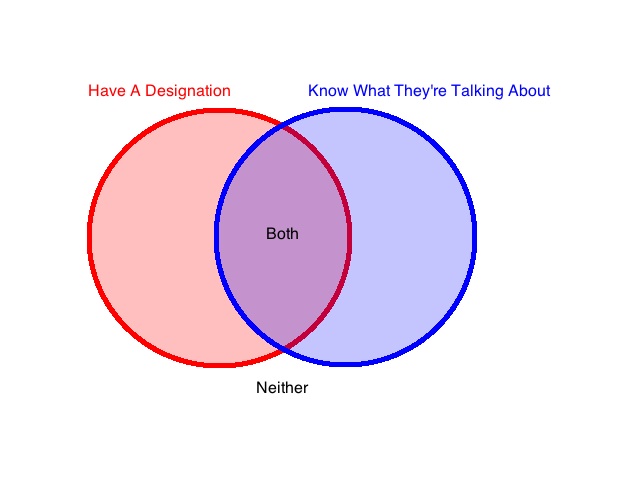
I mentioned at the top the argument above is pretty easy to dismiss. Knocking something you haven’t actually tried? Striking down the straw man of heavily credentialed morons? Here’s a Venn diagram:

I did a fairly terrible job of scaling the image. The Red-only zone should be pretty tiny, the smallest of them all, really. Most people who spend the time and energy studying a topic do come away with some competence.

The deeper question is something anyone who spends a lot of time studying for tests should struggle with: is it worth your time? What does it get you?

Once upon a time I was at a dinner with a client who gave me some offhand advice: take some courses, they’ll teach you something, you’ll get an initialism for your business card and you’ll advance your career.

What terrible advice. I followed it, which I’ll get to later, but here’s what he should have said:

  1. Education is good, but remember its two functions: to teach you practical skills and signal your intelligence.
  2. Many certifications, unfortunately, are completely useless. By that I mean they teach you nothing useful and don’t signal a damn thing of any use to strangers.
  3. Most skills that will actually improve your job performance are best learned on the job. There is usually no good substitute for experience. Go help domain experts solve problems and effing pay attention. Study them.
  4. The most important skill of all? Check out this paper, which I’m actually reviewing for another blog post:

    In this study, measures of interpersonal and task-related skills were obtained from two groups of engineers: those nominated as “stars” by their managers and those nominated as “average”. Interestingly, the researchers found that the only distinguishing difference between the two was the stars’ interpersonal and affective skills. Specifically, the stars were better at developing rapport with coworkers and building extensive, loose networks of reliable problem solvers.

    Interpersonal skills. No certifications for that.

  5. Depressed yet? Well you should be. There is no reliable way to accelerate your career except to experience more. The only other possibility is to perhaps the change the trajectory of your career by changing the what kind of experience you get and how you respond to it.

NOW let’s talk about certifications.

Certifications work best as an introduction to a body of knowledge. Your goal should be enough understanding to follow a conversation between experts. Doesn’t sound like much, but this is incredibly important.

Imagine your mind dragging a net along behind it everywhere you go in life. You actually don’t have enough knowledge to properly interpret a lot of the experiences that pass through the net. Think of a certification as a way of shrinking the mesh of your net.

The second thing certifications can offer is the opportunity to work your ass off. Some certifications are really challenging to complete. Following my client’s advice I took a softball course, which has proven useless. The last module in it, however, was an introduction to finance which I really enjoyed (I was shocked – I HATED finance in undergrad and nearly failed it).

So next I tackled the CFA exams, then moved onto the CAS exams. Some would look at the amount of time I spent on these (over years and years) and shudder. Good. This makes them a fantastic signal of all kinds of qualities employers love.

But even the most grueling course yields nothing in isolation. What you want is the holy grail: high-value experience. By that I mean working with and learning from the best.

You see, the skills of the most incredibly skilled have afforded them prestige (always), wealth (often) and an extraordinary demand for their skills (always). They need help. And who are they going to pick? Putting nepotism to one side, they’re probably going to pick the highest status recruits, which means those with the strongest signals of quality.

I’m pretty fortunate to have a challenging certification available I can sink my teeth into. But programmers have an enormous expanse of open source projects they can attach their names to. And writers can always write, artists can, um, create, etc.

Certifications are ideal in mature industries where innovation is slow and the canon of skills relatively stable. In others, go online, the Internet has enabled quality signaling in just about any worthwhile pursuit.

But remember the iron law of education: if you don’t have to work hard for it then it probably isn’t worth your time.
The Twilight of Catastrophe Modelers

One interesting idea in Kevin Kelly’s *What Technology Wants* is that technologies undergo a life cycle where they are at first specialized and poorly designed (they just don’t effing work right) and progress to the point where they are ubiquitous.

I am reminded of that by this article on cat models (via Jim Lynch):

Speakers at several recent insurance conferences stressed the need for property insurers and reinsurers to develop their own independent views of catastrophe risk, rather than outsourcing their risk views to third-party vendors. But they differed on exactly how to get to there.

While experts observed that reinsurers and insurers are increasingly using multiple models to inform their views of cat risks (with the smallest insurers enlisting the help of reinsurance brokers to accomplish this), Peter Nakada, managing director of RMS, a Newark, Calif.-based firm, suggested that a multi-parameter view is preferable to a multi-model view…

“Pick one of the giant simulation things and then force the modeling firms to give you the secret sauce from inside the models,” he advised, suggesting that users can then select “multiple points of view on the parameters that run the model” to develop a range of estimates.

Nakada is fighting a serious rearguard action here. RMS overreached with their last update and modeled claims costs skyrocketed. Instead of recanting on their update (unthinkable), they instead downplay the importance of their technical view of the risk. And they’re right. But I wonder if they realize how much pushing the commoditization of their black box will fundamentally change their business.

Kelly would phrase it like this: what happens when open sourced cat models are ubiquitous? How does that affect the industry?

The day may well come when the ‘secret sauce’ of the cat models goes open source and the state of the art is free to all. In that world RMS goes from R&D shop to industry consultant. They’ll provide outsourced analysis and data cleaning services.

They’ll fight like rabid dogs to avoid the billable hour revenue model, since nobody gets rich in businesses that don’t scale, so they’ll need products. Maybe they’ll look to compete with ISO and offer some kind of master database of property values in the US, who knows.

Their heyday, though, is perhaps ending.

Bernanke Failed In The 90s. That’s Why He Fails Today

I find Ben Bernanke endlessly fascinating. This is a guy that built his entire academic career around studying the exact situation we now find ourselves in.

Seriously, and by all accounts this was a first rate career, too.

Yet now he finds himself in a position where he is dismissing the most important conclusions of his most important research. I think it is hard to overstate how mind boggling this is.

Here is Scott Sumner:

Bernanke keeps insisting that the Fed is never really out of ammo.  I know that some people think he’s lying, but he also passionately believed that as an academic.

…The Fed’s newly transparent forecasts make it quite clear that we will fall short of almost anyone’s definition of a desirable level of demand growth over the next few years.  And yet the Fed holds back from doing more.  Reporters are beginning to probe this inconsistency at press conferences.  He answers the queries the only way he can—mysterious “costs and risks” of aggressive unconventional stimulus.  That basically means that if they bought up a large chunk of the national debt, they might later have to sell it at a loss.

Does Bernanke actually believe these costs and risks are more important than millions of unemployed?  Based on his work on Japan as an academic, almost certainly not.  But other people at the Fed certainly do worry about this, and he must speak for the entire Fed at the press conferences.  What else could he say?

I figure that Bernanke’s research may have convinced him (and some others) but it has not convinced enough of the rest of society (median economist, median politician, median voter, whatever) for it to make a difference in policy. The idea of the fed as an independent institution is complete BS. Bernanke is forced to give voice to a consensus he believes is totally wrong.

So Bernanke was a failure as an academic. Which means he will fail as a central banker.

The Staggering Genius of Taco Bell

Warning: I’m being pretty generous with over-the-top superlatives today.

I think Taco Bell is the most innovative company on earth. Honestly.

Some might look at what this company offers and think them a bit pedestrian, but remember, this may be the most mature industry conceivable. Innovation is NOT supposed to happen in mature industries.

First is a unique offering which exploits the only true competitive advantage Taco Bell has, the ability to offer texture in its food. To the uninspired, it’s the usual hamburger formula: carb, veg, cheese, beef carb. But, come on, crunch in your burger? Nobody makes it like this!

And the grand triumph is a co-branding strategy that I think is possibly the most extraordinary work of marketing genius ever committed on earth.

These are its best selling products of all time and no surprise.

Now consider this: anyone with half a brain figured out smartphones were coming, tablet computers were coming and… wedge laptops? Puh-leeze. Easy.

Taco Bell has come up with two complete breakthroughs which I’m convinced would otherwise never exist. And in commodity fast food! I’m so impressed.

Barclays Scandal – It’s the Stupidity That Shocks Me

So LIBOR and EURIBOR are these benchmark interest rates. They’re calculated by surveying a (large) panel of banks and taking the average of their *reported* borrowing rates.

We use them as crediting rates for holding accounts on various deals. The point here is that people ACTUALLY USE these rates because they’re viewed as a neutral estimate of risk-free (-ish) borrowing costs. Everyone gets that they’re sorta BS, but they’re probably not THAT bad, so we use them anyway.

Well…

58. Barclays’ Derivative Traders would request high or low submissions regularly in emails, for example on 7 February 2006, Trader C (a US dollar Derivatives Trader) requested a “High 1m and high 3m if poss please. Have v. large 3m coming up for the next 10 days or so”. Trader C also expressed his preference that Barclays would be “kicked out” of the average calculation. Trader C’s aim was therefore that Barclays’ submissions would be high enough to be excluded from the final average calculation, which could have affected the final benchmark rate.

…At least 14 Derivatives Traders at Barclays made these requests. This included senior Derivatives Traders.

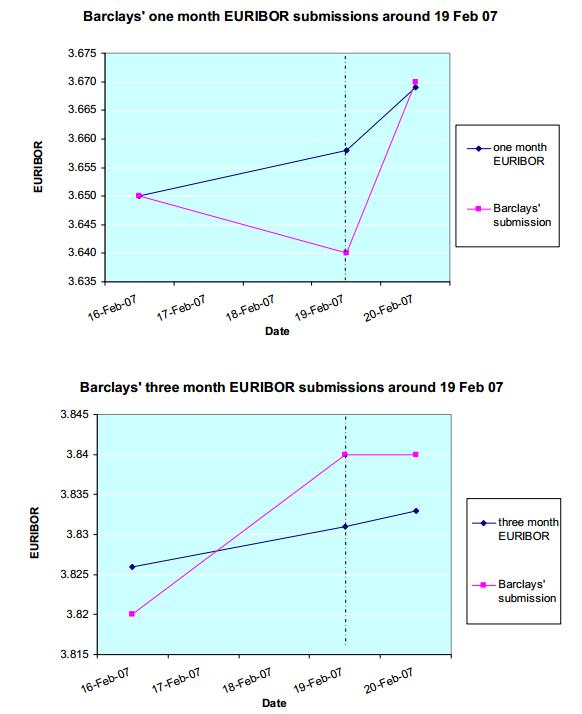
That’s about all you need to know about the Barclays EURIBOR fixing scandal. Here are some graphs from the pdf:

I find this fascinating reading, though. Here’s more:

59. On Friday, 10 March 2006, two US dollar Derivatives Traders made email requests for a low three month US dollar LIBOR submission for the coming Monday:

i. Trader C stated “We have an unbelievably large set on Monday (the IMM). We need a really low 3m fix, it could potentially cost a fortune. Would really appreciate any help”;

ii. Trader B explained “I really need a very very low 3m fixing on Monday – preferably we get kicked out. [DW- LIBOR and EURIBOR are calculated by clipping the highest and lowest rates submitted by the banks. I wish I understood why having the Barclays submission kicked out helps their trade…] We have about 80 yards [billion] fixing for the desk and each 0.1 [one basis point] lower in the fix is a huge help for us. So 4.90 or lower would be fantastic”. Trader B also indicated his preference that Barclays would be kicked out of the average calculation; and

iii. On Monday, 13 March 2006, the following email exchange took place:

Trader C: “The big day [has] arrived… My NYK are screaming at me about an unchanged 3m libor. As always, any help wd be greatly appreciated. What do you think you’ll go
for 3m?”

Submitter: “I am going 90 altho 91 is what I should be posting”.

Trader C: “[…] when I retire and write a book about this business your name will be written in golden letters […]”.

Submitter: “I would prefer this [to] not be in any book!”

60. The number of requests and the period of time over which they were made indicate that the Derivatives Traders made requests on a routine basis. Specific emails also indicate the requests were made regularly. For example, the following email exchange took place on 27 May 2005:

Submitter: “Hi All, Just as an FYI, I will be in noon’ish on Monday […]”.

Trader B: “Noonish? Whos going to put my low fixings in? hehehe”

Submitter: “[…] [X or Y] will be here if you have any requests for the fixings”.

And this!

67. On 6 August 2007, a Submitter even offered to submit a US dollar rate higher than that requested:

Trader F: “Pls set 3m libor as high as possible today”
Submitter: “Sure 5.37 okay?”
Trader F: “5.36 is fine”

Are these the stupidest people on earth? This is SNL-worthy idiocy.

Harry Potter Hating On The Players, Not The Game

Harry Potter And The Order Of The Phoenix star Daniel Radcliffe enjoyed annoying the paparazzi during his recent stint on the London stage – for six months he deliberately wore the same clothes when leaving the theatre so photographs would be worthless. The 17-year-old was greeted by photographers each night outside the Gielgud Theatre during his stint in controversial West End play Equus, where the teenage actor disrobed onstage every night. Radcliffe quickly realized newspaper and magazine editors wouldn’t publish photos of him wearing the same outfit night after night, because it would look like the pictures were taken on the same day. He says, “They (the paparazzi) were outside the theatre every single night, but we came up with a cunning ruse. I would wear the same outfit every time – a different T-shirt underneath, but I’d wear the same jacket and zip it up so they couldn’t see what I was wearing underneath, and the same hat. So they could take pictures for six months, but it would look like the same day, so they (photos) became unpublishable. Which was hilarious, because there’s nothing better than seeing paparazzi getting really frustrated.”

It’s easy to hate on the paparazzi because it looks very annoying to have to deal with them, but this surely infuriated Radcliffe’s agent. Love ’em or hate ’em the paparazzi are an essential part of the fame machine and working with that machine can make you rich. Disrupt its machinations at your financial peril.

If in 10 years’ time, Danny Radcliffe can’t pay a parparazzo to snap shots of him swimming naked in the Thames he may wish he spent less time biting their hands when they were full of food.

Hearing Footsteps

The Economist pooh pooh’d Microsoft’s latest splash in tablet computing:

One reason why the iPad has been so successful is that it blends beautiful hardware with an amazing range of software. Microsoft has attractive assets, in particular Skype (an internet calling service), its alliance with Barnes & Noble (a big online bookseller) and its Xbox ecosystem. Yet other than the firm’s Office suite of productivity tools, none of these was shown at this week’s launch. “Microsoft has missed an opportunity to highlight things that can inspire people,” says Sarah Rotman Epps of Forrester, a research firm.

Ok, let’s dial down the ‘new and shiny’ fetish for a sec. Microsoft Office is THE reason the company remains relevant today. The fact that a tablet computer is coming out with the potential for seamless support of Excel and Word and Outlook is most definitely an iPad-maiming development.

People make money using “productivity software”. They don’t make money playing games and messing around on social networks. And the bottom line of business is you get rich by helping people get rich*. Those who wish to clone Apple and Facebook ignore this point.

If the MS tablet is 50% as good as the iPad at everything else, I’ll buy it. Hell, the blackberry is 10% as good as the iPhone at everything other than email (at which it is 100% better) and because I vote with my wallet, RIM can easily ignore my distant envious whine as they self-destruct.

*I feel like I should clarify that there’s absolutely no denying that dominance of the consumer segment is incredibly lucrative for Apple. So let’s either call that an exception to my little pet rule or admit that I simply don’t know what I’m talking about.