Kids These Days (?)

Tyler Cowen sends us to this very interesting post by Steve Postrel on higher education:

My hypothesis is that it is precisely the dumbing down of U.S. education over the last decades that explains the increase in willingness to pay for education. The mechanism is diminishing marginal returns to education.

Typical graduate business school education has indeed become less rigorous over time, as has typical college education. But typical high school education has declined in quality just as much.

Postrel offers up four links to support the decline in rigor at all levels of education. Given that the entire argument rests on this point, we should follow those links:

1. Dumbing Down High School English. Opens up with this quote:

A recent ALSCW ( Association of Literary Scholars, Critics, and Writers) study finds that

a fragmented English curriculum and a neglect of close reading may explain why the reading skills of American high school students have shown little or no improvement in several decades despite substantial increases in funds for elementary and secondary education by federal and state governments.

After that it’s all hand waving. Disappointing because Postrel is worried about the LEVEL of education and this link despairs over the rate of positive change. Not relevant.

2. Link to this book. I haven’t read it. In this review, they say the book refers to one study in particular (pdf here) with this abstract:

Using multiple datasets from four different time periods, we document declines in academic time investment by full-time college students in the United States between 1961 and 2004. Full-time students allocated 40 hours per week toward class and studying in 1961, whereas by 2004 they were investing about 26 to 28 hours per week.

Students spend less time studying. I believe that.

But one thing the study does not control for is major type. Are engineers less well educated than in the past? I sincerely doubt that. Cowen may not find answers to declines in productivity improvements in this line of inquiry.

3. The Math Wars. Short version: the quality of math instruction in high schools has declined. I suppose I buy that. But I don’t envy my grandparents’ math instruction. I am sympathetic to reformers here.

4. On MBAs. Here’s a relevant quote on the author’s memory of his MBA student days and what he thinks has happened:

So, we read 30-40 academic journal articles per class. We became capable of digesting their content and, thereby, able to access new ideas 10-20 years ahead of widespread practice. We traced the trajectories of core research streams and, thus, came to recognize that subtle thinking is required of complex issues. We jammed into Merton Miller’s class, not because he was entertaining or capable of summarizing complex ideas into exquisite 10-bullet lists, but because everyone knew he was a genius and felt damn lucky to sit in his presence and glimpse into his thinking about finance. Excerpts from books by Tom Peters and other management “gurus” were not viewed as examples of special wisdom but, more accurately, of sloppy, shallow, unsubstantiated pap. That was a bad-ass education — one that served us well throughout our careers, not just in our next jobs.

What happened? Well, Business Week rankings coupled with the “Northwestern Innovation.” BW rated schools on: (1) student satisfaction, (2) recruiter assessment, and (3) research ranking. Northwestern, which was not a contender back then, realized that moving (2) or (3) could only happen veeery slooowly. Item (1), on the other hand, well, that could be manipulated almost instantaneously. And thus began the race to the bottom of the toilet. As far as I can tell, anything approaching the education I got has long since been abandoned.

More hand-waving, mostly, but I accept his premise. I’d point out a few things:

  • Chicago is a special place. Not every school has super-duper-star instructors and highly motivated students.
  • MBA programs are a ridiculously easy target for this kind of argument. I happen to think quite a lot of management ‘theory’ is complete garbage. Economics can be nearly as bad. Rigor in these subjects can often obscure learning outcomes. Let stories be told where stories must be told.

I find the idea that bad high school quality drives the increase in the college premium persuasive. I’m more sympathetic in respect of math than other subjects, though we must remain ever vigilant against cognitive bias. Complaining about the “kids these days” is usually total crap.

Quotes of The Day

“Spain is not Greece.” Elena Salgado, Spanish Finance minister, February, 2010.

“Portugal is not Greece.” The Economist, April 2010.

“Greece is not Ireland.” George Papaconstantinou, Greek Finance minister, November, 2010.

“Spain is neither Ireland nor Portugal.” Elena Salgado, Spanish Finance minister, November 2010.

“Ireland is not in ‘Greek Territory.’”Irish Finance Minister Brian Lenihan. November 2010.

“Neither Spain nor Portugal is Ireland.” Angel Gurria, Secretary-general OECD, November, 2010.

“Italy is not Spain” – Ed Parker, Fitch MD, 12 June 2012

“Spain is not Uganda” Spanish PM Rajoy. June, 2012

“Uganda does not want to be Spain” (Ugandan foreign minister) June 13th 2012

source here. hat tip @justinwolfers

Record Labels Will Never Die

Hit songs, books, and movies are many times more successful than average, suggesting that ‘‘the best’’ alternatives are qualitatively different from ‘‘the rest’’; yet experts routinely fail to predict which products will succeed. We investigated this paradox experimentally, by creating an artificial ‘‘music market’’ in which 14,341 participants downloaded previously unknown songs either with or without knowledge of previous participants’ choices. Increasing the strength of social influence increased both inequality and unpredictability of success. Success was also only partly determined by quality: The best songs rarely did poorly, and the worst rarely did well, but any other result was possible.

More here (via Barker).

A few quick thoughts:

  • A quick proxy for status is how many people talk about you when you’re not there. Record labels (and movie studios) create this real value.
  • There can be only one #1 song at any given moment so, all things equal, the biggest baddest promotion machine gets the slot. This is an arms race. Also, timing your release to avoid the Lady Gaga/Pitbull/whatever Gorillas matters.
  • One can imagine an equilibrium with lower overall promotional costs and similar music quality. It’s called the no-trademark equilibrium. There is no incentive problem in high-status businesses so higher returns just flow back into marketing budgets. And the arms race heats up.
  • So killing music trademarks will hobble marketing budgets. What effect does this have on eyeball businesses like the Internet? Might trademarks be key to the bubble so many feel but cannot prick? A transfer of measured GDP to more ‘real’ sectors would look pretty awesome to rocking chair economists.

What Google Did and Facebook Has Not Done

Made its customers rich:

The Internet solved our problem, but in an unexpected way. In 1999, I had made a large conference table for a Philadelphia client. We put a picture of it on our Web site. People started to call about the table in 2003. They told me that they found my site using something called Google. In 2002, zero percent of my sales were driven by Web searches. By 2004, it was 90 percent, and we passed $1 million in annual revenue for the first time. We canceled our print ads and used the money to buy Web searches aimed at dining furniture and conference tables. Most of the callers wanted conference tables, so we turned our attention to the business-to-business market.

Behind The Curtain At The Fedborg

JG: Chairman Bernanke would deny that political pressure influences his vote, and he even went out of his way to make a public appearance in Texas after Rick Perry made his threat. But FOMC members all read the papers. They see the virulent opposition to their policies on the right and the silence on the left. (Paul Krugman is a big exception, but he is not a politician.)

via Yglesias more here.

Forget the median economist theory of the fed. Its power is granted by congress, a club for politicians, not economists.  And so it makes sense to avoid the ugly mess of legislating change by stocking the fed board (fedborg) with people who are sensitive to political pressure:

They want to avoid any Congressional action that would reduce their independence in the future, in part because they think this might lead to even worse economic outcomes than we are currently experiencing.

And this is also relevant:

JG: I think the average economist outside the Fed thinks the Fed has less ammo than the average economist inside the Fed.

Addendum: here Krugman on on the fedborg idea and a summary here:

In a lengthy column to be published in this week’s New York Times Magazine, Paul Krugman compares the Federal Reserve to a Borg—a race of beings from Star Trek that act based on the wishes of a hive mind, and present major threats to the Starfleet and the Federation.

Krugman argues that Fed Chairman Ben Bernanke has succumbed to this Borg mentality, subduing the beliefs he espoused during his career as an academic.

Timing Is Everything – The Euro Crisis In One Short Paragraph

Krugman with an outstanding summary of the Euro history (this is why you never stop reading Krugman, regardless of how off-putting the tiresome political whining may be):

I’d put it this way: it so happened that the euro came into existence at a time when the German economy was in the doldrums. Then the euro made investors believe that southern Europe was safe, causing a huge fall in interest rates there:

This in turn led to vast inflows of capital; the flip side of these inflows was large trade deficits, and large counterpart German surpluses, which was just what the Germans needed. Everyone was happy! For a few years.

Hard to make it more succinct than that. If the Euro was born in another other era maybe it would never have worked in the first place!

Long Gold = Short Central Bank Efficacy

I once watched John Paulson pretend he knew why the Gold price was going up. Now consider this example of the conventional wisdom:

Gold is at highs – also thanks to Fed activity. This basically leaves foreign exchange – in other words, the Fed would print dollars and buy foreign currencies, driving up the value of foreign currencies and down the value of the dollar.

Yglesias thinks the Fed should do this to stimulate the economy. I think so too, as it would increase the value of my gold holdings a lot.

The price of gold has nothing to do with inflation expectations in this environment. I tried to put together a TIPS spread vs Gold price graph at FRED but it doesn’t look like they have one.

Consider this idea for the price of gold: it goes up when the market realizes the fed’s lost its way. Can mean deflation or inflation.

How Medicine Might Change

Last week’s Economist had a few articles on how costs will be controlled in medicine. I’d summarize the higher-profile 3-page briefings can be summarized in one word: specialization.

Physician assistants in America can do about 85% of the work of a general practitioner, according to James Cawley of George Washington University.

Great, but this has nothing to do with technology and all to do with simple economics and… politics:

But any change will first require swaying the doctors. The American Medical Association, the main doctors’ lobby, greeted the IOM’s report with a veiled snarl. “Nurses are critical to the health-care team, but there is no substitute for education and training,” the group said in a statement.

The doctors’ power rests on their professional prestige rather than managerial acumen, for which they are neither selected nor trained. But it is a power that they wish to keep. The Confederation of Medical Associations in Asia and Oceania, a regional group of doctors’ lobbies, wants “task-shifting” limited to emergencies.

The pace of productivity increase in medicine needs to keep up with the pace of technological innovation, which in medicine, unlike in most other industries, increases costs. The power of new toys to create their own demand is something Facebook wishes it could share with medical device makers.

I’m far more excited about the second article, from the Technology Quarterly, on ‘open-sourced’ medical technology. What’s that?

Two medical physicists, Rock Mackie and Surendra Prajapati, are designing a machine to combine radiotherapy with high resolution computed tomography (CT) and positron-emission tomography (PET) scanning. Their aim is to supply, at zero cost, everything necessary to build the device from scratch, including hardware specifications, source code, assembly instructions, suggested parts—and even recommendations on where to buy them and how much to pay.

You can see some specs here, which looks like a work in progress. Could DIY instructions combined with something like additive manufacturing be cost-killing future of medicine?

Here’s another awesome idea from the same article:

More intriguing still is the Medical Device Co-ordination Framework being developed by John Hatcliff at Kansas State University. Its aim is to build an open-source hardware platform including elements common to many medical devices, such as displays, buttons, processors and network interfaces, and the software to run them. By connecting different sensors or actuators, this generic core could then be made into dozens of different medical devices, with the relevant functions programmed as downloadable “apps”.

The problem? The FDA is not set up to monitor this kind of thing and (probably) fumbles the approval process.

“In the 1990s we developed an excellent radiation-therapy treatment-planning system and tried to give it away to other clinics,” says Dr Mackie. “But when we were told by the FDA that we should get our software approved, the hospital wasn’t willing to fund it.” He formed a spin-off firm specifically to get FDA approval. It took four years and cost millions of dollars.

The FDA’s power is in the ascendent. In a way, this is good because it will help protect us. But remember that stories like this have happened:

An especially absurd example of device delay occurred to the Sensor Pad. The Sensor Pad is so simple it hardly justifies the term device: it is two sheets of sealed plastic that sandwich a silicon lubricant. With the Sensor Pad, a woman can more easily detect unusual breast lumps in a self-examination. Although the product is simple, it is quite useful and can save lives through early detection of breast cancer. The Sensor Pad was invented in 1986 by Earl Wright of Inventive Products and was submitted to the FDA for approval. The FDA, however, could find no other substantially equivalent product on the market and thus automatically classified the Sensor Pad as a high-risk, Class III device. Before being allowed to sell the Sensor Pad, Inventive Products had to submit a premarket approval application to the FDA.

There’s a bottomless pit of demand for event the most modest improvements on existing devices and tests. And then there are the big scary problems that we barely understand for which there is also unlimited demand for innovation.

Combine this with an unparalleled expertise bias in medicine (as evidenced by the FDA when at its worst) and you get some truly toxic economics. There is very little wikipedia/crowd-source/open source innovation in medicine right now.

Doesn’t that have to change eventually?

Betsey and Justin Go Closet Sumnerinan

High-frequency data on consumer confidence from the research company Gallup, based on surveys of 500 Americans daily, provide a good picture of the debt-ceiling debate’s impact (see chart). Confidence began falling right around May 11, when Boehner first announced he would not support increasing the debt limit. It went into freefall as the political stalemate worsened through July. Over the entire episode, confidence declined more than it did following the collapse of Lehman Brothers Holdings Inc. in 2008. After July 31, when the deal to break the impasse was announced, consumer confidence stabilized and began a long, slow climb that brought it back to its starting point almost a year later. (Disclosure: We have a consulting relationship with Gallup.)

That’s from a great article by Betsey Stevenson and Justin Wolfers (whose twitter feed I really enjoy: @justinwolfers) on how the debt ceiling wrangle damaged the economy.

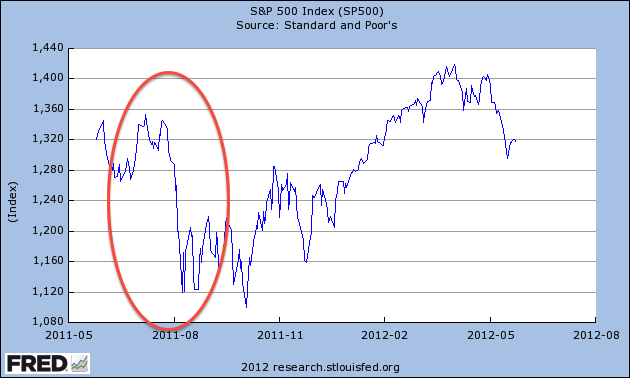
And there are other data points that may be more credible even if they give less clean of a signal. Let’s put on our Scott Sumner hat and ask what he’d have to say about all this.

I predict Scott Sumner will apply his model for NGDP expectations and post about these graphs from that summer:

Falling TIPS spread, strengthening dollar, falling stock market? That’s a nominal shock, folks.

And furthermore I predict Sumner is going to finish his post by pointing out that the Fed did nothing, even though it could have offset this effect with a stroke of its pen (ie press release with some mega-charged loose money /pro-NGDP rhetoric).

Guess That City

via MR:

The riches reflect a regional economy as resilient—and as strange—as any in the world. “We don’t make anything here,” Fuller says simply. […] is one of the few metropolitan areas in the country that have no significant manufacturing sector, placing it alongside Atlantic City, N.J.; Myrtle Beach, S.C.; Cape Cod, Massachusetts; and Ocean City, N.J.

The answer isn’t Las Vegas.

Here’s the answer.