Clash of the Machines

Here is a great series on High Frequency Trading. I was most intrigued by this:

It’s important to note that market making is nothing new. In the era when stocks were traded in 1/8ths and 1/16ths, market making was done by humans working in the pit. A single human trader would often run a market making strategy on larger stocks with significant volume. Later on, from the 1980’s to the early 2000’s, human daytraders would often fill this role. To a much lesser extent they still do.

Automated trading systems have replaced these human market makers for a very good reason – cost. For a strategy (and note: this strategy works only for a few securities, no human can track hundreds of stocks mentally) to be worth a financial professional’s time and effort, it must generate at least $20-200k profit each year (this assumes a human smart enough to daytrade would work for $20k/year). In contrast, a single server in a data center can run hundreds of strategies at a cost closer to $50k/year, and they can do it faster and more accurately than any human.

…Suppose that at precisely 10:31:30:000 AM, new information becomes available which suggests that it will now be profitable to place a buy order at $20.07 – perhaps a press release has hinted that the price will go up, or a correlated security has just gone up in price. Because of this, both Mal and Jayne want to change the price on their orders to $20.07. Whoever happens to be fastest will rise to the top of the book:

This is why automated market making has morphed into high frequency trading, and why so much effort is poured into creating low latency systems. Whoever places their order first will be the most likely to trade.

It’s interesting that progress in this market is defined as the degree to which machines talk to and understand each other.

The immediate ability to profit from technological advances means computers will be autonomously driving market liquidity before they’re driving cars.
Still In The Woods

I go straight to Calculated Risk for all my ‘real’ economic news, by which I mean the data and basic commentary. Their graphs are outstanding.

And those graphs are telling all kinds of still-nasty stories about the downturn we are still in.

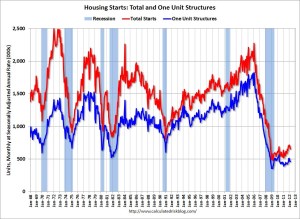
Look at the housing starts:

Hopefully it’s becoming clear that the economic story is not about ‘we built too many houses’. It’s about lots of stuff (debt deleveraging, etc). Have a look at this. The single family housing starts are down, sure, but so are owner built and built for rent sales, which didn’t really pick up in the boom.

And I like the graph below because I’ve long had the impression that most apartment buildings were built in the 70s and 80s. And it’s true!*

When people talk about “infrastructure spending” think about all of the low hanging fruit that’s already been picked.

Let’s build some highways. Got ’em.

Let’s build some airports. Got them, too.

Ok, how about apartment buildings? Done, and, in any case, NIMBY!

Replacing these things are going to be much less accretive to growth than building them in the first place.

And of course the real story is employment.

*My wife and I recently moved and had trouble finding a place that would both let our two dogs in and was built in the last 10 years.

Data Science

The Netflix competition will probably go down as the event that gave birth to the Data Science Era. Like all iconic events there was absolutely nothing groundbreaking or new about it, it was just the firs time a few trends came together in a public way: large scale data, a public call for solutions, a prominent relatively recent startup disrupting an ‘evil empire’ kind of industry. And a bunch of money.

And the winner’s solution was never used:

If you followed the Prize competition, you might be wondering what happened with the final Grand Prize ensemble that won the $1M two years later. This is a truly impressive compilation and culmination of years of work, blending hundreds of predictive models to finally cross the finish line. We evaluated some of the new methods offline but the additional accuracy gains that we measured did not seem to justify the engineering effort needed to bring them into a production environment.

To me it makes the whole thing an even better story as a cautionary tale in the differences between academic indulgence and commercial needs.

Perfect is often the enemy of good.

Today In Unanswerable Questions

What is the value of something?

Here’s Pete Warden with the best explanation for what Facebook gets in Instagram. Many commentators have gotten caught up in the comparison of valuations between the New York Times and Instagram (both $1bn). Don’t be fooled, this is deep stuff.

The best answer for what something’s worth is the amount of money you can make from buying it. To a pure trader, most everything is inherently valueless, they simply buy and sell assets to flip them. Economically, all they do is provide liquidity. Markets *really* work only when interested parties transact with heterogenous uses for the assets. One man’s trash is another man’s treasure.

To Facebook, Instagram is worth $1bn. To Facebook, the NYT is worth far less than $1bn because they would probably destroy quite a lot of value by buying it. To Microsoft or Yahoo! Instagram may well be worth a lot less than $1bn. Heck, Instagram may well not be worth $1bn to Facebook, either, but Facebook *thinks* it is at the moment.

And that’s as satisfying an explanation as you can get. Talking about an abstract “price” for something is nonsense.

Reverse Engineers

Leaky, a car insurance comparison website, ran into a problem:

The problem? In order to compare the insurance prices you’d pay with different providers, Leaky was scraping the data directly from the insurance companies’ websites. It sounds like Traff wasn’t entirely surprised by the letters (“We understood their objections and complied with them,” he says now), but he thought Leaky would have more time to fly under-the-radar while it figured out the best way to get its data. However, the high-profile launch made that impossible, and the site went offline after four days.

The solution?

Now Leaky is back, and it’s offering price comparisons based on a new data source — the regulatory filings that car insurance companies have to file with the government. Using those filings, the company has created a model that predicts, based on your personal details, how much each insurance provider will charge.

I presume he means the rate filings insurers give to regulators (I smell an actuary in there somewhere!). This is a fascinating project but I’m pretty pessimistic.

The web startup model, as I see it, is to build something geeks love, piggyback on the free advertising in the startup press and wait to get bought out by someone who has the platform to actually bring your product to the masses.

Leaky is offering no product, though. They’re offering replica pricing. Oh, but it’s so close to the real thing!

That means Leaky is no longer getting its prices directly from the providers, but Traff says the new model is making predictions that fall within 3 percent of the actual prices.

First lesson in stats: means mask the tails of the distribution. There’s plenty of wiggle room in 3% average deviation (if that’s what he means) to make this product completely useless.

Car insurance is not unlike car manufacturing. I remember reading an interview with Carlos Ghosn where he was lamenting that the only way to make money is to have huge scale in auto manufacturing and the only way to get that scale is to kill your margins.

Online platforms, like manufacturing plants, are a colossal capital outlay. As soon as it’s up insurers need to pour money into advertising to get people to the site. Sure you’re cutting out the broker, but you need to pay Google and network TV to get the word out and promise (cross our hearts) that your deals are actually cheaper.

And the real cheap deals only come occasionally as a carrier grasps for market share. Leaky can’t predict that from the rate filing.

So the only way to improve on the existing model is to compare real quotes from real insurers. Online players killed the broker a long time ago, they aren’t going to let him back in now.

The Fat Of The Land

Dane-o sent me this article on the possibility of a Student Debt bubble. I’m often wary of Zero Hedge: they are an odd mix of great analysis and sensationalist extrapolation.

The core of the story is that Jamie Dimon is pulling back hard on his student loan business. I’d divide my interest in this topic into a few areas: 1. If student loan defaults went bananas, should I be worried about systemic risk? 2. Are student loan defaults going bananas? 3. What does all this mean for higher education?

Ok, let’s start with 1. Is the student loan market systemically important?

First, how big is it? One estimate is 1 trillion (and that’s a high/overstated number), which is bigger than I’d expect. But my favorite view on the Great Recession is that even the housing collapse would have been a trivial shock if not for monetary tightening. And the US Mortgage market is about 10 trillion.

And you can walk away from your mortgage, wheres lenders have “broad powers” to seek repayment on student loans. Bankruptcy isn’t an option. That means that lenders aren’t going to feel much pressure to write the suckers down. No solvency risk means no systemic risk.

So why exit?

Probably because though they won’t sink the ship, they aren’t lifting the boat. Much is made of the large number of delinquent student loans. And 27% at 30 days past due is big. But in mortgages, at least, a lot of loans are ‘cured’ between 30 and 90 days, after which they’re considered in default. And anyway, you can’t kill a student loan with bankruptcy.

Following the chain of links leads us to an American Banker piece:

The CFPB recently began accepting student loan complaints on its website.

“I think there’s going to be a lot of emphasis and focus … in terms of what is deemed to be fair and what is over the line with collections and marketing,” Petrasic says, warning that “the challenge for the CFPB in this area is going to be trying to figure out how to set consumer protection standards without essentially eviscerating availability of the product.”

Outstanding student debt, including private and federal loans, has topped $1 trillion, surpassing previous estimates, the CFPB reported earlier this month.

More regulation, uncertain cash flows. Sounds like a plain old fashioned crappy business. Not much of a story.

What matters, to me, is the fact that the government owns most of this business and appears to be picking up share as private firms rush out. Higher education reform will be high on the agenda in the coming budgetary armageddon. Those costs have to come down somehow.

US the richest and most productive economy in history. And it is spending an all-time record *proportion* of that all-time mass of wealth on health care and education.

Education is not the most productive sector in the world. It’s just the fattest in the world.

For The Finance/Econ Geeks

via Tyler Cowen we are sent to FT Alphaville for a some serious brain damage. I have training in both bond markets and monetary macroeconomics but have no real practical experience in either, so I know only enough to be dangerous here. Beware.

With that, let’s of course talk about how bond markets affect monetary policy.

Banks borrow money. In the olden days, they’d borrow it from you and me (deposits) and lend it out for profit. Sometimes the banks would make enough bad loans that borrowers would all simultaneously freak out and try to withdraw all their money. Loans can’t be called that fast. Bank run… Bust.

A big part of Bernanke’s academic legacy is describing the nasty things that happen when an economy is starved of credit after an epidemic of bank runs.

Deposit insurance stops this problem because the olden days creditors (us) never have to worry about getting their money back.  But these days there’s a new channel for bank runs: shadow banking.

Here’s how a shadow bank works: you have a treasury bond or some highly rated corporate debt but you WANT cash. So you borrow money overnight and pledge that bond as collateral then go make some money with that cash. That’s shadow banking.

The point of the FT post is that shadow banking is huge and absolutely TANKED during the crisis. There’s lots of interesting discussion in that piece on this point. Here’s a graph (there are may more)

This had the effect of sucking money out of the economy, perhaps not quite like what happened in the Great Depression but certainly more than the experts thought they saw in 08-09.

I really liked this quote:

6) How does this understanding of the crisis jive with Gary Gorton’s theory of what happened? Recall that Gorton’s story wasn’t just about collateral values plunging and haircuts rising in repo markets. It was that certain types of debt used as collateral flipped from being information-insensitive to information-sensitive. And this flip wasn’t limited to subprime MBS, which would have caused only minor stresses.

His argument wasn’t about the relative safety of the collateral as its value fell. It was about the collateral going from safe to unsafe just because lenders in repo markets realised that it could potentially fall. So they pulled out en masse and hiked haircuts even when the collateral wasn’t subprime-related, and voila you’ve got a crisis. This was partly an issue of repo market transparency, but it also reflects a different, more binary understanding of what triggered the crisis.

Summary: on a one-day time horizon, highly rated corporate paper wasn’t risky until it was. And if that stuff was used for repo loans then the repo system stops working.

What nobody really understands, even now, is how important the repo system is. Even though Scott Sumner thinks it doesn’t matter.

Where Productivity Goes

Lots of talk about how we’ve progressed since 1949. Here’s one graph. (and more and more).

I like thinking of it like this (using this dataset to see that we are about 2.75x the 1949 median income level)

As pointed out in the original Atlantic piece and in this awesome Tyler Cowen piece, our relative consumption is shifting away from super competitive ‘making things’ sectors and towards protected domestic service-oriented industries.

We’re spending similar amounts of money on food and apparel, etc. We’re spending much of the gains made since (and that’s a LOT of gains) on services and housing.

And housing’s a funny one because it’s simply rent paid to an owner of capital. Shouldn’t we be bidding for opportunities in productive industry rather than stocks of housing?