Brain Science

That’s a non-ironic title (this time).

Here’s Robin Hanson:

It persuades me that raw brain hardware was more important than I’d thought in our history.  Here is my current best guess on brain history.[..]

The added ellipsis is my attempt a building some tension there. If you have any interest in evolution or anthropology (I wish I could make that sound less pretentious), read the link. I know about 30% of what I’d need to know to comment intelligently.

Final-e

Ok, I think I’ve finally got the whole e thing straight in my head.

They key to e, you see, is that it’s arbitrary.

First, my thought progression: one, two and three. Reading over them again, I realize how poorly I understood what was going on because those posts really suck.

Mathematicians are obsessed with two things:

  1. Shoving as much information as possible into small spaces; and,
  2. Making things look like other things without changing them

As far as I can tell, the history of mathematics is a long string of ‘discoveries’ wherin people learn some kind of identity, like this one that describes e:
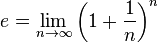
and feel the faint tickle of recognition. “Hmmm…”, they would say, “now where did I see that before? Ah! Now I remember!” and ka-blammo: apples become oranges that taste like apples.

Think about the calculation of a probability using the Poisson:

This is misleadingly complex. The Poisson distribution is NOT complex. The Poisson distribution doesn’t even exist. It’s an approximation of the Binomial distribution, which is freakishly simple:

Um… ok, maybe it doesn’t look that simple but that’s because the question it’s designed to answer is a bit complicated: “what is the probability of something happening exactly k times if its probability of happening once is p and you try n times?”

The way of answering it is super easy to understand, though: for one trial the probability is p. For many trials you just start multiplying ys together with (1-p)s, mostly.

Anyway, so what’s the point of the Poisson distribution, then? Well, some clever dude realized this:
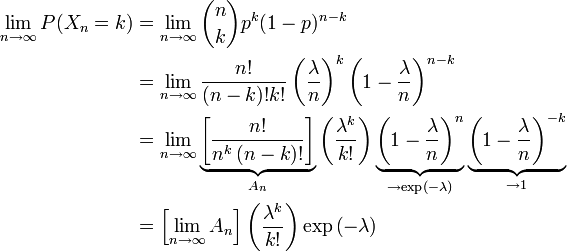
And what is all that crap. Well that crap is all about the little horizontal curly braces. These are instances where somebody recognized an equation from someplace else and plugged it in. These simplifications remove many steps in calculating the binomial distribution, but increase the difficulty of understanding it.

So e is a massive red herring here. There is no ‘deep truth’ to any of these probability distributions or to the magical math that describes them. You could express a probability using any constant other than e, it’s just that writing it out would be much more complicated and annoying.

Besides, Poisson probabilities are build around the idea of infinite trials. Infinite! There’s no such thing as infinite as far as I’m concerned.

Cute? Yes. Clever? Absolutely. “TRUE” in a deep sense of the word?

Nope.

PS. I was amazed to see what the Binomial distribution is. It’s the effing Normal distribution:

No wonder the normal distribution is such a silly concept! It only describes linear, super-simple probabilities. Hmph.

Ego vs Efficacy

From Dan Pink (now on the blogroll) via Barker:

when people solved problems on behalf of others, they produced faster and more creative solutions than they did when they solved the same problems for themselves.

So if you want the best solution to your problem, give it to someone else. Ouch to the ego!

And this is the point: it’s humiliating to watch someone blast through a problem I’ve slaved over for hours on end. No doubt for some this is exactly why some cannot work in a team. It’s hard to focus on outcomes and cede social status to the solver of your problem for the sake of the team.

But how powerful the team can be! Social ability is the ultimate intelligence.

The solitary mind can never reach its potential.

Review: David Haye vs Wladimir Klitschko

Watched the big boxing match today.

I haven’t read any of the post-fight analysis because I’m disappointed that ‘my guy’ lost so convincingly and don’t really want to read about what I can figure out for myself.

There are three relevant facts that made tonight’s result unsurprising (as much as I wish it were not so).

First, both guys have the fundamentals down: they’re both very skilled and show up in shape.

Second, David Haye is much smaller than WK.

Third, both guys fight to avoid getting their glassy chins broken.

The first fact means that neither guy has an obvious and easy weakness to exploit. The second fact means that Haye can’t outbox WK. He needs to travel too far to score shots to get a decision win. The third fact takes Haye’s last option off the table: he can’t walk in Tyson-style and trade cannonfire because he won’t risk getting put to sleep.

I’ve said it before: the best boxers can really beat the crap out of each other when they put their mind to it. Superstars just have too much to lose to let themselves get hit a lot and it shows; they fight to not lose.

WK’s style is perfectly suited to a superstar boxer because he risks so little. He just has to be bigger and jab away at people until they do something stupid.  I predict he’ll continue to box for a while, but I bet Haye’s going to retire soon and try to have a go of just being a ‘celebrity’.

It’s easier work.

An Anonymous Rant Against A Professional Writer

PC360 gives us this. It’s so sticky with jargon to be barely readable.

Let me summarize the (2,300 word) article:

Claims data can teach underwriters about where claims come from and expose new drivers of claims cost. Analyzing claims databases is a good way of testing new hypotheses but,  for organizational reasons, most companies aren’t great at this.

Yawn. Could have been written at any point in the last 300 years.

Next is a big discussion about how automated computer programs can correlate variables without the burden of actually ‘understanding’ the data.

[shields up! BS ALERT!]

My old man once spent some time learning about a stock picking technique which, to be perfectly honest, looked like garbage to me. But sometimes it worked!

I’d argue it’s complete luck. As they say, “even a broken watch is right twice a day”.

Narrative validation a powerful test for statistical conclusions: correlation is useless without a deep understanding for the causal mechanism. Unexplained, ‘dumb’ empirical relationships (describes all too much of medical research, imo) are too unreliable for me to back with cash.

If you don’t know how it works, how on earth do you know when it breaks?

Ancient Inventory Lists (and Quantum Computing)

Some industrious researcher has transcribed thousands of lists of households’ goods in some small German town from the 17th and 18th centuries.

I love this kind of story. Datasets are so easy to build and analyze now relative to, say, 10 or 20 years ago.

And anyone interested in projecting trends in such computing power might try an online course in Quantum Computing!

Life is About Virtuous Routines

I haven’t linked to Barker in a while. Today’s study resonated with me:

We suggest that shifting focus from the impact of major life changes on well-being to the impact of seemingly minor repeated behaviors is crucial for understanding how best to improve well-being.

The specific examples investigated are church attendance and physical exercise. I don’t go to church, but the exercise thing makes sense.

My wife looks upon my physical exercise routine with a mixture of bemusement and mild irritation. I’ve had the tough guy cycle down pat for years now, so I spend about as much time rehabbing injuries as I do actually exercising and playing sports.

I am undaunted, however, and today Barker teaches me why. Exercise probably has health benefits over some long time horizon, but I don’t believe people people think in long time horizons. I do these things to achieve something small and distract me from the other parts of my life. Physical therapy works just as well as power cleans or soccer games.

Perhaps relatedly, my old man always said he loved playing squash and boxing because they forced you to be completely in the moment.

I agree with that, too.

Epic Engineering Porn

Dealing with the flooding of the Mississipi:

Worst flooding on record:

This is the 10th time since 1937 that the Bonnet Carre’ Spillway [pictured above -DW] has been opened. The Army Corps is considering opening the final spillway they have in reserve, the great Morganza Spillway in Louisiana, late this week. The Army Corps has never opened all three Lower Mississippi River spillways at the same time.

First Impressions

I know that first impressions matter and that you can learn some surprising things from someone just by looking at them.

What I don’t know, though, is what people think of me when they first see me.

Remember hotornot.com? It would be interesting to see such a site that rates people on some other dimensions: likability, trustworthiness, aggression, psychopathy.

And imagine tracking a group of people over time in a panel study?

I bet you’d get a good feel for social mobility over time, too.

Forget income data!