China Roundup

The Chinese las Vegas is doing ok.

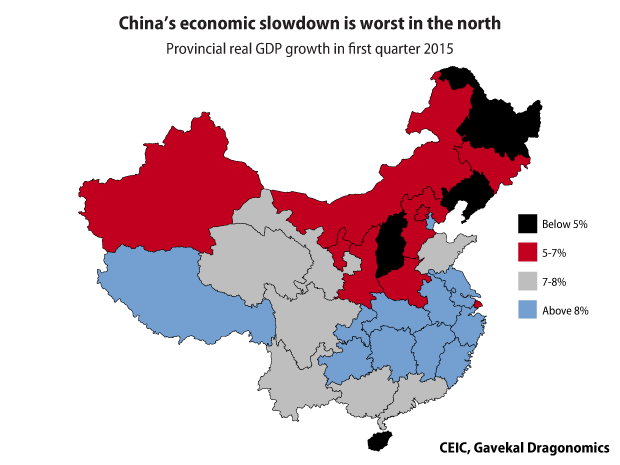
The Chinese rustbelt is not. At that link we get this map that helps drive home the point that this is a big regional economy.
image

Here is Scott Sumner

2.  People forget that until recently China had 10% trend growth, so when it goes from 14% to 7%, that’s a big slowdown.  People also forget that some sectors of the Chinese economy are probably growing smoothly.  Health care, college education, subways rides (which are constrained by capacity), etc.  So if the overall RGDP growth rate slows from 14% to 7%, and some sectors are growing smoothly at 10%, then the cyclical sectors are slowing extremely rapidly.  And the cyclical sectors are also the commodity intensive sectors.  You could easily see lots of industry data that seems inconsistent with a 7% RGDP growth rate, during a cyclical slowdown.

And, boom, Michael Pettis

But every “growth miracle” ends up following the same credibility path, with what once seemed an unending stream of sophisticated and dedicated leaders at every level of policymaking suddenly and unexpectedly becoming an administration of clunky, incompetent bureaucrats, as foolish as the rest of us. When the miracle country outperforms expectations year after year during the expansion phase, we assume that brilliant policymaking is the cause, rather than– more appropriately, as I will explain– inverted balance sheets. When this same balance sheet inversion subsequently causes the economy sharply to underperform expectations during the contraction period, our admiration for policymakers quickly turns into contempt for their incompetence, usually tinged with bitterness that our forecasts turned out so magnificently wrong.

And more..

I believe, however, that without a massive and fairly unlikely transfer of wealth from the state sector to the household sector, the average Chinese GDP growth rate under Xi Jinping cannot exceed 3-4%.

This is what had surprised me most, which is that the massive state transfer hasn’t happened, to my personal financial detriment.

Where Innovation Goes to Die

Steve Blank quoting a friend of his:

“Most of the time our attempts at innovation result in “innovation theater” – lots of motion (memos from our CEO, posters in the cafeteria, corporate incubators) but no real change. We were once a scrappy, agile and feared organization with a “can-do” attitude. Now most people here don’t want to rock the boat and simply want do their job 9 to 5. Mid-level bureaucrats kill everything by studying it to death or saying it’s too risky. Everything innovative I’ve accomplished has taken years of political battles, calling in favors, and building alliances.”

Startups are high status these days. It’s a remarkable characteristic of our times. No surprise outsiders want to capture some of this status by adopting the startup lingo. In the end, companies optimized for execution (not innovation) carry on as usual. They have no business innovating, really, it would kill their very valuable incumbency. For a culture of moon shot gambling? Makes no sense. Try this from Horace Dediu on Steve Ballmer:

Microsoft ascended because it disrupted an incumbent (or two) and is descending because it’s being disrupted by an entrant (or two). The Innovator’s Dilemma is very clear on the causes of failure: To succeed with a new business model, Microsoft would have had to destroy (by competition) its core business. Doing that would, of course, have gotten Ballmer fired even faster.

Steve Ballmer’s only failing was delivering sustaining growth (from $20 to over $70 billion in sales.) He did exactly what all managers are incentivized to do and avoided all the wasteful cannibalization for which they are punished.

If anything, Steve Ballmer avoided The Innovator’s Curse. Being successful with new market innovations would probably have led to an even shorter tenure. Destroying prematurely the pipeline of Windows in favor for a profit-free mobile future would have been a fireable offense. Where established large companies are concerned, markets punish disruptors and reward sustainers.

Steve Ballmer will not be remembered as favorably as the man who created Microsoft. But at least he won’t be remembered as the fool who killed it. That epitaph is reserved for his successor.

Grouping is Hard

Nokia was a phone company, blackberry was a smartphone company. They were both destroyed by a computer company called Apple, making phones. Each company’s products performed a similar service for consumers but production at these companies wasn’t at all similar. These companies got good at systematizing the multitude of tradeoffs that go into scale production. In the vernacular of Steve Blank, they were optimized to execute a very narrow business model. If a different mix of tradeoffs comes along, they were dead. And they are dead.

Yet we are surprised. We are surprised because we have grouped these companies together (PHONES) when they aren’t actually very much alike. Grouping is hard when it really matters.

A better grouping might have been (?): Nokia made voice transmission devices over wireless networks. Blackberry made data transmission devices optimized for efficiency. They were beat by a company that was still happy to (again channeling Steve Blank) continue searching for new business models. Here’s a neat quote from Steve:

The large companies that survive rapid technology and/or platform shifts are often run by founders, (Jeff Bezos at Amazon, Steve Jobs at Apple, Larry Page at Google, Larry Ellison at Oracle) or faced with an existential crisis and forced to change (Satya Nadella at Microsoft) or somehow have miraculously retained an innovation culture through multiple generations of leadership like W.L. Gore.

Your Grandfather’s Model (Is Your Model too)

From John Taylor’s post on the fed’s model error:

The solid black line plots changes in the estimated sacrifice ratio of unemployment to changes in inflation implied by the model over 64 vintages.


Could easily be an actuary’s pricing model. That’s overfitting, folks. Responding to specific (recent) data points without and real generalizability. We must be humble in what we can know about very complex things.

What Advice Would you Give to Your Younger Self?

Listen to extremely successful people answer this question and you get pretty bored pretty quickly. “Take it easy, it’ll all be ok”, “don’t stress so much”, “love and live more”…

Their earlier selves were clearly serious strivers. It’s a nice thing about our world that the very successful got there by self sacrifice and hard work. But for some people, myself included, the advice to the younger self should amount to something more like:

Care more, relax less, life is short and you’re losing.

My younger self did didn’t need relaxation. I needed to correct the mismatch between ambition and effort. I needed pressure. Real pressure. I got there eventually but got there late.

Real pressure isn’t good for everyone so nice for me that it hasn’t driven me insane. And also good for us all that real pressure is easy to avoid in our society if it isn’t internally generated.*

But dodge that pressure at your ambition’s peril, if you care about that sort of thing.

*At least for the middle class, anyway. Certain segments of our society experience real pressure in living normal life (violence, poverty, addiciton, etc). That’s a different problem.

Who’s At Your Table?

“If you could have dinner with four people, historical or living, who would be at that table?”

A common interview question but every answer I’ve heard ignores the premise of a dinner: A five-person dinner isn’t about you, it’s about the interaction of all five. Somehow this question gets translated to: if you could have four one-on-one conversations, who would they be with? Maybe that’s the question the interviewer wants to ask, but that would be a terrible dinner.

Here’s one idea: Ever heard of the Bronx High School of Science? Eight Nobel Prize winners went there. The next most for one high school is four. And four of the eight winners were there at the same time, two in the same class (classes of 47, 49, 50, 50) and all four won for physics. What the hell happened there? Extraordinary group of teachers that was in place only for a short time? Competitive students raising their game to match their peers? Something else? I’d put them around a dinner table and encourage reminiscence to try and understand what went on.

Here’s another idea that’s a bit more fantastical: let’s have a series of dinners with historical scientific figures, like Newton or Euclid at, say, age 40 or something, and drop them into a table with three experts in the fields these guys once dominated. How would they react to suddenly facing a series of people with far greater domain knowledge than they could possibly imagine? Could they handle being so inferior? Here’s a better idea: a series of dinners with a few figures at various ages: Newton at 20, 30, 40, 50, 60. Einstein the same, etc.

The point here is that historical figures are all people. I’d like to explore their humanity a bit. And mine, for that matter.

Trolling Diet Nuts

So if we cared mainly about people’s health, we should cheer this effort by soda forms to push people to exercise. Even if that also causes people to cut down less on soda. A population that exercises more doesn’t weight much less, but it lives much longer. In fact, exercise seems to be one of the biggest ways we know of by which an individual can influence their health. (Much bigger than medicine, for example.)

I suspect, however, that what bothers most people most about fat people isn’t that they’ll die younger, its instead that they look ugly and low status, and so make them also look low status by association. So we don’t want people near us to look fat. All else equal we might also want them to live longer, but that altruistic motive can’t compete much with our status motive.

That’s Robin Hanson. Follow the link for references to reaearch that back the health claims. I love this for two reasons.

First, it’s always fun to be contrarian and cheer a category of companies (soft drink firms) that educated white people like me are ‘supposed’ to hate.

More importantly, I love the chance to talk about how asking slightly different questions yields very different answers. It’s easy to be lazy and think that “What is the most effective cause of better health” is the same as “what makes people thin”.

It’s not, even if “not being obese” is on the list of things that improve health (but not #1).

Climate Quote

“We should really be aware that if you go back 10,000 years, the climate goes apesh*t,” he says. “People generally have no idea about this, but these warm-cold-warm-cold patterns are standard for the Pleistocene. The stability of the Holocene, which human civilisation was built upon, is totally anomalous.

More here.

Esperanto

Like its vastly more successful digital cousins — C++, HTML, Python — Esperanto is an artificial language, designed to have perfectly regular grammar, with none of the messy exceptions of natural tongues. Out loud, all that regularity creates strange cadences, like someone speaking Italian slowly while chewing gum. William Auld, the Modernist Scottish poet who wrote his greatest work in Esperanto, was nominated for the Nobel Prize multiple times, but never won. But it is supremely easy to learn, like a puzzle piece formed to fit into the human brain.

Invented at the end of the 19th century, in many ways it presaged the early online society that the web would bring to life at the end of the 20th. It’s only ever been spoken by an assortment of fans and true believers spread across the globe, but to speak Esperanto is to become an automatic citizen in the most welcoming non-nation on Earth.

The League of Nations almost adopted Esperanto, but the idea was shot down by the French delegate. Zamenhof was Jewish, so Adolf Hitler denounced Esperanto as a language designed to unify the Jewish diaspora, and the Nazis were officially anti-Esperanto. Joseph Stalin was reportedly an Esperantist, but he turned on the language in the late ’30s, calling it a “language of spies,” and started purging people who spoke it.

Ayatolla Khomeini, too, waffled on Esperanto. Shortly after the Iranian Revolution, he urged his people to learn the language as an anti-imperialist counterpoint to English, and an official translation of the Qur’an followed. But adherents of the Baha’i faith had been fans of Esperanto for decades, and Khomeini was definitely not a fan of Baha’i, so his enthusiasm dimmed.

And Baha’i’s not the only smaller religion that’s embraced Esperanto as a liturgical language. In Brazil, which has one of the world’s largest populations of Esperantists, the language is intimately associated with the séance-centric Spiritist movement, and many followers of the neo-Shinto Japanese religion Oomoto have studied some Esperanto.

Mao Zedong liked Esperanto too. The Communist Party of China has published an Esperanto magazine, El Popola Ĉinio, since 1950, and state radio stations still regularly broadcast in the language.

And perhaps most famously, George Soros grew up speaking Esperanto, though his public involvement with the language hasn’t gone beyond getting his father’s Esperanto memoirs translated into English.

More here via MR. I had never heard of this language before.