Not From An Actuarial Textbook

One of the mainstays of actuarial education is thinking about the ways one might underwrite auto liability insurance. The most accurate predictor of risk should be miles driven; after all, the more you’re on the road, the more likely you’re going to get into an accident.

The problem with calculating the number of miles driven is that it’s simply impractical. You’d need an insurance company to install a mileage monitor in every car, scoffs the textbook, and that’s just too costly to do. Some day, perhaps…

Well well well, the day has arrived!

Telematics insurance relies on a databox the size of a mobile phone which is installed by the insurance company into your car. The box does not damage the car and will not affect the warranty; it uses less energy than a car radio so should not drain your car battery.

What Data Is Collected?

Data from this box is collected by GPS, enabling insurers to monitor:

  • The distance it travels at those times
  • Where the car is located
  • On what type of roads the car travels
  • Speed of travel
  • Braking behaviour of the driver
  • Direction and speed of travel before and after a collision
  • Force of impact in a collision
  • At what times the car is used

Buy High, Says Venture Capitalist

Here is a post by Steve Blank, a venture capitalist, identifying a fact:

Facebook takes our need for friendship and attempts to recreate that connection on-line.

Twitter allows us to share and communicate in real time.

Zynga allows us to mindlessly entertain ourselves on-line.

Match.com allows us to find a spouse.

At the same time these social applications are moving on-line, digital platforms (tablets and smartphones) are becoming available to hundreds of millions. It’s not hard to imagine that in a decade, the majority of people on our planet will have 24/7 access to these applications. For better or worse social applications are the ones that will reach billions of users.

Yet they are all only less than 5-years old.

Here is his inspirational conclusion:

It cannot be that today we have optimally recreated and moved our all social interactions on-line.

It cannot be that Facebook, Twitter, Instagram, Pandora, Zynga, LinkedIn are the pinnacle of social software.

All of these things are true. And here’s his opening line: “The quickest way to create a billion dollar company is to take basic human social needs and figure out how to mediate them on-line.”

I think he needs to shift to past tense, there.

The most influential personal/enterprise software companies in the early 80s were Apple and Microsoft. And who are they today?

No need is ever satisfied perfectly, but there is such a thing as a big head start. Surely it’s more likely that the Instagram acquisition represents the end of the disruptive phase of this technology trend.

Innovation comes from working on a need that you have that isn’t yet satisfied. The best itches to scratch are ones people will pay you for, obviously. And as a general rule, the market price for something is typically about as much money as someone else can make with it.

Social media is a bit different, much like newspapers, radio, TV and other advertising-driven businesses were different. These are super-scalable goods with the ability for pinpoint market segmenting. All very exciting, but their economic function is simply to make insurance more efficient.

I’d be more inclined to think that the next wave of billionaires will attack the problem of process inefficiency more directly. History tells us that this usually happens by elminating processes entirely.

My favorite disruption came soon after this:

In 1898, delegates from across the globe gathered in New York City for the world’s first international urban planning conference. One topic dominated the discussion. It was not housing, land use, economic development, or infrastructure. The delegates were driven to desperation by horse manure.

The horse was no newcomer on the urban scene. But by the late 1800s, the problem of horse pollution had reached unprecedented heights. The growth in the horse population was outstripping even the rapid rise in the number of human city dwellers. American cities were drowning in horse manure as well as other unpleasant byproducts of the era’s predominant mode of transportation: urine, flies, congestion, carcasses, and traffic accidents.Widespread cruelty to horses was a form of environmental degradation as well.
This Week In Space Travel

The price of a standard flight on a Falcon 9 rocket is $54 million. We are the only launch company that publicly posts this information on our website (www.spacex.com). We have signed many legally binding contracts with both government and commercial customers for this price (or less). Because SpaceX is so vertically integrated, we know and can control the overwhelming majority of our costs. This is why I am so confident that our performance will increase and our prices will decline over time, as is the case with every other technology.

The average price of a full-up NASA Dragon cargo mission to the International Space Station is $133 million including inflation, or roughly $115m in today’s dollars, and we have a firm, fixed price contract with NASA for 12 missions. This price includes the costs of the Falcon 9 launch, the Dragon spacecraft, all operations, maintenance and overhead, and all of the work required to integrate with the Space Station. If there are cost overruns, SpaceX will cover the difference. (This concept may be foreign to some traditional government space contractors that seem to believe that cost overruns should be the responsibility of the taxpayer.)

That’s Elon Musk

And is this related?

Space exploration company Planetary Resources will be unveiled in a conference call on Tuesday, April 24th. Besides the audacious announcement, which promises to “overlay two critical sectors — space exploration and natural resources — to add trillions of dollars to the global GDP,” what makes this unique is its high-profile support group. The venture is backed by Google executives Larry Page and Eric Schmidt, director James Cameron, and politician Ross Perot’s son, among others.

Chances any of this matters for regular folk?

Clash of the Machines

Here is a great series on High Frequency Trading. I was most intrigued by this:

It’s important to note that market making is nothing new. In the era when stocks were traded in 1/8ths and 1/16ths, market making was done by humans working in the pit. A single human trader would often run a market making strategy on larger stocks with significant volume. Later on, from the 1980’s to the early 2000’s, human daytraders would often fill this role. To a much lesser extent they still do.

Automated trading systems have replaced these human market makers for a very good reason – cost. For a strategy (and note: this strategy works only for a few securities, no human can track hundreds of stocks mentally) to be worth a financial professional’s time and effort, it must generate at least $20-200k profit each year (this assumes a human smart enough to daytrade would work for $20k/year). In contrast, a single server in a data center can run hundreds of strategies at a cost closer to $50k/year, and they can do it faster and more accurately than any human.

…Suppose that at precisely 10:31:30:000 AM, new information becomes available which suggests that it will now be profitable to place a buy order at $20.07 – perhaps a press release has hinted that the price will go up, or a correlated security has just gone up in price. Because of this, both Mal and Jayne want to change the price on their orders to $20.07. Whoever happens to be fastest will rise to the top of the book:

This is why automated market making has morphed into high frequency trading, and why so much effort is poured into creating low latency systems. Whoever places their order first will be the most likely to trade.

It’s interesting that progress in this market is defined as the degree to which machines talk to and understand each other.

The immediate ability to profit from technological advances means computers will be autonomously driving market liquidity before they’re driving cars.

Still In The Woods

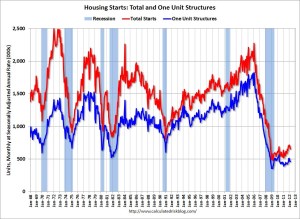
I go straight to Calculated Risk for all my ‘real’ economic news, by which I mean the data and basic commentary. Their graphs are outstanding.

And those graphs are telling all kinds of still-nasty stories about the downturn we are still in.

Look at the housing starts:

Hopefully it’s becoming clear that the economic story is not about ‘we built too many houses’. It’s about lots of stuff (debt deleveraging, etc). Have a look at this. The single family housing starts are down, sure, but so are owner built and built for rent sales, which didn’t really pick up in the boom.

And I like the graph below because I’ve long had the impression that most apartment buildings were built in the 70s and 80s. And it’s true!*

When people talk about “infrastructure spending” think about all of the low hanging fruit that’s already been picked.

Let’s build some highways. Got ’em.

Let’s build some airports. Got them, too.

Ok, how about apartment buildings? Done, and, in any case, NIMBY!

Replacing these things are going to be much less accretive to growth than building them in the first place.

And of course the real story is employment.

*My wife and I recently moved and had trouble finding a place that would both let our two dogs in and was built in the last 10 years.

Data Science

The Netflix competition will probably go down as the event that gave birth to the Data Science Era. Like all iconic events there was absolutely nothing groundbreaking or new about it, it was just the firs time a few trends came together in a public way: large scale data, a public call for solutions, a prominent relatively recent startup disrupting an ‘evil empire’ kind of industry. And a bunch of money.

And the winner’s solution was never used:

If you followed the Prize competition, you might be wondering what happened with the final Grand Prize ensemble that won the $1M two years later. This is a truly impressive compilation and culmination of years of work, blending hundreds of predictive models to finally cross the finish line. We evaluated some of the new methods offline but the additional accuracy gains that we measured did not seem to justify the engineering effort needed to bring them into a production environment.

To me it makes the whole thing an even better story as a cautionary tale in the differences between academic indulgence and commercial needs.

Perfect is often the enemy of good.

Quote Of The Day

Reproduced by hand from my dead tree copy of *What Technology Wants*:

Old world primates have full-color vision and an inferior sense of smell compared to their distant cousins the New World monkeys…

All, that is, except the howler monkey, which, in parallel to the Old World primates, has tricolor vision and a weak nose. The common ancestor to the howler and the Old World primates goes very far back, so howlers independently evolved tricolor vision. By examining the genes for full-color vision, biochemists discovered that both the howler and the Old World primates use receptors tuned to the same wavelengths, and they contain exactly the same amino acids in three key positions. Not only that, the diminished olfactory sense of both howler and apes was caused by the inhibition fo the same olfactory genes, turned off in the same order and in the same details.

Talk about complex interactions. Is it possible for humans to figure this stuff out? What happens when computers figure this sort of thing out for us?

Bonus, from the previous page:

Biologist Richard Dawkins estimates that “the eye has evolved independently between 40 and 60 times in the animal kingdom… There are only so many ways to make an eye, and life as we know it may well have found them all.

Today In Unanswerable Questions

What is the value of something?

Here’s Pete Warden with the best explanation for what Facebook gets in Instagram. Many commentators have gotten caught up in the comparison of valuations between the New York Times and Instagram (both $1bn). Don’t be fooled, this is deep stuff.

The best answer for what something’s worth is the amount of money you can make from buying it. To a pure trader, most everything is inherently valueless, they simply buy and sell assets to flip them. Economically, all they do is provide liquidity. Markets *really* work only when interested parties transact with heterogenous uses for the assets. One man’s trash is another man’s treasure.

To Facebook, Instagram is worth $1bn. To Facebook, the NYT is worth far less than $1bn because they would probably destroy quite a lot of value by buying it. To Microsoft or Yahoo! Instagram may well be worth a lot less than $1bn. Heck, Instagram may well not be worth $1bn to Facebook, either, but Facebook *thinks* it is at the moment.

And that’s as satisfying an explanation as you can get. Talking about an abstract “price” for something is nonsense.

Mash of Links

They made their own clothes and built their own tools and worked on tiny farms. Lots of economic activity has moved from the home to the stock market since 1812. Via MR.

Next, I quote Yglesias, whose blog I’m really enjoying:

One of the most pernicious misunderstandings out there is that the prosperity of the United States in the postwar years indicates that there’s some meaningful alternative strategy for economic growth that doesn’t involve increased education and human capital. This idea is driven by the sense that back in the proverbial day there were great middle-class job opportunities out there for people who hadn’t gone to college, and so maybe what we really need to do is bring that kind of economy back…

America was far and away the best-educated country in the world during the postwar years

Great graph at the link.

My other favorite new blog is Science-Based Medicine. Here’s an excellent fact-filled rant:

It has been a stunning triumph of marketing and propaganda that many people believe that treatments that are ¡§natural¡¨ are somehow magically safe and effective (an error in logic known as the naturalistic fallacy). There is now widespread belief that herbal remedies are not drugs or chemicals because they are natural.

The other major fallacy spread by the ¡§natural remedy¡¨ industry is that if a product has been used for a long time (hundreds or thousands of years), then it must also be safe and effective because it has stood the test of time (this fallacy is referred to as the argument from antiquity)…

This first came to world-wide attention in the 1990s when a group of Belgian women who were taking Chinese herbs as part of a weight loss regimen developed end-stage kidney failure. The syndrome became known as Chinese Herbs Nephropathy, and it was soon discovered that aristolochic acid was likely the culprit…

It is also interesting to consider how aristolochia came to be used to aid in the birthing process – one of its most popular uses and the source of its name, which means “noble birth” in Greek. As with the traditional use of many herbs, it appears to be based entirely on sympathetic magic – the belief that a plant will be useful for an indication based upon what the plant looks like. In this case the flower of many aristolochia species looks like a birthing womb. The rest is anecdote, placebo effect, and confirmation bias – but no science.

Lest we get too self-congratulatory, scientific medicine isn’t always so scientific either.

Cringely on Best Buy, a company doomed to die:

Shopping at Best Buy last Christmas was a joke. Best Buy corporate was upset people were using their smart phones to do price comparisons in the stores. Think about that: Best Buy was upset that their customers were too smart, that they actually used the sort of technology Best Buy purported to sell. Worst of all, Best Buy completely missed the simple point that their prices were too high.