DebtRank: Regulators Can Innovate, Too

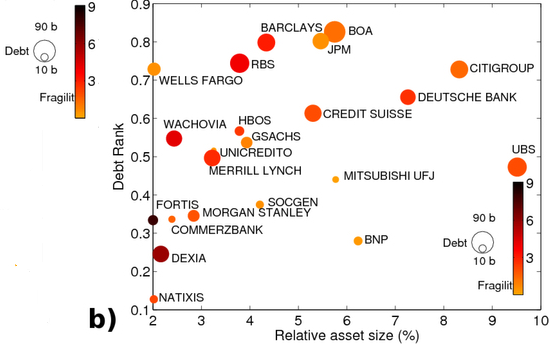
Systemic risk — the risk of default of a large portion of a financial system — depends on the network of financial exposures among institutions, but there is no widely accepted method for working out which institutions in a network are the most important to the stability of the system. Inspired by feedback-centrality measures in networks, such as PageRank, Stefano Battiston and colleagues introduce a new measure of systemic impact, which they call DebtRank. They use DebtRank to analyze a recently released data set with information on the institutions that received aid from the US Federal Reserve Bank through its US$1.2 trillion emergency loans programmes during 2008 to 2010.

The authors find that during the peak of the crisis, a group of 22 financial institutions, which received most of the loans, became more central to the network, which means that the default of each one would have a larger economic impact on the whole network. Even small, dispersed shocks to individual banks could thus have triggered the default of a large portion of the system. The authors note that because the network of impact used in the study is a proxy of the real, unknown network, the findings should be regarded with caution, but the study shows the kinds of insights that can be gained using DebtRank.

More here. Via Alex Tabarrok at MR who comments:

One point to note is that the authors calculated centrality using ex-post data from the Fed. Using this measure, DebtRank clearly signaled danger prior to the crisis and did so earlier than other metrics. In order to do this in real time, however, much more transparent and timely data would be necessary. The fact that centrality doesn’t correlate all that well with bigness, however, indicates that without this data the problem of monitoring risk is even more difficult than it appears.

I am impressed. Being able to distill an abstract concept like “interconnectivity” into a single number is extremely powerful. Politicians should latch onto this and legislate its calculation at reasonably frequent intervals.

Bailouts are a horrible, disgusting abomination. My first reaction to all this is that we should break out the pitchforks and treat high DebtRanking institutions real bad. Like they do in Texas.

And I will plug my ears lest I listen to too much of this kind of cowardly disclaimer:

The authors note that because the network of impact used in the study is a proxy of the real, unknown network, the findings should be regarded with caution

What An Audition For SNL Is Like

You go and do a few characters of your own and a few impressions, if you wanna do impressions, or you can do stand-up if you wanted to do that. But you do it at this comedy club somewhere in New York, and they all come and they sit in the back and they show up late and they watch it and they don’t laugh and you feel horrible. But if you do okay, you get called back and you go into 30 Rock and you do it on their stage at the real show. And they tape it, there’s a camera crew there. So you come out where the host does the monologue on SNL, and you do your audition right there. You’ve probably seen it, like on DVDs with Will Ferrell or whatever. I auditioned twice, one year I got to go in and do that at 30 Rock, but they really ice you out. They try to make it as scary as possible because it’s a live show, and in real life, I’m sure it is terrifying and things do go wrong, so they want you to be prepared.

…So, I went in and did it. And they sit in the back. At that time, Tina Fey was still the head writer. I was friends with Tina. I think Tina’s great, but I think they have this thing that they do where they don’t laugh at anything. So, you go in and you do [a] few minutes. It’s just a wall of silence, just no laughs at all. Nothing. No matter what. No matter who you are because everyone says this. Then, as I was leaving, I was like, “Bye, Tina.” She was like, “Bye, Rob.”

That’s Rob Huebel who I think is hilarious. More here.

A Chiropractor Goes to Damascus

Much has been written (and published on this site) about the implausibility of chiropractic vertebral subluxation theory which proposes that a vertebral subluxation complex or a spinal joint dysfunction “may affect organ system function and general health.” Associated chiropractic gimmickry that might be harmful as well as a waste of time and money should be also be brought to the attention of concerned consumers. As a chiropractor (retired) who has renounced subluxation theory, it might be helpful to share my concerns about some dubious chiropractic methods that are foisted upon an unsuspecting public, unchallenged in the market place.

From the always awesome Science-Based Medicine.

Today In “Holy Freaking Cow”

A bioengineer and geneticist at Harvard’s Wyss Institute have successfully stored 5.5 petabits of data — around 700 terabytes — in a single gram of DNA, smashing the previous DNA data density record by a thousand times.

Scientists have been eyeing up DNA as a potential storage medium for a long time, for three very good reasons: It’s incredibly dense (you can store one bit per base, and a base is only a few atoms large); it’s volumetric (beaker) rather than planar (hard disk); and it’s incredibly stable — where other bleeding-edge storage mediums need to be kept in sub-zero vacuums, DNA can survive for hundreds of thousands of years in a box in your garage.

Here’s more.

Word of the Day: Wormhole Finance

Wormhole Finance (n): a collection of trading strategies most useful when basic assumptions about reality are violated.

Be ready in case you find yourself in a bizarre alternate universe where fire and brimstone rain down from the skies. Forty years of darkness, earthquakes, volcanoes, the dead rising from the grave, human sacrifice, dogs and cats living together… mass hysteria!

Be ready… to assume geometric brownian motion.

Learning Other Languages

There have been a few arguments presented out there against teaching American students  languages other than English in school. Here’s Bryan Caplan:

If you find the typical American insufferably insular and low-brow, I agree.  My point is that given his insular, low-brow ways, the typical American who remains monolingual isn’t missing much.

Tyler Cowen responds by mentioning that the main benefit from learning another language is a general cognitive one. Cowen also refers to this New Yorker article, form which I learn of Larry Summers’ latest controversy. Here’s the key piece of some remarks he made recently:

English’s emergence as the global language, along with the rapid progress in machine translation and the fragmentation of languages spoken around the world, make it less clear that the substantial investment necessary to speak a foreign tongue is universally worthwhile.

When my wife and I were living in Toronto she had a job hiring and coordinating promotional reps across Canada for various brands. She, like all Canadians, took a lot of French in elementary and secondary school and even grew up on the Ontario/Quebec border. So what did she do when she needed to read emails from her French reps? She used Google Translate.

I grew up in a much more Anglo part of Ontario but studied in a French Immersion program in elementary school where just about everything was in French until I was 13 or so. At my peak I’d say I was totally fluent (more so than my wife) but I had lost most of it by my mid-20s. I could still read reasonably well, though, and felt that the Google translation was excellent. Very impressive.

If you evaluated all the time my wife and I spent learning French against the direct economic benefit it afforded us (and this is in Canada, remember), it’d be easy to dismiss multilingualism as a waste. But what did I miss out on? Here’s Cowen again:

Ideally foreign languages can be taught to individuals when they are young, well before high school, thus very much lowering the opportunity cost of such instruction.  Just toss out some of the other material, making sure to keep mathematics and English literacy.  Most of Western Europe does this quite well, and I hardly think of those children as miserable.  I don’t see why this has to cost anything at all.

Great point. Selfishly speaking, I hope to enroll my son in a dual-language school because I want my child to associate with the children of other parents who value multilingualism. In Canada the French Immersion system is often seen as a back-door extended education stream.

In my experience lots of kids drop out. I was one of two boys in my kindergarten class that made it to High School. There were probably 15-20 girls. I didn’t think of it this way at the time, but that’s all probably because the program was just really hard.

Education The Export of the Future? Enter the MOOC

The NYT had the first article on Coursera:

As part of a seismic shift in online learning that is reshaping higher education, Coursera, a year-old company founded by two Stanford University computer scientists, will announce on Tuesday that a dozen major research universities are joining the venture. In the fall, Coursera will offer 100 or more free massive open online courses, or MOOCs, that are expected to draw millions of students and adult learners globally.

And this one has the contract with its partner institutions.

The contract reveals that even Coursera isn’t yet sure how it will bring in revenue. A section at the end of the agreement, titled “Possible Company Monetization Strategies,” lists eight potential business models, including having companies sponsor courses. That means students taking a free course from Stanford University may eventually be barraged by banner ads or promotional messages. But the universities have the opportunity to veto any revenue-generating idea on a course-by-course basis, so very little is set in stone.

And this on the economics:

When and if money does come in, the universities will get 6 to 15 percent of the revenue, depending on how long they offer the course (and thus how long Coursera has to profit from it). The institutions will also get 20 percent of the gross profits, after accounting for costs and previous revenue paid. That means the company gets the vast majority of the cash flow.

I enrolled in the Database and Machine Learning courses in the precursor to Coursera last fall and I’m honestly still astonished it was all free.

I think they could definitely charge some small tuition fee and still attract literally millions of people for some of these classes. There’s a lot of money on the table there and a LOT of it is going to come from outside the US.

I am not confident that anything will seriously threaten the status economy of higher education. This might enhance it.

Imagine this model: online courses offered by MIT are 150% as difficult as the real thing because it teaches the same material with far less instruction. Class sizes can shrink and scholarships are offered to outstanding performers from the MOOC.

Suddenly it’s harder and cheaper to get into MIT.

Khan Academy Teaches Khan, Too

Here is an article attacking the Khan Academy (and a Khan response). Here is another, somewhat deeper critique. The upshot of both of these articles is the same: Khan isn’t a very good teacher.

What sour grapes! Not that this is the point, but find his videos quite good. Of course they aren’t perfect, but there is something extremely important going on here: Khan is a good teacher and he is getting better. Here are some quotes.

From a Khan employee:

Persistent misconception: “…we suggest that Khan Academy desperately needs voices of teaching experience. Khan could tap into any number of existing networks…”

Truth: We have four ex-teachers as full-time employees. We have two high school math teachers as consultants. One Harvard Doctoral candidate in Education and one post-doc in neuroscience at Stanford are in residence. One UPenn Professor is also likely to begin a sabbatical with us. We have a 3 person team dedicated to working with and getting feedback from our 50 pilot classrooms and the 15,000 teachers actively using KA in classrooms.

Persistent misconception: “…it certainly requires more than just “two minutes of research on Google,” which is how Khan describes his own pre-lesson routine.”

Truth: Go read Sal’s AMA response (includes the sentence “When I did organic chemistry, I spent 2 weeks immersing myself in the subject before making the first video”) before taking one of these “two minute” snipped quotes at face value: http://www.reddit.com/r/IAmA/comments/ntsco/i_am_salman_khan…. I’ve seen Sal’s face light up when he gets an unwieldy new shipment of textbooks to start studying in preparation for his videos. Does he dive right into some videos? Absolutely. Is claiming that his “pre-lesson routine” can always be dismissed as two minutes of Googling disingenuous and patently false? Absolutely.

From a mathematics education researcher:

That said, I have been up-front here on HN in suggesting ways that Khan Academy can improve, for example by building more online practice that is truly problems rather than exercises (379 days ago),

http://news.ycombinator.com/item?id=2760663

“Just for friendly advice to the Khan Academy exercise developers, I’ll repost my FAQ about the distinction between “exercises” and “problems” in mathematics education. It would be great to see more problems on the Khan Academy site.”

and the Khan Academy developers have been listening, and I have had interesting off-forum email interaction with them as they attempt to improve the instructional model at Khan Academy.

And here is the most important comment of all:

In general, I think mathematics is much too important a subject to be single-sourced from any source.

I’d add to that by saying that learning difficult things is really difficult. The best way of learning something is to learn it more than once and in more than one way. Khan is a free alternative way for people to learn math (or almost anything). This is incredibly valuable.

No teacher is going to be perfect but I’m sure that Khan is displaying above-average teaching competence in most of the subjects he chooses to teach. Khan will never be an outstanding teacher for his millions of students because there is something important in in-person instruction than cannot be replicated over video.

But very few students will have the opportunity to learn from more than a handful of outstanding teachers in their lives. For the majority of their experiences, Khan, and other instructors like him, will prove to be an immense help.

How many teachers are willing to expose their style for all to see and critique? Few, but those that do (look at this this article that suggets that teaching, like everything else humans do, is a skill) will become better at it. Good for us all.

Bill Gross and Nassim Taleb Sitting In a Tree, T-R-A-D-I-N-G.

David Merkel turned me onto this piece (gated) by Bill Gross wherein he describes the PIMCO strategy in a fairly readable way. It’s fascinating.

Gross opens by describing how some institutions can reap persistent returns by implementing a consistent (“structural”) financial strategy. Banks, for example live by borrowing at short term rates and lending at long term rates. Insurance companies live by borrowing for free and underwriting the risks of repayment timing and amount.

Gross then describes PIMCO’s strategy, which he calls their way of generating “long term alpha” (that really is such a silly term). Basically PIMCO does two things: first, they act as a mini-bank, by borrowing short-term and lending longer-term. The actual implementation he describes of this is a little over my head, given that I have no trading experience, but I get the principle. The second strategy is that they “sell volatility”, which he means they write options of all kinds, flavors and colors.

Gross’ thesis is that the market, from his perspective, overprices volatility. He makes the point that his perspective is extremely important here so it’s worth discussing a bit.

Gross feels that his investors have a time horizon of about 3 to 5 years. Since volatility (fluctuations in asset prices in this case) fades into the background over long time periods, Gross literaly measures volatility to be lower than other investors. If Gross has a longer than average time horizon the market will be more expensive to insure that volatility than him. This is his alpha.

This philosophy is the exact opposite of Nassim Taleb’s view of the world, which I might summarize like this: “You do not understand volatility. Order your portfolio (your life!) so that you are not harmed by volatility, but benefit from it.” He calls this philosophy “Anti-Fragility”. here’s an interview where he discusses it.

There are two ideas in this world view. The first is his well-known Black Swan idea, which is that there are massive, unpredictable events that occur without warning and reap devastation. Exposure to Black Swans can probably never be eliminated, almost by definition, but Bill Gross’ investment philosophy is to explicitly seek exposure to extreme events, arguing that at his time horizon the risk of Black Swans is immaterial. A quick search hasn’t turned up any data on PIMCO’s performance through the crisis. Wonder how they did.

The other half of Taleb’s Anti-Fragility idea is that one should seek out processes that benefit from volatility. He uses human bones as one example: they get stronger as they’re exposed to stress. Obviously a Black Swan for a bone is getting hit by a tank or something, but Taleb would say that if your bones are stronger because of previous stress, you have more of a hope against that tank.

So Bill Gross says sell volatility if your time horizon can take it because it’s systematically overpriced. Nassim Taleb says buy all the volatility protection you can get your hands on because since tail events are impossible to understand volatility is systematically underpriced.

Taleb might say to Gross that his key assumptions (this time about investors’ time horizons) will break down in a Black Swan event and everything will fall apart. Gross might respond by saying it’s easy to be a nay-sayer but big boys take risks and I’ve made tons of money for my investors with this strategy.

Sounds like opposite sides to a trade to me.

Thoughts On Mathematical Finance (3F/MFE Exam)

I moved over to the actuarial side of the business a few years ago from our capital markets team. I’m not an actuary, but I took an interest in modeling and followed the advice of my first boss in the business: “want to get ahead? Be more useful to us”. We were starting an actuarial department and I joined in.

I didn’t start taking the exams seriously until my wife got pregnant. It’s been a breakneck pace since and I just wrote my fourth exam, the 3F/MFE, subject of which is the math of derivative securities. I’m fairly familiar with the area from the CFA exams, but what does this have to do with valuing P&C liabilities, the job I’m training to do? And anyway, isn’t all this math exactly what is supposed to be wrong with finance?

There are two big ideas in the syllabus that are worth discussing. The first has some notoriety, which is that we assume asset returns are distributed normally and so prices are distributed lognormally. The immensity of this assumption cannot be overstated. First because just about everything in mathematical finance requires it to be true; second, it’s just about complete garbage. In fact, there is absolutely no attempt to justrify this assumption in any of the required readings.

The other idea is a bit more esoteric and is called risk neutrality. Risk neutrality is a way of dealing with the problem that people are risk averse, in that we’re unlikely risk $1 of loss for $1 of gain on a 50/50 bet. So we’d only take a 50/50 bet if we could win $1.5 and lose $1.

In a strange twist, the math skips over the ‘utility’ of a dollar of profit vs dollar of loss. Instead, we reweight the probabilities so that the return is the risk free rate. In a risk neutral world, it’s not a 50/50 bet.

Don’t worry, I don’t really understand it, either. One of my complaints is that, once I’ve passed the test (8 weeks ’till they tell me!), it doesn’t matter whether I understand it or not, I’m never going to use this knowledge. The understanding is literally worthless.

So why did I have to learn about it? In the the released sample problems there’s this really interesting remark (number iii after the solution to problem 71 in this pdf document) in respect of risk-neutral pricing:

Arguably, the most important result in the entire MFE/3F syllabus is that securities can be priced by the method of risk neutral pricing… Some authors call the following result the fundamental theorem of asset pricing: in a frictionless market, the absence of arbitrage is “essentially equivalent” to the existence of a risk-neutral probability measure with respect to which the price of a payoff is the expected discounted value.

I didn’t understand what that meant until I really got stuck into the Black Scholes derivation. The story of the that derivation goes like this: borrow some money and buy a derivative. Now hedge away the risk with some shares. All that’s left is the risk free rate. The big trick is figuring out how many shares you need to buy/sell to hedge he risk of the derivative. That’s where normally distributed returns come in and that’s where everything falls apart.

The CAS/SOA don’t make similar comments about any other part of syllabus, so it’s interesting that they decided to play Hitchcock and jump in for a cameo here.*

Why do they think this here is such a big deal? And, more importantly, why do they think actuaries should know this stuff?

There’s a bit of history to this exam. Originally it was paired with a more statistics-heavy exam for the complete Exam 3 (now they’re 3F/MFE and 3L). The split exams were half-exams, too, but the MFE has crept back up to a full-on 3-hour test. Why?

And think of the social context. During the 90s and early 00s, financial mathematics was a pretty big deal. Physicists were pouring out of science departments and onto trading floors, probably amazed that all this abstract math was a valuable skill. It’s no surprise that the CAS/SOA tried to hop onto that bandwagon.

But ultimately the ideas aren’t terribly compelling. I’ve studied these models intimately now (the fixed income ones are laughably useless and WAY more complicated), and I’d never give someone my money to trade with them.

*Get ready for a tangent:

There’s an essay at the beginning of my copy of Moby Dick that for no good reason pops into my head all the time. Melville is describing the most essential characteristic of a whale, the spout, and the essayist claims he has sheds the character of Ishmael and starts writing as himself:

the spout is nothing but mist. And besides other reasons, to this conclusion I am impelled, by considerations touching the great inherent dignity and sublimity of the sperm whale… He is both ponderous and profound. And I am convinced that from the heads of all ponderous profound beings, such as Plato, Pyrrho, the Devil, Jupiter, Dante and so on, there alwasy goes up a certain semi-visible steam while in the act of thinking deep thoughts. While composing a little treatise on Eternity, I had the curiosity to place a mirror before me and ere long saw reflected there a curious involved worming an undulation in the atmosphere over my head. The invariable moisture of my hair, while plunged in deep thought, after six cups of hot tea in my thin shingled attic of an August afternoon, this seems an additional argument for the above supposition.

Incidentally, I don’t buy it; I think he’s still Ishmael here (treatise on Eternity? Puh-leeze). But I think the sentiment remains. Melville is clearly in awe of the whale and pays it a kind of honor by comparing it to his greatest heroes.

Maybe the SOA/CAS is just so impressed with the elegance of the math that they HAD to break in for a chat.