Betsey and Justin Go Closet Sumnerinan

High-frequency data on consumer confidence from the research company Gallup, based on surveys of 500 Americans daily, provide a good picture of the debt-ceiling debate’s impact (see chart). Confidence began falling right around May 11, when Boehner first announced he would not support increasing the debt limit. It went into freefall as the political stalemate worsened through July. Over the entire episode, confidence declined more than it did following the collapse of Lehman Brothers Holdings Inc. in 2008. After July 31, when the deal to break the impasse was announced, consumer confidence stabilized and began a long, slow climb that brought it back to its starting point almost a year later. (Disclosure: We have a consulting relationship with Gallup.)

That’s from a great article by Betsey Stevenson and Justin Wolfers (whose twitter feed I really enjoy: @justinwolfers) on how the debt ceiling wrangle damaged the economy.

And there are other data points that may be more credible even if they give less clean of a signal. Let’s put on our Scott Sumner hat and ask what he’d have to say about all this.

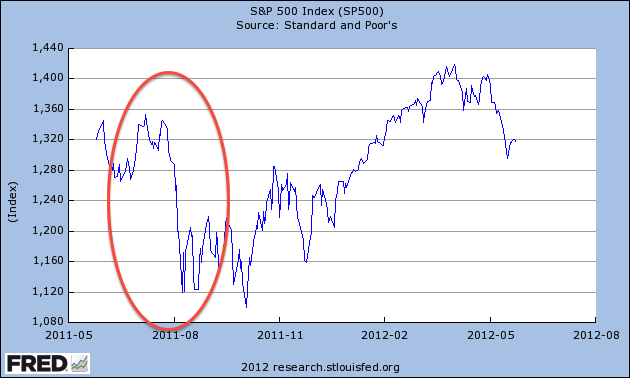
I predict Scott Sumner will apply his model for NGDP expectations and post about these graphs from that summer:

Falling TIPS spread, strengthening dollar, falling stock market? That’s a nominal shock, folks.

And furthermore I predict Sumner is going to finish his post by pointing out that the Fed did nothing, even though it could have offset this effect with a stroke of its pen (ie press release with some mega-charged loose money /pro-NGDP rhetoric).


Things We Sorta Know: Earth’s Core Edition

NYT on some recent reserach:

Now it turns out that existing models of the core, for all their drama, may not be dramatic enough. Reporting recently in the journal Nature, Dario Alfè of University College London and his colleagues presented evidence that iron in the outer layers of the core is frittering away heat through the wasteful process called conduction at two to three times the rate of previous estimates.

The theoretical consequences of this discrepancy are far-reaching. The scientists say something else must be going on in Earth’s depths to account for the missing thermal energy in their calculations. They and others offer these possibilities:

  • The core holds a much bigger stash of radioactive material than anyone had suspected, and its decay is giving off heat.
  • The iron of the innermost core is solidifying at a startlingly fast clip and releasing the latent heat of crystallization in the process.
  • The chemical interactions among the iron alloys of the core and the rocky silicates of the overlying mantle are much fiercer and more energetic than previously believed.
  • Or something novel and bizarre is going on, as yet undetermined.

Obviously not much I can add, except some general geekery. Here’s the photo we all saw in high school.

We can thank the iron catastrophe for the core’s existence, which, by the way, produces the magnetosphere and protects us from cosmic rays.

Here’s a cool image of that with all kinds of sci-fi sounding terminology.

But don’t get all cocky, now, Ethan Siegel reports on how a super villain might overcome the magnetosphere and destroy the world!

Guess That City

via MR:

The riches reflect a regional economy as resilient—and as strange—as any in the world. “We don’t make anything here,” Fuller says simply. […] is one of the few metropolitan areas in the country that have no significant manufacturing sector, placing it alongside Atlantic City, N.J.; Myrtle Beach, S.C.; Cape Cod, Massachusetts; and Ocean City, N.J.

The answer isn’t Las Vegas.

Here’s the answer.

Googorola

The story goes that Tim Cook, CEO of Apple, was trying to poach new head of Motorola, Dennis Woodside, from Google to be Head of Sales at Apple.

But then Larry Page asked Woodside to be the next Steve Jobs.

If there’s one thing I learned from reading the Jobs biography, it’s that in order to build a company that makes great products you’ve got to be a “products guy”. Jobs himself said that Cook wasn’t the type, oddly. Is Woodside? One thinks perhaps not:

Woodside, 43, is an Ironman triathlete with a law degree from Stanford but little experience building hardware or software. He admits to catching up only recently on such technologies as mobile-phone processors.

The focus on engineering credentials, Steve Jobs might say, is beside the point. Does he ‘get’ what great products are? Can he drive people to fill a pipeline with awesome products, which everyone is worried will be Tim Cook’s failure?

It’s an audacious move, but a necessary one, probably. Apple has shown that the strategy of marrying hardware and software was as big a loser for PCs as a winner for mobile.

And one couldn’t imagine Facebook making or pulling off a similar move. So the lines are drawn: Apple vs Google for global technological hegemony.

Ugh… More on Facebook

I’m bored of talking about Facebook but I can’t stop myself.

Two essays (here and here) present the apotheosis of Facebook hating (as a business model). Here’s a quote that about sums it all up. I think.

Facebook is not only on course to go bust, but will take the rest of the ad-supported Web with it.

I say ‘I think’ because the authors present all kinds of complicated analysis extrapolating their hating on facebook to hating on display advertising in general. “It’s a bubble!” and whatnot.

I don’t know, I’m sure they’re very smart, but I can’t figure any of it out.

So let’s just leave it to the marketplace. There are two groups of businesses: those that advertise on Facebook and those that don’t. If Facebook’s products are awesome, it’s going to make its clients rich by making their businesses ridiculously successful. And those businesses will push out the non-Facebook businesses. And Facebook will rule the world.

If not, then the Facebook’s clients will fail from wasting time and money on Facebook ads and Facebook will have no clients. And Facebook will die.

So let’s just wait and see!

The Thrill Of The Chase

Well there is one inescapable fact about the Facebook IPO: there’s a lot of poop in this bed. Just about everyone seems in on it:

  • From a purely technical trade execution perspective, the NASDAQ was in complete chaos
  • The bankers PROBABLY mispriced the biggest tech IPO ever
  • The bankers ALLEGEDLY played fancy with revenue disclosure
  • The bankers DEFINITELY lost boatloads of dough ‘supporting’ FB shares on Friday so the institutions could scurry away once they realized their orders got filled
  • As with any headline-smashing bungle, the legal locusts approach

Good detail here.

Members of the peanut gallery giggle with shadenfreude when the big boys look like idiots, and why not? We spend enough of our time reading about their bonuses and driving by their mansions wondering what it’s like to be rich. Let’s have some fun, too.

But don’t pretend that you know better. It’s not just MS: every single major bank was involved in this mess. So either me and every other Monday Morning QB would do the same in their boots or whatever would stop us from doing the same would also prevent us from getting into those boots.

So what’s the story? Could it just be that everyone got so caught up in the hype? Who knows.

We do know that Facebook didn’t need the money. This was purely paying off back compensation so everyone would just shut up and get back to coding. To the God Emperor of Facebook, the IPO must have been the most annoying of distractions.

So social dynamics played a part: like with so much in life, salesmen only chase to sell you things you don’t need. Was this the most greatest game ever played of ‘Hard to Get’?

I wish I had a satisfying theory. In my mind, I keep coming back to Chris Dixon’s excellent evaluation, which I’ll quote again:

A more likely outcome is that Facebook uses their assets – a vast number of extremely engaged users, it’s social graph, Facebook Connect – to monetize through another business model. If they do that, the company is probably worth a lot more than the expected $100B IPO valuation. If they don’t, it’s probably worth a lot less.

It’s early days for this company still and it may always be thus.

NFL Cities Buy Status

Of the 20 stadiums built since the Georgia Dome opened, four have been privately financed. Of the rest, the average public share is 73% of the total cost.

That’s the Economist on football stadiums. The impetus is the recent plan for the new home of the Falcons: $1bn split more or less evenly between taxpayers and the team. Why do taxpayers want to spend this kind of money on white elephants?

Well, mainly because there are only 32 football teams and economic capacity for a lot more than that. Forgetting ridiculous Green Bay and Canada-sapping Buffalo, the two low-end economic outliers, you get an effective minimum GDP for a mero area of about 60bn. Here’s my data and here’s my source.

Even ignoring LA (and San Bernardino and San Jose) there are no fewer than 15 metro areas with over 60bn GDP and no gridiron. Think any of these cities would chastely hold back if LA starts screwing up its next shot at an NFL team?

Remember, this ain’t the slums of Bangalore: the #1 job of a politician in the USA is to make his/her constituents feel like they’re high status. NFL owners, scarce asset firmly in their grips, are happy to play bidders off each other.

Addendum: here are the cities (note I added San Jose and San Francisco together in the San Fran row):

City 2010* Teams GDP/Team
New York-Northern New Jersey-Long Island, NY-NJ-PA 1,280,517 2 $640,259
Los Angeles-Long Beach-Santa Ana, CA 735,743 0
Chicago-Joliet-Naperville, IL-IN-WI 532,331 1 $532,331
Washington-Arlington-Alexandria, DC-VA-MD-WV 425,167 1 $425,167
Houston-Sugar Land-Baytown, TX 384,603 1 $384,603
Dallas-Fort Worth-Arlington, TX 374,081 1 $374,081
Philadelphia-Camden-Wilmington, PA-NJ-DE-MD 346,932 1 $346,932
San Francisco-Oakland-Fremont, CA 494,444 2 $247,222
Boston-Cambridge-Quincy, MA-NH 313,690 1 $313,690
Atlanta-Sandy Springs-Marietta, GA 272,362 1 $272,362
Miami-Fort Lauderdale-Pompano Beach, FL 257,560 1 $257,560
Seattle-Tacoma-Bellevue, WA 231,221 1 $231,221
Minneapolis-St. Paul-Bloomington, MN-WI 199,596 1 $199,596
Detroit-Warren-Livonia, MI 197,773 1 $197,773
Phoenix-Mesa-Glendale, AZ 190,601 1 $190,601
San Diego-Carlsbad-San Marcos, CA 171,568 1 $171,568
San Jose-Sunnyvale-Santa Clara, CA 168,517 0
Denver-Aurora-Broomfield, CO 157,567 1 $157,567
Baltimore-Towson, MD 144,789 1 $144,789
St. Louis, MO-IL 129,734 1 $129,734
Portland-Vancouver-Hillsboro, OR-WA 124,683 0
Pittsburgh, PA 115,752 1 $115,752
Tampa-St. Petersburg-Clearwater, FL 113,702 1 $113,702
Charlotte-Gastonia-Rock Hill, NC-SC 113,568 1 $113,568
Riverside-San Bernardino-Ontario, CA 109,818 0
Kansas City, MO-KS 105,968 1 $105,968
Cleveland-Elyria-Mentor, OH 105,625 1 $105,625
Indianapolis-Carmel, IN 105,163 1 $105,163
Orlando-Kissimmee-Sanford, FL 104,107 0
Cincinnati-Middletown, OH-KY-IN 100,594 1 $100,594
Columbus, OH 93,353 0
Sacramento-Arden-Arcade-Roseville, CA 92,873 0
Las Vegas-Paradise, NV 89,799 0
Hartford-West Hartford-East Hartford, CT 87,963 0
Austin-Round Rock-San Marcos, TX 86,029 0
Bridgeport-Stamford-Norwalk, CT 84,882 0
Milwaukee-Waukesha-West Allis, WI 84,574 0
San Antonio-New Braunfels, TX 82,036 0
Nashville-Davidson-Murfreesboro-Franklin, TN 80,898 0
Virginia Beach-Norfolk-Newport News, VA-NC 80,518 0
New Orleans-Metairie-Kenner, LA 71,476 1 $71,476
Salt Lake City, UT 66,456 0
Providence-New Bedford-Fall River, RI-MA 66,334 0
Memphis, TN-MS-AR 65,025 1 $65,025
Richmond, VA 64,321 0
Jacksonville, FL 60,303 1 $60,303
Louisville-Jefferson County, KY-IN 58,572 0
Oklahoma City, OK 58,339 0
Raleigh-Cary, NC 57,278 0
Birmingham-Hoover, AL 53,834 0
Honolulu, HI 51,327 0
Omaha-Council Bluffs, NE-IA 47,556 0
Rochester, NY 45,742 0
Buffalo-Niagara Falls, NY 45,150 1 $45,150
.
.
.
Green Bay, WI 15,270  1  15,270

Links on Data

CalculatedRisk rounds up some links on how data collection can come under political fire, which is, of course, terrifying. He also tells this story:

The Depression led to an effort to enhance and expand data collection on employment, and I was hoping the housing bubble and bust would lead to a similar effort to collect better housing related data. From the BLS history:

[T]he growing crisis [the Depression], spurred action on improving employment statistics. In July [1930], Congress enacted a bill sponsored by Senator Wagner directing the Bureau to “collect, collate, report, and publish at least once each month full and complete statistics of the volume of and changes in employment.” Additional appropriations were provided.In the early stages of the Depression, policymakers were flying blind. But at least they recognized the need for better data, and took action. All business people know that when there is a problem, a key first step is to measure the problem. That is why I’ve been a strong supporter of trying to improve data collection on the number of households, vacant housing units, foreclosures and more.

New data is useless and if we had more data on what happened in the Great Depression we might not be scratching our heads as much today. Here’s an example of a chart that tells some kind of story but really doesn’t have enough history to teach us much of use:

(The chart annoys me in that clearly these two datasets have radically different statistical properties: they don’t belong on the same scale, or probably not even the same chart.)

So Government datasets are excellent because they’re (mostly) impartial and consistently measured: I’d rather have a consistently flawed dataset that I can correct than one whose basis changes unpredictably throughout.

But it’s painful to audit data collection and analysis policies, which is why it took so long for economists to figure out the way the government measures productivity changes due to offshoring is garbage. Michael Mandel blew the top off of this recently and taught us all  a lesson.

But governments aren’t the only game in town. There are countless surveys of this and that group (architects, real estate agents, industrial producers, etc etc), which are ok, but big data is hopefully changing that, too. MIT’s Billion Prices Project is a ‘simple’ web scrape but is potentially a vastly better measure of inflation in the cost of goods. Check out their charts.

Hopefully data won’t be a bottleneck to knowledge some day.

addendum: Michael Mandel reports a huge revision in the domestically produced computers figures:

There are four important points here.

1) A big chunk of those computer shipments were supposedly going into domestic nonresidential investment. Post-revision, either the U.S. investment drought was deeper than we thought, or imports of computers were a lot bigger (see the recent PPI piece on Hidden Toll: Imports and Job Loss Since 2007).

2) The U.S. shift from the production of tangibles to the production of intangibles (think the App Economy) has been even sharper and more pronounced than we realized.

3) Budget cutbacks for economic statistics, such as the House Republicans are proposing, would increase the odds of big revisions like this one.

4) Bad data leads to bad policy mistakes, especially at times of turmoil. We need more funding for economics statistics, rather than less.


The Market is Smarter Than You

Two pretty different links here:

1. Scott Sumner is really starting to get good at nailing down his view. It’s been fun watching his writing sharpen up over the last few years. Nobody who cares about macroeconomics can afford to ignore his blog:

In recent months central banks have resorted to using the phony “credibility” issue.  The claim is that they had to fight hard in the 1970s and early 1980s to get markets to believe they were serious about inflation.

Fortunately, that is simply not true.   Markets have little difficulty figuring out what central banks are up to.  When the central bank wants to reduce inflation (as they did after 1981) markets believe them.  When they didn’t want to, markets didn’t believe they’d lower inflation.  There never was a credibility problem.

…I’ve frequently argued that interest rate targeting is like a car with a  steering wheel that locks when you need it most–on twisty mountain roads with no guardrail.  I’ve also argued that although we rarely hit the zero rate bound in past recessions, it may well become the norm in future recessions.

2. David Merkel (who holds the opposite macro philosophy to Sumner, incidentally) with a couple good stories. I like this comment:

rapid growth in financial institutions is rarely a good thing; it usually means that an error has been made.  Two, there is a barrier in many financial decisions, where responsible parties are loath to cry foul until it is way past obvious, because the cost of being wrong is high.

Insurance companies are excellent long term investments if they’re boring. They’re boring because they can’t really grow quickly, because if they do they will die.

The smartest P&C (Re)insurers I know of have a very simple strategy: sit on your hands for about 75% of your career and pray your investors don’t fire you for it. When the market turns step on the gas. Repeat.

The effectiveness of that strategy is proportional to how much you are in the business of assuming insurance risk. Think of the insurance world as a spectrum from support businesses (IT vendors, auditors, etc) which are more or less acyclical to Reinsurers which are completely beholden to the cycle.

From least to most insurance risk:

IT vendor -> broker -> MGA -> Berkshire Hathaway ->  insurer -> Reinsurers

BRK gets its own spot because  it’s an interesting mix of ‘normal’ businesses and insurance businesses. It’s the ability to put their capital to work in something that doesn’t care about the soft market that makes them unique. They DO something with that 75% of their time.

When the market is hard, insurance is an excellent business to be in: entrance is difficult, and the mass extinction of the turn scares the bejesus out of less skilled underwriters. Finding a strategy that lets you capitalize on that but doesn’t handcuff you to soft market valuations is a big deal.