Martinez vs Macklin Fight Review

Excitement can be had with any sport, really; I like watching boxing because it’s my preferred way of working out. There’s a heavy bag in my building’s gym and I bought my own double-end bag a few weeks ago to spice up the routine*.

Another nice aspect of boxing is that it happens year-round, every weekend. Surprised? Don’t worry, you haven’t been missing much lately.

But I just caught one I enjoyed enough to report back on.

Last night Sergio Martinez defended his Middleweight Championship (and by that I mean that nobody in his weight class can touch him: belts in boxing mean about as much as they do in professional wrestling) against a little-known challenger in Matthew Macklin. Read the (excellent) BLH and ESPN reviews.

Here’s mine:

It was a bit confusing at first. Macklin, the 10-1 underdog, was comfortably making Martinez look uncomfortable. Now, calling a fighter awkward or saying he makes another uncomfortable is extremely high praise in a sport dependent on rhythm. Macklin was doing just that, to the consensus #3 pound-for-pound fighter in the world.

Impressive as it was to me, the crowd booed its restlessness over this odd chess match as each fighter looked for… something, I guess. Exchanges were infrequent and most commentators had it even through 7 rounds. Very surprising. But there’s drama in a champ’s struggles, too. Might he lose? Might this be it?

Suddenly, late in the 7th, Macklin scored a cheap, legal knockdown as Martinez tripped after taking a shot.

And the sleeping giant awoke.

What ensued was no crass telephone booth war, mind you. Martinez went from landing tentative shots, mostly jabs, to hammering home straight crosses and hooks at every opening, which were suddenly abundant. Even those same jabs were finding the mark with real, thudding force. His footwork and ring movement are something to behold, better even than Pacquiao’s, who’s slowed a bit.

Macklin’s face started looking like he was getting hit. And he was. Two or three knockdowns later and he’d had enough, not answering the bell for the 12th. TKO.

The story of the first few rounds became clearer in retrospect. In camp, Martinez studied a very different opponent than the one facing him in the ring: Macklin came up with a game plan very different than his normal aggressive style and stuck with it. The plan was no surprise, he stole it from the last guy that Sergio fought. Same tentative first few rounds, same lack of engagement.

Same late-round knockout.

Spare a moment for Macklin, though. Changing your style effectively is impressive stuff: think leopards changing their spots. Macklin was an aggressive attacker and, to his credit, realized this was not going to work against Sergio. No wonder Martinez was confused.

Martinez wasn’t waiting. He wasn’t scared or losing his skills. He was thinking. Often we criticize athletes for thinking too much and freezing. Or thinking too little and not adjusting. Sergio thinks exactly enough. He’s probably the smartest boxer I’ve ever seen.

What he figured out was Macklin’s timing. He started calibrating his punches to an astonishing precision. Macklin’s head slipped slightly to his left when throwing his bigger shots, which helped him avoid the counters. For 7 rounds, anyway.

It’s wonderful to watch the best be awesome at what they do. Martinez is an outstanding boxer and athlete. Can’t wait to see him again.

*I do 3 minute rounds with 30 second breaks. Two warm-up rounds of shadow boxing (usually nobody around to make me feel as stupid as I doubtless look), three rounds on the double-end bag, four rounds on the heavy bag and one more round of shadow boxing. I’m usually completely exhausted by this point. Then I putter around the gym a bit doing some physio exercises for whatever injury’s bugging me at the moment and head back to the apartment. Total time is never more than 45 minutes. Three times a week.
Links

Ever wondered what display screens look like at 80:1?

Remember all that cash hoarding corporations are doing, starving the economy of jobs?

Apple alone represents $64 billion or 36% of the total $179 billion increase in corporate cash since 2009. And in 2011, overall corporate cash would have actually declined by $6 billion had it not been for Apple’s $46 billion increase. Unless Apple changes its philosophy towards liquidity by instituting a one-time or ongoing common dividend, or if Apple starts to buy back stock, we estimate Apple’s cash balances could increase by more than $50 billion in 2012 and approximate $150 billion.

Supported by our expectations that consumers worldwide will continue to feast on Apple products, we expect overall corporate cash and its concentration will increase in 2012. Apple alone could represent 12% of total corporate cash, about three times more than the next cash king.

That’s the FT quoting Moody’s (via MR)

On solar power at datacenters:

The solar array requires 171 acres of land which is 7.4 million sq ft. What if we were to build an solar array large enough to power the entire facility using these solar and land consumption numbers? If the solar farm were to be able to supply all the power of the facility it would need to be 24.4 times larger. It would be a 488 megawatt capacity array requiring 4,172 acres which is 181 million sq ft.  That means that a 500,000 sq ft facility would require 181 million sq ft of power generation or, converted to a ratio, each data center sq ft would require 362 sq ft of land.

…Let’s focus instead on large datacenters in rural areas where the space can be found. Apple is reported to have cleared trees off of 171 acres of land in order to provide photo voltaic power for 4% of their overall estimate data center consumption. Is that gain worth clearing and consuming 171 acres? In Apple Planning Solar Array Near iDataCenter, the author Rich Miller of Data Center Knowledgequotes local North Carolina media reporting that “local residents are complaining about smoke in the area from fires to burn off cleared trees and debris on the Apple property.”

I’m personally not crazy about clearing 171 acres in order to supply only 4% of the power at this facility. There are many ways to radically reduce aggregate data center environmental impact without as much land consumption. Personally, I look first to increasing the efficiency of power distribution, cooling, storage, networking and server and increasing overall utilization and the best routes to lowering industry environmental impact.

Flummoxed By Florida No Fault

There’s change a-happening in the Florida auto insurance market.

Auto insurance is expensive for Floridians. The reason is that they file a lot of expensive claims, more than most. Floridians do this because… well that’s what I’ve been thinking a lot about lately.

First I’ll misquote Bastiat:

Claims Fraud is the great fiction through which everybody endeavors to live at the expense of everybody else.

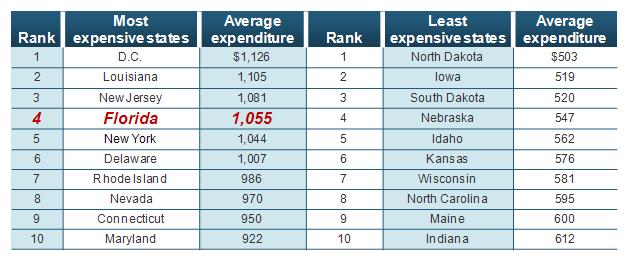
Ok, let’s swipe some graphs from the indispensable III to illustrate the problem (source here and here).

Exhibit A:

So there’s a problem with auto insurance. Got it. Why?

Well, Florida is a No-Fault state, which means that beneath a certain threshold ($10,000 in this case) you claim on your own insurance policy when you get in an accident regardless of who hit whom. Everyone is pretty focused on the No-Fault aspect of the problem.

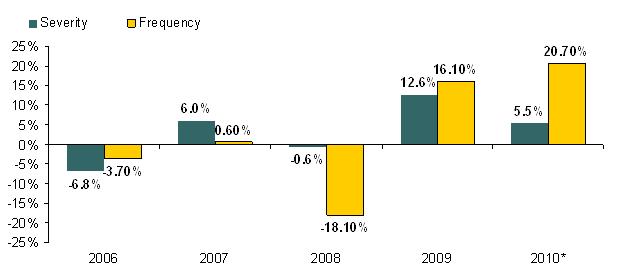
And there’s evidence of a problem. Here’s a graph detailing the growth in claims frequency and severity for No-Fault in Florida:

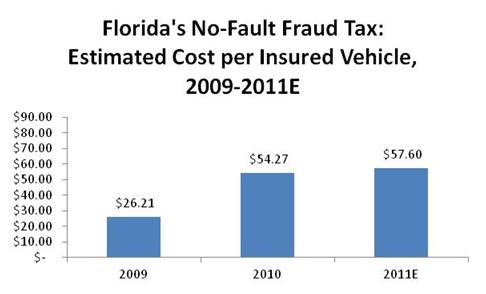
And newspapers have been going bananas down in FL, decrying the Florida No-Fault “Fraud Tax”. Catchy, non?

I’m not completely sure what a “Fraud Tax” is (I haven’t found any published methodology for calculating it anywhere), but here is the III’s view:

The combined impact of rising frequency and severity of claims is driving up the cost of pure premium, which is defined as the premium needed to pay for anticipated losses without considering other costs of doing business. The only reasonable explanation for this dramatic rise: no-fault fraud and abuse.

Even given that you accept that claims frequency and severity are increasing in Florida, I’d say that’s a pretty weak assertion.

They get stronger as the report continues.

Insurers also report suspected fraud to the National Insurance Crime Bureau (NICB), an insurer-funded, nonprofit organization of more than 1,000 members, including property/casualty insurers. The NICB is the nation’s leading organization dedicated to preventing, detecting and defeating insurance fraud and vehicle theft. The NICB gives a closer review to claims that are considered questionable and investigates them based on one or more indicators of possible fraud. A single auto insurance claim may be referred to the NICB for several reasons, and these “questionable claims” are flagged because they possess indicators of:

  1. Staged accidents
  2. Excessive medical treatment
  3. Faked or exaggerated injury
  4. Prior injuries (that are unreported in the new claim) Insurance Information Institute
  5. Bills for service not rendered
  6. Solicitation of the accident victim(s)

A single claim may contain several referral reasons. Questionable claims involving staged accidents surged 52 percent in 2009. For 2010, early estimates suggest an even larger increase.

And the kicker is this graph:

No fault is increasing quite a lot. But EVERYTHING is increasing, isn’t it? And how about #2, there, Bodily Injury? Well Bodily Injury is actually where the story is, in my mind. That’s the At-Fault coverage that extends above the $10,000 cap on No-Fault. You need to go to court and sue people and stuff for that.

What’s more, the Bodily Injury insurance market is 2.5x the size of No-Fault in Florida. BI is the 800 pound gorilla. Why isn’t anyone talking about it if it’s in the dumps, too?

Chris Tidball has an interesting analysis (and is now on the blogroll!):

The problem in Florida is substantial. First, the threshold for determining whether a party may sue has been watered down by the courts over the years, meaning that virtually any injury, irrespective of how minor it actually is, can be adjudicated, even if the true interpretation of the tort threshold says otherwise.

Secondly, a person is able to sue for any percentage of damage for which they were not at fault. Even if a person is 99.9 percent at fault, they are able to sue for damages.

None of that is No-Fault and I’m not sure how it’s related to the organized staged accidents and No-Fault Fraud. Are we addressing the wrong problem?

Ok, give me your hand and let’s walk slowly through this regrettably dense graph I put together with SNL data on the Florida market.

The solid lines are the written premium levels (left axis – see how much higher At-Fault is?) and the dotted lines are reported loss ratios (right axis):

Note that there is a bit of a basis mismatch in the data presented. The loss ratios are reported losses over earned premium while the premium is written premium, which is a more responsive indicator of market pricing.

The grey region is a classic market turn. Claims costs go up massively, insurers lose lots of money and premiums respond after a lag. It happened in No-Fault and it happened in At-Fault.

This time is different. No-Fault is playing that movie over again but At-Fault doesn’t seem to be, in spite of the increase in staged accidents noted above. What are we to make of this?

Some possibilities:

  1. The problem isn’t fraud, which appears to be affecting both No-Fault and At-Fault similarly without a similar impact on loss ratios;
  2. Fraud incidence is higher in At Fault but fraudsters are less successful when they need to go to court.

One observation on the graph above: In 2007, Florida’s No Fault law expired FL was At-Fault only for 3 months. But the loss ratio for that year was higher!

What’d I’d really like is to find a natural experiment in a state that modified its No-Fault laws. The only example I can see is in Colorado, which repealed its No-Fault system in 2003.

Here’s what happened:

At-Fault loss ratios dropped a bit immediately, but the drop persists!

Remember the purpose of No-Fault was to lower expenses. I’d imagine that claims expenses and overhead have also risen on the At-Fault book to deal with increase in smaller claims.

Does that mean that we should expect a higher expense ratio on the At-Fault FL book once No-Fault reform comes into play? That would suggest an advantage to carriers with efficient back offices…

The Real Housewives of Actuarial Science

I read this press release in my inbox this morning announcing that the Society of Actuaries (SOA) was launching a P&C designation, normally the province of the Casualty Actuarial Society. My half-attentive first thought was that the SOA (life actuaries, mostly) and the CAS (P&C actuaries, mostly) were deepening their partnership, perhaps some day to merge.

Jim Lynch has a different take: SOA declares war on CAS

The question I have is: why should anyone care? These organizations already collborate on exams, so it’s not like the SOA is going to weaken the examination gates and let all the ‘riff-raff’ in. Designations are purely about signalling and prestige except, as Jim Lynch notes, when it comes to signing off on Actuarial Opinions, which the SOA P&C designation can’t support, as far as I can tell.

So it’s all about passing hard exams. Pedants will no doubt quibble about curriculum minutiae or “which one is harder”, but the bottom line is that nobody cares enough about this to spend the time wondering which designation to puruse. My prediction is that the SOA’s initiative will either merge with the ACAS or fizzle out.

If these organizations want to grow they need to do better than copy each other.

Tellin’ em Where to Go


Here is Goldman exec resigning via the NYT. That’s burning bridges with napalm.

The article is pure theater, of course. He is pandering to a Goldman bashing audience in exchange for 15 minutes of notoriety. Only fools double-cross on idealistic grouds alone, so what does he gain from this?

Some thoughts:

1. The infamous Goldman Alumni network is closed, which shuts down quite a lot of post-bank opportunity.

2. He has gained 15 minutes of fame and will bear the standard of anti-Goldman sentiment for a while.

I bet he drives something nice and hasn’t saved enough, so the question is how might one act on #2 for a new job?

It’s either a book, a political appointment or his own hedge fund. Any other business and I’d say reality TV show.

Permission to do Evil

Update (2009-12-09): Via @miraglia, here’s a hilarious excerpt from Doug’s talk, “The JSON Saga”, in which he gives some background on why he added this clause to the license and how often people ask him to remove it:

When I put the reference implementation onto the website, I needed to put a software license on it. I looked up all the licenses that are available, and there were a lot of them. I decided the one I liked the best was the MIT license, which was a notice that you would put on your source, and it would say: “you’re allowed to use this for any purpose you want, just leave the notice in the source, and don’t sue me.” I love that license, it’s really good.

But this was late in 2002, we’d just started the War On Terror, and we were going after the evil-doers with the President, and the Vice-President, and I felt like I need to do my part.

[laughter]

So I added one more line to my license, which was: “The Software shall be used for Good, not Evil.” I thought I’d done my job. About once a year I’ll get a letter from a crank who says: “I should have a right to use it for evil!”

[laughter]

“I’m not going to use it until you change your license!” Or they’ll write to me and say: “How do I know if it’s evil or not? I don’t think it’s evil, but someone else might think it’s evil, so I’m not going to use it.” Great, it’s working. My license works, I’m stopping the evil doers!

Audience member: If you ask for a separate license, can you use it for evil?

Douglas: That’s an interesting point. Also about once a year, I get a letter from a lawyer, every year a different lawyer, at a company–I don’t want to embarrass the company by saying their name, so I’ll just say their initials–IBM…

[laughter]

…saying that they want to use something I wrote. Because I put this on everything I write, now. They want to use something that I wrote in something that they wrote, and they were pretty sure they weren’t going to use it for evil, but they couldn’t say for sure about their customers. So could I give them a special license for that?

Of course. So I wrote back–this happened literally two weeks ago–“I give permission for IBM, its customers, partners, and minions, to use JSLint for evil.”

[laughter and applause]

And the attorney wrote back and said: “Thanks very much, Douglas!”

You can see the full video of the talk at YUI Theater (the excerpt above is from 39:45).

more here via this via HN

Bubbles For All

Unlike many readers of Coming Apart, you don’t have to convince me that I live in a Bubble. I’ve known it for decades. In fact, I think my 3-out-of-20 score on the “How Thick Is Your Bubble?” quiz greatly overstates my integration into American society. I live in a Bubble Within a Bubble.

That’s Bryan Caplan.

Unlike most American elites, I don’t feel the least bit bad about living in a Bubble. I share none of their egalitarian or nationalist scruples. Indeed, I’ve wanted to live in a Bubble for as long as I can remember. Since childhood, I’ve struggled to psychologically and socially wall myself off from “my” society. At 40, I can fairly say, “Mission accomplished.”

Why put so much distance between myself and the outside world? Because despite my legendary optimism, I find my society unacceptable. It is dreary, insipid, ugly, boring, wrong, and wicked. Trying to reform it is largely futile; as the Smiths tell us, “The world won’t listen.” Instead, I pursue the strategy that actually works: Making my small corner of the world beautiful in my eyes. If you ever meet my children or see my office, you’ll know what I mean.

One aspect of the Charles Murray debate that I don’t see discussed is the increasing density of subgroups as a potential driver of social phenomena. Bubbles are getting more numerous and more esoteric. Inevitable, I say, social engineering be damned.

Of course, I find the paragraphs above appealing. No doubt Bryan’s a better Libertarian Economics PhD than he would be on his own.*

But what about the bubbles of thieves, terrorists, drug dealers and hackers (bad sense) out there? What grows in those bubbles can break out and ruin your day.

*Addendum: Paul Graham Network(s) function like this: engaged enough to solve problems, but insular enough to supercharge the network effects of smart guys in a room.

Word of the day – Paul Graham Network

Paul Graham Network (n): One or more overlapping groups of people on earth. They’re the Skull & Bones of Silicon Valley, the Freemasons of Geekdom, the apex predators of innovation. They are the most accomplished engineers/entrepreneurs on earth: high energy, deeply social and deeply technical. They do the extraordinary.

Their junior members cut their teeth founding startups and the silverbacks stock the VC funds and angel lists, forever on the hunt for their own kind.

Also see here.

Notes from Paul Graham’s Speech at PyCon

Wow, great speech. Recommend you read all the notes, they’re short and packed up tight. Here’s the part that caught my eye:

instead of getting a degree from an institution, get it from a person. (sorta like phds). this is actually how universities used to work – you’d get certified by someone from the guild.

As noted, educational is going in the opposite direction and so becoming more democratic (less about who you know, etc). Standardized tests are a way of minimizing the damage from a crappy network. In my world, the CFA and CAS exams do this.

But let’s not get caught up in the romance. The best way of being extraordinary will never change: you need to learn from extraordinary people by joining a (the?!) Paul Graham Network.

I Wouldn’t Eat There

A restauranteur is miffed:

Yelp reviews of my restaurant, Fior d’ Italia, are a perfect example of the flaws in the Yelp system. The Fior has been around for 125 years and has been successful because of great food and service. But if you look at the Fior Yelp site today, the restaurant has 218 posted reviews averaging 2 1/2 stars, with many terrible one-star reviews.

What you don’t see (unless you look hard for them) are the 115 “filtered reviews,” which average out to a ranking of more than four stars. That is a current problem for the Fior, and in the long term, a problem for Yelp.

Not even a whisper of the incredibly obvious point of Yelp’s policy? They’re accusing you of padding your reviews, bud, and feigning ignorance of this very obvious point makes you look super guilty.

First Italian restaurant in the US, eh? They must be taking tips from the soccer team. (BAM!)