Andreessen’s Non-Sequitur

Marc Andreessen in the WSJ is hard to excerpt. It’s a good article and here is my summary:

  1. Technology companies are in the headlines again.
  2. They aren’t getting awesome valuations in the stock market
  3. Every major industry in the world is being transformed by software
  4. Therefore the software companies should win

I agree with his sentiment and I agree that his investment strategy is probably the only way of trying to make money on this trend, but I see a non sequitur in #4 above.

The problem is that existing companies are pretty bad at software, particularly compared to the young, high-energy Valley startups. The Amazon/Borders story that Andreeseen references will probably prove the exception. It’s a path of much less resistance for incumbent companies to just pick up some Valley Best Practices and change their cultures a  bit over time than the other way around.

Certainly some will acquire their software-only valley doppelganger (if, say, Borders had bought Amazon in 2002) to try to change their culture. Over Andreessen`s macro time-horizon, this is probably the best he can hope for. But a software company just makes software and there aren’t many industries that can actually support SaaS players: not enough scale.

The pardigm will be for companies to keep doing what they do, but with more and more software.

The winners will have top-notch proprietary, internally developed and maintained software wrapped in a traditional business model.


Pricing Power

Looks like Buffet invested in Verisk Analytics, which is an organization that I am familiar with. Here is the real point:

Verisk is an American company that was founded in the 1970s by the major US property and casualty insurance companies. These companies collectively provided Verisk with their claims data in order to create a centralized database that would allow the industry to analyze risk better.

The analyst gets the point right but the names wrong. The Insurance Services Office (ISO) was created as an information mutual for the industry. It’s now a subsidiary of Verisk.

There’s no doubt Buffet’s onto something, though. This is a company with a gigantic ‘moat’, as he likes to call it.

ISO pulls off the confidence trick that I’ve seen before. They poll member companies for data, aggregate it and then sell it back to them. For quite a price, I’m told.

ISO data gives every insurance company a benchmark for claims costs and trends in various lines of business. It is literally the only way people have of guessing whether they can make a profit in a particular line of business if they aren’t currently in it.

Imagine a mining company that pulls zinc out of the ground and is mulling over the possibility of opening up a copper mine next door. How would this company make this decision? Well, they’d probably check the pricing history for copper and see whether they think they can make money on it. They know their costs of production, but they don’t know the price.

Insurance companies don’t have this information. They literally do not know how much their policies cost up front, which means that they need intimate knowledge of a market before they can decide whether investing in new products is a good idea or not. ISO is the only way they can get this data out of their competitors’ hands.

I’ve often toyed with the idea of what it would take to start a company that would compete with ISO. The problem is that ISO benefits from gigantic network effects. Without any scale you’re just one insurance company’s data. And I know that the biggest insurance companies (like AIG) guard their data jealously, so you HAVE to rely on the little guys banding together.

What I’d need to identify is a blind spot for ISO. A line of business that they don’t serve very well and probably won’t start serving soon. I’m sure it exists. The other thing I’ve heard about ISO is that it’s an antiquated, backwards organization. Doesn’t surprise me. They’re practically the insurance government. What incentive do they have of serving someone well?

None.

“Can We Really?” Or “In Which I Retweet A Scott Sumner Post”

Yikes:

I once read all the New York Times from the 1930s (on microfilm.)  You can’t even imagine how frustrating it was.  They knew they had a big problem.  Then knew that deflation had badly hurt the economy (including the capitalists.)  They new that monetary policy could reflate.  And yet . . .

Weeks went by, then months, then years.  Somehow they never connected the dots.

“Monetary policy is already highly stimulative.”

“There’s a danger we’d overshoot toward too much inflation.”

“Maybe the problems are structural.”

“There are green shoots, things are getting worse at a slower pace.  The economy needs to heal itself.”

“Consumer demand is saturated.  Even workingmen can now afford iceboxes and automobiles.  We produced too much stuff in the 1920s.”

And the worst part was the way political news kept slipping into the financial section.  Nazis make ominous gains in the 1932 German elections, Spanish Civil War, etc, etc.  In the 1930s the readers didn’t know what came next—but I did.

Thankfully we can learn from their mistakes.

Made in China

As both a fact of labeling and an economic boogeyman, this now qualifies as a complete joke (from MR):

Chinese goods account for 2.7% of U.S. PCE, about one-quarter of the 11.5% foreign share. Chinese imported goods consist mainly of furniture and household equipment; other durables; and clothing and shoes. In the clothing and shoes category, 35.6% of U.S. consumer purchases in 2010 was of items with the “Made in China” label.

When my in-laws were renovating their home a couple years ago, I helped out where I could when we visited. They were intrigued and somewhat excited to source some shelf units from Canada (they live in Canada).

The shelf units were garbage. The customer service was garbage. I unhelpfully quipped that we should expect nothing less from something that wasn’t made in China.

Now, I’d say that the real story is that this company was just out of its league distributing furniture through Home Depot. It has nothing to do with Chinese vs Canadian manufacturing; it’s actually about scale and professionalism.

Let’s face it, most professional companies that operate at scale have a portion of their supply chain laying across the Middle Kingdom. In that sense, my comment was appropriate: a company that makes ‘stuff’  and doesn’t source something from overseas is suspect in my books. They’ve probably effed up their supply chain.

And that’s a signal that they’ve probably effed up a bunch of other stuff, too.

The point is that the bulk of value does not sit in China, no matter what the stupid label says. Most of it is very close to home.

Michael Mandel responds with two points in support of the “the sky is falling because we don’t make anything anymore” philosophy:

The authors did not distinguish between dollar shares and quantity shares of imports. When imported goods are much cheaper than domestic goods, then the quantity share can be much larger than the dollar share.

The input-output tables used by the authors contain no actual information about how much of Chinese imports are going to personal consumption.

I’ll start with the second point, which is a strong one: the data used to allocate the cost of imports to personal consumption don’t measure the imports for personal consumption and how could they? Intermediate goods, parts, goods for corporate consumption: it’s hard to tell what’s what.

The way around it is to measure the share of PCE in the economy as a whole and apply that share to the imports as a whole. If there is a different mix of GDP factors in imports relative to the whole economy, our figures are way off.  Ok, got it.

Now for the first point, which makes sense. The problem is that he goes on to say this:

Which share is right?  For sizing the  impact of imports on U.S. jobs and manufacturing, the quantity share is much more relevant than the dollar share.

But if the per unit cost of imports plummets, there’s a lot more money to be spent elsewhere. This isn’t measured in quantities.

Mandel is the most persuasive proponent of the manufacturing fetish around, but he still doesn’t have me.

Look at this graph from an earlier post:

The U.S. needs to change course to a production economy: put more emphasis on investment in physical, human, and knowledge capital, and less on consumption as the yardstick of success. We need to take up our fair share of the global productive burden.

Good analysis and graph.

But I don’t share the doom-and-gloom. I still can’t think of anything that says that this relationship is a terrible thing.

Personally, would I rather be an engineer or a sales manager? Engineer, for sure. But are sales managers less valuable to the world?

Look a bit harder and it looks like what Mandel is really worried about is debt, not consumption vs production:

Given that we as a society are running up big debts,  it is highly likely that our children will be better off if we choose to invest more today and consume fewer goods and services, whether they are imported or domestic.

No disagreement with me, then. If we took out gigantic blocks of debt and spent it on useless white elephant projects I presume Mandel would have a problem with that, too.

I’m Gonna Learn Me Something (I hope)

Stanford (like MIT before it) is offering a pile of classes for free online. I have the same feeling I used to get walking into a video game store. I don’t even know where to begin.

Actually, I do know where to begin:

Machine Learning

This course provides a broad introduction to machine learning and statistical pattern recognition.

Databases:

This course covers database design and the use of database management systems for applications.

I’m very excited to have signed up for these courses. I desperately hope this blog post ties me tight enough to the mast that I actually follow through.

Here’s a Puzzle

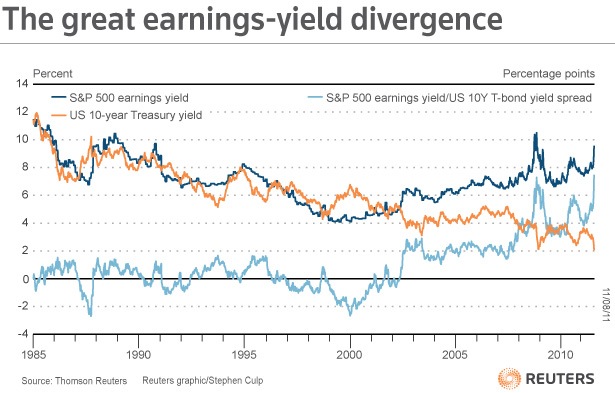
Felix Salmon points to this chart, which is a head-scratcher:

[F]rom 1985 through about 2002, it was just as common for the S&P earnings yield to be lower than the Treasury yield as it was for the yields to be the other way around…

In 2002, everything changed. The spread between the two jumped up to a very high level and stayed there, all the way through the onset of the financial crisis. This was the Great Moderation.

He can’t figure it out but concludes that it must mean it’s time to buy stocks. I’m too much of a believer in EMH to think that it’s that black-and-white.

Here’s a follow-up that peels away all of the apples-and-oranges issues from comparing government debt to corporate equity.

We’ve elminated a lot of the gap. Now what is probably the answer is becoming clear.

Nick Rowe focuses on the fact that stocks are more ‘real’ and less ‘nominal’ than bonds. I like this explanation a lot. I predict, then, that there should be no gap unless the market misestimates inflation.

So let’s eyeball-shift that graph.

Imagine that blue line nudged up by expected inflation all the way back. There’s probably a reverse gap in the 60s and 70s (high and rising inflation? Check) and a lockstep march downwards during the Great Moderation (predictable disinflation? Check.).

And today? Today we’re staring down the barrel of deflation, folks. No more shift. No gap.

Extreme Couponing

Ever seen this show?

It’s amazing how much money you can save if you 30 hours a week figuring out what corporations are trying to liquidate.  Vitamin water, candy, household toiletries, cans of tuna and dog food… delish.

Do companies view this as an expense? Is there a marginal cost to food that needs to be replaced by incoming inventory? Just-in-time, baby.

This didn’t exist in the Great Depression: one reason why our society is immensely less vulnerable than it has ever been. You can buy $1,500 of groceries for $5 just by clipping coupons? Great Stagnation my ass. That’s not captured by median income measures.

Another fascinating comparison popped up when they showed a couponer living in a New York suburb.  It sounded like much harder work than those living in Ohio, Arizona or Idaho: lower ceilings, lower total coupon limits, more deposits and taxes.

Why is it so easy to live in these smaller communities?

Another trick: everyone has gigantic pantries with “one year’s supply” of just about every piece of crap food you can imagine. Apparently things only tend to go on sale once every six months. Gotta stock up.

How Computers Read Numbers

One thing that I’ve learned about computer languages is that there’s a hierarchy:

  1. High-level languages (Python) are “interpreted” into
  2. Lower-level languages (C), which are “compiled” into
  3. Assembly, which is “translated” into
  4. Machine code

Machine code is basically 1s and 0s and is mostly incomprehensible. Obviously there are rules and stuff, but it’s twilight zone.

Assembly is a step towards understandability and I’ve happened to find my way to this online book about programming in Assembly.  It’s in here that I’ve learned how computers look at numbers:

Computers use binary values because transistors can only occupy one of two states: 0 volts or 0.5 volts. 0 or 1. But how do you get real numbers from just 0s and 1s? Surprisingly, the answer is exponents:

For each “1” in the binary string, add in 2**n where “n” is the zero-based position of the binary digit. For example, the binary value 11001010 represents:

1*2**7 + 1*2**6 + 0*2**5 + 0*2**4 + 1*2**3 + 0*2**2 + 1*2**1 + 0*2**0
=
128 + 64 + 8 + 2
=
202 (base 10)

So the binary number ‘0’ means you multiply 0*2^0.

The ^0 comes in because it’s the first digit in the sequence.

’00’ would be 0 * 2^1 + 0 * 2^0 = 0.

’10’ would be 1*2^1 + 0*2^0 = 2.

Clever. It’s pretty impressive how exponents can squeeze so much information out of the ordering of 1s and 0s.

I’m not going to bother trying to figure out how they make words out of this mess today.

NGDP

Scott Sumner presses his crusade:

The Fed has picked such a bizarre and convoluted strategy that it is difficult for markets to predict which way the economy will go.

And the reference to Ryan Avent quoting Tyler Cowen was good, too:

 Those looking for a positive, pro-inflation sign in the statement could point to the three dissenters, he noted; clearly enough changed in the report to drive the more hawkish members (whatever the merits of their view) to find the shift objectionable. However, he noted that its ambiguity was suggestive of a Fed facing intense pressure from two sides, and wishing to put itself in a position to avoid blame for failure but take credit for success.

Totally confusing. You know we’re in a crisis when the markets go nuts with every fed statement.

Technocrats look at the fed as the holiest of technocratic institutions. It’s a kind of mount Olympus for economists who believe economists deserve a seat at the policy making table.

Unfortunately we’re zero for two in massive crises that have been (or will eventually be) seen as preventable with monetary policy. The fed is a reactionary institution. Like all political institutions.

But what would the fed to do correct/prevent crises? The best framework I’ve come across for figuring this out is Scott Sumner’s holy focus on NGDP.

It makes sense: NGDP is revenue. It’s the most easily measured (and understood) economic variable.

The point is that even though ultimately inflation is the only variable under the mechanical control of the fed, the expectations for inflation are incredibly important in the real economy. In practice, therefore, the fed affects the real economy today by signalling the path of prices tomorrow.

If this path changes for some reason, the economy is thrown into disarray. “Disarray” means investment plummets, unemployment spikes and recession strikes.

Obviously everyone knows about when the path of prices is shifted upwards (70s-80s). But problems are perhaps more serious when it shifts downwards.

That’s what happened in the 30s.  And that’s what’s happening today.

Baiting ‘Conservatives’

The central finding is this: people who win large amounts are just as likely to end up bankrupt as people who win small amounts. People who win a large amount, $50,000 to $150,000, have a lower bankruptcy rate immediately after winning but a higher bankruptcy rate a few years later so the 5-year bankruptcy rate for the big winners is no lower than for the small winners.

Amazingly, by the time the big winners do go bankrupt their assets and debts are not significantly different from those of the small winners. The big winners who ended up bankrupt could have paid off all of their debts but chose not to.

Here’s the link.

Yikes. Read a conservative-type person this and prime them into ‘far’ mode by linking this to income transfers, entitlement spending and welfare receipts. I dare you.

What’s the sympathetic view? Professional athletes that are too trusting and get taken advantage of? Mike Tyson?

A bit harder to pull off.