Productivity in Canada (and elsewhere)

Here is Stephen Gordon:

increased productivity – as it is usually measured – is not a sufficient condition for higher standards of living. It’s not even necessary. For instance, the post-2001 fall in Canadian productivity is simply a mathematical artifact of an income-increasing sectoral reallocation of capital and labour.

And Tyler Cowen comments on the great graph:

Falling TFP in mining reflects Canada’s move from “suck it up with a straw” oil to complex, high cost extraction tar sands projects and the like.  They have moved down this curve a long, long way.

Yet Canada still prospers: someone is willing to pay for all the time and trouble they put into extraction, because the other natural resource options are costlier at the relevant margin.  Another way to make the point is that this graph, and the embedded story of productivity, is very bad news for someone, just not Canada, at least not so far.

I left a comment on MR asking whether this might be a good thing, and here’s my logic:

The cost of resources is going up because they are scarce. Since that’s happening regardless of how the resources get extracted, what’s the problem with increasing costs of extraction? They’re just moving money from the bottom line to the expense line. A socialist dream: surely this is ‘job creation’ at its best!

Now I’m not so sure. Let’s say that in the future, productivity improvements (or supply discoveries, or substitution) reduce the demand for, say, oil, casuing the price to drop. It isn’t going to be able to drop much farther than the cost of this expensive extraction though, which means that we have a new floor to the price of oil. Not good.

More importantly: do we really want primary industries sucking up more and more of our human capital? This is the opposite of innovation. Society is best off when smart people are inventing new things and eliminating inefficiencies, not creating them.

Why don’t we just make the laws more complicated so we can employ more accountants, lawyers and politicians? No thanks.

I’m reminded of the problem with innovation: who wants to be in the industry that is destroyed or automated? What do you do then?

Watch out for ideas that make it look like progress doesn’t need to be a bit painful. They’re seductive bastards.

Review of *The Blind Side* (film)

I first heard about this story on Econtalk where Michael Lewis discussed his great fortune discovering this incredible story. I’ll say: homeless illiterate black kid taken in by rich white Christians and winds up a 1st round NFL draft pick. You can’t make this stuff up.

This movie is also half of the subject of the best film review I’ve ever read, by A.O. Scott. I came across it two years ago and, quite honestly, I think about it all the time.

Some choice quotes:

AN African-American teenager, overweight and undereducated, a survivor of poverty and abuse, is rescued by the benevolent intervention of strangers. That, in a nutshell, is the plot of “Precious: Based on the Novel ‘Push’ by Sapphire,” which has attracted fervent praise, as well as some controversy, since its debut in limited release two weeks ago.

The same sentence could sum up “The Blind Side,” based on a nonfiction book by Michael Lewis, which opened nationally on Friday.

And here’s the upshot:

Both movies tell stories that suggest a way out of poverty, brutality and domestic calamity for certain lucky individuals while saying very little about how those conditions might be changed…

Both locate the problems facing their main characters in the failure of families — of mothers in particular — and find solutions in better families, substitute mothers (Ms. Rain and Leigh Anne), whose selflessness and loyalty exorcise the biological monsters who have been left behind.

I have to first admit that I’m a sucker for feel-good, happy ending movies and, unlike Scott, I enjoyed *The Blind Side* more than *Precious*. The latter was just a bit too real for me, even if it probably ‘taught’ me more about life.

I’m afraid that Scott’s ideas have infected me so completely that I’m barely able to muster an original thought of my own. So I’ll give up.

Read his review.

Holy Cow, Lots Going On

Some links:

Here’s a scathing review of S&P’s conduct, generally:

To say that S&P analysts aren’t the sharpest tools in the drawer is a massive understatement.

Naturally, before meeting with a rating agency, we would plan out our arguments — you want to make sure you’re making your strongest arguments, that everyone is on the same page about the deal’s positive attributes, etc. With S&P, it got to the point where we were constantly saying, “that’s a good point, but is S&P smart enough to understand that argument?” I kid you not, that was a hard-constraint in our game-plan. With Moody’s and Fitch, we at least were able to assume that the analysts on our deals would have a minimum level of financial competence.

Yikes. And imagine what the real regulators are like.

As for S&P’s downgrade, here’s Sumner’s take, under the title of 1.07% on the 5-year and falling fast.

The markets this morning gave a massive vote of no confidence to S&P ratings service, as yields plunged on Treasuries.

The real after-tax rate of return on the 30 year Treasury is now negative, assuming a 30% MTR.  That means the tax rate on capital now exceeds 100% in real terms over the next thirty years, which doesn’t seem particularly conducive to capital formation.

Yikes.

But what’s the ultimate signal that things are bad? Berkshire’s getting the itch.

Here’s Ajit swooping in and demolishing the incumbent bidders’ stock/cash offers with an all-cash, thank-you-very-much email.

Mr. Robert Orlich
President & CEO
Transatlantic Holdings, Inc.
80 Pine Street
New York, NY 10005

Dear Bob:

As you can imagine, subsequent to our telephone conversation yesterday, I have been watching the screen all morning. With your stock trading at $45.83, I have to believe that you will find our offer to buy all of Transatlantic shares outstanding at $52.00 per share to be an attractive offer. As such, I am now writing to formally inform you of National Indemnity’s commitment to do so at $52.00 per share under customary terms for a stock purchase agreement of a publicly traded company to be agreed (but not subject to any due diligence review or financing condition of any nature [emphasis DW’s]). This commitment is subject to:

  • A formal response from you no later than the close of business, Monday, August 8, 2011.
  • Should you decide to accept this offer, your agreement that should the deal not close for any reasons that are under your control by December 31, 2011, a break-up fee of $75.0 million would be paid to us.
  • Your commitment that until the deal closes, you will continue to manage the affairs of the company in a manner that is consistent with how you have managed it historically.

I have deliberately tried to be brief and to the point. I will be happy to discuss any details that you would like at your convenience. I can be reached at [number withheld] (work), [number withheld] (cell) or [number withheld] (home).

Regards,

Ajit Jain

TRC probably figured there wasn’t any point in summarizing the offer and just published it in whole online. Also gives us our “parenthetical statement of the day”.

Note that this values TRC’s stock at something close to the incumbents’ bids BUT the value of the stock portions of the bids have diminished substantially since they were made.

Timing is everything, n’est-ce pas?

update:

Here’s a neat post speculating on who got the margin call today:

You see the desperate selling of the biggest liquid names is a sign of margin calls.

The market is not puking. Some prime broker is puking the stocks held by one or more very large hedge funds.

So lets play the game: guess who got the margin call!

Khan vs Judah Review

Wife went to bed early so I thought I’d rewatch Khan Judah. Forthwith, some observations:

Key point early on: the ref clearly (like, clearly) points to the TOP of each fighter’s belt and says any punches below that will be called off.

There’s a lot of talk about handspeed and Lampley said Judah claims to have never been in the ring with a fighter with faster hands. He (Judah) said that he was faster than Mayweather over the first four rounds. Kellerman (during the third round I think) said that he hasn’t seen a Khan speed advantage yet.

Yet.

That’s a key Zab qualification from K and Zab himself. I agree that Zab looked to be Khan’s equal early, actually, but he slowed down at a much faster rate than Khan. He became hesitant.

From what I’ve read, the observation that Zab cedes the psychological game too easily isn’t a controversial one.

And that Khan reach! They look like they should be in different divisions.

As the fight progresses, Khan looks faster.  He’s also got this ridiculous left hook (my favorite punch, generally) that is great as a third crack in a combination or a surprise lead.

Then there’s the 5th round body-blow KO. Incredibly, it might have been a Judah give-up; it didn’t look that bad. Mentally weak.

Here’s BLH and Dan Rafael. Generally, the commentariat seem to agree that the KO shot wasn’t a low blow and I suppose they’re probably right.

Still. The ref said that that exact shot would be disallowed. Probably means the refs should explain the rules a bit better if that wasn’t actually against the rules.

here’s a video

This is finally a fight where the old vet isn’t totally mailing it, KO controversy notwithstanding. And that’s probably because he’s fighting a hungry young fighter. I predict that Mayweather/Ortiz will be an excellent fight for this same reason. Ballsy of Floyd to take on a youngster.

They don’t mess around.

On Strange Timing and Petulant Whiners

CDL, LLC (owners of the The Millennium Hilton right next to ground zero) is suing the WTC developers for a bunch of money to allegedly install double-paned windows, allegedly to minimize the noise produced by the construction site.

WTF, you might ask. The construction didn’t exactly start yesterday. Why now?

Well, apparently the ground zero developers have installed new windows on “residences adjacent to the site” and CDL wants in on the action. It’s only fair.

I think there’s actually only one residential building that fits the description of “residence next to the site” and I’ve lived there. It’s an ancient one, but newly renovated since the attacks (obviously). And it’s nowhere near the size of the Millennium Hilton.

It’s like if you gave a 3-year-old a bit of your ice cream and a 600-pound gorilla got jealous and wanted 15 ice creams.

But maybe cost isn’t the problem. Is there a difference between people who live in an area and those who are only tourists? Um, yep. Tourists don’t vote.

Fundamentally, the Port Authority is a political beast and it is impossible to underestimate the political clout actual residents of the area around ground zero wield (particularly the ones that lived through the attack). They might be the post powerful polity in the country. Irritate them at your peril.

Sorry, Millennium Hilton. You probably ain’t getting windows.

Eur-Woe

Wow, what a report.

That link leads to a fantastic summary of the Euro area’s trouble. There is no pleasant scenario on the horizon.

Here is my big-to-small picture summary:

Currency unions are really tough to make work. See this (short) and this (long) from Krugman. There are economic benefits to joining up (lower transaction costs and higher trade/specialization) but, as we’re finding out, a gigantic loss in flexibility in a crisis.

Countries not in a currency union, like Iceland, can just let their currency devalue when they hit the buffers. This drives up the cost of imports (ie inflation), which crushes the real wage and lowers the standard of living. Newly competitive export industries and domestic suppliers pick up the slack and get everything started again. It takes a bit of time and pain, but it’s pretty straightforward.

Members of a currency union can’t do this, so they to relay on other stabilization mechanisms. The two biggies are labor-market integration and fiscal integration. As an example, remember that the USA is a currency union, too, while I borrow Krugman’s analogy.

Let’s say Nevada had a similar crisis to Ireland.

Nevadans that lose their jobs can move to California (um, bad example) or North Dakota. Nevadans speak the same language and share a pretty similar culture, so that’s pretty easy. Bingo, labor market integration. We’ve reduced the unemployment burden in Nevada because the whole state shrinks to fit its economy. Moreover, Nevadans that stay put benefit from a social safety net provided by the feds (medicare, medicaid, unemployment insurance, etc). That’s fiscal integration.

You need fiscal and labor market integration for currency unions to work.

BUT.

The Germans are NEVER going to pay for Greek medicare. Not with Michael Lewis painting evocative pictures of Greeks as free-riding crooks. And change the laws all you like, but different languages make immigration really difficult.

So the Euro was risky all along? Yep. But they also made it worse when they designed the financial system. The article above has a great example: the ECB accepts sovereign debt as collateral for loans and started out not distinguishing among sovereign names. They later changed this to adjust for risk, but “these adjustments were minor”.

What does this mean? Well this means that a bank can buy a bunch of Greek debt (at, say 10%) and park it with the ECB as collateral for a 2%  loan. Big spread.

Greek bonds are therefore much more attractive to institutions that can use this trick. This lowers interest on Greek bonds but concentrates Greek credit risk in the Eurozone. I can only imagine the happy-clappy atmosphere these kind of ridiculous rules were forged in.

So you have a shaky system supercharged with systemic risk that you’re politically welded to. Eurocrats don’t want to admit the whole thing was a mistake and, besides, there are some quirky problems with breaking up the Eurozone:

Let’s say German banks get a bit freaked out about Irish bonds. They sell those bonds to an Irish bank (probably the only market makers left) and take their Euros home. Weirdly, though, the Irish bank doesn’t pay the German bank.

What happens is that German central bank pays the German bank the money and the Irish bank pays the Irish central bank. This means that now the Irish central bank owes the German central bank the money.

That, apparently, is a loan that is not meant to be paid back. What might be seen as a de-linking of the system actually concentrates the credit risk of Ireland with the German government. Now pretend it isn’t Germany but Italy that is suddenly more exposed to Ireland. Systemic risk piling onto systemic risk.

Get the picture?

The Euro was conceived as a way of bringing the stability of the Northern financial systems to the wayward southerners. The Euro, therefore, was really meant to behave just like the USD. And it has. The problem is that the longer everyone sits in the purgatory of politically squeezed half-assed bailouts, the longer the list of problem countries gets.

Eventually, the inmates take over the asylum and the Euro becomes more like the Italian Lira or the Greek Drachma than the German Dmark (more here). The idea I hadn’t heard until today was that maybe Greece and Ireland should stay in the Euro.

It’s Germany that’s the outlier now.

Throwing Grandma Under The Bus

Here’s an Op-Ed polemic trying to rally thinking folks to the idea that the social safety net for the elderly is the problem.

I tend to agree. People on the social dime will simply have to deal with getting a lesser standard of care than they do today. Does that mean that, in the interests of fairness, EVERYONE gets a lesser standard of care? It might. That’s how it works in most other countries.

I’ll be clear about two things from my experience of moving here from Canada:

  1. The US health system is hands down a billion times better…
  2. if you have decent access.

Pick two. Or none. No other solution is affordable.

The flip side of THIS is that it’s amazing that people are taking so much of their compensation in the form of astronomically expensive health insurance (by global standards).

But what’s the end game? What precedent is there in history for democratically disenfranchising a fifth of the population, not to mention the fact that everyone plans on becoming elderly eventually. Ask everyone that had their pensions in Enron stock what they think of the idea of a gigantic negative savings shock later in life.

Poker Virgin

I’m a poker virgin. I’ve never played a real game, even though I’m intrigued by it.

I’ve accepted an invitation to a charity poker tournament (Texas Hold’em) put on by a client of ours tonight and am writing this to try to retain some of the ‘tips’ I’ve been reading on the web.

(for experienced poker-playing readers looking for an easy post to mock, here’s your chance. I am aware of how stupid I sound below, though)

First the easy stuff:

  • Don’t play drunk, fold more than you think you should, pay attention to what other people are doing, don’t bluff much.
  • Card hierarchy. In order: straight flush, four of a kind, full house, flush, straight, three of a kind, two pair, one pair, high card.
  • And the basic rules: one player is the dealer (or ‘dealer’) and to his/her left is the small blind then the big blind, who seed the pot after everyone gets their first two cards. After they do this, everyone puts money in in whole number multiples of the big blind. Everyone either folds or matches the largest bet on the table.

I can handle all of the above, but that doesn’t really tell me what to DO.

So here is what I’m going to do.

For the first few hands I’m going to do nothing, maybe not even if I see a top-3 hand.

After that, I’m going to need to start exercising judgment, which I don’t have. Aside from reading the other players (which I have no hope of doing, of course), judgment to me means knowing how to calculate pot odds and money odds. So here’s what I’ve learned about pot odds and money odds.

Pot odds are about understanding what the chances are of getting the card I want next. 52 cards in a deck, 13 cards in a suit, 4 instances of each number. Need to figure out what my chances are of getting a winning hand. Money odds is what my bet is as a share of the pot size. If my pot odds are larger than my money odds, that’s a positive sign.

Some rules of thumb for probabilities:

  • The chances of not even getting a pair through the whole session is 50%
  • The chance of one pair is 42%.
  • This means that a winning hand is probably two-pair or better.
  • Two pair is 4.75% and three of a kind is 2.1%
  • This means that the higher ones are all less than 0.5% likely.

Now, these odds are all for a 5-card draw, which is only somewhat useful for Hold ’em. I take the magnitudes as important, though.

One pair is useless, two-pair and three-of-a-kind are ok. I should only feel like I have a good shot if I’m reasonably likely to hit a flush or better.

I’m in over my head…

Astronomers Before Telescopes

That’s my metaphor for describing economic growth theory.

So what’s the problem? Not enough reliable data.

Let’s say there are millions of interdependent variables that contribute to the economic growth (and measurement of even these is often royally screwed up).  But you have only hundreds of observations in which to evaluate whether a particular combination of circumstances worked. Is that science? No way.

And yet, all this whining is no substitute for plausible answers is it. We want to know how to grow!

So bring on the smorgasboard of cognitive bias.

Easterly and Roberts focus on a few of these biases, for instance leadership bias (ie looking for heroes bias), which is one I particularly dislike. They link this to the technocrat’s fantasy: “imagine you were the sole adviser of an absolute dictator. What good you could do with that power!”

The bottom line from E&R’s discussion is that autocracies produce a greater variance of growth outcomes. One interesting observation was that variance is not just between leadership regimes, but within the same regime. So yesterday’s stars are tomorrow’s dogs when the growth ‘miracle’ inevitably falters.

And it’s not really a surprise: what does a dictator care about most? Staying in power (the minute he leaves he’s either going to the Hague or the hangman). Is economic growth the best way of doing this? No, doing favors for the military is the best way of doing this.

Anyway, the entire field is a technocratic aphrodisiac. You can tell how exciting the prospect of having “the answer” is when the titans of policy commentary get super upset with their lack of influence.

But limiting an individuals’ influence is the whole point. If you’ve really invented a telescope, everyone will start using it on their own.

Worse Than Useless Chart Of The Day

From Felix Salmon:

Sorry, Felix, this chart is unhelpful and misleading, no matter what your political predisposition.

Let’s imagine you’re a lefty. You look at this chart and think it’s great, but ONLY because you think it will help you convince ‘conservatives’ or ‘tea-partiers’ that taxes can/should go up. I would argue you have absolutely no idea whether this chart supplies a useful way to think about politics or economics. You’re thinking with your debating hat on, not your scientist hat. That means that you’re looking for something helpful and not something true.

Ok, so let’s say you’re not a lefty (not the same thing as being a righty and easily in the majority). You look at that chart and don’t give a crap. Peoples’ reaction to tax rate changes have nothing to do with sober analyses of what share of revenue the government can/should get in a society. It has to do with whether people feel like they can afford to pay more taxes or not.

This makes the chart misleading because it doesn’t address peoples’ real concerns and unhelpful because it distracts lefties from arguments that might actually work. If there are any.

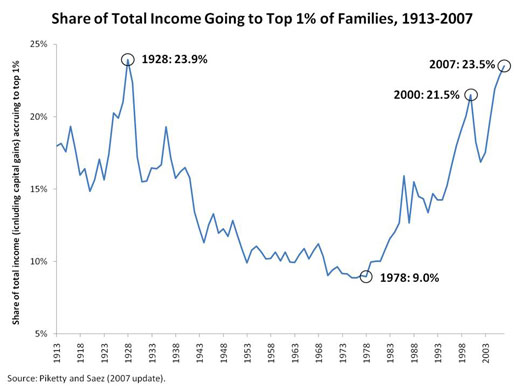
The only chart that’s less useful than the one above is this doozy (or something like it):

Again, a bias-confirming, load of garbage aggregate measure. Inequality is about how you feel you stack up to your neighbors. This chart does NOTHING to convince anyone that they stack up less well to anyone they know.

Populist movements arise when people feel like others are getting stuff they aren’t entitled to. That’s unfair. That’s inequality.

And right now, for whatever reason, public-sector-supported left-wing sacred cows are the poster children for getting a free ride.