The Real Larry Summers

From Felix, a constant critic of Summers, comes this gem.

Quote of the piece has nothing to do with economics:

MR. ISAACSON:  So was that scene in the social network true?

(Laughter.)

DR. SUMMERS:  I’ve heard it said that I can be arrogant.

(Laughter.)

DR. SUMMERS:  If that’s true, I surely was on that occasion.  One of the things you learn as a college president is that if an undergraduate is wearing a tie and jacket on Thursday afternoon at three o’clock, there are two possibilities.  One is that they’re looking for a job and have an interview; the other is that they are an asshole.

Watch and read it all.

Excel Is Crap, Long Live Excel

I spent the entire day redlining on a data cleansing project for a client. The database is based in excel (as almost all are, in my experience) and I’m once again forced to use VBA linked into excel for my work.

“Real” programmers despise visual basic and I’m starting to agree that it’s a crappy way to analyze anything. But it has one gigantic advantage over other tools: Excel.

Excel is, in my mind, possibly the most remarkable program ever created. I once listened to a podcast with a guy that worked for Microsoft who talked about how the Excel team were the ass-kickers back in the early days.

I’m not surprised. That program has introduced millions of people to the power of automating simple functions (ie computer programming). I suspect the back office of my company is typical: mostly middle-aged, mostly female and mostly born in other countries. Now how many of them thought they’d be building and running simple computer programs for a living?

Yet that is what they do.

I admire Excel and though I immediately select a different tool when I have the choice, I rarely have that choice. The tech boom became a tech bubble for the same reason that postal services still exist: change is cultural as much as it is technological.

Excel is about as much as our society can take for now.

Watergun Fight

Apparently they happen here in Boston all the time:

I saw one go down today in the oldest city park in the US. It was pretty lame.

There were two kinds of people there: little kids and 20s-30s guys who put way too much time into their shields, costumes and bags of waterbombs.

As a friend of mine with me put it: a virgins-only event.

Teams Dominate

Even in creative processes:

Analysis of over half a million patented inventions supports these arguments: individuals working alone, especially those without affiliation to organizations, are less likely to achieve breakthroughs and more likely to invent particularly poor outcomes.

more here.

Fin de Poisson

Ok, probably the last post in this series. I’m finally feeling comfortable with Poisson.

Lets recap, first: one, two, three and four.

So, recall the original code that sparked all this:

algorithm poisson random number (Knuth):
    init:
         Let L ← e^−λ, k ← 0 and p ← 1.
    do:
         k ← k + 1.
         Generate uniform random number u in [0,1] and let p ← p × u.
    while p > L.
    return k − 1.

I was confused about what the e is doing in there. I think I get it, now. Here is a link to a chapter that helped me with the following (a bit):

Imagine you’re sitting in a room with Danny DeVito and Arnold Schwarzenegger is in another (identical) room. We want Arnold to walk across the room ten times and see how many steps it takes each time. BUT we can’t get into Arnold’s room. What do we do?

Well, let’s say that these are special rooms. They have been designed so that Arnold will take on average ten steps to cross the room. Now, we also know that Danny’s stride is exactly half as long as Arnold’s. The calculation becomes easy!. We tell Danny to go halfway across the room ten times and that’s our answer.

This conversion is the same idea. We know that each Poisson event takes a bit of time (length of Arnold’s strides) and that that time varies a bit. The trouble is that Arnold’s strides vary on an exponential distribution, which we can’t really model. We can model a uniform distribution easily (Danny’s strides), but we need to find a way to convert them.

We do that by picking a different distance.

Unfortunately, though, exponents really screw with your intuition here, which is why this site has been so helpful.

Think of an exponent as the amount of time a number (e) spends growing until it hits a target: say, 100. Ok, we can figure that out easily by taking the ln(100) = 4.6. But we want random nubmers, which means that e does not equal 2.71, its expected value is 2.71. But the target stays at 100, which means that our random number is actually the time e needs to grow to hit 100.

So we’ve got two random numbers, now. e is random (input) and the (output) time is random. But we can’t do random es, it’s too hard. We CAN do random uniforms (0-1), but how do we pick our target?

Well, why don’t we figure out what the expected value of the uniform is (0.5) and tell it to grow for that time=4.6 we calculated? That’s our new target!

Now things get easy. We just get this new target and generate lots of uniform random numbers to see how many it takes to hit our new target. Each time we hit the target, we write down how many uniforms it took.

Voila, each of those counts is Poisson-distributed.

Now, back to the derivation of Poisson for a sec:
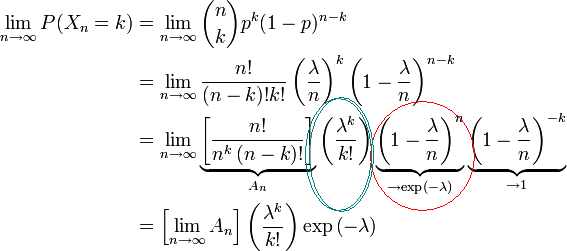
The two circled terms are the Poisson formula. I didn’t really realize how that red-circled part worked before. Look what it’s saying!

It is 1 – λ/n, which is the probability of NO event, ‘grown’ by the number of trials. In my examples above, I used events as opposed to probabilities of events. This makes no difference to the math, really, you just take the inverse of all your terms.

And now the code is clear: it just strings together a bunch of events until you hit the probability at which you know there can be no more events. And that probability is different when expressed a uniform distributed number than as an e-distributed number.
Focus

Cringely is fast becoming one of my favorite writers:

One question I am frequently asked because of my background is if this is a good time to be an entrepreneur — a good time to start a company? Understand people have been asking me this question for 30 years — a period of time that encompasses some major booms as well as two of our deepest recessions. And the funny thing is that my answer to this question never changes: it is always a great time to be an entrepreneur and start a business. And with the passage of time I tend to think it has only gotten better, even today.

More here.

Better companies outperform worse ones in recessions and booms. If you can satisfy your customer, you should start a company and do so.


In Which I Light A Fire

After my first year of university, I lived in a run-down student house alone for four months. It kinda sucked generally but one experience in particular from sticks in my head.

I started the summer with a trip to Ikea (what student doesn’t?) and bought a bunch of stuff, including a little bedside table with three drawers in it. I started assembling it as soon as I got home, but didn’t finish. Didn’t finish the next day either.

Or the next day. Or the next week.

Or all summer, actually. It was at a very specific point of semi-construction, too. I managed to put together the frame and, on my second attempt, the top drawer. I then got the second drawer done in the first try. After that, though, I completely lost interest.

I sometimes think I lost interest because the challenge of finishing it was minimal: I’d figured out HOW to do it and mastered the process with the second drawer. There wasn’t anything of interest to me any more.

And it wasn’t like I didn’t have any spare time. My god, I feel like I did nothing that summer except sit around on my ass and eat and stare at my three-quarters-finished bedside table.

How ridiculous, right? Just finish the stupid table! It would have taken all of 10 minutes and I’d have that great feeling of accomplishment afterwards.

But, then again, I didn’t give a crap about the table. I didn’t really need it for anything and at that point only the direst of needs (like going to work or the bathroom) could possibly shake me from my idle stupor.

I think this hints at the difference between people who actually DO STUFF and people who don’t. And by STUFF I mean the important, interesting and remunerative activities of the world. The high status stuff.

In one of Dan Carlin’s excellent podcasts on the fall of the Roman Empire, he talks about how Julius Caesar was perceived by his contemporaries during his youth. Hard to excerpt from a recording, but (from memory) JC’s most consistently noted feature was his level of activity. He was always doing stuff, always getting stuff done, always up to something. As a kid.

Seeing some project (big or small) through to completion is not easy. Doing it all the time is harder.

I write all this to relight my fire for working on the weekend project. I’d say that my progress level is 1 drawer out of 3 at the moment. I refuse to stop until I’m done.

Final-e

Ok, I think I’ve finally got the whole e thing straight in my head.

They key to e, you see, is that it’s arbitrary.

First, my thought progression: one, two and three. Reading over them again, I realize how poorly I understood what was going on because those posts really suck.

Mathematicians are obsessed with two things:

  1. Shoving as much information as possible into small spaces; and,
  2. Making things look like other things without changing them

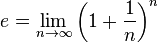
As far as I can tell, the history of mathematics is a long string of ‘discoveries’ wherin people learn some kind of identity, like this one that describes e:

and feel the faint tickle of recognition. “Hmmm…”, they would say, “now where did I see that before? Ah! Now I remember!” and ka-blammo: apples become oranges that taste like apples.

Think about the calculation of a probability using the Poisson:

This is misleadingly complex. The Poisson distribution is NOT complex. The Poisson distribution doesn’t even exist. It’s an approximation of the Binomial distribution, which is freakishly simple:

Um… ok, maybe it doesn’t look that simple but that’s because the question it’s designed to answer is a bit complicated: “what is the probability of something happening exactly k times if its probability of happening once is p and you try n times?”

The way of answering it is super easy to understand, though: for one trial the probability is p. For many trials you just start multiplying ys together with (1-p)s, mostly.

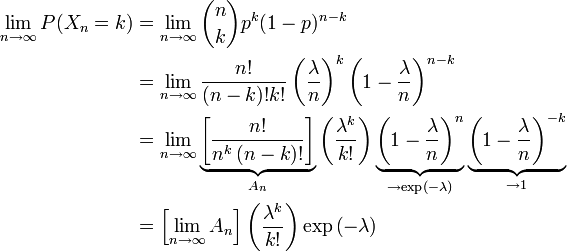
Anyway, so what’s the point of the Poisson distribution, then? Well, some clever dude realized this:

And what is all that crap. Well that crap is all about the little horizontal curly braces. These are instances where somebody recognized an equation from someplace else and plugged it in. These simplifications remove many steps in calculating the binomial distribution, but increase the difficulty of understanding it.

So e is a massive red herring here. There is no ‘deep truth’ to any of these probability distributions or to the magical math that describes them. You could express a probability using any constant other than e, it’s just that writing it out would be much more complicated and annoying.

Besides, Poisson probabilities are build around the idea of infinite trials. Infinite! There’s no such thing as infinite as far as I’m concerned.

Cute? Yes. Clever? Absolutely. “TRUE” in a deep sense of the word?

Nope.

PS. I was amazed to see what the Binomial distribution is. It’s the effing Normal distribution:

No wonder the normal distribution is such a silly concept! It only describes linear, super-simple probabilities. Hmph.