Equivalent to about 98% of my medical needs.
Does this mean doctors are a bigger or smaller deal?
Why is the most important one for overall health (Nutritionist) the only one NOT called doctor?
Equivalent to about 98% of my medical needs.
Does this mean doctors are a bigger or smaller deal?
Why is the most important one for overall health (Nutritionist) the only one NOT called doctor?
This film completely baffled me. I found it slow and, if not quite boring, certainly not engaging. Continue reading Film Review: *One Flew Over The Cuckoo’s Nest*
Here is Steve Blank touting a youngster’s project that impressed him:
Max and his partners interviewed and analyzed over 650 early-stage Internet startups. Today they released the first Startup Genome Report— a 67 page in-depth analysis on what makes early-stage Internet startups successful.
Interesting stuff. According to Steve, it sorta passes the Ariel Rubinstein test for interesting sociological research: it gives the answers you already knew but didn’t necessarily formulate so crisply in your own mind. Introspective validation is the gold standard here.
Anyway, moderately interesting research conclusions aren’t the story. The story is that Max is (was at the time?) 18. Steve’s reaction:
Holy sx!t [sic]… Max set the record for smarts divided by age… I can’t wait to see what [he] does by the time he’s 21.
Precocity. It’s a fascinating subject. I’m often very disparaging of my own abilities and achievements when I was much younger and when I evaluate younger people, I typically compare them to this view of myself.
I think this is a bit of a flawed approach for two reasons. First, people are terrible evaluators of themselves. Two, linear extrapolation, implicit in the last quote from Steve up there, is nuts.
People tend to not have very many truly interesting achievements waiting for them in their futures. I don’t know why this is, but I can offer this alternative view of young Max’s achievement:
‘Wow, pity this kid blew his load so early on a moderately interesting project. Imagine what he’d have achieved if he waited a few years, met some more people and channeled all that experience into a truly extraordinary achievement.’
The one-and-done model makes precocity a tragic flameout rather than an awe-inspiring prophecy.
PS I tried to make this post sound less negative than it wound up. I don’t mean to say that Max is doomed to mediocrity, nor to I mean to advocate deliberate repression of the entrepreneurial instinct. For most people, a bias for inaction is what screws you over. I mean this as observation rather than advice.
Enjoyed watching the champions league final this afternoon. Yay Barca.
One unoriginal observation I made was that the Barca players were shorter than the Man U players. A bit of googling shows that this question has had a healthy examination before.
So I figured I’d calculate, in a back-of-the-envelope way, what the average heights were of the teams:
Man U Mean: 1.79
Man U Median: 1.76
Barcelona Mean: 1.75
Barcelona Median: 1.73
I haven’t adjusted these figures for round-number bias as per the Freakonomics link and I’ve used the wikipedia ‘starting lineup’, which has a different number of players for each team. And I’ve excluded Keepers. Not really soccer players, anyway.
That said, I’m not surprised at the result and it jives with the observation of the Spanish team being short, too.
Funny, though, isn’t it.
I’ve now twice been sent the Julian Grantham piece, so I read it. And now that I’ve read it, I might as well review it.
First a roundup of other commentary on this thing, which I read without realizing it was about the same paper: Continue reading The Sky Is Falling!
Hint: it wasn’t the fat guy.
Cristobal Arreola has been disappointing boxing fans for a few years. Very talented heavyweight. Bad training habits. Continue reading Championship Habits
Robin Hanson has been blogging Ken Lee’s PhD dissertation and saved the best for last: Jobs Kill.
The big result: death rates depend on job details more than on race, gender, marriage status, rural vs. urban, education, and income combined!
He presents this table:

Two comments on the chart. As I understand it, the higher the factor above the more a job characteristic contributes to death. So, “Overall:Physical Demands”, at 1.699, is a big killer. Also, more stars means a higher statistical significance.
Ok, so I want to talk about “Context: Socially Challenging”. Here’s Ken Lee (this link may some day break) describing this factor a bit:
Work Context: Socially Challenging… has such attributes [such] as as impact of decisions on others, frequency of conflict situations, stress tolerance, and dealing with physically aggressive or angry people.
One thing Robin has taught me (though this perhaps isn’t his insight) is that intelligence evolved to deal with the social complexity in our society. This means that jobs that are socially challenging are jobs that tax the human mind more than any other job in the world.
The most socially complex jobs, in my opinion, are sales jobs. Remember, the best salespeople are those that are best at two things: one-on-one persuasion and accepting rejection, two incredibly socially stressful activities.
If my take away here is that salespeople have high mortality, then I completely buy it. It’s brutal work.
It would be cool to correlate these ‘death factors’ to wage and employee turnover in the occupations. I bet wage is related to status and turnover will be highest in low-status, high-danger jobs.
This is a deeply powerful point about the insurance business:
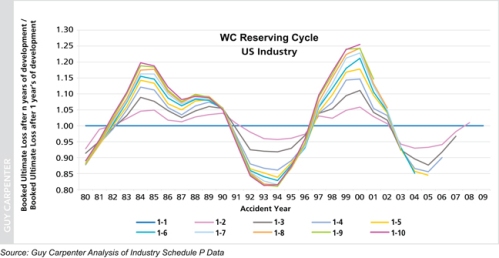
There are ten lines in that graph..
The straight blue line is the 1-1 line, which is the measurement of a year’s performance 1 year out. This is a pure fudge figure because the insurer doesn’t have enough information to measure the cost yet.
The fact that this line is at 1.00 is important. 1.00 means that the insurer expects to pay out 100% of its premium in claims. Nominal Revenue = Nominal Cost. 10 years of interest makes this possible.
As you look back at the year over time (1-2, 1-3, etc), the amplitude of the ‘wave’ increases. This happens because, over time, insurers gain information about how well that year is going and absorb the volatility in the relationship between revenue and costs.
Workers’ Compensation business is the most ‘long tail’ of insurance businesses. This means that the claims cost of comp policies take the longest to resolve.
In fact, insurers have very little idea for the ultimate cost when they write a comp policy. Workers’ comp is notorious for this and many, many insurance companies avoid it entirely because of this uncertainty.
The cycle is present in all insurance businesses, though. Once people figure out they’re losing money, they pull capacity and rates go up. The difference with comp is that there is more risk of finding out too late.
Think of that realization like a tsunami. When they’re out to sea, small waves look like big waves because very few have enough power to displace the entire vertical distance of water from the ocean floor all the way to the surface. Good years and bad years and company-killing years look pretty similar.
But once the sea floor shortens up and you hit the shore, you find out how much energy was in the sucker.
And with comp, those suckers can be big.
a judge granted a privacy injunction, meaning that English newspapers could not legally publish the name of a professional soccer player who allegedly had an affair, despite thousands of people who have reported the name on the social-networking site.
The reason here is, of course, because of legal liability. The UK has one of the most spectacularly aggressive libel laws in the world.
The intended consequence is, presumably, that people play together more nicely, but the unintended consequences are more interesting. Libel Tourism, for one.
Another is that, because libel is by definition printed, and most print is online, the Internet is making for some interesting legal theatre, as in the case above.
Score another massive point for Web 2.0. Because big firms are a big fat target, people sue them.
But that cost isn’t borne by the firms. Oh, no. It’s paid by the insurance companies who, in turn, raise rates for the entire media industry.
I was working on an account today and noticed that liability insurance for UK Media Firms is about 6x more expensive than the equivalent for Australia and Canada (no data for the US in my little trove).
Twitterers don’t pay liability insurance for libel cover because they can’t realistically be sued for libel.
This is obviously a margin at which power is being transferred away from Big Media and whatever coalition is blocking libel reform in the UK.
Yay for liberty.
Thinking is hard. Really hard.
I remember reading somewhere that most of what we might call ‘thinking’ is actually performing a routinized task of some sort. In that sense, it’s more like remembering than thinking.
I suspect that this is why people don’t like change. What they’re actually recoiling from is the prospect of having to do thinking, which is work. The familiar is comforting because it cushions us from real effort.
For instance, right now I have taken a moment to post to this blog instead of thinking through a problem I’m having on my weekend project. Learning a new skill requires real hard thinking, which my brain is fighting against constantly.
What’s interesting about this to me is that it isn’t obvious that thinking is work, but my natural reaction to the prospect of real thinking is similar to my reaction when confronted with physical labour: the lazy panic of procrastination through television, internet surfing and familiar, useless hobbies.
Case in point.
 Not Unreasonable
