Paying College Athletes

Here’s a video of a top-ranked high school football player choosing his college on live tv. The upshot is that he is from Louisiana and his mom voices discontent of his choice of Alabama over LSU.

Ben Casnocha says: “pay the athletes”

I say that impossible:

To get paid, the players will immediately form a union. Here is going to be their list of demands:

1. Pay us (fine).
2. Don’t make us go to school (uhhhh).
3. Let us play longer than 4 years (what?)

Here’s the student body response:

1. These aren’t students
2. I want to play football (or basketball) for my alma mater
3. Set up a parallel system for me to play in

The problem with this system isn’t that student athletes aren’t getting paid. The problem is that the NBA and the NFL don’t have a feeder league system like every other major professional sport. This means that the NFL and NBA are less popular than they otherwise would be.

Think about the difference between fan followership of college football and basketball vs all the other lower-tier sports leagues on earth. Orders of magnitude larger. Why? Because they’re piggybacking on college support. These are fans that would otherwise pay more attention to the pros.

The winners in today’s arrangement are, first, sports administrators and, second, sports fans. The losers are the NFL, NBA and lower-tier college athletes.

One interesting possible externality of sports administrators winning so big is that sports administration and so sports itself probably wins. Gigantic sports facilities support more than football. I bet you that the quality of the US Olympic team would decline demonstrably if you killed the college sports money machine.

And paying the athletes would kill it.

No Controlling This!

The US economy has no hope.

From Robin Hanson:

A randomized insurance experiment found that on average people who thought they had a higher health risk bought more insurance. But they didn’t actually have higher risk:

[In] a large-scale randomized field experiment in Mexico … [in ’04 on] a voluntary health insurance option [=SP] … ‘high risk’ agents are, ceteris paribus, more likely to opt into SP—although the insured are not more ‘risky’ on average. That is, despite the absence of a positive raw correlation between agents’ insurance status and proxies of risk, this paper presents evidence of the systematic selection predicted by theory. In particular, individuals who rated their health as “bad or very bad” before SP became available are 6.9 percentage points more likely to sign up for SP than those in “good or very good” health (compared to an overall treatment effect of 29 percentage points).

Curiously, however, agents in the experiment sort only on pre-period medical expenditures and subjective well-being. There appears to be no selection on objective measures of health—possibly because individuals are less aware of the latter. … [Regarding] preventive care decline with insurance coverage, the effect of SP on the utilization of these services is negative and non-trivial in size. Given the positive price effect, such a decline is likely due to ex ante moral hazard. (more)

This supports the idea that medicine is less about health than health-related feelings. If medicine were more about the reassurance that comes from being taken care of medically (because medicine is a standard way for others to show that they care about us), it makes sense that we want more insurance when we feel more vulnerable to illness, but that sense of vulnerability would have a lot more to do with the social assurances we desire than our state of health.

Since moving to the US from Canada, I can definitely tell you that there is an order of magnitude more supply of health care here. Wouldn’t surprise me if that explains all of the cost differential (as % of GDP).

No silver-tongued politician is going to talk voters into less health care. This is a wiring problem in the human mind.

I’d invest in health care and health care-related industries*. However, we’ll have to watch out for attempts at regulating costs, which means providers will be more concerned with lobbying and rent-seeking than building profitable businesses. An unpleasant investment environment, but perhaps not an unprofitable one.

Every other polity in the world will probably find this human wiring problem too powerful to control. Two-tier for all! International expansion of health care companies from the US is going to be a gold mine.

*Insurance is a funny case here because its costs are driven by liability claims related to medical care. Its performance will probably be like heavy consumers of resources during a price spike.

When Borrowing Dominates

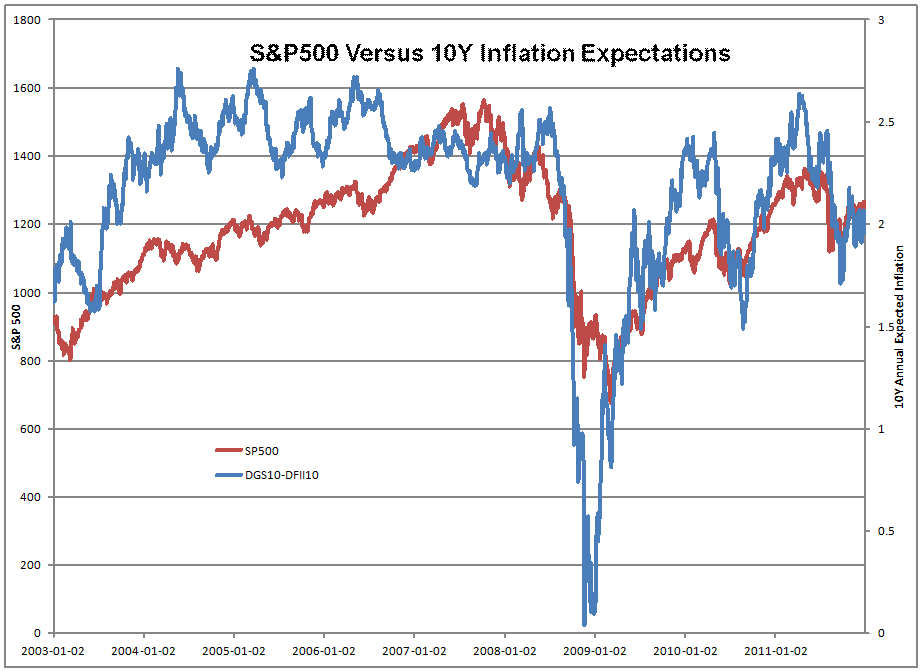
David Merkel has another thought-provoking post. I like when people put real data up. Here is his chart:

So the stock market is being driven by inflation expectations. Hm… Let me put on my Monday Morning QB hat and think about this.

I think this is normal behavior in bad times. If things are healthy, the boom should rise for far longer than inflation expectations coming out of a recession. You need healthy demand to fuel inflation and the series really never had a chance to decouple from the early 2000s slodown.

My second point is that the series really link up in 2007 when subprime hits the headlines and investors probably start seriously thinking about worst case scenarios. Worst case scenario here meant a debt-deflation spiral.

Deflation KILLS borrowers by making the real burden go up. This makes the borrowers less likely to pay back their loans, which means, ironically, that the banks lose big time.

And the market tells us what happens when the banks lose big time:

How to Be Heard

from Krugman:

I realized that I also wanted to say something in response to the concern trolling, the “if you were more moderate you’d have more influence” stuff. Again, this amounts to wishing that we lived in a different world. First, there is no such thing in modern America as a pundit respected by both sides. Second, there are people writing about economic issues who are a lot less confrontational than I am; how often do you hear about them? This is not a game, and it is also not a dinner party; you have to be clear and forceful to get heard at all.

If I were Tyler Cowen (to whom Krugman is sorta responding), I’d ask: ok, but at what margin does confrontation detract from your message? Surely there is a limit.

Krugman is very confrontational. Pundits, as they are normally called, are supposed to be confrontational because that is what moves newspapers and attracts eyeballs. That is NOT necessarily what moves policy, though they are no doubt related.

Krugman has been listening to the whispers of his NYT editors (who would much rather Krugman attract eyeballs than policy clout).

Hockeynomics

Much as I am on board with more Canadian hockey teams, I’m not convinced these halfanalyses. Here’s the point:

“A secret National Hockey League report detailing the ticket revenues of its 30 teams provides additional ammunition for those suggesting more struggling U.S.-based teams should be relocated to Canada.”

Then this paragraph invalidates much of the whole point:

Unlike other pro sports leagues such as the National Football League, which generates billions of dollars in revenue from huge TV and sponsorship contracts, the NHL is a so-called “gate-driven” league where ticket revenue accounts for close to half of the league’s total revenue.

WCI adds the effect of FX rates:

While there are other revenue streams other than gate revenue, it would appear that a new team in Canada could survive all but the most extreme of exchange rate fluctuations.

So we conclude everything from and analysis of half the revenue? Take any financial statement, cut out half the revenue and EVERYTHING else. Now pick a company to invest in.

Look, I’m not saying that it isn’t a good idea. I’m biased towards it, if anything. But this is sports writing, not financial journalism.

From an Economic History Perspective, I Hate the 50s

Krugman LOVES invoking the 50s:

First, instead of a hypothetical example, let’s talk about a real case: US debt after World War II. The government emerged from the war with debt exceeding 100 percent of GDP; because there was almost no international capital movement at the time, essentially all that debt was owned by domestic residents, with a sizable fraction consisting of savings bonds bought by individuals.

Now, here’s the question: did that debt directly make America poorer? More specifically, did it force America as a whole to spend less than it would have if the debt hadn’t existed?

The answer, clearly, is no.

But have a read of MR’s link to this paper:

The statistical trend for growth in total economy LP ranged from 2.75 percent in early 1962 down to 1.25 percent in late 1979 and recovered to 2.45 percent in 2002. Our results on productivity trends identify a problem in the interpretation of the 2008-09 recession and conclude that at present statistical trends cannot be extended past 2007. For the longer stretch of history back to 1891, the paper provides numerous corrections to the growth of labor quality and to capital quantity and quality, leading to significant rearrangements of the growth pattern of MFP, generally lowering the unadjusted MFP growth rates during 1928-50 and raising them after 1950. Nevertheless, by far the most rapid MFP growth in U. S. history occurred in 1928-50, a phenomenon that I have previously dubbed the “one big wave.”

The 50s, when we last had a gigantic debt burden to work off, was right smack in the middle of the most extraordinary burst of productivity the world has ever seen. Life changed more slowly before and after. How can you derive policy recommendations for today from this datapoint? You can’t!

And here’s a graph from Krugman:

Now that’s something that I have NO intuition for. Borrowing from foreigners and buying their assets with the proceeds? WTF?

Look For The Winner

Schools in India are about to get an overhaul:

Nationally, a large majority of students still attend government schools, but the expansion of private institutions has created parallel educational systems — systems that are now colliding. Faced with sharp criticism of the woeful state of government schools, Indian policy makers have enacted a sweeping law intended to reverse their decline. But skeptics say the litany of new requirements could also wipe out many of the private schools now educating millions of students.

“It’s impossible to fulfill all these things,” said Mohammed Anwar, who runs a chain of private schools in Hyderabad and is trying to organize a nationwide lobbying campaign to alter the requirements. Referring to the law, he said, “If you follow the Right to Education, nobody can run a school.”

Ok, so private schools lose. These guys win (but they always do):

In Hyderabad, principals at several private schools said inspectors regularly threatened them with closings unless they paid bribes. Now, the principals say, the inspectors are wielding the threat of the Right to Education requirements and seeking even bigger bribes.

Who else wins? Who wants lots of regulations and requirements and BS for private schools? The article doesn’t touch on it, but whoever does is who is behind this bill.

And don’t say ‘students’ or ‘everyone’. Law-making isn’t about policy.

Write Dead Cat ILWs (a year later)

It’s a crazy time of year for us reinsurance brokers. The days just before 1/1 feature little ‘work’ in terms of hours spent making stuff like submissions, analyses, meeting schedules, etc. They do feature, however, a load of stress as the negotiations for deals incepting at 1/1 reach their fever pitch.

Anyway, in my spare moments this week I’ve sought refuge from the casualty market and swapped my actuary hat for my catastrophe analyst hat.

I have an ongoing fascination with inflation rates. I’m not entirely sure what they are, but wow do they sure exist. Have a look a these figures (swiped from Swiss Re’s sigma reports) on catastrophes deflated to their original nominal values by the CPI, which Swiss Re uses to trend their losses to present day dollars. I’m going to argue this is a stupid idea.

There are two trend lines below.
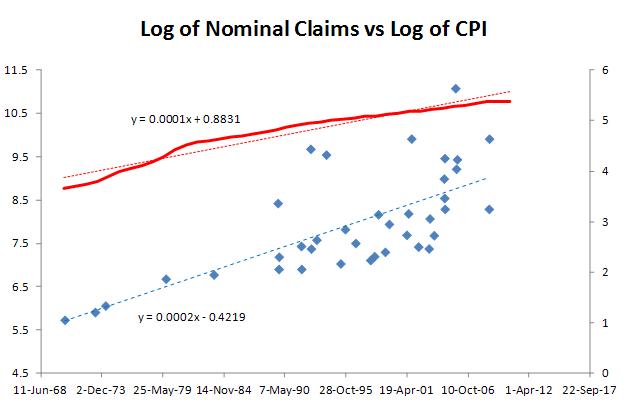
One, the red, is a linear fit of the ln of the CPI level. (Always use the log of a growth rate to pull out the compounding effect*)

The other line is my nominal catastrophe cost data. Notice that the slope is about double that of the CPI. Obviously some of that is due to the fact that there are WAY more outliers.

Remove those (arbitrarily), though, and some effect remains.

The CPI is a funny thing – a strange mixed bag of goods and services. Occasionally I dig into the CPI and one day I hope to to see if I can figure out what a good basket that predicts these cat cost levels might be.

I’m missing Non-US data, of which there is some in the source files I used. I kicked what was there out because they’re presented in USD each year (at that year’s FX rate) and inflated using the US CPI. Blagh. PPP is weak weak weak and even in theory only applies to general monetary inflation, which is completely different to building cost inflation plus the hundred other possible non-monetary sources of claims inflation for catastrophes+.

Ok, the next bit of analaysis, which is what I really wanted to do. Here’s the question: how good are the estimates of the total cost of these disasters at year-end following the loss? Here’s the answer: pretty good.

Each year, Swiss Re report the Industry loss size and, amazingly, the nominal values rarely fluctuate.

There are two notable exceptions. First is Katrina, which jumps big-time, from 45bn to 65bn. The reason for this is that Swiss started including flood losses in this total only a year later. The second exception is Wilma, which was notorious at the time for being an under-reserved loss. We were down to the ‘W’ in the hurricane alphabet and some suspect that insurers were being willfully blind to preserve capital/face so they could better handle Katrina.

These estiamtes are used heavily in a market for products called ILWs (Industry Loss Warranties). These work like this: pick a level (say 20bn US Wind) and collect if the industry payout exceeds that amount. Lower attachments (10b, 5b, etc) means higher probability of loss and so a higher price.

What’s more is that there’s a market for covers called ‘dead cats’, which supply coverage for a catastrophe after it happens. For example, when Hurricane Katrina hit, the loss first loss estimates were something like 20bn (this being a week after the loss). A prudent insurance company might look at that loss and say, wow, I think it’s going to be much higher than that. They then go to the market and buy cover agains the deterioration of the loss estimates of a catastrophe that’s already happened (a ‘dead catastrophe’ or dead cat).

This analysis suggests dead cats are a great write. A year out, anyway.

* A few weeks ago, my mom said the following to me (paraphrased): “I remember so little about high school math. I learned what I needed to to get through it and into a good University, but who really cares? Like, does ANYBODY actually USE logarithms?”

+ For example, catastrophe models use one proxy called ‘demand surge’, which purports to measure the non-linear increase in costs for rebuilding things when the normal supply of local materials/labor is fully occupied. Economies can only be stretched so far. Remember people traveling from all over the country to New Orleans to build houses after Katrina? Well, the housing supplies market before all that supply showed up is what demand surge measures.
Google and The Tragedy of the Commons

This caught my eye:

There are a lot of things I love about my Android phone–like the easy integration into the rest of my Google life. With the release of iCloud, that’s less of an advantage now than it used to be. Sure, some of the Android devices are beautiful, but if they become obsolete in a year from a software perspective in less than a year, this is going to be a serious problem.

There is a linked-to commentary of an original editorial, which is all a very interesting discussion.

The problem is a cultural one: Samsung considers its relationship with the consumer to be concluded the moment the sale is completed. Whereas Apple, Microsoft, and other software vendors have learned the value of supporting current users in the hope of enticing new ones, Samsung’s attitude remains deeply rooted in its history as a hardware manufacturer. It sees production and R&D costs in one column and it tries to balance them against sales revenue in the other, never raising its gaze to the long-term consideration of whether anyone would come back for a repeat purchase.

And from the commentary:

Samsung, as with HTC and — until a few months ago — Motorola, is a primarily a hardware company. They only make a buck when that device is purchased by a carrier or individual. Thereafter, every ounce of effort it puts into producing an update for devices already on the market eats into its profit on that sale.

Compare this to what Amazon chose to do when it forked Android for the Kindle Fire. Now, for all intents and purposes, it owns its own version of Android. It, unlike all of these companies making phone after phone using Google’s Android (plus a crappy skin), is in control of its platform and has incentive to improve and update it.

The problem isn’t Samsung, it’s systemic to Android as a whole. The makers of Android hardware see little benefit in updating even devices that are less than a year old. And, though I think it’s a punk move, I don’t blame them. There is little to no return to be had.

This is a classic tragedy of the commons. Google has this strange strategy of providing a lot of the public goods for the Internet and now maybe they’ll find that this is too big of a burden to bear?

Or maybe they go full government and raise taxes (license fees). No doubt they’re measuring the impact of mobile advertising on the bottom line. Maybe Google’s worst case scenario is Apple finding a way of sucking all that traffic into its ecosystem (a la AOL from the 90s). So keeping Android healthy and free keeps the Internet free and ad-driven.