Ax Grinding Article of the Year [political personality test]

Interesting article on a tenured professor struggling financially.

What’s interesting to me about it is just that I can see how this article would quicken the political pulse of just about everyone that reads it. There’s so much material! I’m almost suspicious of it being some kind of hoax designed to drive the entire political spectrum insane with fury.

I’ll briefly mention and skip the irony of a religion professor as a single mother raising her kid alone and messing around with bad boys who lie and cheat (sorry, couldn’t resist).

I’ll try again: her stated complaint in the article is that the brewing attack on the welfare state would be catastrophic to her counter-factual life (ie she’d have had to get a job with which she would be able to pay the bills).

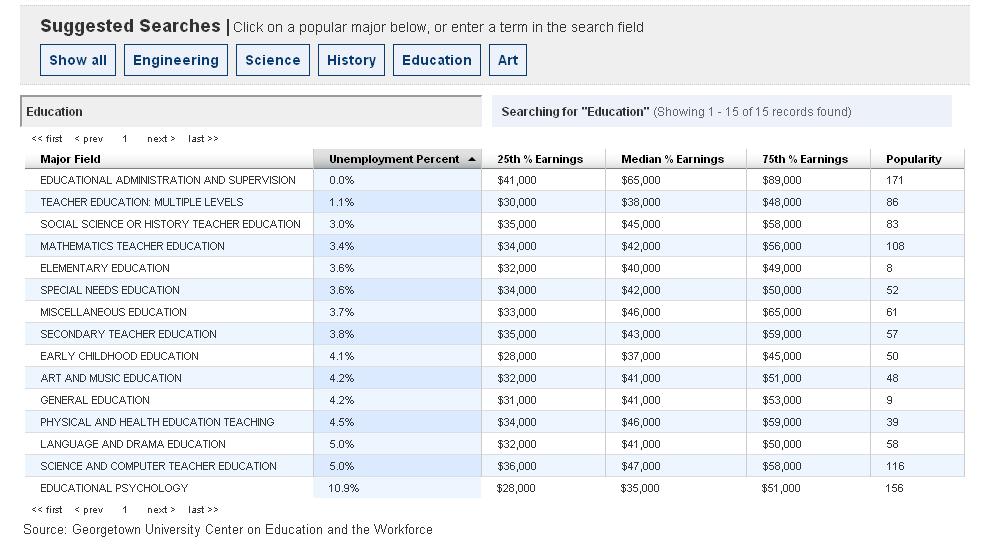
But she isn’t an unbiased observer, folks. She works for a private university in a field where the median wage is probably set by public institutions, who have been giving it (in a bad way) to teachers for a while now:

Overall, if we exclude for-profit schools, which were a tiny part of the landscape in 1999, we have seen tuition fees rise by 32% between 1999 and 2009. Over the same period, instruction costs rose just 5.6% — the lowest rate of inflation of any of the components of education services. (“Student services costs” and “operations and maintenance costs” saw the greatest inflation, at 15.2% and 18.1% respectively, but even that is only half the rate that tuition increased.)

The real reason why tuition has been rising so much has nothing to do with Baumol, and everything to do with the government. Page 31 of the report is quite clear: “except for private research institutions,” it says, “tuitions were increasing almost exclusively to replace losses from state revenues or other private revenue sources.”

In other words, tuition costs are going up just because state subsidies are going down. Every time there’s a state fiscal crisis, subsidies get cut; once cut, they never get reinstated. And so the proportion of the cost of college which is borne by the student has been rising steadily for decades.

Her skills aren’t worth much and her job is to teach other people those same skills. For 35 Gs plus room and board?

Yeah friggen’ right.

No Free Lunch [Or: The Stupid Germans Come Home To Roost]

I know that my friends and associates who work at at investment banks make piles of money. I know that they make this money mostly because the value of their skills is colossal. I know that the value of their skills is colossal because people with their skills can make mountains of money with a sprinkling of capital and a deluge of leverage.

Nine years out of 10, anyway.

But in that 10th year they wipe out about 10x-100x their capital. The business model is spared, the conventional wisdom goes, because of bailouts of various kinds.

But bailouts don’t tell the whole story for me. Bailouts aren’t certain so there will only be SO much money willing to bet on a bailout. There’s an idiot at that poker table and I think we’re figuring out who it is.

Here are some quotes about this recent paper:

Krugman:

this is the latest in a series of papers arguing that the U.S. shadow banking system consists in large part of … European banks. This suggests that the creation of the euro had large implications even in US capital markets; and of course it suggests that the financial fallout of the euromess could be very large here as well.

In short, the ECB could be in the process of destroying not just the euro, but the world.

Cowen quotes the abstract under the title “If True We Are Doomed”:

European banks may have played a pivotal role in influencing credit conditions in the United States by providing US dollar intermediation capacity. However, since the eurozone has a roughly balanced current account while the UK is actually a deficit country, their collective net capital flows vis-a-vis the United States do not reflect the influence of their banks in setting overall credit conditions in the US.

Michael Lewis:

When Goldman Sachs helped the New York hedge-fund manager John Paulson design a bond to bet against—a bond that Paulson hoped would fail—the buyer on the other side was a German bank called IKB. IKB, along with another famous fool at the Wall Street poker table called WestLB, is based in Düsseldorf—which is why, when you asked a smart Wall Street bond trader who was buying all this crap during the boom, he might well say, simply, “Stupid Germans in Düsseldorf.”

@#$@ing Monopolies

From my hometown:

Those owners want to add 500 acres of space under glass, which would allow them to operate 24 hours a day, 12 months a year. That would translate into 2,300 short-term and 1,050 permanent jobs, not to mention allow the town to expand its market for locally grown fruits and vegetables.

It seemed like a done deal when system upgrades in Essex County were set to begin in May 2010. But when Leamington Mayor John Paterson met with hydro officials he learned the ugly truth. “They said, with the way the economy was going in Windsor, their bosses said there wasn’t enough economic activity down here to worry about it,” he said. “My jaw dropped.

This infuriates me. A potentially positive NPV infrastructure project going unfunded because the bureaucrats in charge of the process possess local POWER but no local KNOWLEDGE.

THIS is a fantastic example of why governments fail. This makes me want to camp outside this despicably ignorant bureaucrat’s office and shout Arnold Kling blog posts from the top of my lungs.

Motivations And Scale

A paper on small businesses.

[W]e show non pecuniary benefits (being one’s own boss, having flexibility of hours, etc.) play a first-order role in the business formation decision. We then discuss how our findings suggest that the importance of entrepreneurial talent, entrepreneurial luck, and financial frictions in explaining the firm size distribution may be overstated.

Here’s the MR link.

Another important quote:

some firms do not grow or innovate simply because they do not want to grow or innovate… those business owners that report starting their business in part for non-pecuniary reasons were much more likely to want to keep their firm size small well into the future.

I recently heard a story about a round of layoffs at a large reinsurance company. It started with an email to 50 or so people (NOT BCC’d!!) who were told to cancel any vacation they had for the next two weeks. Sure enough, two weeks later, as told to me by one of the guys on the list, HR and managers were walking the hallways and slipping into offices to deliver their fatal blow. My storyteller suddenly found himself facing his own angel of death (his boss) but was told his name was a decoy on the list (they couldn’t be that obvious!). He was fine.

Work for yourself, indeed.

Another quote:

Second, some businesses may stay persistently small because they are in industries which have low natural efficient scales. Many small businesses are dentists, plumbers, real estate and insurance agents, small shop keepers, and beauticians. Within these industries, the productivity of the firm is directly linked to the individual’s skill set.

If you’re in a business for which human service is the primary function, there is NO economy of scale. Humans aren’t scalable.

Once upon a time, Investment Banks were such businesses, like doctors and lawyers. They ate or starved on the relationships and execution skill of a few individuals. They found scale when they figured out they could raise capital and trade on their knowledge advantage. The free option (bailout) on their debt for their bondholders turbocharged this model and they became the omnipotent behemoths we know today.

The Market Speaks

Want job security?

Have a look at the professions you should consider.

There are, broadly speaking, three industries with impressive future/current demand. The first is easy: anything that requires math and science. Want a free lunch for our grandchildren? Find a way to increase M&S aptitude and interest in your kids by 1%.

The second is a darker reality. Remember TGS and Baumol’s cost disease: the share of health care and education in our economy will be constantly rising over time.

Here are the skills:

1. People good at math and science

2. Healthcare and pharmacology (50% math and science, 50% Baumol’s cost disease/TGS).

3. Teaching teachers (100% TGS).

#3 makes me think of the (perhaps proverbial) merchants in the gold rushes of history. We’re funneling talent into the teaching profession, but the smart talent doesn’t go into the mine, the smart talent sells miners $50 pints of recycled beer and $10,000 pickaxes.

Lots of Links This Morning

Big picture econ heavy.

1. Tyler Cowen gives us a brace of thoughts today: First is a big-think:

Going back to unemployment, labor market opportunities for college grads have been eroding — except for the elite — in absolute terms since 1997-2000, well before the collapse in AD.  If those same grads are highly willing to be geographically mobile, highly willing to consider actuarial training, and highly willing to take tougher courses and study where the jobs are (doesn’t have to be tech subjects, some of those are failing too), the unemployment response to a given AD shock will be much lower.  But they aren’t, so it isn’t.  I’ve seen only small adjustments in the ambition and flexibility of college goers, not enough preaching about TGS I suppose.

Read it all.

2. Next he makes two points with quotes: 1. online education is improving and 2. ‘real’ education is stagnating. My ax grinds away.

3. Now Sumner gives us the word of the day, which I also like: “Reify” in quoting Yglesias:

don’t reify the concept of an inflation rate and then worry about whether or not the government is “really” calculating the “real” one. Things change in a lot of ways, preferences are heterogeneous and aggregating it all up into a single number is inherently wrong. It’s just that the programs need a single number.

Excellent. He follows up:

A few decades back the British tried indexing the initial benefit levels to the CPI (not wages as we do.)  Eventually the old people revolted, because as real wages trended upward over time, the living standards of the old fell further and further behind the lifestyle of those still working.

I commented on his blog with this:

My grandfather remains a retired college instructor/administrator, which he’s been for over 30 years. In fact, his life was divvied up into thirds: 1/3 before work (including WW2), 1/3 working and 1/3 retired. He’s (I think?) 90 right now. He is often amazed at how his living standard has skyrocketed since he retired.

Aha! So That’s What Social Media Is For!

Cringely recently ran a piece asking what his readers think the next world-changing technology. He then ran one with his ideas, which are:

I think our next frontier should be a combination of additive manufacturing and autonomous flight… Additive manufacturing is in the middle of a revolution that within a decade will have usable devices appearing in volume and at competitive prices from backyard sheds and sold into local commerce…

…What qualifies autonomous flight as a good frontier is that it fits beautifully in the traditional frontier paradigms of population expansion and steadily increasing property values. American frontiers, as I wrote earlier this week, have long been paid for with free or inexpensive land…

Powerful ideas, particularly additive manufacturing. But this feels a bit too much like so many pronouncements of yesteryear on what ‘the future’ will look like. They’re always wrong. And they’re always wrong because they are about technology and the future is shaped by economics.

His point about flight reducing land values (possible… I suppose) is close. But the most powerful idea in economics is that incentivized individuals collaborating privately produce astounding things.

And technology pronouncements are about the things we DO think of, which means we need to think about the meta-process that produces technology. That means (to me) that the real future will be shaped by the revolution that is starting in education.

Consider this HN discussion:

TITLE: Best approach for self-taught developer looking for job?
Comment 1: Pulled up your github account. Aside from you accidentally adding your home directory, you’re making good progress. If you’re looking to get a job quickly, I’d encourage you to focus on one area and I think your shortest path is the front end technologies. Pretty much every firm I know of in NYC is hiring front end developers and the main limitation is finding people who actually know javascript…

And you can demonstrate it by sticking something on github

Prove yourself on Github and you suddenly have absolutely no need for a college degree. Even today I’d argue that there’s nothing you can achieve in a college liberal arts program you can’t do with a blog (implying an Internet connection as well) and a library card. That is to say, more or less for free.

This cuts to the heart of what an education is, which is two things: learning things and proving it. The reason why people don’t go to Wikipedia University isn’t that you can’t learn anything there, it’s that you can’t prove you learned it. It’s too easy to misjudge competence: even losers can look and sound like they know what they’re doing. The signaling aspect of ‘going to Harvard’ gets around this problem. But messily. And for so very few.

Now that’s changing. If you can demonstrate real domain competence in an open environment, suddenly the dual-power of a University (giving not just knowledge but also a piece of paper that proves it) is broken.

Michael Nielsen is getting close to what I’m thinking of in pushing for collaborative science. I’m imagining a Github for all worthwhile public goods in all scientific disciplines, but not as an output, as an input. Eventually all scientists will grow up sharing everything they do online. Those Githubs will be their training grounds. The universities of the future.

And they’re free.

There Is No Middle

The Economist laments:

Imagine a presidential candidate next year who spelled out the need for deep future cuts in spending on entitlements and defence, as well as the need to raise some revenue (largely by getting rid of deductions); who explained that the pain would be applied only after the recovery was solidly in place; who avoided class or culture wars; who discussed school reform without fear of the Democrats’ paymasters in the teachers’ unions. Better still, imagine a new centrist block in Congress, which might give that candidate (or for that matter a President Obama or Romney) something to work with in 2013.

The political system is too open to so cleanly flip the bird to enfranchised minorities like teachers unions, farmers and everyone within earshot of the Medicare dinner bell.

THE problem today is that we aren’t as wealthy as we thought we were (and elect politicians whose job it is to preserve that illusion). There is a lot of debt that needs to go bad, which means gigantic capital losses. And that capital doesn’t ‘belong’ to bankers, folks.

It belongs to you. It’s your savings. It’s your pension. It’s your home equity.

It’s all well and good to idolize (in hindsight) historical figures that make good decisions in tough circumstances, but we quickly forget the ones that flub their moment of truth. There’s a reason the’re called “tough” decisions. It’s because you’re picking losers.

No politician in his right mind is going to tell voters: I’m going to destroy some of your wealth and keep destroying more until the system starts working again. I’ll let you know when I’m done.  Gosh, I hope I figure it out in time to stop before I go too far. Yes, I’m doing this when unemployment is 9%.

But that’s what has to happen. The most painless way is to do it with a burst of inflation. The most painful way is austerity. But it has to happen.

It’s no surprise WW2 happened after the last such episode.