Progress And Unreliable Sponsors

Here’s Jeff Masters.

NHC director Bill Read stated in a interview this week that had Hurricane Irene come along before the recent improvements in track forecasting, hurricane warnings would have been issued for the entire Florida, Georgia, and South Carolina coasts. At an average cost of $1 million per mile of coast over-warned, this would have cost over $700 million.

Wow. The article goes on to lament the potential budget cuts to the NHC that threaten further improvement in this forecasting system.

But this isn’t really ‘pure science’ in the classic sense: there’s a genuine commercial application for the stuff the NHC puts out. As Masters points out, $700m is not a small number.

I guarantee that some kind of private (re)insurer consortium would step in to fill the funding gap in this research budget were credibly threatened. They’re a group that can easily measure how much money is on the table to lose.

Heck, I’d bet that the budget would increase.

Down With Crap Research

Here is a post on demographics. CalculatedRisk sums it up well:

This is probably another reason many boomers will never retire

I agree with the general sentiment here, but will quibble nonetheless.

The study correlates one-year trailing P/E to the ratio of Middle-Aged over Old People (sounds a bit juvenile putting it that way). They calibrate this relationship and project the P/E ratio over the next few years. I have a few comments

  1. I generally dislike statistical models. They are prone to many biases.
  2. I dislike statistical models that adopt point estimates for variables even more. In this case, I have little doubt the modelers have non-stationary data. That means that these folks aren’t accounting for changes in variable relationships.
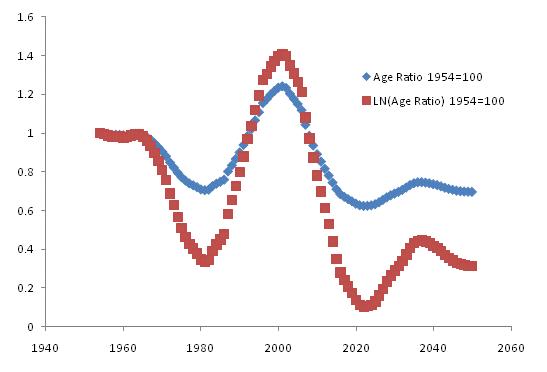
  3. Then there’s this graph:

Ok, now I’m pissed off. What on earth are they doing taking the log of the age ratio? What is non-linear about an age ratio? Oh, wait, let me just flick down to the footnotes to find the explanation for this unexpected and important assumption.

[crickets]

What does taking the ln of the age ratio do? Well, luckily they offer up their data and I compared the log data and the ‘raw’ data. Logarithms matter, folks:

Back to #1 above for a sec. Russ Roberts has this fantastic idea that every scientific study should be published with a little appendix showing all of the dead ends and false leads the researchers spun their wheels on.

I wonder how many different ways these researchers crunched this (these!) data before they found a proposition that fit their conclusion. Did they write up the report before they even conducted the analysis?

Anyway, even garbage research can tickle my bias and make me think for a sec. In this case CalculatedRisk has the right tack, which has been expanded upon by WCI. Boomers aren’t retiring.

Great, but yawn. Heard that before.

I’m drawn back to one of the irritating things about that previous analysis. If the boomer retirement party is postponed, what was the reverse effect back in the 90s when they were peaking in productivity?

Back to WCI, for a Canadian take:

Declining employment levels of their elders is the answer. Early retirement. Poor boomers won’t have it as good as those they displaced.

The thing with Tsunamis is that, just before they strike, they suck all of the water off the beach. Then, as we all know about big waves the water pulls back from the force of the retreating water. Boomers can’t help but push their adjacent demographic groups out of the workforce.

Hurricane Irene

I’m watching this situation pretty closely for all kinds of reasons. It’s not often my professional and personal interests coincide.

Best resource, hands down, is Jeff Masters’ blog. The source of all the raw analysis is the National Hurricane Center.

The latest modeling is annoyingly inconclusive.

I’m going to focus on New York, because that’s where I live. (In general I’d say the Carolinas are effed and most of Jersey is in for a beating)

There are three scenarios for New York, all of which seem plausible from that modeling output.

  1. If the storm stays inland and heads over the Pocono mountains, we get some serious flooding and damaged countryside, but nothing too crazy. The storm weakens considerably and the wind dies off.
  2. Toss up over which of the next two is worse: if the storm goes straight across the Carolinas and streaks along the coast, we’ve got a problem in the city. This means that all of the coastal areas (ie the most vulnerable to storm surge) get battered and (AND) the warm water keeps the storm strong. NY will probably get flooded right up to 14th street, I get evacuated from Battery Park City and it takes days for the Subway system to drain.
  3. Door #3 has the storm veer off into the ocean, really really power up and hammer (absolutely clobber) Long Island. This will have the worst wind damage, though Jersey and NYC will probably be spared. Next up is Cape Cod and Nantucket. These probably get a big helping of Hurricane winds, too.

Using this, I’m trying to handicap the models and am having some serious trouble. I’ll probably keep updating this post as the day wears on.

Edit 1:

I keep saying Carolinas, but I really mean North Carolina and Virginia

Edit 2:

Wowee. Jeff Masters gives us lots to think about. A few key points:

  • They eyewall has collapsed, which means higher pressure and a less powerful heat engine. We’re in the endgame, so rapid, massive intensification is unlikely now.
  • Wind shear, hurricane Kryptonite, is moderate (note on pic: red line is direction relative to storm track, I think, and blue is speed) but doesn’t seem to be having a big effect.
  • This sucker is a monster, which means more storm surge, damage potential measured at an eye-popping 5.1/6.
  • Masters gives a 20% chance of topping Manhattan’s flood walls and filling the Subway system with seawater.
  • Wind damage likely won’t be a big deal, now. The heaviest winds are East and out to sea (sorry, Long Island!), but aren’t crazy-strong, just strong.
  • Probability of big winds in NYC has plummeted
  • Get ready for blackouts

Personally, I’m scheduled to fly to Florida tonight for a wedding in the Jacksonville area tomorrow. 20% chance of complete flooding is probably high enough to evacuate and fleeing to the Hurricane’s wake is probably my best bet.

How and in what manner I get back is the trick.

Edit 3:

Well, looks like I’m outta here. From my building management:

The NYC Office of Emergency Management is strongly advising all residents of Battery Park City to evacuate today.  While the evacuation is not mandatory at this time, it seems clear that it will become mandatory at some point today or tomorrow.  Since the MTA is going to shut down at some point tomorrow, we strongly urge everyone to make immediate arrangements to evacuate now.

To JAX!

Incentive to Innovate

I’m spending a lot of time on Mandel. Here is another one I disagree with.

In other words, if we suddenly get access to a bunch of cheap Chinese labor, we don’t bother to invent robots. Then tomorrow, when the cheap Chinese labor runs out, we find ourselves without any robots.

The point is that necessity is the mother of invention and Chinese labor is dialing down our motivation.

Can’t you just argue that cheap Chinese labor provides even greater competitive pressure than robots? Now the robots have to be even smarter/faster/etc.

Firms don’t stop competing when they lose a round to someone. It doesn’t matter whether it’s Chinese people, American robots or Chinese robots.

The technology just has to hit a higher target. And when those Chinese people become truly highly educated and start earning higher wages as a result (ie they finish the catch-up process), total innovation in the world will explode.

I’ll take another billion minds working on today’s problems, thank you very much.

Gold

I read somewhere once that all of the gold reserves in the world could fit inside a normal-sized suburban home. So let’s test this:

There has been 165,000 tonnes of gold mined in history.

A tonne (metric tonne. Which is actually a megagram) is 1,000 kilograms.

A cubic meter of gold weighs 19,300 kg.  165,000 * 1,000 / 19,300 gives us 8,549 cubic meters.

How big of a cube is that? The cube root is 20.43.

So a 20m by 20m by 20m cube would do it.

Ok, let’s say the average house has two floors and 2,000 square feet total. That’s 1,000 per floor, which is 92.5 square meters per floor.  Let’s say there are 2.75m ceilings. This gives us a cube of roughly 10m x 10m x 5.5m

550 cubic meters. Not even close.

You’d need more than 15 houses to do the trick.

Culture

Excellent piece by Cringely:

The decline of HP began, I think, with the spinoff of Agilent Technologies in 1999…

You see Hewlett Packard was in 1999 an instrument company that made a hell of a lot of money from printers, not a printer company that also built instruments…

Hewlett and Packard were instrument guys: had they still been on the job in 1999 they would have gone with Agilent.

The point is to say that the things that made HP great weren’t recognized by the people who ran it (“into the ground!” we’d like to shout) in its later years. ‘Professional managers’, as opposed to founders, need to really really understand why and how a company makes money.

It’s a key understanding that profitability isn’t in the numbers, it’s in the culture, in the people. Looking at HP’s numbers in the 90s, someone would say: “well, they’re a printer company that does all this other crap”. They’d also say about Apple: “they’re a computer company that makes a few cool accessories”.

HP’s power was the innovative capacity of its engineers, supercharged by its culture.

We’ve all heard how great it is that Google allows its employees to spend 10 percent of their time working on their own projects. Google didn’t invent that: HP did. And the way the process was instituted at HP was quite formal in that the 10 percent time was after lunch on Fridays. Imagine what it must have been like on Friday afternoons in Palo Alto withevery engineer working on some wild-ass idea. And the other part of the system was that those engineers had access to what they called “lab stores” — anything needed to do the job, whether it was a microscope or a magnetron or a barrel of acetone could be taken without question on Friday afternoons from the HP warehouses. This enabled a flurry of innovation that produced some of HP’s greatest products including those printers.

Understanding that point, that the printers were a lucky strike that emerged from an excellent, innovative culture was was absolutely critical to keeping HP on top. Such a culture could get lucky again and again.

But now the culture is a wreck.

Andreessen’s Non-Sequitur

Marc Andreessen in the WSJ is hard to excerpt. It’s a good article and here is my summary:

  1. Technology companies are in the headlines again.
  2. They aren’t getting awesome valuations in the stock market
  3. Every major industry in the world is being transformed by software
  4. Therefore the software companies should win

I agree with his sentiment and I agree that his investment strategy is probably the only way of trying to make money on this trend, but I see a non sequitur in #4 above.

The problem is that existing companies are pretty bad at software, particularly compared to the young, high-energy Valley startups. The Amazon/Borders story that Andreeseen references will probably prove the exception. It’s a path of much less resistance for incumbent companies to just pick up some Valley Best Practices and change their cultures a  bit over time than the other way around.

Certainly some will acquire their software-only valley doppelganger (if, say, Borders had bought Amazon in 2002) to try to change their culture. Over Andreessen`s macro time-horizon, this is probably the best he can hope for. But a software company just makes software and there aren’t many industries that can actually support SaaS players: not enough scale.

The pardigm will be for companies to keep doing what they do, but with more and more software.

The winners will have top-notch proprietary, internally developed and maintained software wrapped in a traditional business model.


Pricing Power

Looks like Buffet invested in Verisk Analytics, which is an organization that I am familiar with. Here is the real point:

Verisk is an American company that was founded in the 1970s by the major US property and casualty insurance companies. These companies collectively provided Verisk with their claims data in order to create a centralized database that would allow the industry to analyze risk better.

The analyst gets the point right but the names wrong. The Insurance Services Office (ISO) was created as an information mutual for the industry. It’s now a subsidiary of Verisk.

There’s no doubt Buffet’s onto something, though. This is a company with a gigantic ‘moat’, as he likes to call it.

ISO pulls off the confidence trick that I’ve seen before. They poll member companies for data, aggregate it and then sell it back to them. For quite a price, I’m told.

ISO data gives every insurance company a benchmark for claims costs and trends in various lines of business. It is literally the only way people have of guessing whether they can make a profit in a particular line of business if they aren’t currently in it.

Imagine a mining company that pulls zinc out of the ground and is mulling over the possibility of opening up a copper mine next door. How would this company make this decision? Well, they’d probably check the pricing history for copper and see whether they think they can make money on it. They know their costs of production, but they don’t know the price.

Insurance companies don’t have this information. They literally do not know how much their policies cost up front, which means that they need intimate knowledge of a market before they can decide whether investing in new products is a good idea or not. ISO is the only way they can get this data out of their competitors’ hands.

I’ve often toyed with the idea of what it would take to start a company that would compete with ISO. The problem is that ISO benefits from gigantic network effects. Without any scale you’re just one insurance company’s data. And I know that the biggest insurance companies (like AIG) guard their data jealously, so you HAVE to rely on the little guys banding together.

What I’d need to identify is a blind spot for ISO. A line of business that they don’t serve very well and probably won’t start serving soon. I’m sure it exists. The other thing I’ve heard about ISO is that it’s an antiquated, backwards organization. Doesn’t surprise me. They’re practically the insurance government. What incentive do they have of serving someone well?

None.

“Can We Really?” Or “In Which I Retweet A Scott Sumner Post”

Yikes:

I once read all the New York Times from the 1930s (on microfilm.)  You can’t even imagine how frustrating it was.  They knew they had a big problem.  Then knew that deflation had badly hurt the economy (including the capitalists.)  They new that monetary policy could reflate.  And yet . . .

Weeks went by, then months, then years.  Somehow they never connected the dots.

“Monetary policy is already highly stimulative.”

“There’s a danger we’d overshoot toward too much inflation.”

“Maybe the problems are structural.”

“There are green shoots, things are getting worse at a slower pace.  The economy needs to heal itself.”

“Consumer demand is saturated.  Even workingmen can now afford iceboxes and automobiles.  We produced too much stuff in the 1920s.”

And the worst part was the way political news kept slipping into the financial section.  Nazis make ominous gains in the 1932 German elections, Spanish Civil War, etc, etc.  In the 1930s the readers didn’t know what came next—but I did.

Thankfully we can learn from their mistakes.

Made in China

As both a fact of labeling and an economic boogeyman, this now qualifies as a complete joke (from MR):

Chinese goods account for 2.7% of U.S. PCE, about one-quarter of the 11.5% foreign share. Chinese imported goods consist mainly of furniture and household equipment; other durables; and clothing and shoes. In the clothing and shoes category, 35.6% of U.S. consumer purchases in 2010 was of items with the “Made in China” label.

When my in-laws were renovating their home a couple years ago, I helped out where I could when we visited. They were intrigued and somewhat excited to source some shelf units from Canada (they live in Canada).

The shelf units were garbage. The customer service was garbage. I unhelpfully quipped that we should expect nothing less from something that wasn’t made in China.

Now, I’d say that the real story is that this company was just out of its league distributing furniture through Home Depot. It has nothing to do with Chinese vs Canadian manufacturing; it’s actually about scale and professionalism.

Let’s face it, most professional companies that operate at scale have a portion of their supply chain laying across the Middle Kingdom. In that sense, my comment was appropriate: a company that makes ‘stuff’  and doesn’t source something from overseas is suspect in my books. They’ve probably effed up their supply chain.

And that’s a signal that they’ve probably effed up a bunch of other stuff, too.

The point is that the bulk of value does not sit in China, no matter what the stupid label says. Most of it is very close to home.

Michael Mandel responds with two points in support of the “the sky is falling because we don’t make anything anymore” philosophy:

The authors did not distinguish between dollar shares and quantity shares of imports. When imported goods are much cheaper than domestic goods, then the quantity share can be much larger than the dollar share.

The input-output tables used by the authors contain no actual information about how much of Chinese imports are going to personal consumption.

I’ll start with the second point, which is a strong one: the data used to allocate the cost of imports to personal consumption don’t measure the imports for personal consumption and how could they? Intermediate goods, parts, goods for corporate consumption: it’s hard to tell what’s what.

The way around it is to measure the share of PCE in the economy as a whole and apply that share to the imports as a whole. If there is a different mix of GDP factors in imports relative to the whole economy, our figures are way off.  Ok, got it.

Now for the first point, which makes sense. The problem is that he goes on to say this:

Which share is right?  For sizing the  impact of imports on U.S. jobs and manufacturing, the quantity share is much more relevant than the dollar share.

But if the per unit cost of imports plummets, there’s a lot more money to be spent elsewhere. This isn’t measured in quantities.

Mandel is the most persuasive proponent of the manufacturing fetish around, but he still doesn’t have me.

Look at this graph from an earlier post:

The U.S. needs to change course to a production economy: put more emphasis on investment in physical, human, and knowledge capital, and less on consumption as the yardstick of success. We need to take up our fair share of the global productive burden.

Good analysis and graph.

But I don’t share the doom-and-gloom. I still can’t think of anything that says that this relationship is a terrible thing.

Personally, would I rather be an engineer or a sales manager? Engineer, for sure. But are sales managers less valuable to the world?

Look a bit harder and it looks like what Mandel is really worried about is debt, not consumption vs production:

Given that we as a society are running up big debts,  it is highly likely that our children will be better off if we choose to invest more today and consume fewer goods and services, whether they are imported or domestic.

No disagreement with me, then. If we took out gigantic blocks of debt and spent it on useless white elephant projects I presume Mandel would have a problem with that, too.