Worse Than Useless Chart Of The Day

From Felix Salmon:

Sorry, Felix, this chart is unhelpful and misleading, no matter what your political predisposition.

Let’s imagine you’re a lefty. You look at this chart and think it’s great, but ONLY because you think it will help you convince ‘conservatives’ or ‘tea-partiers’ that taxes can/should go up. I would argue you have absolutely no idea whether this chart supplies a useful way to think about politics or economics. You’re thinking with your debating hat on, not your scientist hat. That means that you’re looking for something helpful and not something true.

Ok, so let’s say you’re not a lefty (not the same thing as being a righty and easily in the majority). You look at that chart and don’t give a crap. Peoples’ reaction to tax rate changes have nothing to do with sober analyses of what share of revenue the government can/should get in a society. It has to do with whether people feel like they can afford to pay more taxes or not.

This makes the chart misleading because it doesn’t address peoples’ real concerns and unhelpful because it distracts lefties from arguments that might actually work. If there are any.

The only chart that’s less useful than the one above is this doozy (or something like it):
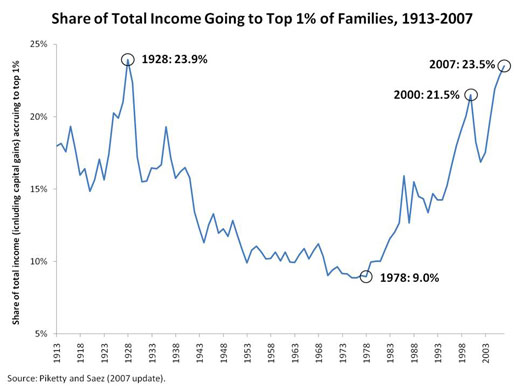
Again, a bias-confirming, load of garbage aggregate measure. Inequality is about how you feel you stack up to your neighbors. This chart does NOTHING to convince anyone that they stack up less well to anyone they know.

Populist movements arise when people feel like others are getting stuff they aren’t entitled to. That’s unfair. That’s inequality.

And right now, for whatever reason, public-sector-supported left-wing sacred cows are the poster children for getting a free ride.
“Measuring Unobservable Risk”

That is a paraphrasing of the title of an article in an issue of CFA magazine I found around my apartment. It caught my attention. Particularly because I’m inclined to think anything that makes that sort of claim is either BS or dangerously misleading.

So here’s the mechanism to the ‘omega-score’:

  1. Correlate returns data to ‘operational issues’ (“These include criminal, civil, and regulatory issues.”) disclosed in a regulatory filing *some* hedge funds have to make.
  2. Establish that funds with these issues perform poorly. No surprise. They use something called ‘canonical correlation‘, which assigns weights to a set of variables (‘operational issues’) and tests their weighted effect on returns. Without reading the paper, it’s tough know what the ‘omega-score’ is, but it’s probably some kind of representation of the correlation.
  3. Now find some data that is publicly disclosed by all hedge funds. These are the new variables.
  4. Test various correlations that match the profile of the #2 variables. This is how we set some kind of statistical equivalence between the variables we know have an effect on the returns (from #1) and those we suppose have an effect (the ones that are always disclosed).

That ‘canonical correlation’ thing is a clever technique that I don’t know much about. One thing to watch out for is that we’re talking about establishing a statistical artifact that has no direct intuitive basis.

In other words, there’s a difference between saying “hey, I think that these two or three variables will have an effect on returns” and saying “hey, these variables might be related to these other variables that probably have an effect on returns”. Gets messy.

And the focus is a bit confusing. What we’re really doing is correlating ‘operational issues’ with variables that heretofore had not been associated with that kind of nastiness. If I’m right that that’s what we’re doing, I’d have two questions:

  • Why do we need to do this for each fund individually? If variable x is associated with bad behavior at one fund, wouldn’t it be similarly associated at another?
  • Aren’t the findings of the correlation study interesting in of themselves? If you can get better at figuring out which funds are in legal trouble, why risk building a statistical white elephant trying to link it to returns results?

Anyway, really interesting stuff. This kind of study demonstrates the power of even modest bits of information if they’re consistently and universally disclosed.

Soros Is Out

CNBC harped for a few minutes this morning about how Soros no longer manages money for other people. A few angles were pointed out:

  1. How does a DEMOCRAT bemoan regulation?!
  2. Why do we care what Soros does?
  3. Wait, 24.5b? I thought he only had 15b?

They also made a strange point, which I haven’t been able to find backup for online, so beware. They said that Soros parks some of his money in other hedge funds and that he isn’t likely to pull that cash back to himself.

Strange, isn’t it? He hates the regulation as a manager but is happy to live with it as an investor.

Is there a ‘there’ here? I’m not sure.

So What Is Default, Anyway?

Here is Felix:

ISDA has made the right decision: the Greek bond default does not and should not count as a “credit event” for the purposes of whether Greek credit default swaps will get triggered.

As Felix rightly points out, if you take a 21% haircut on your bond principal and can’t call that a default, what good is CDS protection?

A few years ago, just about every reinsurance broker in the world (us included) was looking at CDS as a way of hedging insurers’ exposure to reinsurance recoverables in the event of reinsurer insolvency. It only took a few days’ work to realize the whole thing was useless.

The problem in insurance is that reinsurers don’t go into ‘default’. They go into something called “run-off”.

Insurer obligations are fundamentally negotiable. If an insurer declares itself ‘in runoff’ (ie it is accepting no new business) it has signaled its financial weakness and warned claimants that the pot might run dry before they get paid. Suddenly a claimant will accept 0.80 on the dollar for fear of getting even less later.

Well, that improves the solvency of the insurer but the people owed money get screwed.

Bankers tend to feel pretty smug about their black-and-white default definitions because the cross-default provision lets most lenders push the big red button when they get miffed. Looks like the Eurocrats have got that one sewn up somehow, though. Oops.

All anyone really wants is protection against principal reductions on what’s owed ’em. Throw in a bit of relief from the legal nonsense of squeezing your last few pennies out and you’ve got yourself a product.

Problem is, this is a product that doesn’t exist.  In any financial market, it seems.

The Present

Tyler Cowen links to this paper and quotes from it:

Most service production is consumed domestically and virtually all public services are not traded…the most remarkable structural change in the Canadian economy is that Canada was less integrated in world markets at the end of 2006 than it was a decade earlier measured by intense export openness

I didn’t read it. The point as I see it is that non-resource Canada is becoming a service provider to itself.

So, in caricature: Canadians trade energy, minerals and timber for manufactured goods and swap food with California and Chile. Mostly, though, Canucks just scratch each others’ backs.

Meet Your Insurance Broker: Google

Insurance is the most expensive keyword money can buy.

This is GEICO and Progressive showing us that insurance distribution is extremely valuable. Those local brokers’ salaries are now being paid to Google engineers.

Advertising is expensive, though, and you need scale for this business model to work.

US Auto liability works fine, but it is both the biggest and most standardized insurance market in the world. It is the exception that proves the rule that an insurance broker is an economically useful advocate.

The Real Larry Summers

From Felix, a constant critic of Summers, comes this gem.

Quote of the piece has nothing to do with economics:

MR. ISAACSON:  So was that scene in the social network true?

(Laughter.)

DR. SUMMERS:  I’ve heard it said that I can be arrogant.

(Laughter.)

DR. SUMMERS:  If that’s true, I surely was on that occasion.  One of the things you learn as a college president is that if an undergraduate is wearing a tie and jacket on Thursday afternoon at three o’clock, there are two possibilities.  One is that they’re looking for a job and have an interview; the other is that they are an asshole.

Watch and read it all.

Excel Is Crap, Long Live Excel

I spent the entire day redlining on a data cleansing project for a client. The database is based in excel (as almost all are, in my experience) and I’m once again forced to use VBA linked into excel for my work.

“Real” programmers despise visual basic and I’m starting to agree that it’s a crappy way to analyze anything. But it has one gigantic advantage over other tools: Excel.

Excel is, in my mind, possibly the most remarkable program ever created. I once listened to a podcast with a guy that worked for Microsoft who talked about how the Excel team were the ass-kickers back in the early days.

I’m not surprised. That program has introduced millions of people to the power of automating simple functions (ie computer programming). I suspect the back office of my company is typical: mostly middle-aged, mostly female and mostly born in other countries. Now how many of them thought they’d be building and running simple computer programs for a living?

Yet that is what they do.

I admire Excel and though I immediately select a different tool when I have the choice, I rarely have that choice. The tech boom became a tech bubble for the same reason that postal services still exist: change is cultural as much as it is technological.

Excel is about as much as our society can take for now.