DebtRank: Regulators Can Innovate, Too

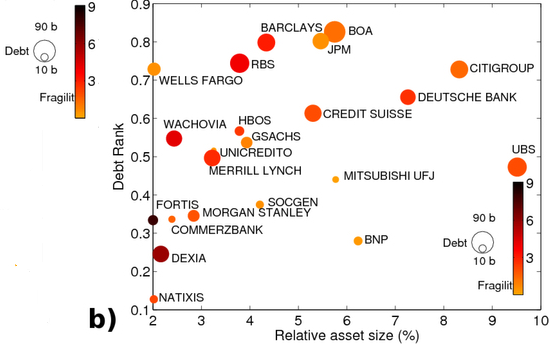
Systemic risk — the risk of default of a large portion of a financial system — depends on the network of financial exposures among institutions, but there is no widely accepted method for working out which institutions in a network are the most important to the stability of the system. Inspired by feedback-centrality measures in networks, such as PageRank, Stefano Battiston and colleagues introduce a new measure of systemic impact, which they call DebtRank. They use DebtRank to analyze a recently released data set with information on the institutions that received aid from the US Federal Reserve Bank through its US$1.2 trillion emergency loans programmes during 2008 to 2010.

The authors find that during the peak of the crisis, a group of 22 financial institutions, which received most of the loans, became more central to the network, which means that the default of each one would have a larger economic impact on the whole network. Even small, dispersed shocks to individual banks could thus have triggered the default of a large portion of the system. The authors note that because the network of impact used in the study is a proxy of the real, unknown network, the findings should be regarded with caution, but the study shows the kinds of insights that can be gained using DebtRank.

More here. Via Alex Tabarrok at MR who comments:

One point to note is that the authors calculated centrality using ex-post data from the Fed. Using this measure, DebtRank clearly signaled danger prior to the crisis and did so earlier than other metrics. In order to do this in real time, however, much more transparent and timely data would be necessary. The fact that centrality doesn’t correlate all that well with bigness, however, indicates that without this data the problem of monitoring risk is even more difficult than it appears.

I am impressed. Being able to distill an abstract concept like “interconnectivity” into a single number is extremely powerful. Politicians should latch onto this and legislate its calculation at reasonably frequent intervals.

Bailouts are a horrible, disgusting abomination. My first reaction to all this is that we should break out the pitchforks and treat high DebtRanking institutions real bad. Like they do in Texas.

And I will plug my ears lest I listen to too much of this kind of cowardly disclaimer:

The authors note that because the network of impact used in the study is a proxy of the real, unknown network, the findings should be regarded with caution

Education The Export of the Future? Enter the MOOC

The NYT had the first article on Coursera:

As part of a seismic shift in online learning that is reshaping higher education, Coursera, a year-old company founded by two Stanford University computer scientists, will announce on Tuesday that a dozen major research universities are joining the venture. In the fall, Coursera will offer 100 or more free massive open online courses, or MOOCs, that are expected to draw millions of students and adult learners globally.

And this one has the contract with its partner institutions.

The contract reveals that even Coursera isn’t yet sure how it will bring in revenue. A section at the end of the agreement, titled “Possible Company Monetization Strategies,” lists eight potential business models, including having companies sponsor courses. That means students taking a free course from Stanford University may eventually be barraged by banner ads or promotional messages. But the universities have the opportunity to veto any revenue-generating idea on a course-by-course basis, so very little is set in stone.

And this on the economics:

When and if money does come in, the universities will get 6 to 15 percent of the revenue, depending on how long they offer the course (and thus how long Coursera has to profit from it). The institutions will also get 20 percent of the gross profits, after accounting for costs and previous revenue paid. That means the company gets the vast majority of the cash flow.

I enrolled in the Database and Machine Learning courses in the precursor to Coursera last fall and I’m honestly still astonished it was all free.

I think they could definitely charge some small tuition fee and still attract literally millions of people for some of these classes. There’s a lot of money on the table there and a LOT of it is going to come from outside the US.

I am not confident that anything will seriously threaten the status economy of higher education. This might enhance it.

Imagine this model: online courses offered by MIT are 150% as difficult as the real thing because it teaches the same material with far less instruction. Class sizes can shrink and scholarships are offered to outstanding performers from the MOOC.

Suddenly it’s harder and cheaper to get into MIT.

Bill Gross and Nassim Taleb Sitting In a Tree, T-R-A-D-I-N-G.

David Merkel turned me onto this piece (gated) by Bill Gross wherein he describes the PIMCO strategy in a fairly readable way. It’s fascinating.

Gross opens by describing how some institutions can reap persistent returns by implementing a consistent (“structural”) financial strategy. Banks, for example live by borrowing at short term rates and lending at long term rates. Insurance companies live by borrowing for free and underwriting the risks of repayment timing and amount.

Gross then describes PIMCO’s strategy, which he calls their way of generating “long term alpha” (that really is such a silly term). Basically PIMCO does two things: first, they act as a mini-bank, by borrowing short-term and lending longer-term. The actual implementation he describes of this is a little over my head, given that I have no trading experience, but I get the principle. The second strategy is that they “sell volatility”, which he means they write options of all kinds, flavors and colors.

Gross’ thesis is that the market, from his perspective, overprices volatility. He makes the point that his perspective is extremely important here so it’s worth discussing a bit.

Gross feels that his investors have a time horizon of about 3 to 5 years. Since volatility (fluctuations in asset prices in this case) fades into the background over long time periods, Gross literaly measures volatility to be lower than other investors. If Gross has a longer than average time horizon the market will be more expensive to insure that volatility than him. This is his alpha.

This philosophy is the exact opposite of Nassim Taleb’s view of the world, which I might summarize like this: “You do not understand volatility. Order your portfolio (your life!) so that you are not harmed by volatility, but benefit from it.” He calls this philosophy “Anti-Fragility”. here’s an interview where he discusses it.

There are two ideas in this world view. The first is his well-known Black Swan idea, which is that there are massive, unpredictable events that occur without warning and reap devastation. Exposure to Black Swans can probably never be eliminated, almost by definition, but Bill Gross’ investment philosophy is to explicitly seek exposure to extreme events, arguing that at his time horizon the risk of Black Swans is immaterial. A quick search hasn’t turned up any data on PIMCO’s performance through the crisis. Wonder how they did.

The other half of Taleb’s Anti-Fragility idea is that one should seek out processes that benefit from volatility. He uses human bones as one example: they get stronger as they’re exposed to stress. Obviously a Black Swan for a bone is getting hit by a tank or something, but Taleb would say that if your bones are stronger because of previous stress, you have more of a hope against that tank.

So Bill Gross says sell volatility if your time horizon can take it because it’s systematically overpriced. Nassim Taleb says buy all the volatility protection you can get your hands on because since tail events are impossible to understand volatility is systematically underpriced.

Taleb might say to Gross that his key assumptions (this time about investors’ time horizons) will break down in a Black Swan event and everything will fall apart. Gross might respond by saying it’s easy to be a nay-sayer but big boys take risks and I’ve made tons of money for my investors with this strategy.

Sounds like opposite sides to a trade to me.

Thoughts On Mathematical Finance (3F/MFE Exam)

I moved over to the actuarial side of the business a few years ago from our capital markets team. I’m not an actuary, but I took an interest in modeling and followed the advice of my first boss in the business: “want to get ahead? Be more useful to us”. We were starting an actuarial department and I joined in.

I didn’t start taking the exams seriously until my wife got pregnant. It’s been a breakneck pace since and I just wrote my fourth exam, the 3F/MFE, subject of which is the math of derivative securities. I’m fairly familiar with the area from the CFA exams, but what does this have to do with valuing P&C liabilities, the job I’m training to do? And anyway, isn’t all this math exactly what is supposed to be wrong with finance?

There are two big ideas in the syllabus that are worth discussing. The first has some notoriety, which is that we assume asset returns are distributed normally and so prices are distributed lognormally. The immensity of this assumption cannot be overstated. First because just about everything in mathematical finance requires it to be true; second, it’s just about complete garbage. In fact, there is absolutely no attempt to justrify this assumption in any of the required readings.

The other idea is a bit more esoteric and is called risk neutrality. Risk neutrality is a way of dealing with the problem that people are risk averse, in that we’re unlikely risk $1 of loss for $1 of gain on a 50/50 bet. So we’d only take a 50/50 bet if we could win $1.5 and lose $1.

In a strange twist, the math skips over the ‘utility’ of a dollar of profit vs dollar of loss. Instead, we reweight the probabilities so that the return is the risk free rate. In a risk neutral world, it’s not a 50/50 bet.

Don’t worry, I don’t really understand it, either. One of my complaints is that, once I’ve passed the test (8 weeks ’till they tell me!), it doesn’t matter whether I understand it or not, I’m never going to use this knowledge. The understanding is literally worthless.

So why did I have to learn about it? In the the released sample problems there’s this really interesting remark (number iii after the solution to problem 71 in this pdf document) in respect of risk-neutral pricing:

Arguably, the most important result in the entire MFE/3F syllabus is that securities can be priced by the method of risk neutral pricing… Some authors call the following result the fundamental theorem of asset pricing: in a frictionless market, the absence of arbitrage is “essentially equivalent” to the existence of a risk-neutral probability measure with respect to which the price of a payoff is the expected discounted value.

I didn’t understand what that meant until I really got stuck into the Black Scholes derivation. The story of the that derivation goes like this: borrow some money and buy a derivative. Now hedge away the risk with some shares. All that’s left is the risk free rate. The big trick is figuring out how many shares you need to buy/sell to hedge he risk of the derivative. That’s where normally distributed returns come in and that’s where everything falls apart.

The CAS/SOA don’t make similar comments about any other part of syllabus, so it’s interesting that they decided to play Hitchcock and jump in for a cameo here.*

Why do they think this here is such a big deal? And, more importantly, why do they think actuaries should know this stuff?

There’s a bit of history to this exam. Originally it was paired with a more statistics-heavy exam for the complete Exam 3 (now they’re 3F/MFE and 3L). The split exams were half-exams, too, but the MFE has crept back up to a full-on 3-hour test. Why?

And think of the social context. During the 90s and early 00s, financial mathematics was a pretty big deal. Physicists were pouring out of science departments and onto trading floors, probably amazed that all this abstract math was a valuable skill. It’s no surprise that the CAS/SOA tried to hop onto that bandwagon.

But ultimately the ideas aren’t terribly compelling. I’ve studied these models intimately now (the fixed income ones are laughably useless and WAY more complicated), and I’d never give someone my money to trade with them.

*Get ready for a tangent:

There’s an essay at the beginning of my copy of Moby Dick that for no good reason pops into my head all the time. Melville is describing the most essential characteristic of a whale, the spout, and the essayist claims he has sheds the character of Ishmael and starts writing as himself:

the spout is nothing but mist. And besides other reasons, to this conclusion I am impelled, by considerations touching the great inherent dignity and sublimity of the sperm whale… He is both ponderous and profound. And I am convinced that from the heads of all ponderous profound beings, such as Plato, Pyrrho, the Devil, Jupiter, Dante and so on, there alwasy goes up a certain semi-visible steam while in the act of thinking deep thoughts. While composing a little treatise on Eternity, I had the curiosity to place a mirror before me and ere long saw reflected there a curious involved worming an undulation in the atmosphere over my head. The invariable moisture of my hair, while plunged in deep thought, after six cups of hot tea in my thin shingled attic of an August afternoon, this seems an additional argument for the above supposition.

Incidentally, I don’t buy it; I think he’s still Ishmael here (treatise on Eternity? Puh-leeze). But I think the sentiment remains. Melville is clearly in awe of the whale and pays it a kind of honor by comparing it to his greatest heroes.

Maybe the SOA/CAS is just so impressed with the elegance of the math that they HAD to break in for a chat.
Examining the NYT

Was turned onto a documentary about the NYT by Ebert:

The paper remains, as it has long been, the most essential source of news in this nation. “Page One: Inside the New York Times” sets out to examine its stature in these hard times for print journalism, but ends up with more of the hand-wringing that dominates all such discussions.

Indeed. Sadly for Ebert, he stumbles into a bit of hang-wringing of his own with a “kids these days!” kind of comment:

I suspect that at the bottom of the crisis in print media is a crisis in American education, and that many of today’s college graduates cannot read and write as well as grade-school graduates did a few decades ago.

That Ebert review was from last year and this post has been sitting in my drafts folder since then. I’ve finally seen the movie!

The documentary is about the NYT Media section, which is tasked with reporting on New Media / Old Media stories. Obviously this is happening at one of the great Old Media establishments so there’s an interesting kind of circularity about the whole thing.

But wait, there’s more. In this movie about Dying Media vs Disrupting Media which stars writers writing about the same subject from within the Dying Media, the main plot thread is a story about another newspaper company struggling with the same changing industry. The result of it all is this article by David Carr (Ebert’s favorite character in the film and mine) about the Tribune.

The tribune story is interesting. Sam Zell played the Murdoch card and tried to solve the paper’s problems by going downmarket, joking that he’d add a porn section if he could.

Obviously in hindsight this was the wrong strategy (the porn industry is doing terribly!). But it’s wrong in an interesting way. Zell tried to solve a technology problem with an editorial strategy.

Here’s my take. The news business has heretofore been made up of what we are discovering are three very different businesses:

  1. The distribution of information (and advertising).
  2. Research.
  3. The construction of narrative. Also called great writing.

The Internet clearly upended #1. Nothing much has changed about the others, though.

Yet everyone is worried that #1 is the only thing that anyone cares about, so is the only thing that advertisers will pay for. Without the subsidy of an information distribution cartel, what about all that great research and writing?

All pure information enterprises are being challenged by the Internet. Into this group I’d lump newspapers with academia and television. Are there more economies of scale available with this new technology? You betcha. Economics says that if incumbents are too slow to figure this out new entrants will steal their lunch. Those foreign bureaus everyone likes to point to as justification of the Newspaper’s Divine Right to exist? There’s an algorithm for that.

One thing that struck me about seeing the inside of the NYT is that its core is simply a bunch of (mostly) middle-aged white guys sitting around figuring out what is happening in the world and what it all means. The Internet didn’t change our appetite to pay someone to do that.

The Internet simply changed just about everything else. If they wanted to they could have tried to compete with Google or Wikipedia or whatever 20 years ago. But instead they chose the higher status ‘white guys in a room talking about world events’ as their business, not distribution of information.

Now they complain it’s a smaller business than they thought? Let me go get my violin.

What Do The Unemployed Do With All That Spare Time?

“[L]ess than 1% of the foregone market work hours are allocated to job search. However, this represents a fairly large percentage increase given how little time unemployed workers allocate to job search. We show that individuals increase their time investments in their own health care, their own education, and civic activities. Specifically, around 12% of foregone market hours are allocated to these investments.”

We show that the bulk of the foregone market work time during the recent recession is allocated to leisure. …  These categories include, for example, socializing with one’s friends, watching television, reading, and going to the movies. We include sleep, eating, and personal care into our leisure measure given that the marginal investments in these activities may be more akin to leisure than personal maintenance. … [L]eisure activities absorb only about 50% of a given decrease of market work. Additionally, a large fraction of this reallocation is directed towards sleep (more than 20% of foregone work hours).

more here.

The Innovator’s Curse

Great Cringely piece here.

If I were Apple, knowing that Samsung is the only other game in town (just as Sony was in the iPod days), I would use every method possible to slow them down.  Lawsuits show a sign of desperation frankly, and that is likely to be the case here.  Consumer electronics is characterized by commoditization and Apple had better get used to that fact…

The weapons available to Apple are, as they were for Sony in the Walkman days, difficult stuff like continuous innovation, building a brand and maintaining it (that is what I think this lawsuit is really about by the way), distribution, getting a lock on the supply chain, getting a lock on content, and very occasionally using the International Trade Commission and lawsuits.

Apple needs to do all of this and not just rely on innovation because, unfortunately, as Samsung and previously Microsoft have shown them, they can’t win on innovation alone.

…Samsung doesn’t have to do anything different. Samsung is the Borg.

It is easier to go on litigious autopilot than invent the next iphone or ipad. Bill Gates says the only way to make money in technology is to be the de facto standard. That means the optimal strategy is to push yourself to the max to build a monopoly, hire a pile of lawyers and ride it out.

The problem, incredibly, is that Apple’s competitive position isn’t as strong as Microsoft’s was in the early 90s. Without a motivated visionary at the helm, game changing innovation is very unlikely. Same happened at Microsoft, same happens at every tech company.

Innovation is an extraordinary thing best left to the small and hungry. Big companies are simply relatively much better at being a Borg.

The Singularity Is Here

Singularity is a tongue-in-cheek, of course. Read this if you’re unfamiliar with the idea.

Ok now start here with Thiel vs Schmidt. I’ll just blockquote Alex Tabarrok with the meat of the debate and the deathblow from Thiel:

PETER THIEL: …Google is a great company.  It has 30,000 people, or 20,000, whatever the number is.  They have pretty safe jobs.  On the other hand, Google also has 30, 40, 50 billion in cash.  It has no idea how to invest that money in technology effectively.  So, it prefers getting zero percent interest from Mr. Bernanke, effectively the cash sort of gets burned away over time through inflation, because there are no ideas that Google has how to spend money.ERIC SCHMIDT: [talks about globalization]

The moderator repeats Thiel’s point:

ADAM LASHINSKY:  You have $50 billion at Google, why don’t you spend it on doing more in tech, or are you out of ideas?  And I think Google does more than most companies.  You’re trying to do things with self-driving cars and supposedly with asteroid mining, although maybe that’s just part of the propaganda ministry.  And you’re doing more than Microsoft, or Apple, or a lot of these other companies.  Amazon is the only one, in my mind, of the big tech companies that’s actually reinvesting all its money, that has enough of a vision of the future that they’re actually able to reinvest all their profits.

ERIC SCHMIDT:  They make less profit than Google does.

PETER THIEL:  But, if we’re living in an accelerating technological world, and you have zero percent interest rates in the background, you should be able to invest all of your money in things that will return it many times over, and the fact that you’re out of ideas, maybe it’s a political problem, the government has outlawed things.  But, it still is a problem.

ADAM LASHINSKY:  I’m going to go to the audience very soon, but I want you to have the opportunity to address your quality of investments, Eric.

ERIC SCHMIDT:  I think I’ll just let his statement stand.

ADAM LASHINSKY:  You don’t want to address the cash horde that your company does not have the creativity to spend, to invest?

ERIC SCHMIDT:  What you discover in running these companies is that there are limits that are not cash.  There are limits of recruiting, limits of real estate, regulatory limits as Peter points out.  There are many, many such limits.  And anything that we can do to reduce those limits is a good idea.

PETER THIEL:  But, then the intellectually honest thing to do would be to say that Google is no longer a technology company, that it’s basically ‑‑ it’s a search engine.  The search technology was developed a decade ago.  It’s a bet that there will be no one else who will come up with a better search technology.  So, you invest in Google, because you’re betting against technological innovation in search.  And it’s like a bank that generates enormous cash flows every year, but you can’t issue a dividend, because the day you take that $30 billion and send it back to people you’re admitting that you’re no longer a technology company.  That’s why Microsoft can’t return its money.  That’s why all these companies are building up hordes of cash, because they don’t know what to do with it, but they don’t want to admit they’re no longer tech companies.

ADAM LASHINSKY:  Briefly, and then we’re going to go to the audience.

ERIC SCHMIDT:  So, the brief rebuttal is, Chrome is now the number one browser in the world.

And now for Bryan Caplan:

Schmidt is pretty clearly stumped. Here’s what I would have said if I were in his shoes:

The reason we’re not investing more in new technology isn’t that we’re out of ideas. It’s that we’re out of ideas that we think will make money. Why are we out of ideas that make money? Because millions of people keep giving away incredible innovations to everyone for free!

Challenge for the audience: Think of something you want. Now use Google to locate whoever’s already providing it for free. I could do this all day.

Google’s “problem,” in short, is what I call consumption-biased technological change:

Sure, high-skilled workers’ incomes have risen a lot faster than other people’s over the last forty years. But iPods, Google, Twitter, and much of the Internet demand virtually zero workers of any skill level. From this perspective, “skill-biased technological change” is a major misnomer. A much more accurate description is consumption-biased technological change. Firms are figuring out ways for small numbers of workers to create tons of value – then give it away to consumers for pennies or less. And as far as I can tell, the CPI totally ignores these benefits.

CPI bias: Now worse than ever. Quality of life: Now better than ever.

From the Front Lines of Finance

In a post titled: would you give his small business a loan?

Once we dug deeper, however, we learned some things about the borrower that created problems. First of all, she was on payment plans with three government entities. This immediately knocked her out of the running for an S.B.A. loan — you have to be current on all of your taxes before you can benefit from an S.B.A. guarantee. We can sometimes solve this situation by paying off the back taxes with a six- or 12-month merchant cash advance loan before the borrower gets the S.B.A. loan. But in this case the back taxes were too large, more than she could borrow on this kind of loan.

The hairdresser’s second problem was that she had called her mortgage company a few months earlier and explained that she was having a tough time. She asked the company if she could make interest-only payments for a while. This was an honorable thing to do, but it is likely to give any potential new lender pause. And that was now an issue.

The hairdresser did have some options. For example, she might qualify for a “hard money” real estate loan — a bridge loan in which the lender takes five points upfront and then charges 12 to 14 percent interest for one year until the borrower can refinance through a more traditional source. While this might be her most appealing option, it would come with significant risk — the interest payments alone could destroy her business. As an alternative, she could sell the building, pay off the current note holder, and take the cash. If she took this approach, she would lose the tax advantages of owning her property, but at least she could focus on running her shop and generating cash flow.

Now consider the context of the Great Recession. If your bank is sitting on a stack of non-performing loans it simply cannot afford any more losses lest it need to realize the writedowns of its mortgage book.

Now imagine that because this hairdresser can’t get a loan her business closes. Those people are out of work. And now her suppliers are worse off. A bit a negative feedback loop develops and NGDP expectations are revised downward. Back to the banks and their new nancy-boy risk appetite who pull back even harder on the brake. And on it goes.

That’s a way a financial crisis might contribute to an overall economic downturn.

But remember that in order for a complex system to fail, many many underlying failures are necessary. This is not THE cause of the Great Recession, but it is A cause.

Left Wing And Right Wing. Why They Don’t Get Along.

Scott Sumner with an outstanding blog post. One of the best I’ve ever read.

Let’s assume Krugman was correct [about everything – DW].  Why wouldn’t the left gradually win the vigorous debate among intellectuals?  Why wouldn’t the gradual accumulation of facts tend to discredit one model and support the other?  Isn’t the intellectual debate in the blogosphere a sort of Darwinian struggle?

Krugman’s answer is that the right is dishonest.

Scott figures they’re both partly right.

…If I’m right that both sides are partly correct, then you’d expect the most successful countries on Earth to embody ideas from both sides of the spectrum, and they do.

Another point I’d make is that whereas left wing pundits are right about some issues, and right wing pundits are right about other issues, the markets are always right.  Now that’s a pretty bold assertion, so let me qualify it.  I don’t mean the market have perfect foresight, and can predict the future.  And I am restricting this claim to policies about efficiency, supply-side and demand-side policies, not egalitarian policies.  My claim is that the markets are left-wing on the need for adequate AD, and right-wing on the need for sound pro-growth supply-side policies.  The markets believe that each side of the ideological debate has a sort of blind spot—the left underestimates the importance of incentives, and the right underestimates the damage done by demand shortfalls.

Scott could easily have mentioned Robin Hanson and prediction markets. The problem here is that the left and right have a BIAS, which they are unable to break free from. Markets help to overcome this bias

.