Evil is Complicated

Here’s Ross Douthat:

The point is that as a society changes, as what’s held sacred and who’s empowered shifts, so do the paths through which evil enters in, the prejudices and blind spots it exploits.

So don’t expect tomorrow’s predators to look like yesterday’s. Don’t expect them to look like the figures your ideology or philosophy or faith would lead you to associate with exploitation.

Expect them, instead, to look like the people whom you yourself would be most likely to respect, most afraid to challenge publicly, or least eager to vilify and hate.

Because your assumptions and pieties are evil’s best opportunity, and your conventional wisdom is what’s most likely to condemn victims to their fate.

From an interview with a (Yugoslavian) guard at Auschwitz:

SPIEGEL: Do you feel a something like a sense of moral guilt?

W.: No. I spoke to them in a friendly manner; I never hit, kicked or killed any. I do not feel like a criminal just because I had to guard them. Germany had invaded Yugoslavia and that was a crime against humanity and international law. Then the Nazis conscripted me and brought me to Auschwitz. And how was I supposed to get away from there? If I had deserted, they would have shot me.

So let’s be clear that this guy should definitely feel moral guilt.

And yet, I don’t know what your grandfather is like but most men I know from that generation express moral views I often find pretty shocking. In the context of his time, is this man’s lack of remorse as surprising even given that we judge it to be horrible?

The key idea, I think, isn’t that people from other eras are evil, it’s that evil takes on a form that is palatable to its time. It is evil all the same and we are just as capable of it today even though we might haughtily look down upon older, ‘backward’ generations.
Two Things That Annoy Me About English

First, there is no canonical term for the second person plural. Much odd the US, outside the Northeast, uses ‘Y’all’. This does the trick, but is low status. Even lower is an alternative, ‘Yous guys’, which still makes me shudder, and is annoyingly gender specific for a term that needs to be able to include females and males in the group.

Is it too weird for a Canadian to consciously drop the odd y’all in conversation? Do I need to feign an ironic self awareness even though I don’t mean it as a joke?

Second is the lack of a gender neural third person term. What if I don’t know or want to reveal if I’m talking about a ‘he’ our a ‘she’? We use ‘they’ but it is too imprecise when I might want to specify a single subject of the comment.

I don’t have a solution for that one.

Who Robin Williams Was

When I was 14 years old, I went on location to film Mrs. Doubtfire for five months, and my high school was not happy. My job meant an increased workload for teachers, and they were not equipped to handle a “non-traditional” student. So, during filming, they kicked me out.
It’s devastating, at 14, to have your formal education terminated. I felt like a freak and a reject. When I arrived at work the next day, Robin noticed that I was upset and asked me what was wrong. I explained what had happened, and the next day, he handed me a letter that he wrote to my school. He explained that I was just trying to continue my education while pursuing my career. He wrote embarrassingly kind things about my character and my work, and requested that they reconsider and allow me to return to my classes.
When I told him I still didn’t think they would take me back, he said, “It’s kinda like Amnesty International. That school just needs to know that people know the truth.”
The school framed the letter. They hung it in the principal’s office. But they didn’t invite me to return to school.
But here’s what matters from that story. Robin stood up for me. He was in my corner. I was only 14, but I had already seen that I was in an industry that was full of back-stabbing. And it was entirely clear that Robin had my back.
I know I said thank you at the time and I’m sure I wrote one of those stiff thank you notes that 14-year-olds write with slanting lines and spelling mistakes. But that all seems so insufficient now.
Even though I had not spoken with Robin in a very long time, I always assumed there would be some future opportunity to tell him that his letter changed my life. It taught me that you stand up for the things that matter. And even if your attempts fail, you tried. You told the truth. You took care of your friends. You fought back.

That’d Lisa Jakob.

Hard to be small, hard to be big.

Ryan Decker, John Haltiwanger, Ron Jarmin, and Javier Miranda write,

the typical young firm (as captured by the median) exhibits little or no growth even conditional on survival…however, among all the young firms, a few do exhibit very high rates of growth which yields a high mean growth rate.

Later,

the annual startup rate declined from an average of 12.0 percent in the late 1980s to an average of 10.6 percent just before the Great Recession, when it plummeted below 8 percent.

Still later,

firms aged five years or less made up about 47 percent of all firms in the late 1980s, but this number declined to 39 percent of all firms before the start of the Great Recession, and has declined further since then.

They point to one factor that I had thought of, which is that large retailers are reducing entrepreneurial activity in the “mom and pop” sector.

They also point to the possibility that startups now must spend more resources assembling a trained work force

That is from Arnold Kling. I’m not sure how to reconcile that with this story from a little while back.

Another more significant measure of fall from leadership position is provided by my old colleague and mentor, Dick Foster, who looked at the average lifespan of companies on the S&P 500. In 1937, at the height of the Great Depression and certainly a time of great turmoil, a company on the S&P 500 had an average lifespan of 75 years. By 2011, that lifespan had dropped to 18 years – a decline in lifespan of almost 75%

So we’re getting fewer new firms while at the same time more new firms at the large end of the spectrum.

So is it harder to start a company but also harder to maintain your edge? I like the explanation about small retail driving the start up rate decline.

Gut Call Valuation

Look in the mirror and start listing off salaries, starting with the one you would first expect and then start increasing it.

$100,000.  $120,000.  $150,000.  $175,000.  etc.

As soon as you can’t look at yourself without smiling and laughing, that’s where you stop.

That’s the top Quora answer to the question of picking your own salary in a negotiation. See the link for a more complete response from Jason Calacanis.
If you’ve had a hard time thinking of a price, use your gut. Often the seller is happy just to get a response. And you never know…

The Disruption of DVD Keeps Hellboy 3 On the Shelf

From a Reddit discussion, answering the question: whence Hellboy 3?

It is a question that I myself ask of the world many times, but we have gone through basically every studio and asked for financing, and they are not interested. I think that the first movie made its budget back, and a little bit of profit, but then it was very very big on video and DVD. The story repeated itself with the second already, it made its money back at the box office, but a small margin of profit in the release of the theatrical print, but was very very big on DVD and video. Sadly now from a business point of view all the studios know is that you don’t have that safety net of the DVD and video, so they view the project as dangerous.

Creatively, I would love to make it. Creatively. But it is proven almost impossible to finance. Not from MY side, but from the studio side. If I was a multimillionaire, I would finance it myself, but I spend all my money on rubber monsters.

Let’s assume that Hellboy fans would happily collectively pay enough money into the a pot to get this film made, like they did for the last two. But the existing pipe for that money, DVD sales, is broken. There WILL be another pipe, of course, (kickstarter? a specialty online film channel? who knows) because there is demand and supply that simply need a market in which to transact.

But until that gets sorted out, we have frustrated fans and a frustrated creator.

If you’re a fan, here’s GDT’s idea for Hellboy 3 from the same thread:

Well, you know, we don’t have that movie on the horizon, but the idea for it was to have Hellboy finally come to terms with the fact that his destiny, his inevitable destiny, is to become the beast of the Apocalypse, and having him and Liz face the sort of, that part of his nature, and he has to do it, in order to be able to ironically vanquish the foe that he has to face in the 3rd film. He has to become the best of the Apocalypse to be able to defend humanity, but at the same time he becomes a much darker being. It’s a very interesting ending to the series, but I don’t think it will happen.

Securitization Doesn’t work

That is, only 18% of U.S. securitization – primarily auto loans and credit card debt – are free from government guarantees! Even at the peak of private-sector securitization in mid-2007 – before the financial crisis grew intense – the government-backed share exceeded 60%.

To put these numbers into perspective, we can look at another part of the U.S. financial system: insured bank deposits. You may be surprised to learn that (again, as of end-March 2014) only $6,094 billion out of $9,922 billion in bank deposits are insured. That is, 61% of bank deposits are government backed (see chart below) versus 82% of securitizations.

This is from here via Arnold Kling.

You can interpret this to mean that securitization does not ‘work’ in the sense that both buyer and seller are better off for having done the deal, else why need the guarantee? You might argue that the market would exist without the guarantee but who can say. If investors are so interested in these payment streams why not just invest on a bank?

I see securitization as inviting investors with very little domain knowledge to take massive risks in a mature market. Is that a good idea? Professional investors know financial markets are always looking for (and finding) suckers. If you want them to do something new, they need a deal they can’t refuse. Why would you give a new entrant such a deal over existing players?

A great question. Without a good answer, securitization is a bad idea.

Disruption Big Time

One of the metrics in our Shift Index looks at what economists call topple rate – the rate at which leaders fall out of their leadership position. In this case, we focused on the rate at which public US companies in the top quartile of return on assets performance fall out of this leadership position. Between 1965 and 2012, the topple rate increased by 40%.

OK, but the skeptic might reply that this is only about financial performance. Another more significant measure of fall from leadership position is provided by my old colleague and mentor, Dick Foster, who looked at the average lifespan of companies on the S&P 500.  In 1937, at the height of the Great Depression and certainly a time of great turmoil, a company on the S&P 500 had an average lifespan of 75 years.  By 2011, that lifespan had dropped to 18 years – a decline in lifespan of almost 75%.  At the same time that humans are significantly increasing their lifespan, large companies have been heading rapidly in the opposite direction.

That is from this post.

The key summary is something like: more software (and data) plus less regulation keeps making life harder for incumbent firms.

One implication I’ve been thinking about a lot lately is how our is going to transform the insurance industry.

Something like 40% of all insurance premium in the US is concentrated in the most regulated and data intensive marketplaces in the world: auto insurance. The doom of auto insurers as consumer facing businesses could be approaching because of driverless cars. But this could also mean the end of insurance regulation as we know it.

The lion’s share of regulatory attention in insurance is spent on auto. Consumers are forced to buy it and it is expensive so they put pressure on politicians to oversee it. What if it goes away? Will we lay those regulators off? Somehow I doubt it.

Off topic: it’s amusing to also note that the most prolific buyers of advertising on tv are auto makers and auto insurers. We are a society obsessed with cars.

When Investment Costs Nothing

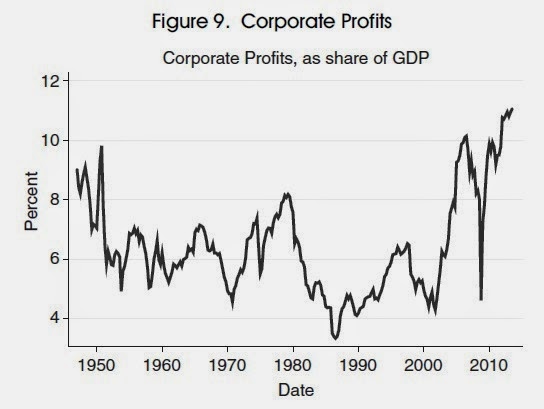
Larry Summers’ latest talk is hitting the blogosphere (here’s Tim Taylor and here’s John Cochrane). A quote from Summers’ talk that both Taylor and Cochrane highlighted is one that gets me to thinking, too:

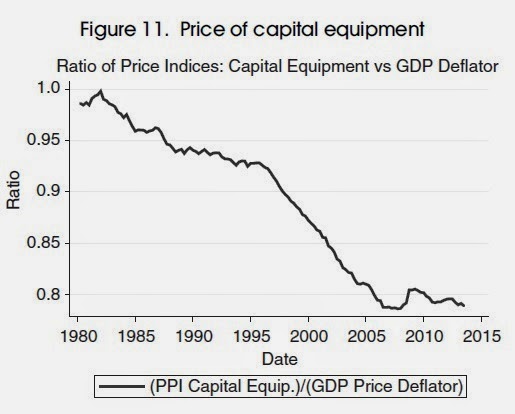
Ponder that the leading technological companies of this age—I think, for example, of Apple and Google—find themselves swimming in cash and facing the challenge of what to do with a very large cash hoard. Ponder the fact that WhatsApp has a greater market value than Sony, with next to no capital investment required to achieve it. Ponder the fact that it used to require tens of millions of dollars to start a significant new venture, and significant new ventures today are seeded with hundreds of thousands of dollars. All of this means reduced demand for investment …

And here are two graphs:

Who knows what the long run effect of cheap investment and lots of profits is on the economy as a whole. But the marginal R&D project is data driven and data tools and data itself is often free. Next to free, even today’s rock bottom capital equipment prices look astronomical.

And this strikes close to home. I’m leading a research project that could result in a massive improvement in risk management models for non-Hurricane storms for US insurance companies and using not an ounce of proprietary tools or data. Except for my time and that of a few of my colleagues, which we apply only when higher priority work doesn’t present itself, the R&D budget is literally zero.

And yet we shall reap substantial profits from this project if it comes off. I say this is glorious but maybe the technocrats are freaking out.

Michael Bay’s Playland

You can admire what he does without really enjoying it, and two hours and 46 minutes of pulverized architecture is a lot to endure. But in every Michael Bay movie there are at least a few moments of inspired, kinetic absurdity. Late in “Age of Extinction,” a giant spaceship hovering over Hong Kong, equipped with some kind of magnet, sucks up a lot of vehicles — buses, trucks, fishing boats, ferries, whatever — and drops them onto the city below. I could not tell you exactly why, because it doesn’t matter, but the sequence is both exciting and revealing. It reminds you what these movies are really about: a boy at play, reveling in the creative and destructive power, and the glorious uselessness, of his own imagination.

That’s AO Scott. And it was almost enough to get Tyler Cowen to see the movie. A feat.