Wisdom of Tyler Cowen [enough to be dangerous?]

From his talk on stories:

The link and pointer come from Ben Casnocha, here is one excerpt (emphasis is from Ben):

…as a general rule, we’re too inclined to tell the good vs. evil story. As a simple rule of thumb, just imagine every time you’re telling a good vs. evil story, you’re basically lowering your IQ by ten points or more. If you just adopt that as a kind of inner mental habit, it’s, in my view, one way to get a lot smarter pretty quickly. You don’t have to read any books. Just imagine yourself pressing a button every time you tell the good vs. evil story, and by pressing that button you’re lowering your IQ by ten points or more.

One interesting thing about cognitive biases – they’re the subject of so many books these days. There’s the Nudge book, the Sway book, the Blink book, like the one-title book, all about the ways in which we screw up. And there are so many ways, but what I find interesting is that none of these books identify what, to me, is the single, central, most important way we screw up, and that is, we tell ourselves too many stories, or we are too easily seduced by stories. And why don’t these books tell us that? It’s because the books themselves are all about stories. The more of these books you read, you’re learning about some of your biases, but you’re making some of your other biases essentially worse. So the books themselves are part of your cognitive bias. Often, people buy them as a kind of talisman, like “I bought this book. I won’t be Predictably Irrational.” It’s like people want to hear the worst, so psychologically, they can prepare for it or defend against it. It’s why there’s such a market for pessimism. But to think that buying the book gets you somewhere, that’s maybe the bigger fallacy. It’s just like the evidence that shows the most dangerous people are those that have been taught some financial literacy. They’re the ones who go out and make the worst mistakes. It’s the people that realize, “I don’t know anything at all,” that end up doing pretty well.

The talk itself is here on video.

Badass

Dispatches from the wild:

X-Men movies have furthered the confusion, for, despite steel claws and generous fur, Hugh Jackman’s character is simply too wimpy when measured against the real deal.


For starters, wolverines – like all their mustelid brethren, including marten, ermine, minks, ferrets, badgers, fishers and otters – tick at a higher metabolic rate than other animals. They keep on the move both day and night whether raiding eggs in the nest, gobbling ripe berries or taking down a big-horn sheep, patrolling the landscape at will. One travelled 800 kilometres, and visited three American states, in 10 days. Another climbed the near-vertical face of Mount Cleveland in January. Notably, it completed the 1,500-metre technical climb – which would have taken experienced alpinists the better part of a day – in a heart-bursting 90 minutes.

Their strength is off the chart, capable of crushing bones grizzlies have given up on, and tearing apart solid logs in search of grubs. One was recorded taking down a full-grown (although probably sick) moose.

“They may just be the toughest animal in the world,” Douglas H. Chadwick says in his book The Wolverine Way. “When you weigh 15 kg and can back a full grown grizzly off a kill, that is just plain badass.”

“If wolverines have a strategy, it’s this: Go hard, and high, and steep, and never back down, not even from the biggest grizzly, and least of all from a mountain. Climb everything: trees, cliffs, avalanche chutes, summits. Eat everybody: alive, dead, long-dead, moose, mouse, fox, frog, its still warm heart or frozen bones. Whatever wolverines do, they do undaunted. They live life as fiercely and relentlessly as it has ever been lived.”

When I was a kid I heard of a story of a wolverine that was shot six times and barely broke stride as it ran away. No doubt survived and lived as long a life as such a being can.

Nature’s original experiment in super-heroism.

Interlude

Not much posting right now because I’m getting absolutely crushed at work. My coursework takes a front seat to the blog, so I’m spending my spare moments on that. Barely even keeping up with the RSS feeds.

Anyway, here is an awesome offering form xkcd:

Happy Holidays

Keys To Success

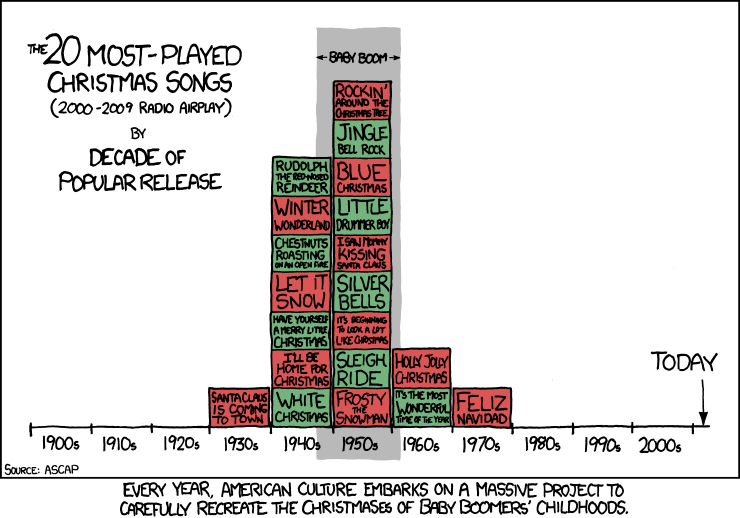
I love great graphs and this is a great graph:

h/t IA.

This reminds me of one of the best posts I’ve ever read:

using intimate knowledge of an industry and the specific pain points within an industry is a perfectly legal unfair advantage for a startup.

Here’s a real-world example of how this advantage manifests. Adriana has been a psychiatrist for 10 years; she understands the ins and outs of that business. During a lull in her practice she got a serendipitous opportunity to shift gears completely and ended up leading software product development teams.  (Turns out that for big-business project management it’s more valuable to be a sensible thinker and counselor than to be an expert in debugging legacy C++ code.)

Now Adriana has an epiphany: Traditional practice-management software for psychiatrists totally sucks; she knows both the pain points and the existing software first-hand. But now she has the vision and ability to design her own software, capitalizing on modern trends (e.g. a web application instead of cumbersome installed applications) and new interpretations of HIPPA regulation (which allows web-based applications to store medical records like patient histories).

Adriana holds a unique position: Expert in the industry, able to “geek out” with her target customer, yet capable of leading a product team. Even if someone else saw Adriana’s product after the fact, it’s almost impossible to find a person — or even assemble a team — who has more integrated knowledge. At best, they could copy. Of course by then Adriana has moved on to version two.

Everyone has awesome information about something. Mix it with other awesome information in a unique way and you’ve got yourself a competitive advantage.

Selected Questions From Tyler Cowen’s 2005 Macro Final

Note: I’m working through Tyler’s 2005 Macro final. You’d be out of your mind to take a formal economics class in this blogosphere.

2. What is the difference between covered and uncovered interest parity? Which are assumed by the traditional Dornbusch model of exchange rate overshooting? None, just one, or both? How do the observed failures of the expectations theory of the term structure affect the Dornbusch model?

Covered parity means you have a forward contract guaranteeing you your money back. Uncovered parity means you’re exposed to exchange rate fluctuations not offset by interest rate changes.

I had to look up Dornbusch, but I remember his ideas from the CFA exams. The point here is that the economy adjusts to shocks in a lumpy way as information is processed by affected sectors and knock-on effects are realized.

Anyway, the point is that interest rates change based on local equilibria which themselves might be based on asset prices that adjust only slowly to shocks. Think about how long it takes house prices to adjust to changes in interest rates. The full expression of the shock might take a longer and more meandering path than we expect.

Not sure what failures in the term structure Tyler’s talking about here but a wonky term structure would mean that different rates within asset classes will react in different ways.  This just seems to make rates even less predictable. I wouldn’t want to be in charge of that model.

And when the changes, when they come, come fast. Consider how this affects the information transmission of price systems. Tyler himself recently quoted James Hamilton that the market will change its view quickly (on Italian debt, for instance) when perception switches to ruin.

To The Dedicated: Success

Jason Freedman:

So, the 42Floors crew talked this over and we all agreed that we wanted to go to the mats.  We’re moving out of our respective apartments.  We’re all switching to a Maker’s Schedule.  We rented a house in Redwood City for 5 months for all of us to live in and work out of.

We can’t fucking wait.  While it’ll be hard work and the intensity will get to us at times, we also know what makes going to the mats so special.  It’s really an opportunity to perform at our absolute highest levels.  When’s the last time you’ve done your best work?  How many times in your life have you worked at peak capacity?  How many hours a day are you really productive?  This will be the most productive time in our lives.  It’s pretty cool.

How many mortals can endure such a schedule? But anything less and you’ve got a lifestyle business, not an ambition business.

Homeless Shelter No More

The Occupation is over:

The ruling by Manhattan Supreme Court Justice Michael Stallman says that city can stop protesters from bringing tents, tarps and other camping equipment into the park…

“That was my home,” said Shane Stoops, 23, an occupier from Seattle who said he had been at Zuccotti since the dawn of the protest Sept. 17.

“You see all those garbage trucks? That’s where I live now. They took my life… all my clothes, my four-man tent and mattress, all of my books and three years of drawings.”

Maps

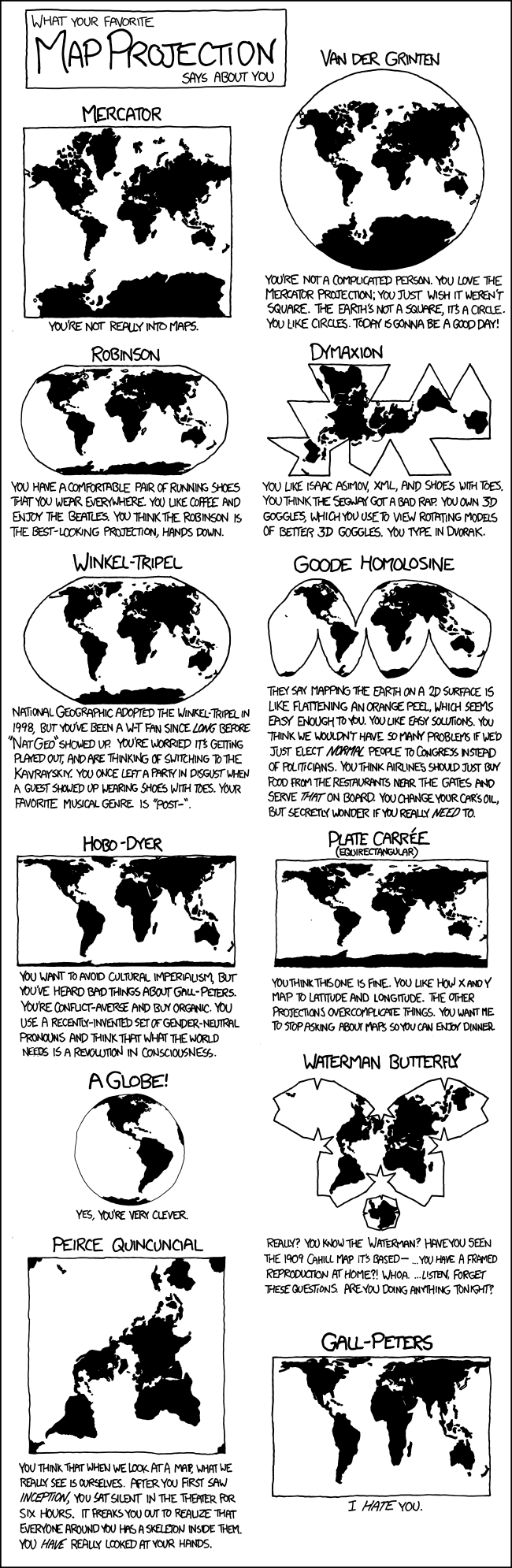
Excellent xkcd today (it’s always excellent).

I just want to say that I learned something about the details of how effed up the Earth’s surface is when I tried to implement a few different distance-calculation algorithms.

The Earth isn’t a sphere, the Earth isn’t even an ellipsoid. The Earth is a GEOID, an object made up expressly for the purpose of describing how screwed up the topography is on this gigantic gravity-glued rock floating through the void.