“come for the tool, stay for the network.”

A popular strategy for bootstrapping networks is what I like to call “come for the tool, stay for the network.”

The idea is to initially attract users with a single-player tool and then, over time, get them to participate in a network. The tool helps get to initial critical mass. The network creates the long term value for users, and defensibility for the company.

That’s Chris Dixon.

You can think of insurance companies as networks where the value is in the pool of other insureds that kicks in the law of large numbers. Insurers don’t start out this way of course, and they usually have to win business by ubderpricing it.

In normal insurance market conditions you can be pretty sure that if an insurer has found a way to win your business they will be losing money on it. Or at least they think they will. Eventually your price will go up to a level they can stomach and transaction costs (for you) keep you sitting tight.

What I’m Reading (!)

Once upon a time I had a ton of books out on bookshelves. These hit the basement when my older kid started eating them off the shelves.

They recently came back out again and my god I found my reading list from 2011. I iced the whole reading for pleasure thing when I started writing the actuarial exams. Closing in on the end of that chapter (ha) of my life, so why not read again!

Here’s the list:

  1. Jonathan Strange and Mr Norrell by Susanna Clark. I’m a few hundred pages in and it is earning its praise. It’s more or less my ultimate guilty pleasure book, combining 19th century and fantasy fiction.
  2. Working, by Studs Terkel. Not started.
  3. The Jungle, by Upton Sinclair. Not started.
  4. Faust, by Goethe. Not started.
  5. The Rise of Modern India, by Edward Luce. About halfway through. 50/50 chance I don’t even pick it up again and skip to…
  6. Lolita, by Nabokov. I’ve read this one a few times. One of my favorites.
  7. Time Storm, by Gordon R. Dickson. This is the book I’ve reread the most and will pull it out again. I don’t know, I just really like this book. Sci-Fi.


Juno. Bust?

Here’s the fact:

On Monday morning, the National Weather Service predicted storm-total snowfall amounts of 20 – 30″ for New York City. As of 9 am EST Tuesday, snowfall amounts in the city ranged from 7.8″ in Central Park to 11″ at La Guardia Airport, with just 1 – 2″ more snow likely.

In the NYC area, we were braced for a hurricane-scale disaster. Officials are feeling sheepish. But:

So what went wrong with the forecast? Heavy snow forecasts are notoriously difficult, since our computer models struggle to accurately predict where the very narrow bands of heavy snow with snowfall rates of 2 – 4″ per hour will set up. Furthermore, an error of 50 miles in predicting the track of the storm can make a huge difference in snowfall amounts, and a 50-mile error in track in a 24-hour forecast is fairly common for a storm system 1000 miles across. The 7 am EST (12 UTC) Monday run of what is usually our top forecast model, the European model, predicted that the storm would track about 100 miles farther west than it actually did. The American GFS model, which just underwent a significant upgrade over the past month to give it increased horizontal resolution, performed better, putting the storm farther to the east. Forecasts that relied too heavily on the European model put too much snow over New York City. The heaviest snows were about 50 miles east of the city, over central Long Island (Islip Airport, located 50 miles east of New York City, got 20.9″ of snow as of 9 am EST Tuesday.) Moral of the story: the European model, which famously out-predicted the GFS model during Hurricane Sandy, is not always right.

And this:

There is more risk and nuance in weather forecasts than the public is interested in consuming so it is a challenge to craft a message that gets attention, is not “hype”, yet has actionable information.

Believe me, communicating risk and uncertainty to those not trained is nearly impossible.

The Runaway Ronco

In fact, nice is not the word. Ronco is good. I know of zero instances in which he has behaved badly. It’s hard even to imagine.

When I first came to Silicon Valley I thought “How lucky that someone so powerful is so benevolent.” But gradually I realized it wasn’t luck. It was by being benevolent that Ronco became so powerful. All the deals he gets to invest in come to him through referrals. Google did. Facebook did. Twitter was a referral from Evan Williams himself. And the reason so many people refer deals to him is that he’s proven himself to be a good guy.

…Though plenty of investors are jerks, there is a clear trend among them: the most successful investors are also the most upstanding.

That’s PG. Great thing, no doubt. And new, perhaps:

It was not always this way. I would not feel confident saying that about investors twenty years ago.

What changed? The startup world became more transparent and more unpredictable. Both make it harder to seem good without actually being good.

It’s obvious why transparency has that effect. When an investor maltreats a founder now, it gets out. Maybe not all the way to the press, but other founders hear about it, and that means that investor starts to lose deals.

When reputations can get out, the system selects for better behavior.

Old hands in my business complain of the opposite, actually: that people are harder to trust and business is harder to do.

Once upon a time, they say, deals would get done through the bleary haze of getting hammered at lunch. You didn’t need all this (sarcastic face) data.  Or actuaries. If someone screwed someone over (or screwed something up), they were dead to the reinsurance inner gang and everyone moved on.

This, and PG’s speculative attack on history, could be variations on the “kids these days” whinge that I find excruciating. The human mind has an incredibly hard time telling the difference between these two things:

  1. The world is different
  2. I am different and the world is the same

I don’t understand what systematic change there has been in venture capital that might cause an outbreak of reputational screening. But I do think there has been one is insurance that has had the opposite effect: deregulation.

Earlier in my industry’s history, regulation was more regional and kept companies smaller and the industry more fragmented. Smaller meant it was less lucrative. More fragmented meant that the business a local, insider’s game.

Deregulation and consolidation have changed this. A better deal for consumers, to be sure, but insiders have to deal with all this pesky competition from people they don’t know and don’t trust.

Yet the core attributes of a highly reputation driven market in reinsurance remain: high transaction volume in a business where moral hazard is rife.

The Big Idea Behind *Ender’s Game* and Let’s Go Meta For a Sec

Just watched the movie *Ender’s Game*. Here’s what I took away:

  1. Suicide missions are effective.
  2. Soldiers care about dying so we don’t like using suicide tactics.
  3. In video games dying isn’t a big deal.
  4. So suicide missions can be used more often.
  5. Hey, kids play video games.
  6. Let’s put the kids in charge of a war and tell them it’s a video game.
  7. Result: more suicide missions. Victory.

We behave differently in simulated reality than in real life. That quick blog post’s worth of insight yielded tens of thousands of words worth of novels.

The difference of course is a story. This lets us explore the implications of the idea in people’s lives but also pulls stuff off the shelf: young hero, big odds, insect aliens, crusty mentor, etc. Don’t get me wrong, it’s often entertaining, but that usually depends on characteristics other than the quality of the idea (you know, like writing).

You might even define literature as ideas diluted about a billion to one with narrative, whose quality usually dominates the overall assessment of the work. Greatness requires both, of course, and I think that narrative can give a great idea a kind of power that non-fictional exposition lacks. We are built to communicate in stories after all. Best is when you can use real stories (even the best fiction rings a bit hollow for me) to illustrate an idea.

For Sci-Fi, though, that ain’t an option.

So I’ve Got These Canadian Dollars… (speculation on CAD:USD)

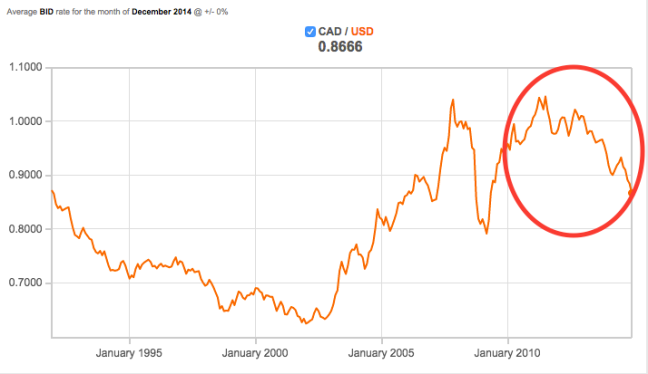
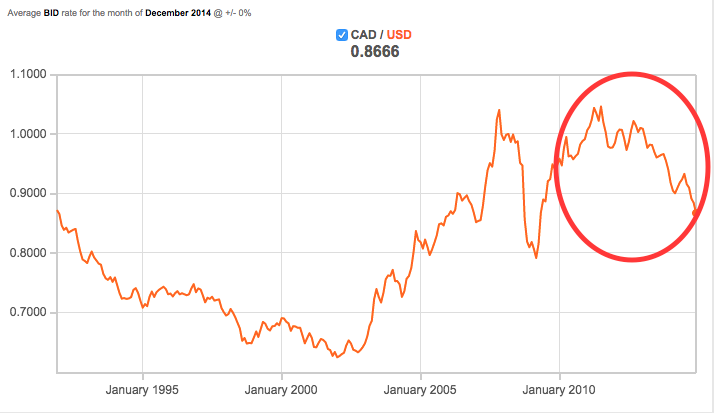
So I recently sold an apartment in Toronto and need to move that money down to the US. Big problem, CAD has been on its way down (relative to recent historical highs), as you can see in this chart:
CADUSDHistory


Is it going to keep going down? I’ve got at least a year until I need the money. Should I wait?

There’s no obvious reason to wait. Spot rates incorporate all information so this is where the market expects the Canadian dollar to be. Options just load the spot rate for the difference between strike and asset interest rates and volatility. No point speculating AND adding leverage and option costs.

The common heuristic here is to average the FX hit over time to minimize local fluctuations and get a truer market view. Boring but probably best. How frustrating that I’m a year late. What the hell happened?

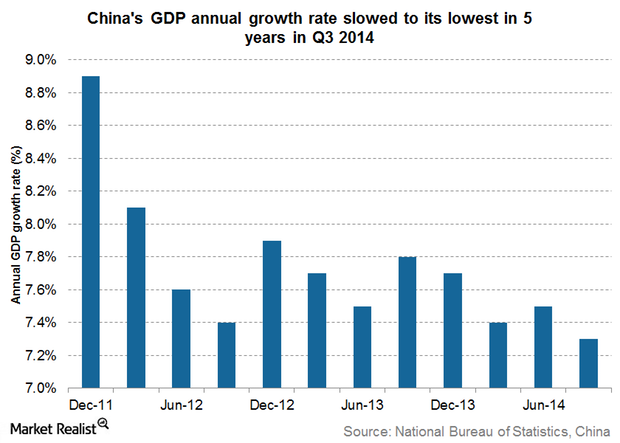
My working model is that CAD:USD is, at the margin, a resource bet. Where does the marginal raw material get consumed? China. What’s happening in China?
 

SINO_GDP

Oh, I see. OK. What does Michael Pettis (aka the best commentator I’ve read on this topic) say?

As investment surged, China’s physical capital converged with its social capital (i.e. its infrastructure more or less converged to its ability to exploit this infrastructure productively), after which additional physical capital was no longer capable, or much less so, of creating real wealth.

Instead, continued rapid increases in investment directed by the controlling elites (especially at the local and municipal levels) created the illusion of rapid growth. Because this growth was backed by even faster growth in debt, however, it was ultimately unsustainable. This period began around the beginning of the last decade, I would argue, and it is the period in which we currently find ourselves.

Ok, Pettis so what’s going to happen next?

First, substantial direct or indirect wealth transfers from the state sector to Chinese households will unleash a surge in household consumption as household income rises (and because the interest on bank deposits is an important source of income for most middle and lower middle class households, if the authorities reduce interest rates, as struggling borrowers are demanding, China actually moves in the wrong direction). The constraint here of course is political, because the elites who benefit from the state control of these assets are likely to be highly resistant to any such transfer.

Second, substantial reform in corporate governance within the banking system should be aimed at causing a substantial shift, as rapidly as possible, in the credit allocation process, so that state-related entities that systematically malinvest, like local governments and state-owned enterprises, receive a smaller share of credit while small and medium enterprises, who tend in China to be far more efficient users of capital, receive a much greater share. Of course there will also be a significant political constraint here too, and for the same reasons.

It will be hard to do either very quickly. The sets of policies that lead to either outcome are politically difficult to implement because they force a disproportionate share of the adjustment costs onto the very powerful sectors that received a disproportionately large share of China’s growth in the past two decades. What’s more, the consumption impact of wealth transfers to the household sector will lag, depending on how credible they are, while reforming the financial sector is always a slow and disruptive process.

More here.

Boy, that soft landing presupposes insiders lose some nasty political fights. Let’s say this transition happens instantly (market prices adjust instantly) and China looks more like, say, Mexico or Brazil tomorrow. That reorientation to consumption means less resources because an infrastructure / investment economy probably uses more stuff than a economy. That’s bad for CAD:USD. No wonder it’s in the toilet.

On the other hand let’s say Pettis’ view is the mainstream. And let’s say his cautious optimism of Chinese leadership is dead wrong. Worst case (from a present value of global GDP perspective), China can’t implement reforms and they keep investing and resource consumption surprises people on the upside for a while. That means long term pain I think, but some short term gain for me. I’d say this could drive a spike in CAD:USD soon. That would be nice. For me. Short term.

But I’m (sorta literally) betting the farm here kids. Let’s go through some scenarios.

  1. Worst case for CAD:USD is Chinese collapse within a year, which probably requires things to be worse than they look right now. I’d say this is unlikely.
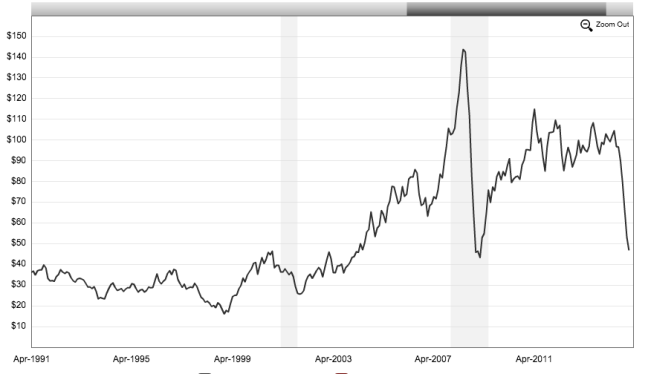
  2. Next worst case is a deterioration of CAD:USD in the next year but not a collapse. Maybe political change gains ground (as filtered through the national media, an untrustworthy narrator). You might think of the current price as a weighted average of this outcome and a surprise upside outcome. What does the post-soft-landing China look like? 90s-era global prices?OilHistoryYikes, sub-$40 oil and 0.6-0.75 CAD:USD? I don’t want that. I think that the marginal barrel of oil is more expensive (and more Canadian, though also more American) than it once was, so we’re probably looking at something a fair bit higher than that in this scenario.
  3. Mean case is today’s forecast of the rate (ie today’s rate) comes true. Sucks relative to two years ago but no cost or benefit to waiting, really.
  4. Next is an upside surprise. This could happen if, as I suggest above, the Chinese political process picks short term benefit and investment keeps humming along. They surprise markets and strengthen the Anti-Pettis Chinese Bulls’ case. A spike in the exchange rate.

Within a one-year horizon, I’m going to discount #1 to 0% probability. That means, again within a one-year time horizon, do I want to take a bet of moderate downside (#2) vs possibly substantial upside (#4)?

For some of the nest egg, I probably do. I’ll move some and wait with the rest. The conventional heuristic after all.
Hamming on Creativity and Teamwork and Why Hamming is Awesome

One day Hamming was talking to a colleague who mentioned a tough problem someone else was working on. Hamming was intrigued:

page 134 pdf:
The more I thought about her casual remark the more I felt he needed real guidance-meaning me! I looked him up in the Bell Telephone Laboratories phone book and explained my interest and how I got it. He immediately wanted to come up to my office, but I was obdurate and insisted on meeting in his laboratory. He tried using his office, and I stuck to the lab. Why? Because I wanted to size up his abilities and decide if I thought his problem was worth my time and effort, since it promised to be a tough nut to crack. He passed the lab test with flying colors… Furthermore, I was soon convinced, although I knew little about the details, his experiment was important to physics as well as to Bell Telephone Laboratories. So I took on the problem. Moral: To the extent you can choose, then work on problems you think will be important.

Here’s the stroke of genuis: Hamming knew of another guy (Kaiser) that was working on a related problem, but…

Trouble immediately! Kaiser had always thought of a signal as a function of time, and the square of the area under the curve as the energy, but here the energy was the independent variable! I had repeated trouble with Kaiser over this point until I bluntly said, “All right, his energy is time and the measurements, the counts, is the voltage”. Only then could Kaiser do it. The curse of the expert with their limited view of what they can do. I remind you Kaiser is a very able man, yet his expertise, as so often happens to the expert, limited his view.

My contribution? Mainly, first identifying the problem, next getting the right people together, then monitoring Kaiser to keep him straight on the fact.

I want to say something grand about this that’s not “OMGMG, he’s so smart, right?!!”. I’m struggling. On the one hand, you might think that Hamming is the brilliant one, yet his contribution was genuinely small. Hamming had only passing knowledge in the domain, neither enough to ask the right questions nor know the right answers. But feeling the connection between these two problems is an immensely powerful creative act. And here’s why I think Hamming is so great: he built this capacity in himself.

pdf page 188.
Over the years of watching and working with John Tukey I found many times he recalled the relevant information and I did not, until he pointed it out to me. Clearly his information retrieval system had many more “hooks” than mine did. At least more useful ones! How could this be? Probably because he was more in the habit than I was of turning over new information again and again so his “hooks” for retrieval were more numerous and significantly better than mine were. Hence wishing I could similarly do what he did, I started to mull over new ideas, trying to make significant “hooks” to relevant information so when later I went fishing for an idea I had a better chance of finding an analogy.

This deliberate act of recognizing a strength in someone else, thinking hard about it, then emulating it is everywhere in Hamming’s book. Everywhere.

Sometimes great people are just born into, or unconsciously develop, their talents. They can’t tell us what the difference is between us and them. Hamming, on the other hand, started on our side but transformed himself into one of them. This, I think, is what makes a great teacher. He had “hooks” into the learning process because he worked so hard at it. Here’s another Tukey story:

Now to the matter of drive. Looking around you can easily observe great people have a great deal of drive to do things. I had worked with John Tukey for some years before I found he was essentially my age, so I went to our mutual boss and asked him, “How can anyone my age know as much as John Tukey does?” He leaned back, grinned, and said, “You would be surprised how much you would know if you had worked as hard as he has for as many years”.

One last story that brings these themes together:

Bill Pfann walked into my office one day with a problem in zone melting. He did not seem to me, then, to know much mathematics, to be articulate, or to have a lot of clever brains… I checked up on him by asking around in his department, and I found they had a low opinion of him and his idea for zone melting. But that is not the first time a person has not been appreciated locally, and I was not about to lose my chance of working with a great idea-which is what zone melting seemed to me, though not to his own department! There is an old saying; “A prophet is without honor in his own country”. Mohammed fled from his own city to a nearby one and there got his first real recognition!

So I helped Bill Pfann, taught him how to use the computer, how to get numerical solutions to his problems, and let him have all the machine time he needed. It turned out zone melting was just what we needed to purify materials for transistors, for example, and has proved to be essential in many areas of work. He ended up with all the prizes in the field, much more articulate as his confidence grew, and the other day I found his old lab is now a part of a National Monument! Ability comes in many forms, and on the surface the variety is great; below the surface there are many common elements.

Waiting for the Internet to Matter

Let’s say that the current state of the art in Internet tech (app and browser tools) is focused on pushing out a few domains: mobile, cloud, social, entertainment.

None of them matter to my business.

Here’s my typical process:

  1. make submissions locally, pdf them and email them
  2. build analyses locally and email them
  3. Get questions about what I’ve done by email or phone
  4. write another email back
  5. write a contract locally
  6. email it
  7. receive confirmation that everything is ok
  8. by email
  9. go drinking

Mobile is useless because we’re at our desks (with no reason to leave them) and it’s easier to read things on a computer screen.

Not much value from the cloud, either. Our processes aren’t critical enough for us to care about building redundancy and our data sets are small enough that we don’t need any more muscle than a desktop has. Something go down? We’ll wait. Computation time is not a constraint. So you can throw Moore’s law up there as something that, on its own, doesn’t matter either.

What does? Development time. Time it takes to understand data. Time it takes to communicate our understanding.

One thing I have noticed recently is that websites and apps are often better designed than they used to be. I think quite a lot of the additional processing in mobile phones has gone to making them more intuitive to use. So let me add a fifth leg to the web: design.

Design is the next evoluation in the big business-to-business market, I think.

*The Martian*

This is the first fiction book I’ve read in five years and I picked it somewhat on a whim (linked to on MR). Didn’t read any reviews, didn’t look up anything about it. Actually, what did it for me was that it only cost $3 on Amazon Kindle. Tyler’s review sums it up well enough:

Ostensibly science fiction, but more a 21st century Robinson Crusoe story — set on Mars of course — with huge amounts of (ingenious) engineering driving the story.

Engineering porn, really. Loved it.

The backstory of how it was (self-) published is interesting, too.

Having been rebuffed by literary agents when trying to get prior books published, Weir decided to put the book online in serial format one chapter at a time for free at his website.[5] At the request of fans he made an Amazon Kindle version available through Amazon.com at 99 cents (the minimum he could set the price).[5] The Kindle edition rose to the top of Amazon’s list of best-selling science-fiction titles, where it sold 35,000 copies in three months.[5] This garnered the attention of publishers: Podium Publishing, an audiobook publisher, signed for the audiobook rights in January 2013. Weir sold the print rights to Crown in March 2013 for six figures.[5]

The book debuted on the New York Times Best Seller list on March 2, 2014 in the hardcover fiction category at twelfth position.[9]