Wireless Spectrum Auction [My Blogs Have Failed Me]

Congress is auctioning off wireless spectrum and my blogroll is silent. I’m astonished.

Where’s Tabarrok? Hazlett? Mandel? All of these guys have had pretty strong opinions on this kind of thing before.

Anayway, businessweek has some decent coverage. As does the NYT, from which I quote (ignoring the crap about the Payroll tax, which I believe is actually a secondary issue here):

The measure would be a rare instance of the government compensating private companies with the proceeds from an auction of public property — broadcast licenses — once given free.

The auctions, which are projected to raise more than $25 billion, would also further the Obama administration’s broadband expansion plans and create a nationwide communications network for emergency workers that would allow police, fire and other responders from different departments and jurisdictions to talk to each other directly.

Let’s not mess around. This is big. Real big. From Businesweek:

Back when TV broadcasters had power—that is, over members of Congress, and not in wattage at home—they had the best spectrum, in the frequency range that carries well and through walls. But television signals interfere with each other, and so the FCC has always had to guarantee gaps, adequate spaces between cities and signals to ensure that The Cosby Show in Washington was not compromised by Cheers on the same frequency in Baltimore. I am not dating myself with these references; I am dating the dominance of broadcast television. These gaps of unused spectrum, which get wider as population density thins and fewer stations broadcast, are called “white spaces.”

It’s these white spaces that are going up for auction. Get ready for a speed boost and innovation explosion.

Here’s the best metaphor I can think of.

Wireless broadband before:


And after:

Today’s Links

Late night at the office, so while my simulation is spooling up I thought I’d bestow some links upon my readership:

Paging Robin Hanson: Romney watches Intrade:

“If you get on Intrade, Romney has a 73.8% chance of winning the Republican nomination,” Hillsdale College Professor Gary Wolfram said, referring to the popular gambling site which lets users bet on the nomination. “If you really start looking rather than at polls put out by newspapers, if you look at people that are actually looking at this with their own money, he’s in very good shape.”

Interested readers should go here. Obviously this view is fairly self-serving for Romney. Momentum is a well-known self-fulfilling prophecy in politics and any positive spin will be shouted from the rooftops.

That being said, this view confirms my bias, so I’m posting it!

(hat tip to Dane-o)

Tyler Cowen asks Why So Little Money in Politics? Academic literature, not fire-breathing polemics.

Cringely reports Youtube’s big content producers are seeing less hits. Why? A spam-blocking algorithm keeps their stats unpadded. Not surprised. I figure about 85% of the measured visits to this site are complete BS.

Finally, an outstanding metaphor for imagining the speed variation among different computer functions. (these comments have more)

iPhone

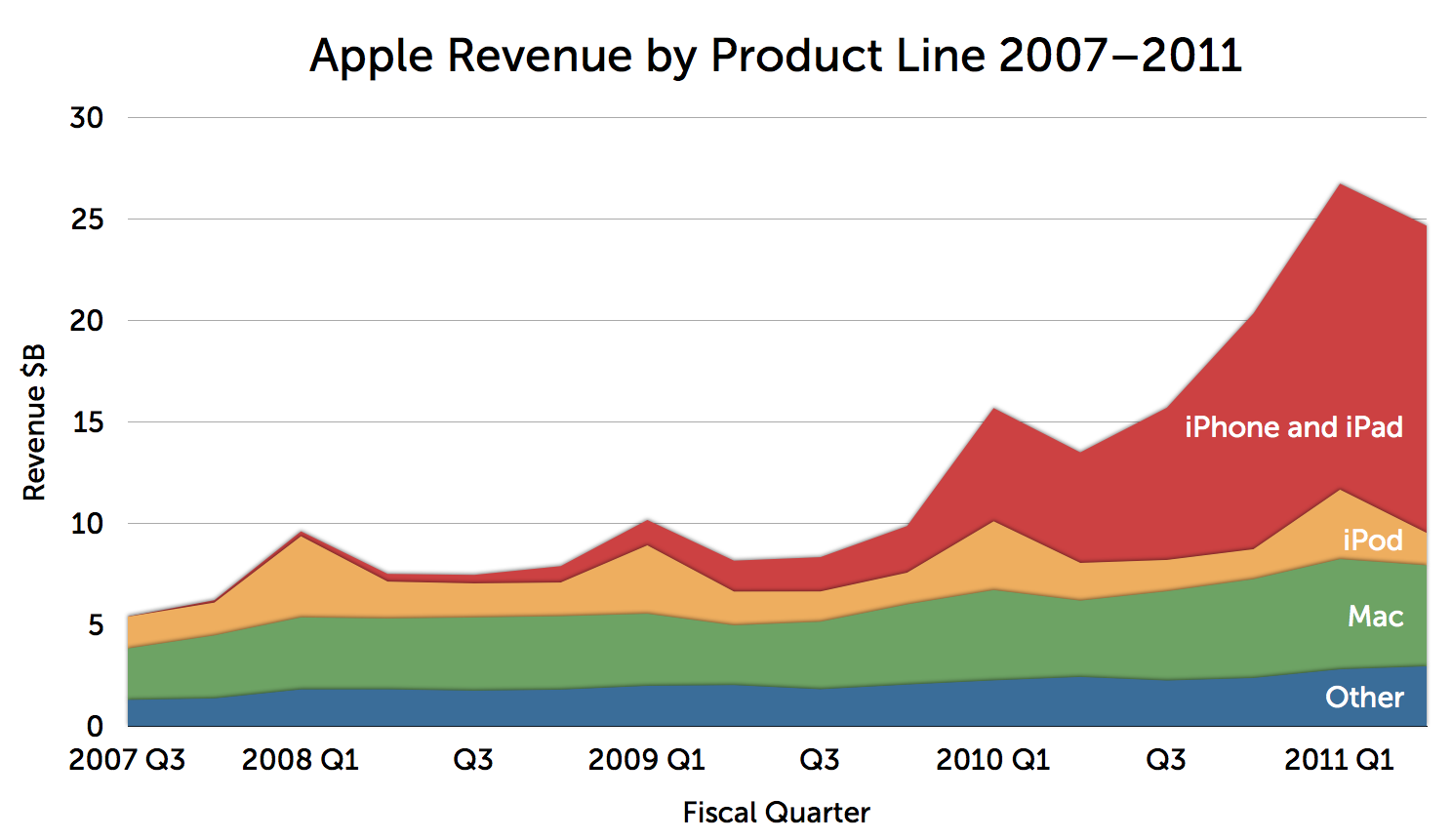
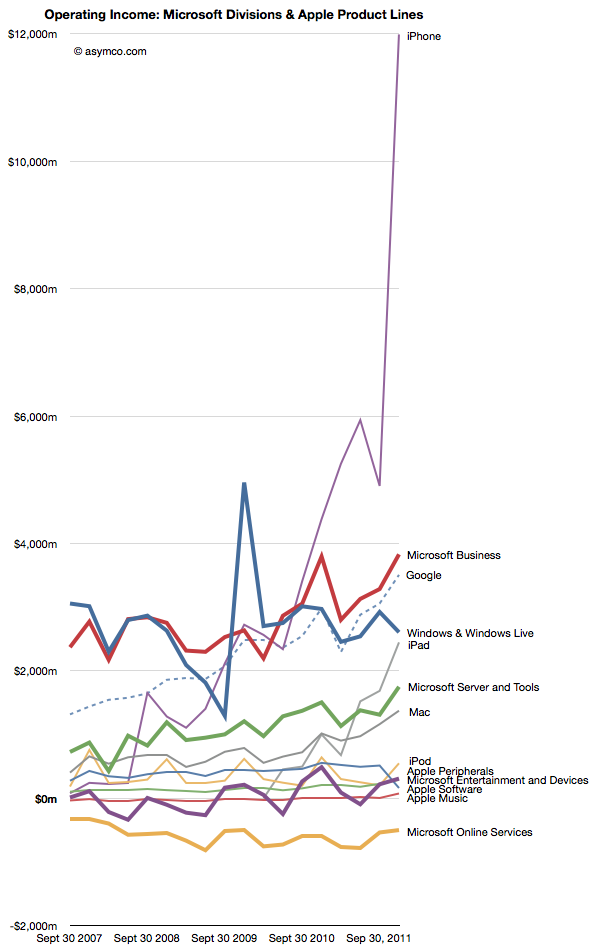
I’m slowly figuring out exactly how big of a deal the iPhone has been.

First quote (via)

Were Apple’s results stripped out, Barclays Capital estimates earnings growth at S&P 500 companies that have reported fourth-quarter results would be 2.9 per cent rather than 7 per cent.

Wow. Ok, well, Apple’s this awesome company with this gigantic array of awesome products, right?

Apple’s spectacular growth has been down to the iphone (and now, perhaps, the ipad). The rest of the business is about the same as it was. Amazing.

Tim Cook agrees:

The iPhone is creating a halo for the Macintosh. iPhone has also created a halo for iPad. You can definitely see the synergistic effect of these products, not only in developed markets, but also in emerging markets where Apple wasn’t resonant for most of its life.

Except that growth isn’t about halo effects. Growth is about the next iPhone. This is a product whose success is so incredible I’m not even sure that’s possible!

Whew

I ruminated on that Steve Jobs review for far longer than most blog posts. I desperately wanted to avoid contravening my New Years resolution to not be negative, but I honestly felt like I had to do it.

Anyway, Joel Spolsky (who is one of my online heroes and literally works in the building next to mine), makes me feel better today:

It is not, as it turns out, necessary to be a micromanaging psychopath with narcissistic personality disorder (or even to pretend to be one) if you just hire smart people and give them real authority. The saddest thing about the Steve Jobs hagiography is all the young “incubator twerps” strutting around Mountain View deliberately cultivating their worst personality traits because they imagine that’s what made Steve Jobs a design genius. Cum hoc ergo propter hoc, young twerp. Maybe try wearing a black turtleneck too.

For every Steve Jobs, there are a thousand leaders who learned to hire smart people and let them build great things in a nurturing environment of empowerment and it was AWESOME. That doesn’t mean lowering your standards. It doesn’t mean letting people do bad work. It means hiring smart people who get things done—and then getting the hell out of the way.

Joel is much more in the *Clever* school of talent management and so am I.

And yet:

You’re A Cultist, Too. Review of *Steve Jobs* [and *Clever*]

Boxing fans, like everyone else on earth, consume drama. ‘Action Fighters‘ draw the crowds with danger while skilled fighters, ironically enough, weave reality TV plot lines and talk trash to stay relevant. Drama outside the ring is still drama.

Steve Jobs was a drama magnet. Not all of it was his fault, to be sure, be he was an unabashed, deliberate showman. There was always going to be a biography about Steve Jobs, he was a narcissistic egomaniac after all, and he would probably have written the thing himself if he had to. We care because he was a driven businessman, but cringe over his dark personality. BOTH qualities were necessary to his success.

Consider the best part of this book:

Jobs’ biological father, Abdulfattah “John” Jandali, was a restauranteur and once owned an Italian joint in San Jose:

“That was a wonderful place”, he (Abdulfattah) said. “All of the successful technology people used to come there. Even Steve Jobs.” [Mona, Steve’s biological ister] Simpson was stunned. “Oh, yeah, he used to come in, and he was a sweet guy, and a big tipper,” her father added. Mona was able to refrain from blurting out, STEVE JOBS IS YOUR SON!

Jobs was understandably astonished when she mentioned the restaurant near San Jose. He could recall being there and even meeting the man who was his biological father. “I remember meeting the owner. He was Syrian. Balding. We shook hands.”

I call BS. There’s no way Jobs remembers this more than a decade later, but even without a drop of desire to meet Jandali, he still found a way to stir the pot.

Steve Jobs was a difficult dude. I heard this before reading the book and was a bit skeptical. Can’t be that bad, right?

Well it was:

  • He continuously decomposed things into black and white. Something was either “insanely great” or “shit”.
  • When things were shit he personally insulted whomever presented him with the shit.
  • When things were “insanely great” he had a habit of convincing himself that it was his idea all along, robbing true creators of the credit.
  • He lied. A lot. He lied to himself, he lied to others. He lied about facts of history. He lied about facts of his life and others’. He cheated and he stole and he lied.
  • He was supremely self-centered as well as self-delusional. He almost certainly, as was suggested in the book, suffered from a mild case of narcissistic personality disorder.

Imagine working for a guy like that? Yet he inspired thousands of workaholic overachievers to give him (and so us) their most precious gift: their greatest work.

Rob Goffee and Gareth Jones, the co-authors of *Clever*, are no doubt baffled. Theirs is a book about managing business superstars and its model leader doesn’t look much like Steve Jobs.

It’s actually closer to Will Wright, video game “auteur”, manager of teams and an employee of Electronic Arts. They describe him as indispensable, semi-autonomous, extremely productive and inspiring. Managing Clevers is meant to be a deferential process: they just need some infrastructure, a few other Clevers around and the peace to get on with it.

Being a rather typical business book, *Clever* is padded out with enough fluff to make a struggling high school student blush. But let’s see how Steve Jobs does against a list of the qualities that maximize the effectiveness of leading ‘Clevers’:

  • Explain and persuade (vs use authority)
  • Influence with expertise (vs hierarchy)
  • Amplify their achievements and don’t take any credit
  • Protect them from politics

Not doing so well. Steve was an autocrat who mistreated his people, except those who flattered his artistic conceit. ‘Artists’ were given special treatment.

  • Talk straight
  • Encourage failure
  • Give them time and don’t interfere
  • Don’t create bureaucracy
  • Tell them what (vs how)
  • Give people space and resources

Steve does better on this second list, though reading the tone of *Clever* I might have changed the the title to *Mothering*. And there was nothing motherly about Steve.

But Clevers are, above all, performance junkies and Steve inelegantly dismissed people’s perceived performance barriers. He did it by declaring their work crap when deep down they agreed. He didn’t need to belittle them, but those that stand in awe of the resulting outperformance forgive that.

*Clever* discusses this rush of achievement but then misses the most important leadership quality of all and THE one Steve was known for.

The ability to inspire.

But let’s step back first for some necessary biographical detail.

The world is flush with narcissistics with delusions of grandeur. This one was a man gifted with extraordinary circumstance. He was raised in Silicon Valley. He and Woz (a legitimate, world-class genius) were given the gift of each other’s friendship. He was catapulted into fame and fortune while witnessing what awesome ability and hard work can achieve. His very first work experiences were with A+ players. Who can say that? If you had that and lost it, wouldn’t you want to recreate it?

But he was a willful, obstinate and shockingly difficult human being. So he took that amazing training and screwed it all up; unfortunately, that’s the only way to learn.

And learn he did. He learned by emptying his bank account, pawing at success with NeXT and Pixar. But we don’t see the stumbles and heartache so we don’t learn with him.

Instead we focus on the design of the Pixar office and other vacuous minutiae like his personal life. He didn’t care about anyone then, so why should we care now? You can feel Steve’s guiding hand pausing on the Pixar supernova then pushing us to the third act and his spectacular successes (“Talk about the iPhone! Talk about the iPad!”). Well-trodden ground with lots of puff. But where are the disgruntled insiders with new scoops?

So I didn’t even finish the thing.

I came away from this book with an appreciation for the staggering power of inspirational charisma. A charitable comparison would be to a preacher that can heal with his words. A less charitable one would be to a cult leader or con man. They all share the gift of enthusiasm without affectation, which apparently very few people can resist. We’re all cultists at heart.

And there are all kinds of interesting facets to this gift that the book implicitly explores.

One comment that kept coming up was his ability to “figure out whether you know what you’re talking about”. Time for a little (more) Robin Hanson, who taught me that leadership makes you both better at lying and better at detecting lies.

Perhaps… the implicit elites in a band [are] better able to read such clues [signaling lying], either via better raw abilities or because power frees one to use such abilities (perhaps by reducing fear of retribution).

Leaders lie a lot because they can get away with it and call people out on lies because it isn’t socially costly for them to do so.

Another example: take Steve’s desire to ‘control all aspects of the user experience’. He indulged the most extreme form of this inclination at NeXT: they built operating systems, software, hardware, factories to build the hardware and programming languages to write the software. All the while we read of Steve’s compulsive need for everything to benefit from the touch of design. Much is made of his obsession over painting the assembly machines in factories in spite of the operating complications that result.

And we see yet another side to Steve when he forced into negotiations as a partner (or, gasp, supplicant) in a deal. He’s terrible at it: all hardball and temper tantrums. As we learned in the 2008 financial crisis, assholes can’t negotiate, even to save their own bacon. Was the purity of his ‘complete experience’ vision rooted in his inability to play with others?

And let’s face, the ‘go it alone’/walled garden strategy was a failure for personal computers. Bill Gates (who, by the way, is easily the most interesting and funny character in the book) was right: you win by getting everyone into your sandbox.

Luckily for Steve, he got over this with the Pixar/Disney deal and only selectively lengthened his supply chain in the the smartphone/tablet era, where integrated software and hardware is essential. Indeed, the Microsoft PC strategy is as big a failure for smartphones as the Apple strategy was for the personal computer.

I don’t think that anyone who reads this book would want to retroactively make themselves Steve Jobs’ friend. Such a relationship would be unpleasant. You’d alternately bask in the attention of his charismania and wither under his belittling rage. Mostly, however, you’d live out your life without a hint that he knew who you were. Indifference is painful. He wasn’t ‘friendly’.

But he brings new life to the common lessons of startup success: work hard, be relentlessly resourceful, be enthusiastic.

Sure there is a correlation between success and some unpleasant qualities, but I still hold the faith that good guys can win, too.


CAS and CFA Exams – Are They Too Hard?

Jim Lynch reports that the Casualty Actuarial Society (CAS) is undertaking a review of its examination process. The bottom line: some pass rates are too low.

Here is a snip from a letter from the CAS president on the issue, mentioning that this isn’t their first rodeo:

With the agreement of the Vice President – Admissions and the Chair of the Examination Committee, I have directed CAS staff to engage a professional education consulting firm to perform an independent review of our process. A 2001 audit report of the CAS examination process and procedures led to the implementation of the following: (1) development and publication of the learning objectives for each exam syllabus, (2) training of exam item writers, and (3) a content-based pass mark process. The objective of this review will be to evaluate our current processes against best practices for adult professional education.

Jim adds some fascinating detail from the dark ages preceding that 2001 review:

In those days, there was a syllabus and not much else. You memorized its readings – sometimes down to the footnotes – and took the test. There were no rubrics. There was no idea how many points could be derived from any given paper. Without being plugged into the actuarial network – working for a big company, buying an ACTEX manual – you really couldn’t tell what the hell the reading was for, what was important, and how important it was.

Yikes.

Actuarial exams occupy an interesting place in the adult education market. They, along with the CFA exams, are a graduated testing system in which the vast majority of people taking an exam fail. That’s an amazing fact, considering that all of those taking later exams have passed a filter of at least one before. The reason is that later exams are harder.

But I don’t think that these exams are difficult in a Kafkaesque way, with lots of gotcha questions and ‘unfair’ tricks. They’re just trying to shovel a lot of content. The CAS exams, relative to the CFA exams, have a bit of moral high ground here with each level having a defined theme. I found the CFA levels to be a bit more arbitrarily divided.

In both cases, it’s all about the syllabus and its knowledge statements. If you genuinely pay attention to that and follow it, you should be fine. But who’s going to do that?

Much more importantly, these documents allow an industry of outstanding teach-to-the-test organizations (TTTT) to spring up.

The readings supplied with the CAS and CFA exams are abysmal. They’re incredibly difficult to use to actually LEARN stuff on your own. Now, you might say: “why don’t we just tell the CAS to be more like the TTTT companies?” Nope.

These companies are awesome because they need to compete on teaching prowess. In 2008, the CFA Institute forced candidates to buy its crappy books, using its monopoly power to try to force students into an educational stream.

I nearly failed an exam because I felt guilty about buying the Schweser books when I already had the material. I’d argue that the aggregate amount of knowledge gained by candidates went down that year. Is that not the most heinous of outcomes?

So if I had some advice for the CAS and for the CFA Institute (as a member of both), I’d say this: if you’re genuinely concerned about passing rates, the easiest way of getting them up is to double the number of exams and half their content. But that would be administratively painful and I’m not sure you really want to crank up the grades THAT much.

If you’re only concerned about making the exams fair then just work really really hard on the syllabus (with rubrics and knowledge statements and weightings and all the bells and whistles Jim missed out on) and make sure the test is absolutely true to it.

Then back the *#@^ off and let the market teach us.

There’s An App For That

One of my favorite economists, Michael Mandel writes:

Last spring Technet asked me to examine the size of the ‘App Economy’, focusing on the number of jobs being created. The official job statistics from the BLS were no help, given the speed at which the App Economy was evolving. Instead, I developed an innovative methodology for using a ’21st century’ database, The Conference Board Help-Wanted OnLine, to track App Economy jobs.

From the pdf article:

App Economy now is responsible for roughly 466,000 jobs in the United States, up from zero in 2007 when the iPhone was introduced.

Back to the blog post:

  • Today, the App Economy is clearly a job leader. It managed to create jobs during the worst recession since the Great Depression, suggesting that the App Economy will be a major driver of  job growth during the coming expansion.
  • The App Economy cross-cuts industries, including  leading internet companies such as Google and Facebook, hardware/software developers such as Apple and Electronic Arts, smaller app developers,  and wireless providers such as AT&T.
  • State and local governments that want to participate in the coming expansion should think about encouraging App Economy jobs. The methodology I used enabled me to identify App Economy jobs by state and MSA. Much more could be done along these lines.
  • The federal government needs to adopt policies to encourage App Economy growth. More about this in my next post.

Those last two bullets annoy me.

“Study finds a ‘problem’ in an industry? Oh, well we have a policy recommendation for that.”

“What? Oh, sorry, you said NO problem in this industry. Well, we have an app for that, too.”

To an economist with a hammer…

Adventures in Gloomy Distraction

Seeking Alpha has a two-part piece on the Canadian Housing market. Here is the upshot:

1. Some US housing markets (note that is plural) had a big run-up in prices.
2. US consumers had a lot of debt.
3. There was a significant collapse in house prices.
4. 1 is cause by 2 which all caused 3.
5. 1 and 2 are true in Canada.
Therefore housing collapse in Canada. QED.

For pushback on comment #4, listen to Eugene Fama on Econtalk. Or read Scott Sumner.

I did and read that there was no housing bubble. I read that there was a big, huge recession precipitated by shoddy monetary policy. I’ve wondered, then, if there is such a thing as a bubble. And I’m starting to think there might not be.

If you life in North America it’s easy to overstate similarities between Canada and the US. What else is there, anyway? Europe? China? We’re nothing like them, we must be like each other.

What about Australia?

1. Big housing run-up? Check
2. Debt-fueled? Check
3. Resource-based economy? Check
4. Big recession in 2008?…

Um… ahem… big recession in 2008?

Wasn’t there a big recession in 2008 with a housing collapse and a debt-deflation spiral? Like we got in the US? Like we’re going to get in Canada?

Nope. Here’s Sumner:

Nor can people point to the US housing bubble; a speculative bubble also hit Australian housing. The difference is that their bubble never burst, prices are still higher than in 2006. It may burst someday, but if and when it does it will produce a recession only if the Reserve Bank of Australian lets NGDP growth fall significantly.

Here’s the conclusion of the SA piece:

Conclusion

It is clear that the Canadian housing market has undergone a debt-fueled asset price inflation (i.e.: a bubble) that has greatly outpaced inflation. It is equally clear that Canadian home prices have not yet begun their price reversion to the mean.

On average, I suspect that housing prices will correct by about 25-30% across Canada, with some of the extremely overvalued markets (i.e.: Vancouver) declining more like 40% or more.

If the Canadian housing market crash behaves like the USA one, expect most of the losses to occur in the first two years, and then slow down after that.

Canadian banks will suffer, and may need a bailout. They are over-leveraged and over-exposed to housing market debt. I will not be surprised to see a Canadian banking crisis emerge in the next few years, and government bailouts to go with them.

Investment Action: shorting Canadian banks such as CM, BNS, RY, and TD. Also, shorting some home construction companies or commodity companies may work.

This is a bet that the Canadian central bank will let NGDP expectations plummet like the fed did in the US. Without a monetary contraction housing crashes don’t happen.

And I’m even not saying it’s a BAD bet, actually, I’m just saying that this article’s analysis is completely irrelevant to whether its conclusion is correct.

Is the Bank of Canada more like the Reserve Bank of Australia or the Fed or something in between? That’s the analysis you want to undertake.

Fix The Future. Get Outta Your Bubble

From what I can tell, that’s about the upshot of Charles Murray’s book that’s set the blogosphere alight this past week.

I haven’t read the book and probably won’t with the likes of this and this and this review giving me the gist.

And the gist is that the ‘upper class’ are richer, better educated, more likely to go to church, more likely to stay married and more likely to raise kids that will themselves be even more educated, rich, churchgoing and married than themselves. Fine.

But there are two extra bits that Murray (and everyone else) is focusing on. First, the churchgoing part above is a clue to this cutting straight past the labels ‘Republican’ or ‘Democrat’. Second, and most importantly for Murray: these people are self-segregating.

Most of the commentary discusses the geography of this trend, which is apparently stark. The ‘elite’ don’t venture out of their bubble and so the non-‘elite’ don’t get to see what being ‘elite’ is all about. This is meant to ice their and their kids’ chances of moving up.

Therefore, says Murray, the elite have a duty to get themselves out there more.

My parents always worried about what kind of kids my sister and I hung out with. They figured our peers would influence our habits much more than they could.

Charles Murray agrees then turns to them and asks: “but who are YOU hanging out with?”

Full disclosure: Murray would probably say that you, dear reader, and I are both in this elite. As are our parents and everyone we know, basically.