Don’t Want To Choke? Practice Not Choking

Great one by Barker today. Question: “How to not choke under pressure:”

Distraction (counting backwards from 100) or having adapted to self-awareness (being videotaped in prior attempts) both prevented choking:

At some level of achievement, this breaks down. Tiger Woods has more experience not choking than anybody and he does nothing but these days…

Guess even the strongest of mental fortresses crumble under the siege of domestic unrest.

Down Memory Lane: Stanford Machine Learning Course Notes

These courses are serving up distinct reminders of why I’ve always done poorly at school: I’m lazy and sloppy. Very lazy and very sloppy. And my god do schools punish you for these personality traits.

The DB course is teaching me about my laziness. I’ve learned to call my brand of laziness “programmer’s laziness“. I would rather spend a bajillion hours building something that prevents me from doing 5 hours of work, as long as I can satisfy two conditions:

  1. I find a way of engineering the task in a way that interests me (this is easier than it sounds: lots of things interest me)
  2. Nobody tells me to do it this way

Usually the ratio isn’t a bajillion : 5. Usually I save a bit of time doing it because it would probably take me longer to use the conventional method. I suppose it’s not really laziness, as in an aversion to work; rather, it’s an extreme aversion to doing things in a manner I don’t enjoy/choose.

My second problem is that I’m sloppy. This one KILLS me in math-related courses. Now, my brand of sloppiness doesn’t really manifest itself in the workplace because the one-shot-and-done testing environment doesn’t really exist in real life.

Real math and real problem solving happen in an iterative, collaborative and failure-laden environment. I normally get so excited about solving a problem that I stop concentrating on stuff. I can go back later, realize I’ve been screwing it up and crunch away harder than I possibly could on the first pass. Computers take care of the arithmetic and, presto, the product improves. This makes me a TERRIBLE test-taker.

And I’m turning out some TERRIBLE test results right now. Ick.

Stanford DB-class notes

Well, I’m still in the course despite my grumblings. I’m determined to not screw this up.

I have a history with classes like this. In my second year of University, I took a finance course and COMPLETELY effed it up. Like, completely.

It was a tactical error, actually. I focused on the concepts and didn’t drill the equations. I’m still pissed off about that, 10 years later (holy *#$@, TEN years?!).

Anyway, this is clearly a course that looks to teach wrote-learning and I want to redeem myself. So I’m drilling* Relational Algebra this morning and XML data structures this weekend. Making the 7-hour drive back up to the in-laws, so maybe I can find a way for my wife to quiz me.

Ha!

*As an aside, I forgot how much I prefer to write on the right-hand page of a spiral-bound notebook, rather than the left. It just always feels cleaner. I am right-handed, of course.

Homo Heuristicus

The fact of the matter is that humans just aren’t cut out for rational decision making. We’ve spent centuries training ourselves to be otherwise and will always aspire to be less heuristically-driven, but…

We examine the risky choices of contestants in the popular TV game show “Deal or No Deal” and related classroom experiments. Contrary to the traditional view of expected utility theory, the choices can be explained in large part by previous outcomes experienced during the game.

More here (hat tip to loyal reader Brucey)

The key part is that last line: “contrary to expected utility theory”. This is code for: “people do stuff that looks completely stupid to Monday-morning Quarterbacks.”

It’s All BS: Benford’s Law Edition

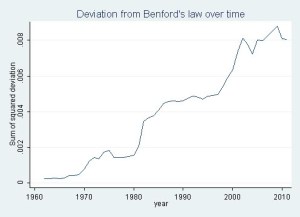
Jialang Wang via MR:

From wikipedia:

Benford’s law, also called the first-digit law, states that in lists of numbers from many (but not all) real-life sources of data, the leading digit is distributed in a specific, non-uniform way. According to this law, the first digit is 1 about 30% of the time, and larger digits occur as the leading digit with lower and lower frequency, to the point where 9 as a first digit occurs less than 5% of the time. This distribution of first digits is the same as the widths of gridlines on the logarithmic scale.

And from Jialang:

Deviations from Benford’s law have increased substantially over time, such that today the empirical distribution of each digit is about 3 percentage points off from what Benford’s law would predict.  The deviation increased sharply between 1982-1986 before leveling off, then zoomed up again from 1998 to 2002.  Notably, the deviation from Benford dropped off very slightly in 2003-2004 after the enactment of Sarbanes-Oxley accounting reform act in 2002, but this was very tiny and the deviation resumed its increase up to an all-time peak in 2009.

Looks like recessions are bad for corporate disclosure. Makes sense: if you can make the growth targets, you’re not worried. Once things get ugly, though…

But levels matter here, not rates. Why does it become entrenched?

I would love to find some time to apply this to insurance company data…

Steve Jobs = Keith Richards

This Gladwell article got me thinking.

The making of the classic Rolling Stones album “Exile on Main Street” was an ordeal, Keith Richards writes in his new memoir, because the band had too many ideas. It had to fight from under an avalanche of mediocrity

Richards goes on to marvel, “It’s unbelievable how prolific he was.” Then he writes, “Sometimes you’d wonder how to turn the fucking tap off. The odd times he would come out with so many lyrics, you’re crowding the airwaves, boy.”

[Richards] came to understand that one of the hardest and most crucial parts of his job was to “turn the fucking tap off,” to rein in Mick Jagger’s incredible creative energy.

The typical and terribly wrong view of innovation is that education and intelligence and creativity are scarce resources and our education systems need to address this.

My view of innovation is that all ideas start out stupid. The scarce resources are filters that eliminate the most egregious wheel-spinners and execution that elevates the remainder.

We focus on guys like Jagger, ablaze in a creative frenzy, and think: “wow, if only I could write that much music, I’d definitely have a hit eventually”. But the real genius here is probably Richards. How do you figure out what to hammer into a song? What if you choose wrong?

The wrong insight you might take away is that the best music ever written is probably languishing in a trashbin somewhere because nobody was able to polish it up. The real answer is that there is no such thing as the best music in a trashbin, because EVERY SINGLE Keith Richards is successful, but the VAST MAJORITY of Mick Jaggers aren’t.

Execution is hardest. Execution is what happens when you realize your original idea is stupid. Execution is identifying the redeeming quality and figuring out how to exploit it.

Let’s take technology companies, who control an enormous share of execution talent for innovative ideas: they have all the best engineers. What makes the difference between Amazon and, say, Pets.com? Execution.

But are Amazon’s engineers THAT much smarter than Pets.com’s? Probably not.*

What probably happens at Pets.com is that the filter doesn’t wipe out the bad ideas and whoever is in the Keith Richards role isn’t seeing the diamond in the rough.

And read the title to find out who sits atop the technology execution pantheon.

*By the way, I have no idea about any of this, obviously. I’m just picking companies out of thin air.

I Have An Origins Fetish

When I was a kid, I read a lot of fantasy novels. Super dorky to be sure, but there was one particular aspect of these fantasy worlds that really captivated me: the backstories.

I loved reading backstories. I loved reading about context. I read Lord of the Rings when I was a kid and was transfixed by the rich history hinted at throughout. And when I found out about The Silmarillion, I devoured it. Twice. I’ve reread all of these books, but I’ve reread the Silmarillion about two or three times for every time I’ve reread LOTR.

I used to read about Mythology and, even though I’m not at all religious, I love reading the Old Testament of the Bible. When I find myself in a Christian church, I immediately look for one. By the way, you’d be surprised how FEW chruches actually have Bibles in them.

Actual, real history is cool, but only the grandiose big-picture parts. As soon as the discussion wanders into pottery and art and cultural minutiae, I quickly fall asleep. Not interested. I only care about things that affect entire societies and shape generations of lives. My favorite history books so far have been Europe Between The Oceans and GG&S. Big big big.

So now I’m learning programming and I’m feeling the itch: what’s going on under the hood? Who made the decisions for how things work and why? When? Python is where it started, but I’m drawn towards the deeper, darker and older aspects of computing. I’m fascinated yet terrified by C, Assembly and the (currently, for me) mystical universe of hardware engineering*.

This big little slideshow was interesting in that it’s JUST accessible enough for me to get through it and candy-coats consumption of the scariness of C. It’s scary because (I think) that you’re speaking to the computer almost directly and computers don’t all take commands in the same way. I would never want to start learning programming by learning C and I’ll leave the expertise to the fat neckbeards.

But I can’t help myself from learning the programming backstory.

*One day I will get this and use the excuse to teach myself how it all really works.

How To Be Awesome

Here is a fascinating article on coaching and it’s written by a surgeon.

I’ve noticed two common themes on the resumes of CEOs of Reinsurance companies: many of them were actuaries at AIG in the 80s and another group were drawn from the ranks of the this famous old defunct firm called F&G Re.

What was in the water? Who set the culture that produced so much success? There had to be someone that kicked it all off, someone whose contribution to the industry has probably gone under-appreciated. Under-appreciated as a coach and a leader, anyway.

Most managers do a very poor job of coaching their employees. Who can blame them? It’s really hard. Once your’e out of school, learning is a strange, solitary process that, bizarrely focuses on all of the wrong things.

Take a typical insurance exam series. You spend a LOT of time learning about insurance law, a bit about definitions of various jargon and the rest is financial theory about capital allocation and pricing.

I would bet that the knowledge differential in these areas explains something close to zero of the variation in career success. If that hypothesis is true why would we teach it and test it and what should we teach and test instead?

I touch on this issue in my little rant against the DB course. We teach these things because they’re easy to test. We can grade people’s ability to memorize lists and perform calculations and delude ourselves (and them) into thinking that this is making them better at whatever it is that they do.

We’re wasting people’s time and, more tragically, we’re wasting their impulse to learn. These are people who have decided to spend extra time, and perhaps extra money, to better themselves. Worse, when they realize it does not work we have taught them that to better oneself is futile.

That IS a tragedy.

So what to do? Well, you do just what the good doctor in the article did: pick a task that you want to improve your performance on and find the best person you know at it and ask them what to do.

For instance, my company is led by a spectacularly good salesman. I don’t think I have EVER gotten a piece of advice on how to become a better salesman from him. Sure I’ve learned things by just being around him and working with him and that’s a powerful way to learn, too, but I don’t fully grasp the thought process that goes on behind his actions. This is an incredibly lucrative thought process, by the way, and our company should find a way of sharing it internally.

Instead I’ve taken lots of courses and spent lots of time doing things like blogging and listening to podcasts and reading articles online. I try to only do things where I will learn something that I think is of value but they’re not things that are making me better at the ONE THING that the boss of my company wants me to become better at. Ironically, this is the ONE THING that he can teach me better than anyone else I know.

Back to the joke about the economist searching under a light. The police officer comes up inquiring about what he’s doing. “Looking for my keys”, says the economist. Well where did you lose them? “Oh, way over there on the other side of the park”. But why are you looking here?

“Because this is where the light is.”
Notes from the 2011 MTV Music Video Awards

[This one is from the drafts folder]

– I was amused and bored by the canned reply about “what are you looking forward to most?”, which was: “Adele’s performance: I just LOVE Adele”. Adele is overweight, plain-looking and got her heart broken: it’s all very nice for singing-and-dancing bombshells to be fans of her music, but the over-the-top, obsequious condescension was a bit sickening.  They might as well say: “isn’t it cute when someone that looks like that can gets to hang out with us for a night? I love how good I look next to her on stage.”

-Speaking of those bombshells, Beyonce put on a performance that everyone agrees was a masterful combination of singing and dancing and looking good. And did it edging into her second trimester at that. Britney made an interesting comment at one point, though, that got me thinking: she said that the two of them came into the business at about the same time. How might one compare these two?

I think Beyonce will go down as the more successful artist. And if you put them through some kind of NFL-style pop star combine, Beyonce would probably jump right off the page: she’s taller, better looking, probably a better dancer, better singer, harder worker. Win win win.

And yet believe it or not I think Britney was by far a more compelling force artistically.

I’ll use a term my wife taught me when she used to act. Britney made music you feel in your crotch. I don’t really mean that sexually, either: it just connects on some deep level. Michael Jackson once said that the unorthodox 30-second lyric-less opening to Billie Jean needed to stay because “it makes me want to dance”.  That’s a powerful feeling and Britney, for whatever reason, has far more consistent ability to inspire it than Beyonce.

Beyonce goes about things differently. Her routines and music are often a spectacular display of ability and talent and creativity. The dance moves are immaculate, the difficult notes are nailed, the songs are often original and interesting. But dammit, I just don’t feel it in my crotch. Beyonce makes me think too much to appreciate her.

I feel like Britney’s career feel apart because she was strapped to rocket of talent and didn’t have the cognitive tools to deal with success. Beyonce has too many cognitive tools.

– Last and certainly least, I’m astonished that Chris Brown is being granted catchy tunes. Yeah x3 is excellent and I’m embarrassed to support this asshole. You don’t need to be a women’s rights activist (and I’m not) to acknowledge this guy’s a scumbag titleholder.

On the other hand, take it as an indication of my opinion of this spectacle that I’m surprised they didn’t cut to Rihanna during his performance. Maybe she wasn’t there? I’m not sure.