When The Chips Are Down: It’s All About #1

I’m just going to quote this whole MR post:

QUOTE

Support for redistribution, surprisingly enough, has plummeted during the recession. For years, the General Social Survey has asked individuals whether “government should reduce income differences between the rich and the poor.” Agreement with this statement dropped dramatically between 2008 and 2010, the two most recent years of data available.  Other surveys have shown similar results.

…the change is not driven by wealthy white Republicans reacting against President Obama’s agenda: the drop is if anything slightly larger among minorities, and Americans who self-identify as having below average income show the same decrease in support for redistribution as wealthier Americans.

Here is more.  The researchers, Ilyana Kuziemko and Michael I. Norton, attribute this to “last place aversion,” namely the desire to always have someone below you in the income pecking order:

Which group was the most opposed [to an increase in the minimum wage]? Those making just above the minimum wage, between $7.26 and $8.25.

For the pointer I thank The Browser.

END QUOTE

Here’s my comment on MR:

Maybe people automatically think that “the poor” is an unemployed person (ie somebody else, most people have jobs). When times are good, you probably don’t mind risking a tax increase for the sake of supporting a cause that signals your magnanimity.

When the ship is sinking, though, @#$@ the women and children, I need to watch out for #1.

My theory of political discourse is that people affiliate with causes when they perceive it to be relatively costless for them to do so. You can yammer on about the poor all you like; actually, you can yammer on about ANYTHING you like, but as soon as shit gets real, the decision-making process changes rapidly.

Talk is cheap: this is why prediction markets are the best way of figuring out what people really think.

-=-

Following a comment exchange below, please be sure to take the title to be a bit of artistic license (ie not, strictly speaking, true).
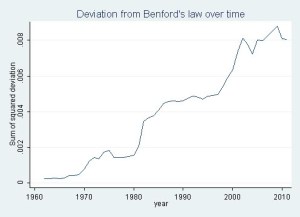
It’s All BS: Benford’s Law Edition

Jialang Wang via MR:

From wikipedia:

Benford’s law, also called the first-digit law, states that in lists of numbers from many (but not all) real-life sources of data, the leading digit is distributed in a specific, non-uniform way. According to this law, the first digit is 1 about 30% of the time, and larger digits occur as the leading digit with lower and lower frequency, to the point where 9 as a first digit occurs less than 5% of the time. This distribution of first digits is the same as the widths of gridlines on the logarithmic scale.

And from Jialang:

Deviations from Benford’s law have increased substantially over time, such that today the empirical distribution of each digit is about 3 percentage points off from what Benford’s law would predict.  The deviation increased sharply between 1982-1986 before leveling off, then zoomed up again from 1998 to 2002.  Notably, the deviation from Benford dropped off very slightly in 2003-2004 after the enactment of Sarbanes-Oxley accounting reform act in 2002, but this was very tiny and the deviation resumed its increase up to an all-time peak in 2009.

Looks like recessions are bad for corporate disclosure. Makes sense: if you can make the growth targets, you’re not worried. Once things get ugly, though…

But levels matter here, not rates. Why does it become entrenched?

I would love to find some time to apply this to insurance company data…

Steve Jobs = Keith Richards

This Gladwell article got me thinking.

The making of the classic Rolling Stones album “Exile on Main Street” was an ordeal, Keith Richards writes in his new memoir, because the band had too many ideas. It had to fight from under an avalanche of mediocrity

Richards goes on to marvel, “It’s unbelievable how prolific he was.” Then he writes, “Sometimes you’d wonder how to turn the fucking tap off. The odd times he would come out with so many lyrics, you’re crowding the airwaves, boy.”

[Richards] came to understand that one of the hardest and most crucial parts of his job was to “turn the fucking tap off,” to rein in Mick Jagger’s incredible creative energy.

The typical and terribly wrong view of innovation is that education and intelligence and creativity are scarce resources and our education systems need to address this.

My view of innovation is that all ideas start out stupid. The scarce resources are filters that eliminate the most egregious wheel-spinners and execution that elevates the remainder.

We focus on guys like Jagger, ablaze in a creative frenzy, and think: “wow, if only I could write that much music, I’d definitely have a hit eventually”. But the real genius here is probably Richards. How do you figure out what to hammer into a song? What if you choose wrong?

The wrong insight you might take away is that the best music ever written is probably languishing in a trashbin somewhere because nobody was able to polish it up. The real answer is that there is no such thing as the best music in a trashbin, because EVERY SINGLE Keith Richards is successful, but the VAST MAJORITY of Mick Jaggers aren’t.

Execution is hardest. Execution is what happens when you realize your original idea is stupid. Execution is identifying the redeeming quality and figuring out how to exploit it.

Let’s take technology companies, who control an enormous share of execution talent for innovative ideas: they have all the best engineers. What makes the difference between Amazon and, say, Pets.com? Execution.

But are Amazon’s engineers THAT much smarter than Pets.com’s? Probably not.*

What probably happens at Pets.com is that the filter doesn’t wipe out the bad ideas and whoever is in the Keith Richards role isn’t seeing the diamond in the rough.

And read the title to find out who sits atop the technology execution pantheon.

*By the way, I have no idea about any of this, obviously. I’m just picking companies out of thin air.

How To Be Awesome

Here is a fascinating article on coaching and it’s written by a surgeon.

I’ve noticed two common themes on the resumes of CEOs of Reinsurance companies: many of them were actuaries at AIG in the 80s and another group were drawn from the ranks of the this famous old defunct firm called F&G Re.

What was in the water? Who set the culture that produced so much success? There had to be someone that kicked it all off, someone whose contribution to the industry has probably gone under-appreciated. Under-appreciated as a coach and a leader, anyway.

Most managers do a very poor job of coaching their employees. Who can blame them? It’s really hard. Once your’e out of school, learning is a strange, solitary process that, bizarrely focuses on all of the wrong things.

Take a typical insurance exam series. You spend a LOT of time learning about insurance law, a bit about definitions of various jargon and the rest is financial theory about capital allocation and pricing.

I would bet that the knowledge differential in these areas explains something close to zero of the variation in career success. If that hypothesis is true why would we teach it and test it and what should we teach and test instead?

I touch on this issue in my little rant against the DB course. We teach these things because they’re easy to test. We can grade people’s ability to memorize lists and perform calculations and delude ourselves (and them) into thinking that this is making them better at whatever it is that they do.

We’re wasting people’s time and, more tragically, we’re wasting their impulse to learn. These are people who have decided to spend extra time, and perhaps extra money, to better themselves. Worse, when they realize it does not work we have taught them that to better oneself is futile.

That IS a tragedy.

So what to do? Well, you do just what the good doctor in the article did: pick a task that you want to improve your performance on and find the best person you know at it and ask them what to do.

For instance, my company is led by a spectacularly good salesman. I don’t think I have EVER gotten a piece of advice on how to become a better salesman from him. Sure I’ve learned things by just being around him and working with him and that’s a powerful way to learn, too, but I don’t fully grasp the thought process that goes on behind his actions. This is an incredibly lucrative thought process, by the way, and our company should find a way of sharing it internally.

Instead I’ve taken lots of courses and spent lots of time doing things like blogging and listening to podcasts and reading articles online. I try to only do things where I will learn something that I think is of value but they’re not things that are making me better at the ONE THING that the boss of my company wants me to become better at. Ironically, this is the ONE THING that he can teach me better than anyone else I know.

Back to the joke about the economist searching under a light. The police officer comes up inquiring about what he’s doing. “Looking for my keys”, says the economist. Well where did you lose them? “Oh, way over there on the other side of the park”. But why are you looking here?

“Because this is where the light is.”

Reality Check

Here is some healthy corrective:

Six hours was enough, between the 6 a.m. start time and noon lunch break, for the first wave of local workers to quit. Some simply never came back and gave no reason. Twenty-five of them said specifically, according to farm records, that the work was too hard.

So they go back to collecting unemployment or something? Yikes, that’s crazy-juice for right-leaning voters.

The thing that irritates me about ‘jobs policy’ (what a ridiculous term) is that people are not very concrete about the problem and I like to remind myself sometimes what it’s all about.

First remember that to quiet down voters we need to satisfy several apparently contradicting impulses:

People don’t want to live in rural areas.

People don’t want to do manual labor. People don’t want to work hard generally. That’s not a criticism, mind you. Who wants to be forced to do something unpleasant?

People want a better life than their parents and are happy to wait for it. And live with their parents until it arrives.

“Good jobs” allow people be lazy, urban and rich. Auto workers were the poster-children of this movement, and for good reason.

I grew up in the catchment area for the Motor City Auto industry and I’ll always remember the stories of the Temporary Part Time job contracts some kids of auto workers were granted.

This was stuff that made lazy teenagers salivate: lots of downtime, no skills required, lots of breaks, discounts on cars and $22/hour in 1998 for a 17-year-old. Absolutely outrageous. And the employment practices were no better than the most hideous nepotocracies* on earth. Insiders win.

Anyway, a complete discussion of this should match my criteria above with a picture of who is actually unemployed.

See here too. In order of predictive power, my understanding is that the characteristics go like this: poorly educated, urban, young and dark-skinned. I’m not actually sure this matters, because the unemployed have probably always come from the ranks of the disenfranchised in society.

*I wish I could put that one into the words of the day, but I googled it and found loads of instances. No such thing as a new idea, I suppose.

“Wall Street” Protesters

I walked by them this morning on the way to work. Hadn’t been by in a week or so. Some observations:

  • It actually smells like manure and compost in there.
  • I wonder what the point of it all is. They’re just kinda sitting there. “We’re going to live like homeless people until… um… until…”
  • What is “Wall Street”? Is that a euphemism for empowered insiders? For rich people? As I walk by in my suit I imagine they think of me as being a “Wall-Streeter” yet I find the idea ridiculous.
  • From a purely personal standpoint, the motivation can only be that they have nothing better to do and are looking for a sense of belonging. People are desperate for meaning and will do ridiculous things searching for it. Read this book.
  • People will say “get these idiots jobs” but that’s misleading. What these people really need are the mortgages, cable bills and car payments that come with having jobs. We need these people’s fear of losing their jobs to insulate us from this kind of stupidity. So yeah, they need jobs, but that’s only a means to an end.

One of my more silly pet theories is that I don’t believe in politics, only economics. Discourse is only good for signaling affiliation and escalating conflict. The only social force that matters is whether people feel they’re better off than they used to be and that means richer than they used to be.

What If Steve Jobs Didn’t Grow Up in Silicon Valley?

From time to time I need an inspirational boost and I turn to this book, which I’m slowly cranking through on the kindle. I recently finished the chapter on Steve Wozniak (the real Thomas Edison of the pair of Steves IMO), which I’m thinking back to a fair bit today.

I think that the most powerful determinant of each man’s future was not himself, but actually Hewlett-Packard, where each worked at one point and which basically sparked culture we know today as Silicon Valley.

Apple, Inc. does not exist if these two kids didn’t meet and, I’d say, also doesn’t exist if they grew up in ANY other city in the world.

Here’s Paul Graham:

The problem is not that most towns kill startups. It’s that death is the default for startups, and most towns don’t save them. Instead of thinking of most places as being sprayed with startupicide, it’s more accurate to think of startups as all being poisoned, and a few places being sprayed with the antidote.

Startups in other places are just doing what startups naturally do: fail. The real question is, what’s saving startups in places like Silicon Valley? [2]

On the mark.

Culture mattes more than anything.

A Journey of a Thousand Miles

I’ve recently come across this new insurance blog by Todd Bault and it’s friggen catnip to me. I disagree with a lot of what goes on in there, in particular (I think) his strange and interesting theory of capital.

That’s cool, though, because it’s making me think my own perceived understanding through more carefully, which is always welcome. His posts are so content-heavy that I’m overwhelmed with where to begin the discussion, so…

I’ll take advice from Barker:

The first step is crucial — keep it tiny. Do not be ambitious yet. That leads to failure.

Consider this the first step: a simple declaration of intent. I intend to keep re-reading Todd’s old posts and figure out exactly where we disagree. Then I’ll try to write something small.

Don’t Read With Sharp Objects Nearby

So I came home tonight in a bit of a mood and elected to shelve today’s work on the weekend project, crack a beer, order some food and curl up with the kindle backlog until my wife came home.

And now I’m depressed.

The first two articles tonight (one by Peter Thiel and the second by Neal Stephenson) were of the TGS variety: big long 3000-ish word whinge-fests on how we’ve stopped advancing technologically. Ugh…

The third (on Google’s dominance) brought me back from the brink but was still so shot through with ominy* that I remain perturbed.

Well, at least my beer hasn’t let me down. Whole Foods. Fantastic selection.

*does this word exist? I want it to be a collective noun for ominous things. Meh, it’s my blog, I can do what I want. There. Done.