This episode features Terri Vaughan (mp3, youtube), professor of actuarial science at Drake University and CEO of the NAIC during the Great Recession. We can call this the Not Unreasonable 10-year retrospective on the financial crisis. I first came across Terri’s work as an actuarial student and been fascinated ever since by her case for state regulation and citation of the insurers’ performance during the financial crisis as evidence in its favor. Here’s the gist:
And on the feds:
Finally, where is state regulation going?
We also cover the origins of insurance regulation, how and why she joined the NAIC, what it was like in Washington during the financial crisis and more! Terri has been a huge influence on my own thinking about our industry, it was an honor to have her on the show! Transcript below: |
Tyler Cowen on Stubborn Attachments
This is a special interview for me because Tyler Cowen (mp3 including transcript, youtube) has been an enormous intellectual and moral influence on me over the last ten years or so.
I’m not alone. Tyler blogs with Alex Tabarrok at marginalrevolution.com, which is usually ranked as the top economics blog and Tyler as one of the most influential economists of the day. Tyler’s books (see below) are also enormously influential and you name your favorite economic or financial public intellectual and they probably read Tyler every single day.
The interview I’ve wanted to do with Tyler has been the “who is Tyler” conversation. Luckily he just wrote an entire book on what he values and why. That new book, Stubborn Attachments, is the foundation for Tyler’s entire value system. What an opportunity to dig in.
And yet I am so immersed in Tyler’s thinking that it’s hard for me to appreciate that you might not yet see why I think he’s worth understanding (and he is!). So down below I’ll put a quick run-down and reading list of some ideas and books that will help prime you for this conversation.
From my interview, here is the first question:
David Wright: I want to start with what I see as the most marginally important Cowenian contribution. For the sake of the audience, marginal in this case doesn’t mean small, it means that there are a lot of commentators and public intellectuals out there saying for the most part a lot of the same stuff. But given all the very smart people saying very smart things, where does Tyler stand out? What do you *need* to go to him for? My answer is it isn’t even Tyler… it’s Tyrone. I’ll defend this selection in a moment but can you explain to us who Tyrone is… and I don’t mean the name on his driver’s license, but you can tell us that, too. Who is Tyrone REALLY..
On how Tyler might have hatched the most important philosophical innovation in 2000 years. Really, you ask? You be the judge!
David Wright:…we read the ancient philosophers because they.. they’ve.. I’ll use my my word: infected our thinking and it’s the roots of quite a lot of current philosophical thought.. they wouldn’t have had a chance to think about compound growth and and in zero time preference right. So it seems to me this is actually a philosophical innovation the likes of which the world hasn’t seen in millennia. Could that be the case?
Tyler Cowen: Yes, you know.. Agnes [DW: Agnes Callard, CoT guest, see below] has one of the deeper understandings of ancient philosophy because she also has a Ph.D. in ancient history and has studied ancient philosophy and the view of many of the early Greeks was there’s something retrogressive about history or sect like so you advance for a while and then you move backwards. So it’s hard to keep a lot of compound returns was probably correct for them to believe that in their time. But we’re now in a world where at least say Great Britain since you know the 16 twenties or so has mostly had positive compound returns for centuries. And that’s a practical innovation and our theories need to adjust accordingly.
What I think is really going on in this book (and then get one-upped!):
David Wright: So I have a Straussian reading of this book and my Straussian reading is that
Tyler Cowen: I’m happy already by the way.
David Wright: It’s that it’s actually a sequel to Average is Over. And I know it’s not. But I would think of it as a sequel to average is over and I was listening to your podcast with Russ Roberts and in that he made the point or you made it I’m not sure who made it first but you were agreeing about the fact that Average Is Over which I’d like you to summarize if you don’t mind a moment I’ll give it my shot which is it’s about how there’s this.. in society there is going to be a big difference between people who are very good at the kind of development the technology that society is producing and then you have people who are not and you’re going to wind up with you know what Ross calls a bi-modal distribution which as you have you know a whole bunch of haves and a bunch of have nots and sort of hollowing out of the middle of society. And in that conversation you were talking about how really the book was not, as you put it, this is not normative in the sense that you weren’t really venturing an opinion on it saying this is good or bad this is kind of what’s happening. And I think that the Straussian reading of Stubborn Attachments is *that that’s not true*. It actually is a message to the have nots from Average Is Over and saying *just do it for your grandkids*.
Tyler Cowen: I agree with that. But I’ll see your bid and raise you a few…
This interview is so jam-packed with awesome moments including where I worry about the social status of venture capitalists (and Tyler tries to reassure me), who the Einstein of Journalism might be, Straussian readings of Conversations with Tyler, how Tyler consumes podcasts, how we value non-economic social phenomena and of course much, much more on Tyrone.
I needed this show to try to understand who Tyler really is and why and came away pretty satisfied! Big thanks to Tyler for his time and thanks for listening!
Tyler Cowen reading list:
- Stubborn Attachments: the book we’re talking about today. Out October 16th!
- The Great Stagnation: A short book. Key observation: our great grandparents’ lives were revolutionized (television, automobiles, airplanes, microwaves, etc, etc) and our parents’ lives are almost indistinguishable from our kids’. Why?
- Average is Over: the middle class will ‘hollow’ out with an upper middle class of tech-enabled thinkers and a lower middle class of customer service workers. How will this happen?
- The Complacent Class: much of the stagnation of the last generation has come about because we want comfortable, riskless lives.
- Conversations with Tyler: as background for this podcast, I’d suggest his talks with Ross Douthat, David Brooks, Peter Thiel, Agnes Callard, Malcolm Gladwell and Dave Barry
- marginalrevolution.com. Some key posts that give you a feel for Tyler’s writing and thought process:
I haven’t even told you about his daily links, yet. Read marginalrevolution.com!
How Arbitrage is Like Specialty Insurance
This episode (mp3, youtube) is about diving deep into a comparison between stock market arbitrageurs and specialty insurance underwriters. The idea for the show came from the guest, Rich Derr, an actuary at Nationwide Insurance Company’s specialty division and I love nothing more than falling down a well with someone comparing financial and insurance markets.
The original paper that inspired Rich is called The Limits of Arbitrage and doesn’t really contemplate insurance. That’s our job! I learned a lot in this conversation, actually, and some of the insights will stick with me a long time.
The paper has two really important ideas. The first describes what I’ll call ‘ironic opportunities’, which are situations where failure actually emboldens you to further action.
David Wright: It looks riskier and that’s the real core insight, isn’t it? When the position goes farther away from where you think it should be, it looks scarier.
Rich Derr: Yep. And especially if you don’t have that specialty knowledge, you’re looking at that position and as the investor, you’re going, wait a minute, you’re telling me everything’s fine, but you’re, you’re recognizing a loss and now you’re coming to me for more money. And where it gets even more fun is the arbitrageurs are saying not only that, but the opportunity is actually better right now. And so we need more capital to go heavier into that position. Um, and that’s, that’s the difficulty of the arbitrageur.
The second idea is that monitoring a specialist is incredibly hard, so capital providers can understand these that ironic opportunities exist in principle but you need to have limits to your ability to trust an arbitrageur. The solution is almost cruel in its simplicity: just look at their track record.
David Wright: So how do the capital providers decide whether to give you money or not?
Rich Derr: So that’s one of the key assumptions of this paper and it gets into the performance based arbitrage, sorry, performance based allocation. What they do is how they decide who gets the capital as they look at the historic experience of the arbitrageur because the strategies of the arbitrageur is so difficult that they don’t really understand it. So they’ll look at the historic results and say, hey look, historically you’ve done great, you’re going to get capital. Historically you’ve done.. meh.. you don’t get a lot of capital, but that kind of provides a disconnect, right? Because what you should be looking at is the expected results.
It’s fantasy football time. So just using that as an example, like if you just used the last year to judge what the players are going to do next year, you’re gonna you’re going to lose. You need to. You need to look at what’s the expected results are and that’s how they’re making the capital decision.
Both of these ideas map to insurance: you have ironic opportunities all the time in insurance and extremely opaque measures of quality. It’s so hard to know who is good!
Listen to the whole thing for more including on some issues I have with this including the point that long successful track records might not be so great and deeper dives into what this framework can teach us about insurance.
Thanks for listening!
Are you an actuary? Someone you know? Check out the Not Unprofessional Project, for the price of a CAS webinar you get unlimited access to content dedicated to Continuing Education Credits for Actuaries, especially Professionalism credits. CE On Your Commute!
Subscribe to the Not Unreasonable Podcast in iTunes, stitcher, or by rss feed. Sign up for the mailing list at notunreasonable.com/signup. See older show notes at notunreasonable.com/podcast.
Joshua Gans on AI

How are we supposed to think about Machine Learning? How are businesses going to change? This week I interview Joshua Gans (youtube, mp3), Professor of Strategic Management at the Rotman School of Business at the University of Toronto and the Chief Economist at the University’s Creative Destruction Lab. Joshua is the co-author, along with Ajay Agarwal and Avi Goldfarb, of Prediction Machines: The Simple Economics of Artificial Intelligence.
Links for this show:
On why economists are joining tech companies?
Joshua Gans: ..we’re talking here about artificial intelligence and if there’s ever a place where, academics and business of sort of fused together, it’s in that field, you know, all of the main pioneers of artificial intelligence, almost, almost all are, um, not now purely academics… I think there are situations in which maybe always has been more integration versus others..
David Wright: and maybe you identified an important idea there which is a lot of technology emerges from academia as well from engineering departments and computer science departments and so they sort of naturally dragged along a few of their friends. Maybe instead you should join us, you’d have something to say here…
Commenting on Benedict Evan’s conception of Machine Learning as data processing:
David Wright: So there’s an analyst who works for Andreessen Horowitz: Benedict Evans, you’ve probably heard of him. And he has a framework for evaluating AI. He wrote a blog post a couple months ago where he said, really, there’s three ways of thinking about the applications.
- The first is do the things we’ve already do, but doing them better.
- Then: Do you ask new questions of existing data that we already have.
- And the third is bringing new data to analyze.
The third one is the most advanced one, the ones that’s the most sexy, let’s call it. And that’s you spend your time second ago talking about but the first two are really probably where we’re generating a lot more of the value I would argue. And so how should we think about that? As a kind of evolution of the ability of AI to do things we already do but a little bit better..
Joshua Gans: I mean the issue that I have with that setup of, you know, what is it doing, it’s not that it’s wrong, but it’s like hard to see. Interesting because you know, we’re going to learn stuff from data and this is true. And so, you know, that data, more data, new data, the whole thing. It tends to put an emphasis on finding the data. But the way we see it, *it’s more finding the problem.*
The bottom line:
Joshua Gans: I think in the next let’s be more interesting in the next five years, there’ll be a startup somewhere who manages to reformulate what, what wasn’t a prediction problem as a prediction problem. Solve that. And it impacts broadly on our lives. The one thing I know about these radical innovations is how they actually ended up manifesting themselves, was always different from what people were imagined at this stage and you know, and I think the same is going to be true of AI.
All that and much more, including a theory of the mind, a discussion of physical intelligence and of course applications for the insurance industry!
Are you an actuary? Someone you know? Check out the Not Unprofessional Project, for the price of a CAS webinar you get unlimited access to content dedicated to Continuing Education Credits for Actuaries, especially Professionalism credits. CE On Your Commute!
Subscribe to the Not Unreasonable Podcast in iTunes, stitcher, or by rss feed. Sign up for the mailing list at notunreasonable.com/signup. See older show notes at notunreasonable.com/podcast.
The Not Unreasonable Book Club-Episode 1

Today I’m kicking off a new series tentatively called the Not Unreasonable Book club to be co-hosted with Steve Mildenhall (who is running for the board of the Casualty Actuarial Society, so vote for him!). Steve is an assistant professor at St John’s University’s school of risk management and former head of Analytics at Aon Re. Steve’s an all-around smart dude and I’m looking forward to learning from him and hopefully disagreeing once in a while!
Books and papers discussed in today’s show (youtube, mp3):
On Radical Markets: Uprooting Capitalism and Democracy for a Just Society by Richard Posner and Eric Glen Weyl
Steve: The basic idea was that you have a wealth tax that would be a self-assessed so you would post your reservation price on assets you own particularly property and you would be taxed according to that to that value but if someone else came along and they wanted to buy it they could buy it at the value that you had posted it
David: that’s your sell price
Steve: yes, it’s kept you honest in your assessment.
David: if you put your too high your tax bill goes up and if you put your price to low somebody will buy your property
Steve: It’s a way around eminent domain problems and hold-outs against construction. If you’re bought every other house along the Train or the right of way or whatever and you know this would be a way of ensuring that those projects that would maybe have a greater of social value would be able to proceed.
David: what do you think about the argument?
Steve: I mean it’s I like it’s concept it sounds great
David: it’s cute
Steve: it is cute. As someone who lived in the same house for 25 years and had an unreasonable attachment to, I didn’t like the idea that someone could come along and just move me out of my house. I did think they missed a couple of points. Presumably if I could post a low price, they could post a price and I could just buy it back. It would be like sniping on eBay auctions where you’d have your listed price and in the back you’d have an actual price you’d bid up to. So it would be a more complicated market than they described. The piece that I struggled with was that they identified the use with the highest value as the use to which the use to which the person who’d be willing to pay the most would put the property and I don’t think that actually is true.
Capitalism without Capital: The Rise of the Intangible Economy by Jonathan Haskell and Stian Westlake
David: one of the ideas that I just love thinking about is the idea that intangible assets have increased as a share of total assets.. insurance companies are maybe not a great example because they’re entirely made of intangible capital..
Steve: Well I’d argue that they’re entirely made of tangible capital
David: Cash
Steve: The cash is the only capital. This is an interesting discussion. It comes down to when a you set up an accounting standard which is what we’re talking about here is what is the objective of the accounting standards and therefore what should I count an asset. And if you think about insurance companies, statutory accounting is around ensuring that claims are going to be paid and so can only count assets that can turn into Cash. If that asset that is not going to turn into cash it shouldn’t be on the statutory balance sheet…
David: Let me go back and try and defend my view that insurance is entirely intangible assets…
The Theory of Risk Bearing: Small and Great Risks by Ken Arrow
Steve: Arrow’s paper has a number of implications for how risk should be shared and what is paper says is risk will end up being shared through a large number of bilateral contract and the net effect of it is that all risk will be thrown into pool and then everyone will Quota Share the pool. And if you do that all of the diversifiable risk has gone away because all the risk is in the pool and you’re just left with the systematic risk ‘what’s the size of the pool’ is the only risk variable that’s left.
David: the only variable that should inform pricing.
Steve: Risk, and people.. sort of the share can come back is inversely proportional to my risk aversion so if I’m more risk-averse I’m prepared to accept a smaller share back in exchange for having gotten rid of all of the risk, right. Less risk averse people will take greater share of volatility. And this was Arrow’s theory that risk was implemented through Arrow-Debreu securities which you may have heard of, which pay $1 in one particular state of the world. So that’s the most fundamental insurance contract if you will and from that I can price any security because any Security is just a combination of these fundamental Arrow-Debreu securities. So this is a wonderful theory when it all works kind of nicely.
David: Except it doesn’t
Steve: It works nicely in theory, I should say. So Ken Arrow’s observation around this is well there should be a lot of risk sharing going on and we also noticed that there’s no place for an insurance firm is in this Arrow-Debreu world… and yet we see them everywhere.
The Nature of the Firm by Ronald Coase
David: An interesting paper that won the Nobel Prize I think in economics which was amazing really for another really short paper and easily readable paper written in 1937 still resonates today. And the question is why do we have firms at all in any industry because if the market mechanism allocates things efficiently to your point there I think but I don’t know if arrows theorem had been.
Steve: It was afterwards.
David: It was afterwards, but we’ll just take it for granted that the economic economic allocation of resources is efficient because of market transactions because you have the price system that governs the value and Ronald Coase says why the heck do we have companies then because companies are not markets they are command and control organizations where you have a CEO telling somebody else what to do and they do it and there’s no price transaction between them.. why? Steve, why don’t you give us the answer.
Steve: [laughs] So the argument against command and control is a sort of amusing everyone looks at the government and oh, the government is necessarily going to be inefficient and stupid at doing things it is so amusing to me or ironic maybe the better would that the theory that sealed that came about just after the second world war that was won entirely on a command-and-control basis.
David: Sure, militaries are the original corporation.
Steve: Governments get this bad rap, but what’s the difference between working in a government and working in a firm…
Do listen to the whole thing!
Many thanks for Steve and feel free to email me with ideas for books we can cover in future episodes at david@notunreasonable.com.
Are you an actuary? Someone you know? Check out the Not Unprofessional Project, for the price of a CAS webinar you get unlimited access to content dedicated to Continuing Education Credits for Actuaries, especially Professionalism credits. CE On Your Commute!
Subscribe to the Not Unreasonable Podcast in iTunes, stitcher, or by rss feed. Sign up for the mailing list at notunreasonable.com/signup. See older show notes at notunreasonable.com/podcast.
Analyzing Lloyd’s results with Rob Johnson
Greetings from Canada!
Every year we head back to the motherland for a couple weeks to unwind, reconnect with friends and my wife’s family, tow the kids around on a boat and… talk about the financial results of the Lloyd’s marketplace!
Rob Johnson (youtube, mp3) returns (here’s the original!) to the Not Unreasonable Podcast for a deep dive into the financial results of the Lloyd’s market. Rob almost always has a contrarian view of insurance company results. Usually when an insurer is lamenting their results they’re much better than they seem. And when they’re pumping up their performance, that’s a warning sign!
Rob has taught me that insurance companies are remarkably resilient institutions and amid all the hand-wringing of the Lloyd’s market’s results he remains more sanguine than you’d think!:
First comment would be that the underlying loss ratio is a phenomenally good. Across all those 17 years that the gross loss ratio is about 65.. that’s gross. I should warn you I always talk gross, and deal with reinsurance as a cost. So the gross loss ratio is 65 and it’s been down under 50 for quite a few years. Last year it 85. I think 2005 it was 112. It’s actually a good figure.Then there’s expenses, net expenses are declining, that’s masked a little bit by the way insurers and Lloyd’s account for quota share reinsuraces. I reverse that out.. if you reverse that out, the acquisition costs have gone from 19-20% to 26-27%. that’s a very big increase and the cost of administering the business has been 6% or 7%.
It’s clear that the original brokerages and commissions have gone up. The originators of the business have a lot of market power and it’s in their interest to push up the rate of brokerage. The other comment I’ll make there is that up until recently Lloyd’s did not specifically report on brokerage it is just netted off. It was in the bottom line but it was not there as a line item and I personally think that’s been a mistake over the long term. If you don’t measure it and report it you won’t control it.
Thanks for listening!
Demotech is The Disruptor with Joe Petrelli
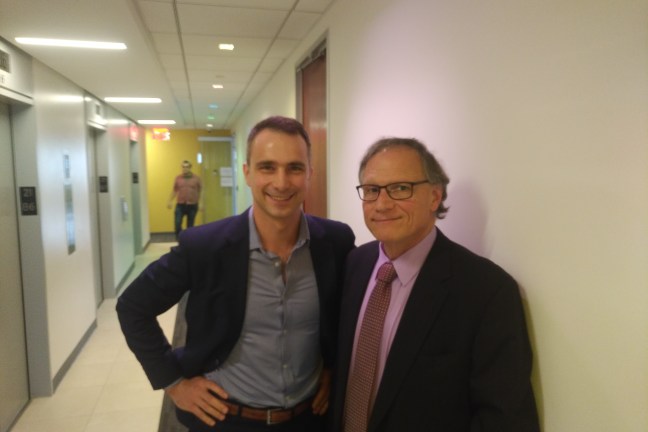
My guest this week is Joe Petrelli (mp3, youtube), the founder and CEO of Demotech, a rating agency based in Columbus, Ohio. This interview was a particular delight for me, folks, because I’ve finally found a real example of classic Clay Christensen Disruption in Insurance. Demotech has been quietly disrupting what he calls “the legacy rating agencies” for decades.
THIS is what real disruption looks like:
JP: We were actually the first company to review and rate independent regional insurance companies. The Legacy rating agencies back in the late 80s, the Legacy rating agencies would rate a small independent company if it was part of a large group but there was no one reviewing and rating independent Regional and specialty companies. And we heard that from Fannie Mae and Freddie Mac about smaller companies that they had been doing those sorts of analysis on their own to qualify a company for offering homeowners insurance coverage in the in the secondary mortgage Marketplace selling off the the mortgage of the home that was insured [DW: the mortgages needed homeowners coverage from a “rated” insurance company to qualify for the secondary mortgage market]
…
JP: and at that point in time they contacted the Legacy rating agencies who would not rate the independent Regional and Specialty Company so we got to talk..
DW: So these companies had no rating.. like a small Mutual company.. because you know what’s amazing because I think of that these days as being kind of the bread and butter for let’s say an AM Best, a Regional Mutual insurance company that’s all they’ve got and they’ve been around for a long time but they’re very small I mean were those guys also excluded from this or is this mostly newer organizations?
JP: No, it was, ah, the smaller independent companies all of them were not rated and actually after we’ve been approved by Fannie and Freddie I actually had a conversation with Arthur J Schneider the president chairman CEO and largest shareholder… the conversation I had with the Arthur J Schneider II was they never wanted to rate the smaller companies.
DW: because you’d think that’s where the rating agency would offer the most value, right, because the smaller companies are the ones perhaps are a little less certain..
- Underserved, low end market? Check.
- Looks like a ‘toy’ product that no serious player should consider? Check.
- Slowly creeping upmarket against all odds? Yep.
That’s disruption kids. And he did it at least two more times with Florida Homeowners and Title insurers. Astonishing. Joe should be an insurance innovation celebrity.
Another amazing point is Demotech’s track record, a much under-publicized fact.
JP: So for A” [DW: called double prime] we said for A”, a hundred percent of the companies we rate A double Prime will survive at least 18 months after we withdraw that rating. At least 99% of the A primes, at least 97% of the A’s at least 95% of the S’s and at least 90% of the Ms after if we withdraw the rating and it goes from rated to unrated you got at least 18 months and those are the survival percents. In terms of what we do to show people that we have confidence in a rating, we have self-published our record from 1989 to date annually updating it.
And this last year year end 2016 and getting a 2017 update, we retained two distinguish professors both of whom had worked with the National Association of insurance Commissioners. Robert Klein was their Economist for years and he’d been at the Michigan Insurance Bureau, he’s a Georgia State University, Dr. Robert Klein and Dr. Michael Barth is I think assistant Dean at the at the Citadel, he’s another PhD, he’s also CPCU. He was at the NAIC and developed was actively involved in the development of the risk based capital framework.
So we got two distinguish Insurance profession we gave them every one of our ratings from 1989 to date and said check our math and they did it and they publish the report in February of 2018 and they basically said we hit our marks every year from 1989 to date.
Here is a link to the latest version of the report. And another to some graphs. Demotech is one of the most fascinating and underrated stories in insurance innovation and in the insurance market in general. Thanks to Joe for his time!
Are you an actuary? Someone you know? Check out the Not Unprofessional Project, for the price of a CAS webinar you get unlimited access to content dedicated to Continuing Education Credits for Actuaries, especially Professionalism credits. CE On Your Commute!
Subscribe to the Not Unreasonable Podcast in iTunes, stitcher, or by rss feed. Sign up for the mailing list at notunreasonable.com/signup. See older show notes at notunreasonable.com/podcast.
Todd Hart on Managing Hedge Funds, Reinsurers and Insurers

| Todd Hart (mp3, youtube) has had the following jobs: political campaigner, investment banker, hedge fund trader, hedge fund portfolio manager, private equity investor, reinsurance company CEO, insurance company CEO and stay at home dad. I’ve seen Todd in action in all kinds of capacities from the lofty heights of deal finance to the gnarliest systems issues in personal lines insurance and I’ve always admired his level-headed attitude in what otherwise might be very difficult situations.
You can be smart and hard working, and Todd is both those things, but to me he is more of a model for *how* to be smart and hard working. In the interview I want you to listen for evidence in the more universal qualities that set Todd apart: curiosity, optimism and a fundamental decency especially towards people that work for him and with him. One of the things I really wanted to ask Todd was whether management is different in hedge funds, reinsurers or insurers. It is not:
Todd on systems:
Folks, there is so much more. I haven’t even given you any quotes on management! Todd is probably the best manager of people I’ve ever witnessed in addition to being one of the best negotiators and strategic thinkers in insurance. And in the show we hear about his strategic thinking and management style but also why American Airlines called him to see if he was ok, what it was like failing in a hedge fund, what a good business opportunity looks like. You will learn from Todd Hart! Subscribe to the Not Unreasonable Podcast in iTunes, stitcher, or by rss feed. Sign up for the mailing list at notunreasonable.com/signup. See older show notes at notunreasonable.com/podcast. If you’re an actuary you, like me, probably dread the professionalism continuing education requirement. I think the best time to satisfy this in podcast time. While on your commute, while walking your dog, mowing the lawn. Head over to notunprofessional.com where, for the price of a CAS webinar you can get content dedicated to continuing education for actuaries. Especially professionalism CE. |
Why Systems Are So Hard to Build

My guest this week is Bill Jenkins (youtube, mp3). Bill is a technology specialist in the insurance industry. I like to joke that the customer satisfaction rate for insurer systems is 0. But does that need to be the case? I’ve finally had the chance to ask these questions of an out and out expert. Bill has headed up internal technology projects at insurers, he’s run the technology at brokers. He’s been a consultant. A Board member. An industry standards advocate. If there is a puzzle in insurance technology, Bill has probably thought about it and here he is today to help us all better understand why we struggle with technology in insurance.
First, the classic question. Why so many systems? This one always puzzled me. It’s not just about acquisitions. It’s because it’s actually easier that way! Such a satisfying answer (for me) since it aligns with the idea of hidden and underappreciated costs as being the main reason why some problems persist in the world.
BJ: some carriers have multiple and duplicate systems so I worked for a large/ medium sized carrier and we had a eight billing systems.
DW: why, acquisitions?
BJ: Partly Acquisitions partly because it’s one system than address one problem with the other system did so they decided that they needed that this additional functionality that the old system didn’t provide. We just want another one. We had three Bop systems. I was listening to a talk that the chief technical officer at the Hartford was giving and he said every year that goes through the examination and review to determine if they should replace all their legacy systems they had over 330 system. I said to replace all these are they that they projected out would be in 50 years or so and the cost would been astronomical. So all they did was just add systems.
Bill on how project management can achieve great things:
BJ: we also use the project management discipline that we called black hat white hat. Black hat was a hired gun. A project manager who comes in and his or her and only charge was to make sure that the specifications for the system were done and was going to be followed for the requirements of the system and that the time frame that was said would be adhered to. The white hat was an internal project manager who basically made sure the right people were on a project to do the work and also did all the reporting to the Senior Management and navigated the political Waters.
…BJ: We built the entire system in 9 months.
DW: Wow, so these things can be done.
BJ: let me tell you the antithesis. Next time around we went with an internal project manager, kept the same skunkworks: 22 months…
DW: So what’s the difference?
BJ: Project Management
DW: So what makes a good project manager?
BJ: well first of all the problem with an internal project manager, and I argue this all the time even when I sit on boards and people are having project problems, a project manager for internal may know all the project management disciplines but they pretty much don’t have the personal characteristics to do the work. You have to be a pitbull.
DW: Put the black hat on
BJ: Put the black hat on.. and you go native too quickly so therefore your scope creep becomes scope leap and you’re fitting more and more into the project and doomed to failure.
And we cover so much more, including how legacy systems are defined by what data they capture and how the information technology industry is perhaps 150 years behind other infrastructure industries. We have a long way to go but things can (will!) be dramatically better!
By the way Bill recommends a book In Search of Excellence, which will hit my reading list soon.
Thanks to Bill for his time. And thanks for listening!
Are you an actuary? Someone you know? Check out the Not Unprofessional Project, content dedicated to Continuing Education Credits for Actuaries, especially Professionalism credits. CE On Your Commute!
Subscribe to the Not Unreasonable Podcast in iTunes, stitcher, or by rss feed. Sign up for the mailing list at notunreasonable.com/signup. See older show notes at notunreasonable.com/podcast.
Product Development from Kenya with Barbara Chabbaga

Hi Everyone,
I lived in Hong Kong for a semester in college. The thing that struck me most about that experience actually how familiar life was there. Succeeding in life takes the same qualities everywhere: honesty, hard work, relationships, fun. For whatever reason, learning these lessons in really foreign environments lends another layer of meaning. Or maybe just makes them more memorable.
That universality shines through in today’s interview with Barbara Chabbaga (youtube, mp3), who lives and works in the insurance business in Kenya. How about this for a lesson we can use anywhere in the world: Get the @#$@ out of the building:
How we do it now at AB consultants we call it a bottom up approach. We would never sit in a boardroom and say this is a really good idea.. the kind of product we’d design. I look back at my previous life of working in the corporate world is very tempting you know to sit in a marketing meeting or a product design meeting and say I really really think that if we did this kind of products would work.
What we do now.. we’d probably commission a study, so if it’s with farmers not bring them to our office, go to the field, go to the tier states or go to the informal settlements here in Nairobi. And to be very honest, David, I actually did that for the first time after I left CIC.
But of course not is all the same in Kenya:
…it was a shooting attack, right, shooting, grenades and just shooting anybody in their sight it didn’t matter whether you’re a child. They shot a children’s convention, a cooking class for children, and they shot the children it was horrible and so I was stuck in this little filing room and I was very lucky because it was very hidden. And there were about 30 of us and we hid there for about 8 hours.
…It went on and on and on and you hear the grenade. And you hear the grenade is rolling on the floor because when you roll a pen on top of a table it makes a similar sound and I never knew that until after that ordeal. And a pen rolling on a table, it terrifies me. And I sat there in this dark room and I think I’ll probably die today and that we knew that for sure they’re going to find us, that’s what we thought, you know, they’ll find us. and I prayed.. please spare my life and I’ll live my life to its fullest.
After I made a couple decisions and one of them was I was going to leave my job at CIC.
There is so much more to the conversation, including the changes she made to her life after surviving that attack, where the Swahili word for insurance comes from, how many actuaries there are in Kenya (guess!) and how the most successful banker in Kenya made his fortune.
Subscribe to the Not Unreasonable Podcast in iTunes, stitcher, or by rss feed. Sign up for the mailing list at notunreasonable.com/signup. See older show notes at notunreasonable.com/podcast.
 Not Unreasonable