MOOCs Can Be Hard, Too

So a bunch of people failed a MOOC:

The problem: More than half the students in the first batch of online courses failed their final exams.

Udacity founder Sebastian Thrun, a machine-learning legend at Stanford and Google, told the AP that the failure rates in the five classes ranged from 56 to 76 percent. Nor was the course material exactly rocket science—the five classes were in elementary statistics, college algebra, entry-level math, introduction to programming, and introduction to psychology.

Pretend you’re hiring a college grad who passed these courses: is this a feature or a bug?

Link via Mathbabe who notes one of the disadvantages these courses have over traditional education: they strip away the networking inherent in much of higher education in the US today.

Of course colleges are a bundle of services. The great experiment, I think, is to see what kind of success you might be able to get a la carte. College isn’t the only place to make connections and friends who do you good turns in life.

But to get the things colleges are the only places to go for, you have to pick those up as part of the package.

The Animal Kingdom Fattens and So Does the Shiller P/E

Animals are getting fat:

Cats and dogs, for example, both increased in weight.  Female cats increased in body weight at a rate of 13.6% per decade and males at 5.7% per decade. Female dogs increased in body weight at a rate of 3% per decade and males at a rate of 2.2% per decade.

Interestingly, this trend is broad enough to include control mice used in scientific experiments.

Control mice are typically allowed to feed at will from a controlled diet that has not varied much over the decades, making obvious explanations less plausible.

It’s still a mystery. From the abstract to the original paper here:

The consistency of these findings among animals living in varying environments, suggests the intriguing possibility that the aetiology of increasing body weight may involve several
as-of-yet unidentified and/or poorly understood factors (e.g. viral pathogens, epigenetic factors).

Next, stock and bond markets might be overvalued again.

The Shiller P/E is now 24.4, about the same level as August 1929, higher than December 1972, higher than August 1987, but less extreme than the level of 43 that was reached in March 2000

I know, already?! I have no idea how it all fits together but I have to think this is involved (extra points if you can figure out which way correlation runs):

Professors Thomas Piketty and Gabriel Zucman of the Paris School of Economics have performed the heroic task of measuring wealth for eight leading economies: the United States, Canada, Britain, France, Italy, Germany, Japan and Australia.

Their estimates reveal some striking trends. For instance, wealth accumulation in these eight countries has risen relative to yearly production. Wealth-to-income ratios in these nations climbed from a range of 200 to 300 percent in 1970 to a range of 400 to 600 percent in 2010. Behind the changing ratios is some bad news, namely that slow productivity growth and slow population growth have depressed income growth, but also some good news — that relative peace and capital gains have preserved wealth.

This Is Your Brain On Computers

A team of Japanese and German researchers have carried out the largest-ever simulation of neural activity in the human brain, and the numbers are both amazing and humbling.

The hardware necessary to simulate the activity of 1.73 billion nerve cells connected by 10.4 trillion synapses (just 1 percent of a brain’s total neural network) for 1 biological second: 82,944 processors on the K supercomputer and 1 petabyte of memory (24 bytes per synapse). That 1 second of biological time took 40 minutes, on one of the world’s most-powerful systems, to compute.

If computing time scales linearly with the size of the network (a big if; I have no idea if this would be the case), it would take nearly two and half days to simulate 1 second of activity for an entire brain.

More here.

WW2 China and The Battle of Midway and the Future of Warfare

I’m on vacation and am finally getting through *The Generalissimo*, a biography of Chiang Kai-Shek.

In my view, the book is a bit light on the economics of wartime China, which was actually a series of somewhat overlapping states. Chiang’s KMT controlled the largest but most of Eastern China went to the Japanese. And don’t forget the various Warlords controlling pockets here and there and, of course, Mao’s communists’ own little micro-state.

As far as I can tell, each of these mini-states used different currencies (mostly foreign denomination but the KMT had their own fiat currency) and relied almost entirely on external support (for the KMT and communists, the Soviet Union) to stay solvent. How on earth did this all work? Was there a shadow trade among them? How about families? Immigration? All fascinating topics (to me) but ignored.

Perhaps because of data issues and perhaps following the priorities of sources (it’s sexier to talk about after all), the book focuses on politics. Both inside China, where the struggle was framed as being between the Communists and KMT, and internationally, where the main forces were the USSR, Japan and, eventually, the USA.

Chiang predicted the Japanese attack on Pearl Harbor, almost to the day. The Imperial forces were bogged down in China (note to Hitler, big countries are hard to take over) and would impatiently turn their attention South forcing a collision with Allied interests in Southeast Asia and the Pacific. Japan could either slowly escalate a war by invading small territories or launch a Blitzkrieg-style surprise attack. Chiang knew from experience the latter was more their style.

Chiang then figured the US would clobber Japan. Which they did. A brief mention of Midway as the turning point (I knew little of the Pacific war) sent me on an evening-long digression into the specifics of the history of that battle.

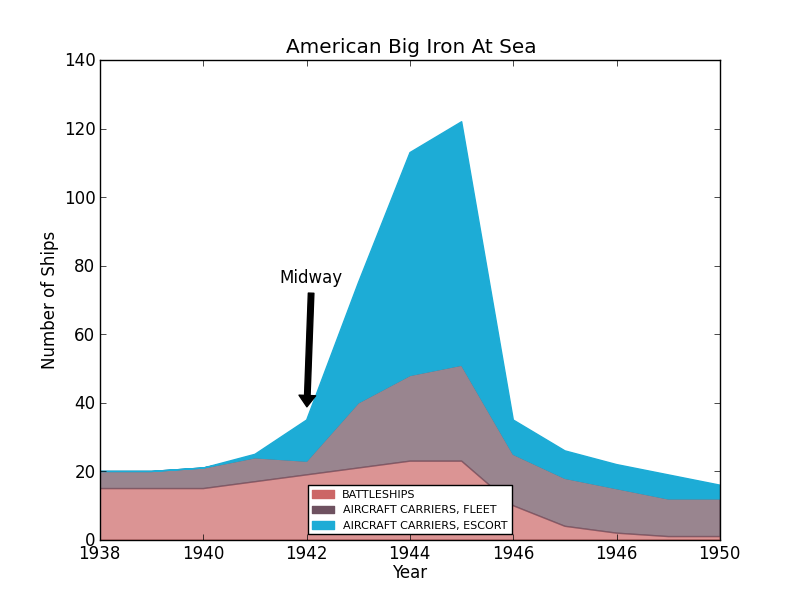
One feeling you get is that the US got a bit lucky: three Japanese aircraft carriers (just now proving they were far more useful than Destroyers) went down in a single bombing raid (one from a single bomb), decimating the Japanese fleet. Going in, Japan and the US’s navies were about even strength. If those carriers hadn’t gone down, perhaps the US might have still been beaten.

Then again, I’ve been looking for an excuse to bone up on my favorite python plotting library, and produced this graph:

source data: http://www.history.navy.mil/branches/org9-4.htm#1938

Japan was doomed from the start. Even if Midway went the other way, the Japanese would have had to contend with the most immense mobilization of navy war machines in the history of the Universe. Nobody could match this. Nobody.

So here’s my question: what would be the equivalent graph for a contemporary military juggernaut?

No way anyone cares about how many aircraft carriers you can build in a three-year span if you’ve got nukes. Then again, nobody can nuke you if you’re sitting in a dorm room in Iceland corralling a million server farms to shut down vital utilities or government facilities.

What makes a nation frightening to other nations? Is that question even relevant?

——
Edit: Here’s the code. Note that it’s an xls file because wordpress won’t let me upload a .py or .txt file. If you want to look at it change the extension to .py or .txt or something and view it in whatever text editor you like.
Actuary Envy From Physicists?

Samuel Arbesman points us to this paper that models the likelihood of a terrorist event. Reading through it quickly, I’m astonished that the authors didn’t bother to look up the actuarial literature on modeling extreme events, much less terrorism. There’s an entire exam dedicated to the methods these authors have ‘developed’.

Anyway, it’s interesting to see how a different approaches a topic I spend a lot of time thinking about and they don’t do too badly, picking the lognormal and an inverse transformed uniform distribution as their main tail estimators. We tend to us inverse gauss, which makes estimation a bit easier, but it’s the inverse transformation that gives the tail the juice.

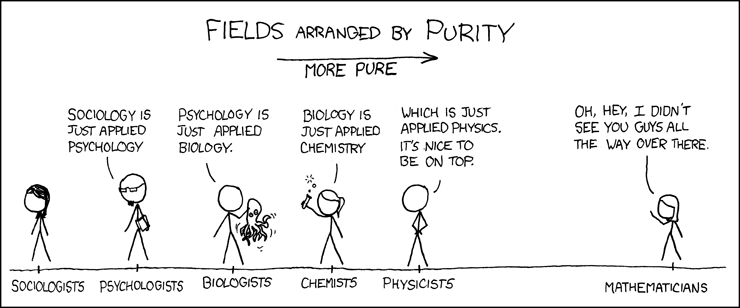
So where do actuaries fall in the xkcd purity scale? 

Off the list, it seems, under: irrelevant.

Marx-onomics: When The World is Your Family

To parents in a certain phase of life, this is art:

The value of this piece has nothing to do with beauty or impressing your friends. This goes on the fridge to reward hard work and build self esteem. The longer and more effort the child put into the work the more he/she cares about it and so the more a parent values it.

Now keep that in mind for a sec. Here is Brad Delong quoting Karl Marx in this very interesting essay:

To say that “the value relation[s] between the products of labour… have absolutely no connection with their physical properties” is simply wrong: if the coffee beans are rotten–or if their caffeine level is low–they have no value at all, for nobody will buy them. Marx says that the value of a good is something inscribed within it and attached to it–the socially-necessary labor time for its production—that then bosses people around. And it is the values–not the prices at which things are actually bought and sold–that are the elements of the real important reality. And those values: “appear as independent beings endowed with life and
entering into relation both with one another and the human race.”

Now I have never found anybody who thinks this way.

Customers don’t care how much work something took. Producers do. If a short project ends in failure, we can shrug it off. If we pour our lives into something that dies, we get grumpy.

Now, there are many who’d go to great lengths to keep you from getting grumpy. Family and friends might wear that hideous sweater you knitted for them once or force down that rubbery low fat jello you insist on bringing to dinner. They want you to feel good because that’s how close relationships work.

But they ain’t most people. And they’re not wearing that sweater anywhere outside your company.

I feel like emphasis on the family metaphor is sometimes a core difference between conservative and liberal politics. Left wing people, in other words, are more likely to support policies that treat strangers as family and right wing people to treat strangers as something less.

The Scourge of Precocity

I realize it isn’t a novel observation but I’m intrigued by how poorly our society can pick future winners. Here’s my caricature of the process:

  1. Take a teenager with a notable ability in math or physics or programming or something.
  2. Watch as he/she masters material at an incredible rate
  3. Maybe even makes some minor discovery of some sort. The key here is that the discovery or achievement would not be notable if done by a 50-ish professional with a career’s worth of experience. It carries little absolute value.
  4. Yet the press latches onto the relative achievement. This puts our subject waaaay out into the tail of the distribution for his/her age level. Everyone loves an outlier.
  5. Attention, fame, status accrue.

We love to imagine the great works our teenager will undertake if they’ve already achieved such distinction. Yet we don’t particularly care about the achievement itself. Who would?

For the the phenom, a door is now opened to cash in on the 15 minutes of fame. Become a writer or speaker with books/talks titled: “How to Revolutionize Education” or “Prodigies: DIY”. Such high status work is both easier and more lucrative than the grind true achievement demands. Or maybe our outlier was just lucky and such luck will never return.

Meanwhile, back home, real achievers incubate. There are schools that produce many Nobel Prize winners (try here). Achievement clusters; I like to think this happens because kids are competitive. Chip firmly in shoulder they go off and make the world a better place.

Ignore the precocious. Watch their friends.

Some Links

Arnold Kling:

I have a vision of the year 2025 in which the difference between the rich and everyone else is that the rich can afford to send their children to private schools, pay full fare for the children’s college education, and pay for their own parents’ long-term care. Everyone else will depend on public schools, community colleges and scholarships, and government-provided nursing homes. Otherwise, the lifestyles of the rich and the non-rich will look pretty similar.

Add in nicer cars and houses and he’s probably right. The point being that much of our leisure is spent online, which everyone gets equally.

Dan Rockwell

Leaders define what matters. Organizations grow weak and lethargic until someone creates focus and direction by explaining what’s meaningfully important. Leaders describe what’s relevant.

It’s very easy to criticize senior people in organizations (or for them to self-criticize) for “doing nothing”, just “going to meetings” or for management types to reminisce about when they used to “do work”.

These comments overlook what makes people very productive. Not ability, not training, not work ethic. Focus.

This is why the most productive people rise up: they have the ability to focus on what is important and deploy their own resources effectively. That skill is so valuable that being able to use it on others is more effective than using it on yourself.

When Does It Matter Whether You Understand Something?

Here’s a post from mathbabe:

Most people just use stuff they “know to be true,” without having themselves gone through the proof. After all, things like Deligne’s work on Weil Conjectures or Gabber’s recent work on finiteness of etale cohomology for pseudo-excellent schemes are really fucking hard, and it’s much more efficient to take their results and use them than it is to go through all the details personally.

After all, I use a microwave every day without knowing how it works, right?

I’m not sure I know where I got the feeling that this was an ethical issue. Probably it happened without intentional thought, when I was learning what a proof is in math camp, and I’d perhaps state a result and someone would say, how do you know that? and I’d feel like an asshole unless I could prove it on the spot.

Anyway, enough about me and my confused definition of mathematical ethics – what I now realize is that, as mathematics is developed more and more, it will become increasingly difficult for a graduate student to learn enough and then prove an original result without taking things on faith more and more. The amount of mathematical development in the past 50 years is just frighteningly enormous, especially in certain fields, and it’s just crazy to imagine someone learning all this stuff in 2 or 3 years before working on a thesis problem.

What I’m saying, in other words, is that my ethical standards are almost provably unworkable in modern mathematical research. Which is not to say that, over time, a person in a given field shouldn’t eventually work out all the details to all the things they’re relying on, but it can’t be linear like I forced myself to work.

And there’s a risk, too: namely, that as people start getting used to assuming hard things work, fewer mistakes will be discovered. It’s a slippery slope.

I don’t have much comment to make on the substance of the post, which I really liked, but it made me think of a few things.

With basically no formal math training since high school I spent a fair bit of time failing actuarial exams (the harder math ones, anyway) until I finally got out the damn textbooks and learned proofs. There’s a difference between ‘knowing’ something and knowing something, which is a distinction I only thought I understood a few years ago. I’m an advocate of deep understanding.

Thinking in terms of business, a consequence of a relatively efficient economy is that returns can mostly be attributed to luck. This can be interpreted in many ways. Consider YCombinator’s strategy of incubating dozens and dozens of startups by concentrating on the drive and focus of the founders and building a support system to nudge up the probability of success. That’s a strategy designed to maximize exposure to luck and be ruthless about recognizing and pursuing it when it strikes.

Then again, some people just screw something up, make a big financial bet on something they don’t understand, and win.

The point is that, entrepreneurially speaking, deep understanding can paralyze. There aren’t many business ideas that make a lot of sense to domain experts.

Most of us aren’t pursuing that kind of grand goal, though, and there are lots of homes for smart nay-sayers. Most organizations deliberately employ them to keep a lid on new ideas. Because they’re mostly stupid.

The Annals of Innovation: T-Shirt Cannon

From the NYT:

Tell me about the first time you saw a T-shirt cannon. In 1996, I was at a San Antonio Spurs game, and their mascot had one. It looked like it came from World War II — so big and bulky. I thought: Oh, my gosh, I’ve got to have one of those. I bet I could build one. So I went home and called up a friend of mine who was a welder, and by the end of the day we had a cannon that would fire about a block away.

A block!?