If Ray Kurzweil is Wrong (worse if he’s right?)

Neither of these two methods, however, would keep Social Security in actuarial balance permanently. The projection periods for future trustees’ reports will include years beyond 2080. In all years after 2080, projected expenses will significantly exceed projected income.

Really. After 2080, eh… is that a fact? My chortle is haughty.

Yet maybe it’ll be worse.

More here.

Two Lessons From Iron Mike

Mike Tyson is my favorite boxer. Obviously this has something to do with his in-ring feats, sure, but everything that’s interesting about him comes from his mind. He has one of the most interesting and powerful minds on earth. Seriously.

All the more so because he agrees with one of my more ridiculous beliefs: there’s no such thing as the good ol’ days. Everything’s better today:

“They would be tough for anybody to fight. I know people hate to believe this but they’re tough for anybody. Sometimes we don’t want to believe it. We’re stuck on apple pie in our era. We like Chuck Berry; we like Elvis Presley. People get better as men from the cavemen to now. We are supposed to get better. From the 80s to now we’ve got better. We’ve got more technology, more people are made, we get more money, the world is bigger, and we become better. So these guys would be difficult to beat for anybody who came before them.”

And, next, knowledge and wisdom can sometimes be a burden:

Tyson is a changed man. Gone is the bristling machismo, and sparks of aggression. “I wasn’t ready to know all this back then [as champion of the world]. I am now. If I’d learnt all that then I probably would never had been a good fighter. I’d have been too docile and meek then. At that particular time it was suitable for me and now that’s not too suitable for me.”

I like that lesson. Sometimes a deep understanding hinders success. I would argue that’s because knowledge is often illusory. In other words, mostly we’re all full of shit. Stop talking. Do stuff.

What Retail Is All About

Many city-types with fancy jobs like to imagine ditching the rat race and settling back to some small town. Maybe open a B&B. Maybe just run a small restaurant or something. Do it RIGHT, know what I mean? Like they do in the city but without the madness.

Well, guess what your number one fear will be:

Little by little the truth dribbled out, I’ll likely never know all the details but it seemed that some people figured that since the cash isn’t counted on a daily basis, why not take that cash and visit the casino. Surely if you gamble a bit then you can make some money, pay back the difference and nobody will be the wiser. And then, if it doesn’t work the next time you go gambling, you just take a bit more. And so on. In a span of 3 months a business that was the 3rd largest employer on the island was destroyed by those that were supposed to be minding it.

Theft. Not quality, not cleanliness, not the little touches that make a space beautiful. All takes a back seat if someone’s dipping into the till.

I’ve never run a small business but I’ve worked in a bunch as a student and bosses are often jerks. Maybe you would be too if you’re genuinely worried about getting cleaned out.

Sunday Night Comedy

An Iranian news agency has reported as fact an entirely fictitious survey carried on The Onion website earlier this week which claimed that most rural white Americans would vote for President Mahmoud Ahmadinejad ahead of Barack Obama.

The English-language service of Iran’s semi-official Fars news agency republished the spoof story from the satirical website word-for-word.

It even went so far as to include a made-up quote from a fictional West Virginia resident it idendified as Dale Swidersk who claimed he would rather go to a baseball game with Mr Ahmadinejad because “he takes national defence seriously and he’d never let some gay protesters tell him how to run his country like Obama does”

More here.

How to Build a Windmill

Admit it, if you’ve ever been surprised by a big electricity bill you’ve fantasized about generating your own power at home. Be it solar or wind or whatever. Electricity’s expensive! The sun shines and the wind blows every day. Why not?

Well, because it’s really hard:

At this point we took a 6 month detour in the wonderful world of sheetmetal fabrication. This was a lot harder than it seemed at first. Finally we settled on using a plasma cutter to cut the stator elements from standard sized sheets of metal (a special kind, which is low on carbon and has very good electromagnetic properties). Die cutting was impossible due to the cost of the dies, but if this were ever produced in volume that would be the way to go).

Actually, maybe this guy is looking or something a bit more serious than I had in mind:

The design parameters of my homebrew windmill are: 2.5 KW of output at a windspeed of 10 m/s, variable pitch blades, rotor diameter 5 meters (about 16’). The total weight of the machine is about 85 kilograms (or about 170 pounds). It has survived numerous storms and worked very well supplying our house with reliable power, far more reliable than the solar panels we had used exclusively up to the point the windmill was finished. The plan was to open-source the design and to make available a list of parts. I really should get around to that one of these days, the fact that I finally had the time to do this write up means that there is hope 😉 If you bought a machine with those specs commercially it would have cost about $10,000, but that would not be a variable pitch one. This machine cost a (fairly) large multiple of that, not counting our time, tooling and so on, but it could be reproduced well under that $10,000 mark if you already had all the tools and the knowledge and you didn’t have to go through a prototyping stage. Prototyping is very expensive and time consuming.

Designing a machine that size was a lot harder than I ever thought it would be. What was intended to be a one summer project turned into a two year tour of technology including magnetic theory, power generation, mathematics, mechanical engineering, woodworking, metalworking, meteorology, CAD/CAM, computer programming, electronics and aerodynamic theory. If you feel like acquiring some real world skills, go build a windmill! I never ever realized how much knowledge goes into making one of these until I tried it for myself.

The most demanding bit in my spec was that the windmill should be super reliable and should not require maintenance other than a lube job once every year or so. The place where it was put up has some of the harshest climate conditions on the planet, winters with days of -40 celsius and summers of +35 and sometimes even higher. Taking the windmill down during the winter was absolutely not an option (too much snow and no grip for the tractor used to raise and lower it) so reliability was extremely important, being without power meant that our house would be inhabitable almost instantly (no backup power grid, we did have a stand-by diesel generator which was used quite a bit before the windmill was installed).

And Now For Something Weird

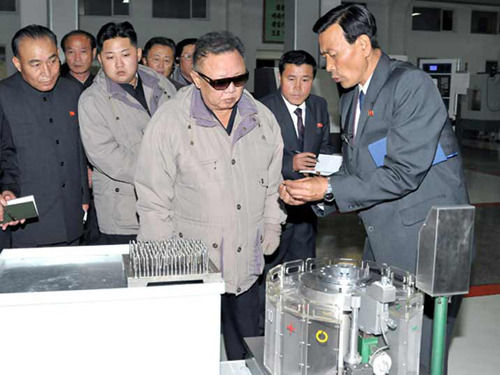
I’ve been following this blog for years called “Kim Jong-Il Looking At Things“.

I find it funny, ok. It might make more sense if you got to the site and see them all in succession.

Anyway, today’s picture (“Looking at Drill Bits“) features a young Kim Jong-Un! Remember these guys are all barely pushing 5’2”.

If you’re thinking, “Wait, isn’t this guy dead?”, you’re right. Here’s what the blog has to say about it:

in memoriam

at last the dear leader has quit this mortal coil. i have decided, nonetheless, to keep the blog running for as long as my photo archive will last. i don’t know when that will be, but i figure that if you’re reading this, you never minded the lack of good taste in this form of humor, which i’m very proud of, and the fact that he’s dead will make little difference.

i have also decided to make no change on the captions. they will remain in the present participle, as always. much like his father still is, and forever will be, the ‘eternal president’ of north korea, so will kim jong-il forever look at things on this site. well, not forever, it’s not like i have infinite photos of the guy, but you know what i mean…

you may tune-in as regularly as before, or if you prefer, join the myriad of successors that have appeared. or do both, if you don’t suffer from some form of attention deficit disorder, which i hope you don’t.

The Unfailingly Interesting Teller

First a letter from Teller I read some time ago about how to be successful:

When we started we HAD no style, no understanding of ourselves or what we were doing.  We had feelings, vague ones, a sense of what we liked, maybe, but no unified point of view, not even a real way to express our partnership.  We fought constantly and expected to break up every other week.  But we did have a few things, things I think you might profit from knowing:

We loved what we did.  More than anything.  More than sex.  Absolutely.

We always felt as if every show was the most important thing in the world, but knew if we bombed, we’d live.

We did not start as friends, but as people who respected and admired each other.  Crucial, absolutely crucial for a partnership.  As soon as we could afford it, we ceased sharing lodgings.  Equally crucial.

We made a solemn vow not to take any job outside of show business.  We
borrowed money from parents and friends, rather than take that lethal job waiting tables.  This forced us to take any job offered to us.  Anything.  We once did a show in the middle of the Benjamin Franklin Parkway in Philadelphia as part of a fashion show on a hot July night while all around our stage, a race-riot was fully underway.  That’s how serious we were about our vow.

Get on stage.  A lot.  Try stuff.  Make your best stab and keep stabbing.  If it’s there in your heart, it will eventually find its way out.  Or you will give up and have a prudent, contented life doing something else.

Next is a piece on Teller and patent infringement. It’s hard to excerpt (the whole thing is excellent). But this is necessary:

Because Teller performs almost entirely without speaking, his voice, strong and certain, comes as a surprise. He speaks in prose, in long, languid paragraphs peppered with literary and historical references. (He once taught high school Latin; dissatisfied with the prescribed textbook, he wrote his own.)

And here is a neat part:

There is a lecture about belief that Teller has given exactly four times. He has never allowed the lecture to be recorded in any way. Unless you were in the audience, it has never happened. It is called the Red Ball, after a trick he added relatively recently to Penn & Teller’s Las Vegas show. Before Teller performs the trick, Penn announces to the hushed theater: “The next trick is done with a piece of thread.” Teller then takes the stage, on which there is a simple bench, with a red ball and a wooden hoop in his hands. He bounces the ball. He gives it to a member of the audience to bounce. And then he drops the ball before he somehow makes it roll around the stage and back and forth along the bench, as though on command. Sometimes the ball is stuck to one of his fingers or to the small of his back; sometimes it is several feet out of his reach. He even has it jump through the hoop. All of which makes it impossible for him to be performing the Red Ball with a piece of thread. Penn must be lying. There must be something more to the trick.

In his lectures, Teller explained that the trick did not originate with him. It is based on techniques developed by a largely forgotten man named David P. Abbott, a loan shark who lived in Omaha and did magic in front of invitation-only audiences in his specially built parlor. Houdini, Kellar, Ching Ling Foo, Thurston — all the great magicians of the era made the pilgrimage to Omaha and left baffled. One of Abbott’s tricks involved a golden ball that floated in the air around him. But rather than use a thread suspended from the ceiling, Abbott revealed posthumously in his Book of Mysteries, he ran the thread horizontally from his ear to the wall. By manipulating that thread with his careful hands, he could make that golden ball seem as though it were defying reality. Best of all, he could pass a hoop over it — what magicians call a prover — and eliminate a piece of thread from his audience’s range of possibility, because a horizontal thread had never entered their imagination. They were looking only for the vertical.

And this:

Penn began his patter. He told the audience that they were about to be given a choice. Teller was going to make good his escape — there was no doubt about that, Penn said. Penn was going to start playing a song on his bass, and Teller was going to finish it on his vibraphone, done deal. The choice for the audience was whether it wanted to be mystified or informed. Keep your eyes open if you want to know the secret, Penn said. Keep your eyes closed if you want to be amazed.

Penn began to finger the strings, and on most nights, most of the people in the crowd kept their eyes open. They chose heads. (If you chose hearts, skip ahead to the next paragraph.)

The choice is yours.