Age Inflation In Champions?

Decade by decade your overall reserves of energy drop a little. It’s not that you lose the ability to rise up and push-through. It’s that the hangover afterwards is worse, begins to accumulate, and lasts well into your next performance.

The research supports the notion that sheer determination alone is not a sustainable approach. When Roy Baumeister studied acts of choice he found that we have one reservoir of will and discipline, and it is depleted by any act of conscious self-regulation. For example, participants who were required to resist eating fresh baked chocolate cookies for 5 minutes before tackling an unsolvable puzzle gave up 60% sooner than those did not have to exercise willpower in advance.

That’s Garry Watanabe on the Role of Recovery in Performance. It’s a good piece that focuses on how great athletes have optimized recovery routines. An edge that has more to do with concentration (meditation, really) than muscles and bones. The idea of a mental edge is important.

For most people, aging is the experience of revising your expectations of your body downwards. But consider the 45-year-old Olympic athlete:

Doctors have confirmed what she instinctively knew: Production of hormones such as testosterone and growth hormone that are critical to building muscle and recovering from workouts are continuing to decrease. She can no longer expect to maintain the strength of her youth, let alone improve on it.

“That’s probably the biggest thing I’m [in trouble] on,” Torres said. “They took my levels, and they’re just low. I’m a middle-aged woman: They’re low. Unfortunately, there’s nothing I can do about it.”

…Even with the new approach, her body has complained and groaned every step of the way. She has had three knee surgeries as well as a pair of operations on an injured shoulder and hernia since the 2008 Summer Games.

“It seems like I’m sore every freaking day,” Torres said in between lifts. “You never get a day where you’re like, ‘My whole body just feels really good.’ ”

It’s amazing when older athletes can (without enhancement) succeed at the highest levels. I think about it in terms of this graph:
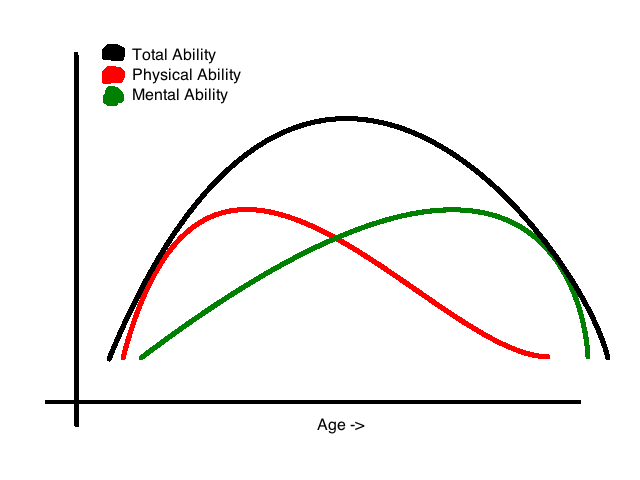
AbilityOk, not the greatest graph, but the point that mental ability matters. The discipline for endless practice, dealing with the temptations of money and fame and the incredible pressure of competition crush the minds of the pretenders.

And this, far more than raw physical ability, is learned. Which means that there’s an element of persistence about the greatest champions that cannot be explained by their talent. This also lets them dodge physical decline.

What’s more, if you believe in progress and science and don’t mind a little wildly unfounded speculation, then an athlete’s mental peak is probably much later than it once was. There could be more Bernard Hopkinses and Dara Torreses in our future.

Failure Is a Precious Thing

Ahem. Failure is actually an awful, painful and humiliating thing but its retelling sticks so much more firmly in our minds. Hearing how smart, motivated, honest people fail is valuable: put yourself in their place, empathize with their horrible decisions; the likelihood is that you’d do the same in their place. Learn from it.

Here is a little piece on why Vinetrade (a wine distribution startup) failed.

The business strategy is a perfectly reasonable push to apply modern inventory and sales systems to a very old-school business:

We wanted to revolutionise the fine wine industry, a market with many layers of middle men, and one that has traditionally eschewed technology, failing to patch it’s many inefficiencies.(sic)

The core problems of this business idea are very common. None are truly toxic, sometimes they work. This time they didn’t.

1. Starting with the solution.

If you haven’t worked in a business and acquired what is known in startup lingo as “domain expertise”, you are unlikely to really understand what works and what does not in that business. I don’t know whether the founders of Vinetrade had any domain expertise, but judging by the tone of the post I am guessing not.

Now, in one school of startup thought, this is a feature, not a bug. A fresh perspective facilitates DISRUPTION, the holy grail of startup achievement. In this case, as is usual, it did not. That speaks to how tough pulling off disruption is more than anything. Industries are organized the way they are for a reason.

2. Assuming that middlemen are a sign of waste and inefficiency.

As a society we have an aversion to middlemen. See this podcast with Russ Roberts, from which I learned of an amazing article: “The Economic Organisation of a P.O.W. Camp” by R.A. Radford. Story goes like this:

There once was a P.O.W. camp where the prisoners got Red Cross packets full of various things: food, cigarettes and so on. Everybody has the same stuff but people have different tastes. Some people don’t smoke, some don’t eat beef, etc.

Enter the Itinerant Padre, who goes around and makes voluntary exchanges with people: carrots for molases, cigarettes for candy. At the end of the day he has two full packets plus a little more to himself. He wasn’t dishonest, he didn’t empty one of the tins. Could have extorted, but didn’t. Yet everyone was better off.

A middleman is someone who creates markets, a function we instinctively disdain. Middlemen happen to be really important in the wine industry, I think because it has many suppliers and many buyers. When a network is really complex you need a lot of humans to keep all of the relationships straight. Consolidation of middlemen can only follow and never lead consolidation of principals. 

Well, at least as long as #3 holds, which is:

3. Hoping we have the technology to replace human interaction.

We haven’t hit the singularity yet and there is no substitute for human interaction. Principals (buyers and/or sellers) resent anything other than the personal touch.  Eventually, firms will be able to spawn human minds inside machines, meaning a central technological force can manage relationships in an infinitely complex network.

But until the human mind is itself commoditized, there is no substitute for an attentive salesman.

More from *Thinking Fast and Slow*

Have a look at the graph below. This shows the how our mind is different from math. 

prob

The blue line shows a bell curve with probabilities increasing for events near the average. The red line is how we interpret the likelihood of events given the same data.

Like math, people think the average outcomes are more likely (peak in the middle for both lines), but unlike math, people place a lot of weight on semi-remote probabilities.

To a human, then, all probabilities are approximately uniform (events are equally likely), at least compared to mathematical models. And see the spikes on the tails? That’s availability bias coming into play. The more time we spend thinking about something the more likely it will seem to be in our minds. Extreme events attract attention. So they must be more likely to occur, right?

Now think of black swans, really extreme, improbable events that people are notoriously unable to plan for.

If we look at a list of events and our guts tell us they’re all more or less equally likely to occur, black swans are just items left off the list. Draw attention to them by putting them on the list and, bang, they go from impossible to about as equally likely as all the other ones on the list.

The core lesson here is that humans are bad at small increments of proportionality. Something is either:

  1. ‘really likely’
  2. ‘not so likely’; or,
  3. impossible.

The secret is that ‘really likely’ and ‘not so likely’ are pretty much equally likely.

Insurers (finally) Starting to Ape Buffett

David Merkel reviews Buffett’s 10k:

Buffett does very well, but I know of no other insurer that invests so much in equities funded by insurance liabilities.  There is a real risk that if the markets fall hard, a la 1929-32, 1973-4, 2007-8. that BRK would be hard-pressed, particularly if there were some significant disaster like Katrina or Sandy, or set of disasters like 2004 or 2011.

He’s right that this philosophy adds risk to the business model. But riding equities isn’t as lonely a strategy for Buffett as it once was.

Consider Greenlight Re, an offshore reinsurance company linked to a hedge fund. Their strategy departed from the typical offshore startup model: write long tail, low-volatility, high-float insurance business and pump the cash into the hedge fund.

Taking big investment risks isn’t new for insurers. It’s just that doing it on purpose is unorthodox. Many insurers quietly took on more asset risk in the mid-00s and got crushed in 08. So did Greenlight for that matter. The difference is that Greenlight, fully expecting such a scenario, kept a hand steady at the till and rode the market back up.

Others tucked their tail between their legs and liquidated, in many cases locking in the losses.

If everyone (regulator, rating agency, management, investors) is on board with the risk, aggressive asset investment coupled with stable, high-float liabilities can work. Put another way, linking a hedge fund to an insurance company means the insurer can get by at lower combined ratios and grow.

But don’t take my word for it, look to the market and see the latest wave of offshore startups copying Greenlight/BRK: Third Point Re, SAC Re. And we see this convergence coming from the other side as AWAC, an established (re)insurer, bought into a hedge fund.

The key is to think of these insurers as more akin to banks: low-risk liabilities, high-risk assets. One can be skeptical of whether they are doing a good job of balancing these risks but in principle there is no reason to assume they will fail.

Link1: Nuclear Potato Cannons; Link2: We Live in the 19th Century

I could like to every single one of the “what if” posts by Randall Munroe:

The official record for fastest manmade object is the Helios 2 probe, which reached about 70 km/s in a close swing around the Sun. But it’s possible the actual holder of that title is a two-ton metal manhole cover.

The cover sat atop a shaft at an underground nuclear test site operated by Los Alamos as part of Operation Plumbbob. When the one-kiloton nuke went off below, the facility effectively became a nuclear potato cannon, giving the cap a gigantic kick. A high-speed camera trained on the lid caught only one frame of it moving upward before it vanished—which means it was moving at a minimum of 66 km/s. The cap was never found.

66 km/s is about six times escape velocity, but contrary to the linked blog’s speculation, it’s unlikely the cap ever reached space.Newton’s impact depth approximation suggests that it was either destroyed completely by impact with the air or slowed and fell back to Earth.

More here.

Same goes for Tyler Cowen, who today excerpts from pieces written in the 19th century. It is *astonishing* how similar the public policy debate then mirrors today’s. As Tyler says: it feels like we’re living in the 19th century.

Turning to insurance for a minute, I often wish I could find a trove of data (or a survey paper!) describing earlier underwriting cycles. There is guaranteed to be a period in the last few hundred years with strong lessons for us today.

Such perspective would be worth big $.

The Anti-Broke

In my business, ‘broking’ is what ‘brokers’ do. It more or less means selling or convincing someone of something. The word ‘broking’, like ‘selling’, can have dark overtones of manipulation (“I’m not trying to broke you, but…”); other times it simply means organizing information and communicating clearly.

Everyone has their style and knowing your style is to be ‘Real’, to be yourself. Nobody feels comfortable buying something from someone who is being fake. A fake demeanor breaks the bond of trust, which is the dearest asset of any salesman. A salesman without trust is a thief.

Anyway, there’s one particular technique that I find myself gravitating towards lately. This style terrifies many in my profession. Some guys get nervous any time a colleague starts to use it.

That style is the Anti-broke.

In essence Anti-broking is to emphasize the negatives of what you are selling. Explain to someone why they might not want to buy. This is heretical stuff. Isn’t the point to get deals done? Why dwell on such counter-productive thought?

You obviously have to be careful about it. Anchoring bias is real and over-emphasizing the negative in someone’s mind might push the benefits out.

But come back to the essence of sales: trust. Anti-broking is about saying “I know where you’re coming from”; it’s about adopting the cynicism of your customers so they don’t have to. It’s comforting.

Eric Barker has an interesting post up about having people buy in to stuff: “The idea of pitching is to begin an engagement with somebody, not necessarily convince them right there”.

Doing a deal with someone is an exhilarating experience and can found lifelong friendships. Inexperienced salesman underestimate how much their customers want to just say “yes!” and seal the deal. Shopping is therapeutic for a reason.

The philosophy of the anti-broke is that if a deal is possible it will probably find itself if there are two genuinely willing, mutually trustworthy parties.

Watch People Pitch

At the Startup Channel. Very cool idea:

Eighty percent of our content will be three-minute elevator pitches for new companies. We have a database of more than 6,000 current business plans (the largest such database in existence) with full financials to draw from and hope to produce at least 2,000 pitches per year. The rest of the content will be contextual: it will inform, explain, educate, and entertain an audience eager to know more about startups and startup culture.

At the heart of The Startup Channel, however, are the pitches, because in addition to being an ad-supported media enterprise, the channel will be what’s essentially the Multiple Listing Service (MLS) for potential startup investments. The JOBS Act, passed last year, allows advertising and solicitation of crowd funding and private placements and someone has to provide a forum for that advertising, which is what we will do. So you can watch the pitch, drill down to the business plan, analyze the financials (we have tools), look for comps, then make your decision. What we don’t do is actually participate in the deal, which would put us under the thumbs of the SEC and FINRA.


How I Spend The Oscars

Grab a beer and witness a thousand comedians feast on awkward interviews and ridiculous clothes at witstream: http://www.witstream.com/.

The ‘stream is at its strongest on the mostly unscripted red carpet and slows down as the ‘real’ show takes over.

Probably the most laughs I get watching tv all year.

__

edit: holy cow does that stream suck. Try Slate. Or google it.

edit2: ok, it’s improving over time.

Tort Reform Is Possible and Worth Bazillions

Jim Lynch turned me onto this paper on the insurance underwriting cycle.*

There’s a neat little graph that caught my eye:

CycleSomething big happened in 1986/1987: the United States economy started shifting serious resources into liability insurance.

In a new paper, Alex Tabarrok describes how this shift toward a more liable society decimated the small aircraft industry: companies could be sued for crash in any plane they had ever produced.

Then, incredibly, unexpectedly, he describes how Congress fixed it:

Our estimates show that the end of manufacturers’ liability for aircraft was associated with a significant (on the order of 13.6 percent) reduction in the probability of an accident. The evidence suggests that modest decreases in the amount and nature of flying were largely responsible. After GARA, for example, aircraft owners and pilots retired older aircraft, took fewer night flights, and invested more in a variety of safety procedures and precautions, such as wearing seat belts and filing flight plans. Minor and major accidents not involving mechanical failure—those more likely to be under the control of the pilot—declined notably.

We complain about the legislative process enough. It’s great to see that it can work for good, too.

As a result of this you’ll see insurance premiums for the aircraft industry fall and that means cheaper planes and cheaper flights. Think back to that graph that shows how insurance surplus has gone from 2-ish% of GDP to 4-ish%. That’s something like $300 billion locked away in low-yielding bonds.

I find it entirely plausible that the underwriting cycle is driven by one-off events. Black Swans if you will. And the big ones seem to make us permanently poorer.

*The paper develops a ‘regime switching’ model and declares it superior to an ‘autoregressive’ model of industry cycles. Without going into too much detail, I don’t really think either are very good at explaining what is going on, I don’t care what the R² score is.

When Data Cannot Do Insurance

Here is David Brooks on what Data can’t do:

Data struggles with the social. Your brain is pretty bad at math (quick, what’s the square root of 437), but it’s excellent at social cognition. People are really good at mirroring each other’s emotional states, at detecting uncooperative behavior and at assigning value to things through emotion.

Computer-driven data analysis, on the other hand, excels at measuring the quantity of social interactions but not the quality. Network scientists can map your interactions with the six co-workers you see during 76 percent of your days, but they can’t capture your devotion to the childhood friends you see twice a year, let alone Dante’s love for Beatrice, whom he met twice.

In insurance we care about scale (the law of large numbers) and not getting f*@#ed over (avoiding moral hazard). Data has definitely helped where moral hazard is somewhat easily guarded against: such as in homeowners or auto liability insurance.

And these are the largest insurance markets on earth. Consumers have no doubt benefited, either through lower insurance premiums or (more likely) through a far more generous tort system and subsidy for people to build their homes in flood planes and on fault lines and  hurricane tracks.

For more complicated lines of insurance, we still need really expensive underwriters to decide who is worthy of trust. Data has a long way to go there.