Down With Crap Research

Here is a post on demographics. CalculatedRisk sums it up well:

This is probably another reason many boomers will never retire

I agree with the general sentiment here, but will quibble nonetheless.

The study correlates one-year trailing P/E to the ratio of Middle-Aged over Old People (sounds a bit juvenile putting it that way). They calibrate this relationship and project the P/E ratio over the next few years. I have a few comments

  1. I generally dislike statistical models. They are prone to many biases.
  2. I dislike statistical models that adopt point estimates for variables even more. In this case, I have little doubt the modelers have non-stationary data. That means that these folks aren’t accounting for changes in variable relationships.
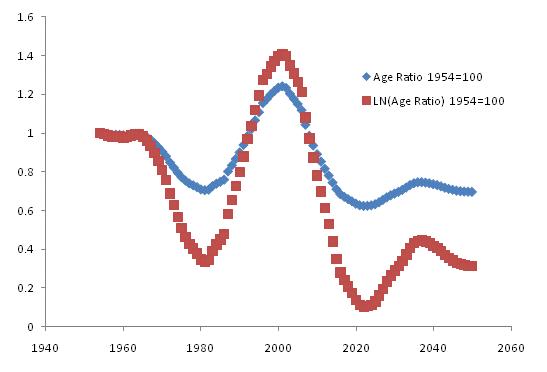
  3. Then there’s this graph:

Ok, now I’m pissed off. What on earth are they doing taking the log of the age ratio? What is non-linear about an age ratio? Oh, wait, let me just flick down to the footnotes to find the explanation for this unexpected and important assumption.

[crickets]

What does taking the ln of the age ratio do? Well, luckily they offer up their data and I compared the log data and the ‘raw’ data. Logarithms matter, folks:
Back to #1 above for a sec. Russ Roberts has this fantastic idea that every scientific study should be published with a little appendix showing all of the dead ends and false leads the researchers spun their wheels on.

I wonder how many different ways these researchers crunched this (these!) data before they found a proposition that fit their conclusion. Did they write up the report before they even conducted the analysis?

Anyway, even garbage research can tickle my bias and make me think for a sec. In this case CalculatedRisk has the right tack, which has been expanded upon by WCI. Boomers aren’t retiring.

Great, but yawn. Heard that before.

I’m drawn back to one of the irritating things about that previous analysis. If the boomer retirement party is postponed, what was the reverse effect back in the 90s when they were peaking in productivity?

Back to WCI, for a Canadian take:

Declining employment levels of their elders is the answer. Early retirement. Poor boomers won’t have it as good as those they displaced.

The thing with Tsunamis is that, just before they strike, they suck all of the water off the beach. Then, as we all know about big waves the water pulls back from the force of the retreating water. Boomers can’t help but push their adjacent demographic groups out of the workforce.


On China

Wow, a lot to digest here.

I’m way too tired after 12 hours of driving to think hard enough to sound coherent on that piece. Instead, I’ll just list my biases about China and hopefully have the presence of mind to check back in when I’ve learned more:

  1. China is poorer than Mexico (per capita)
  2. Never take futurists or medium/long term forecasts seriously (as a test, I offer some below)
  3. Talk of China’s GDP in 2030 (or whatever) is ridiculous
  4. China has an economic growth profile that is radically different than any developed country
  5. Therefore China’s economy will undergo a radical change when it approaches developed status (was that a forecast?! Watch it, now!)
  6. Informal economic and information channels are the only reliable ones. (ie Official China is more Kafkaesque than capitalist).
  7. Chinese consumers have thus far accepted a lower standard of living than they ‘earn’ (ie high inflation and a depressed currency)
  8. Nevertheless, Living standards are rising rapidly. This makes folks feel good.
  9. In spite of their lack of control, Incumbent politicians are blamed for economic malaise. The capacity for a bloodless purge, however senseless, is of course democracy’s strength.
  10. China isn’t a democracy.
  11. And booms always end.
  12. Michael Mandel has taught me to (selectively) mistrust productivity stats and GDP figures for the USA. I chuckle at the skeptical feeding frenzy he’d have with China’s data (ie it’s possibly all complete BS and will perhaps have a Greece-style reckoning)
  13. Nevertheless, living standards have recently been rising rapidly. This makes folks feel good.

Notes from the I-95

We’re driving back to NYC from Florida. 1000 miles. Nothing like a good road trip.

We’re trying to make use of the Diners, Drive-ins and Dives iphone app, which doesn’t have any NYC entries. Love the show and love pigging out a bit when we’re on the road.

Sparing a thought for the economics of this, I wonder whether the fast food establishment cares about triple D. The food’s better and the iphone makes finding them easy.

Then again, these eateries are already running flat out and probably suffer from negative economies of scale. Even the collective spare POTENTIAL capacity for these places is only a drop in the ocean of MacDonald’s top line. All we do is make the lines longer at peoples’ favorite local haunts.

And so the big chains probably don’t care. Unless you can scale at a higher quality level than them, you’re a gnat.

Speaking of scale, it wasn’t until this evening here in North Carolina that I got my first taste of the size of this migration.

Obviously the fact that I couldn’t get a flight that landed anywhere within 4 hours of NY until Wednesday was a clue. The roads should be just as jammed.

I worked at a hotel for a couple years in college and Sunday nights are notoriously slow. Big surprise for the service industry all up the Eastern Seaboard tonight!

My hotel is packed and Ruby Tuesday across the street (salad bar!) had a line out the door at 830pm.

Irene’s timing couldn’t have been better if she wanted to demonstrate capitalism’s ability to absorb shocks.

Hermit Kingdom

Is there a more fascinating country than North Korea?

Alex Tabarrok at MR is reading a book on it. It is amazing how effective brainwashing can be.

I remember listening to a podcast with some kind of ‘expert’ (for the life of me I can’t find it online) who was of the opinion that the one reason the brainwashing is effective is that it taps into the human inclination to racism that’s caused so much trouble in history.

Basically, goes the story, the Korean race is superior. Even if it looks like other countries are prospering, it’s an illusion: how could they if they aren’t Korean?

But a contradiction is developing. North Koreans have to deal with the dissonance of having a racially identical, much richer country next door. I get a warm feeling inside when racist ideologues squirm.

Hurricane Irene

I’m watching this situation pretty closely for all kinds of reasons. It’s not often my professional and personal interests coincide.

Best resource, hands down, is Jeff Masters’ blog. The source of all the raw analysis is the National Hurricane Center.

The latest modeling is annoyingly inconclusive.

I’m going to focus on New York, because that’s where I live. (In general I’d say the Carolinas are effed and most of Jersey is in for a beating)

There are three scenarios for New York, all of which seem plausible from that modeling output.

  1. If the storm stays inland and heads over the Pocono mountains, we get some serious flooding and damaged countryside, but nothing too crazy. The storm weakens considerably and the wind dies off.
  2. Toss up over which of the next two is worse: if the storm goes straight across the Carolinas and streaks along the coast, we’ve got a problem in the city. This means that all of the coastal areas (ie the most vulnerable to storm surge) get battered and (AND) the warm water keeps the storm strong. NY will probably get flooded right up to 14th street, I get evacuated from Battery Park City and it takes days for the Subway system to drain.
  3. Door #3 has the storm veer off into the ocean, really really power up and hammer (absolutely clobber) Long Island. This will have the worst wind damage, though Jersey and NYC will probably be spared. Next up is Cape Cod and Nantucket. These probably get a big helping of Hurricane winds, too.

Using this, I’m trying to handicap the models and am having some serious trouble. I’ll probably keep updating this post as the day wears on.

Edit 1:

I keep saying Carolinas, but I really mean North Carolina and Virginia

Edit 2:

Wowee. Jeff Masters gives us lots to think about. A few key points:

  • They eyewall has collapsed, which means higher pressure and a less powerful heat engine. We’re in the endgame, so rapid, massive intensification is unlikely now.
  • Wind shear, hurricane Kryptonite, is moderate (note on pic: red line is direction relative to storm track, I think, and blue is speed) but doesn’t seem to be having a big effect.
  • This sucker is a monster, which means more storm surge, damage potential measured at an eye-popping 5.1/6.
  • Masters gives a 20% chance of topping Manhattan’s flood walls and filling the Subway system with seawater.
  • Wind damage likely won’t be a big deal, now. The heaviest winds are East and out to sea (sorry, Long Island!), but aren’t crazy-strong, just strong.
  • Probability of big winds in NYC has plummeted
  • Get ready for blackouts

Personally, I’m scheduled to fly to Florida tonight for a wedding in the Jacksonville area tomorrow. 20% chance of complete flooding is probably high enough to evacuate and fleeing to the Hurricane’s wake is probably my best bet.

How and in what manner I get back is the trick.

Edit 3:

Well, looks like I’m outta here. From my building management:

The NYC Office of Emergency Management is strongly advising all residents of Battery Park City to evacuate today.  While the evacuation is not mandatory at this time, it seems clear that it will become mandatory at some point today or tomorrow.  Since the MTA is going to shut down at some point tomorrow, we strongly urge everyone to make immediate arrangements to evacuate now.

To JAX!

Robin Quixote

His windmill:

The most powerful insufficiently-appreciated insight I’ve ever learned is the one intellectual legacy I’d leave, if I could leave only one: we are often wrong about why we do things.

Some context is appropriate here:

I have a colleague here at GMU econ who recently expressed to me his strong feeling that we academics should usually accept such standard explanations unless we see clear strong evidence to the contrary. That is, if an academic journal has a statement of purpose or aim or mission, then we should believe what that statement says about the main social function of that journal in the world — if it says the journal exists to advance knowledge, that is what we should believe. He thinks we should similarly accept official purpose statements of hospitals, universities, charities, and government agencies. (He might not accept mission claims by firms, e.g., “Wal-Mart’s mission is to help people save money so they can live better”; apparently only admired non-profits deserve such deference.)

I have enormous sympathy for this mission. My allusion in the title isn’t that this enemy is imaginary but that it’s a battle that is perhaps unwinnable.

What social outcome would accompany such a legacy? Who wins if Robin’s wish comes true? I would fear that too many have a vested interest in remaining sly rule-benders to give such views too much prominence.

Anyway, Robin’s got more than one strategy for being remembered, though he’s made his first choice clear.

Incentive to Innovate

I’m spending a lot of time on Mandel. Here is another one I disagree with.

In other words, if we suddenly get access to a bunch of cheap Chinese labor, we don’t bother to invent robots. Then tomorrow, when the cheap Chinese labor runs out, we find ourselves without any robots.

The point is that necessity is the mother of invention and Chinese labor is dialing down our motivation.

Can’t you just argue that cheap Chinese labor provides even greater competitive pressure than robots? Now the robots have to be even smarter/faster/etc.

Firms don’t stop competing when they lose a round to someone. It doesn’t matter whether it’s Chinese people, American robots or Chinese robots.

The technology just has to hit a higher target. And when those Chinese people become truly highly educated and start earning higher wages as a result (ie they finish the catch-up process), total innovation in the world will explode.

I’ll take another billion minds working on today’s problems, thank you very much.

Gold

I read somewhere once that all of the gold reserves in the world could fit inside a normal-sized suburban home. So let’s test this:

There has been 165,000 tonnes of gold mined in history.

A tonne (metric tonne. Which is actually a megagram) is 1,000 kilograms.

A cubic meter of gold weighs 19,300 kg.  165,000 * 1,000 / 19,300 gives us 8,549 cubic meters.

How big of a cube is that? The cube root is 20.43.

So a 20m by 20m by 20m cube would do it.

Ok, let’s say the average house has two floors and 2,000 square feet total. That’s 1,000 per floor, which is 92.5 square meters per floor.  Let’s say there are 2.75m ceilings. This gives us a cube of roughly 10m x 10m x 5.5m

550 cubic meters. Not even close.

You’d need more than 15 houses to do the trick.

A Manifesto

Literally every single job on earth is becoming more automated and standardized by and using computers. That’s the economic growth the dotcom bubble mistimed.

Many of the systems being built to replace existing processes are crap, though. The problem is that programmers lack deep knowledge of the processes and the process experts are clueless programmers.

I believe THE economic story of our times in 100 years will be the flourishing of programming skills, which maybe should be called something else.

Think of it this way: some people probably call a plumber to unclog their toilets, I suppose, but most will roll up their sleeves and grab a friggen plunger.

Computers are about enhancing productivity. The more control people can learn to have over them, the more productive they’ll be.

I look around my own company and see low-hanging productivity-enhancing fruit all over the place. The barrier isn’t technology, it’s human capital.

The most valuable skill one can develop is an understanding of computers. This statement will one day sound ridiculous.

The day will come when people will be as appalled of computer illiterates as they are of adults that can’t read or count.

The day will come when every single non-menial job will involve managing a computerized process.

The day will come when advanced programming technology and increasing aggregate programming skill combine to make programming ubiquitous and invisible.

The best companies of tomorrow realize this today.

Culture

Excellent piece by Cringely:

The decline of HP began, I think, with the spinoff of Agilent Technologies in 1999…

You see Hewlett Packard was in 1999 an instrument company that made a hell of a lot of money from printers, not a printer company that also built instruments…

Hewlett and Packard were instrument guys: had they still been on the job in 1999 they would have gone with Agilent.

The point is to say that the things that made HP great weren’t recognized by the people who ran it (“into the ground!” we’d like to shout) in its later years. ‘Professional managers’, as opposed to founders, need to really really understand why and how a company makes money.

It’s a key understanding that profitability isn’t in the numbers, it’s in the culture, in the people. Looking at HP’s numbers in the 90s, someone would say: “well, they’re a printer company that does all this other crap”. They’d also say about Apple: “they’re a computer company that makes a few cool accessories”.

HP’s power was the innovative capacity of its engineers, supercharged by its culture.

We’ve all heard how great it is that Google allows its employees to spend 10 percent of their time working on their own projects. Google didn’t invent that: HP did. And the way the process was instituted at HP was quite formal in that the 10 percent time was after lunch on Fridays. Imagine what it must have been like on Friday afternoons in Palo Alto withevery engineer working on some wild-ass idea. And the other part of the system was that those engineers had access to what they called “lab stores” — anything needed to do the job, whether it was a microscope or a magnetron or a barrel of acetone could be taken without question on Friday afternoons from the HP warehouses. This enabled a flurry of innovation that produced some of HP’s greatest products including those printers.

Understanding that point, that the printers were a lucky strike that emerged from an excellent, innovative culture was was absolutely critical to keeping HP on top. Such a culture could get lucky again and again.

But now the culture is a wreck.