Gold

I read somewhere once that all of the gold reserves in the world could fit inside a normal-sized suburban home. So let’s test this:

There has been 165,000 tonnes of gold mined in history.

A tonne (metric tonne. Which is actually a megagram) is 1,000 kilograms.

A cubic meter of gold weighs 19,300 kg.  165,000 * 1,000 / 19,300 gives us 8,549 cubic meters.

How big of a cube is that? The cube root is 20.43.

So a 20m by 20m by 20m cube would do it.

Ok, let’s say the average house has two floors and 2,000 square feet total. That’s 1,000 per floor, which is 92.5 square meters per floor.  Let’s say there are 2.75m ceilings. This gives us a cube of roughly 10m x 10m x 5.5m

550 cubic meters. Not even close.

You’d need more than 15 houses to do the trick.

I’m Gonna Learn Me Something (I hope)

Stanford (like MIT before it) is offering a pile of classes for free online. I have the same feeling I used to get walking into a video game store. I don’t even know where to begin.

Actually, I do know where to begin:

Machine Learning

This course provides a broad introduction to machine learning and statistical pattern recognition.

Databases:

This course covers database design and the use of database management systems for applications.

I’m very excited to have signed up for these courses. I desperately hope this blog post ties me tight enough to the mast that I actually follow through.

Holy Cow, Lots Going On

Some links:

Here’s a scathing review of S&P’s conduct, generally:

To say that S&P analysts aren’t the sharpest tools in the drawer is a massive understatement.

Naturally, before meeting with a rating agency, we would plan out our arguments — you want to make sure you’re making your strongest arguments, that everyone is on the same page about the deal’s positive attributes, etc. With S&P, it got to the point where we were constantly saying, “that’s a good point, but is S&P smart enough to understand that argument?” I kid you not, that was a hard-constraint in our game-plan. With Moody’s and Fitch, we at least were able to assume that the analysts on our deals would have a minimum level of financial competence.

Yikes. And imagine what the real regulators are like.

As for S&P’s downgrade, here’s Sumner’s take, under the title of 1.07% on the 5-year and falling fast.

The markets this morning gave a massive vote of no confidence to S&P ratings service, as yields plunged on Treasuries.

The real after-tax rate of return on the 30 year Treasury is now negative, assuming a 30% MTR.  That means the tax rate on capital now exceeds 100% in real terms over the next thirty years, which doesn’t seem particularly conducive to capital formation.

Yikes.

But what’s the ultimate signal that things are bad? Berkshire’s getting the itch.

Here’s Ajit swooping in and demolishing the incumbent bidders’ stock/cash offers with an all-cash, thank-you-very-much email.

Mr. Robert Orlich
President & CEO
Transatlantic Holdings, Inc.
80 Pine Street
New York, NY 10005

Dear Bob:

As you can imagine, subsequent to our telephone conversation yesterday, I have been watching the screen all morning. With your stock trading at $45.83, I have to believe that you will find our offer to buy all of Transatlantic shares outstanding at $52.00 per share to be an attractive offer. As such, I am now writing to formally inform you of National Indemnity’s commitment to do so at $52.00 per share under customary terms for a stock purchase agreement of a publicly traded company to be agreed (but not subject to any due diligence review or financing condition of any nature [emphasis DW’s]). This commitment is subject to:

  • A formal response from you no later than the close of business, Monday, August 8, 2011.
  • Should you decide to accept this offer, your agreement that should the deal not close for any reasons that are under your control by December 31, 2011, a break-up fee of $75.0 million would be paid to us.
  • Your commitment that until the deal closes, you will continue to manage the affairs of the company in a manner that is consistent with how you have managed it historically.

I have deliberately tried to be brief and to the point. I will be happy to discuss any details that you would like at your convenience. I can be reached at [number withheld] (work), [number withheld] (cell) or [number withheld] (home).

Regards,

Ajit Jain

TRC probably figured there wasn’t any point in summarizing the offer and just published it in whole online. Also gives us our “parenthetical statement of the day”.

Note that this values TRC’s stock at something close to the incumbents’ bids BUT the value of the stock portions of the bids have diminished substantially since they were made.

Timing is everything, n’est-ce pas?

update:

Here’s a neat post speculating on who got the margin call today:

You see the desperate selling of the biggest liquid names is a sign of margin calls.

The market is not puking. Some prime broker is puking the stocks held by one or more very large hedge funds.

So lets play the game: guess who got the margin call!

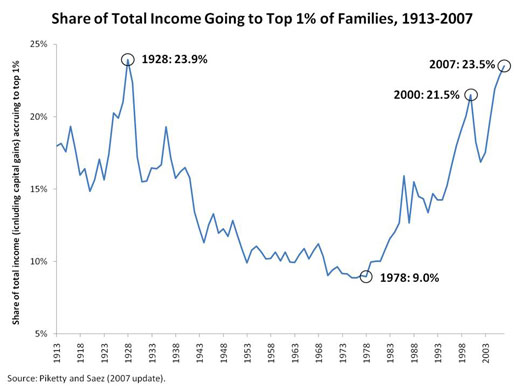
Worse Than Useless Chart Of The Day

From Felix Salmon:

Sorry, Felix, this chart is unhelpful and misleading, no matter what your political predisposition.

Let’s imagine you’re a lefty. You look at this chart and think it’s great, but ONLY because you think it will help you convince ‘conservatives’ or ‘tea-partiers’ that taxes can/should go up. I would argue you have absolutely no idea whether this chart supplies a useful way to think about politics or economics. You’re thinking with your debating hat on, not your scientist hat. That means that you’re looking for something helpful and not something true.

Ok, so let’s say you’re not a lefty (not the same thing as being a righty and easily in the majority). You look at that chart and don’t give a crap. Peoples’ reaction to tax rate changes have nothing to do with sober analyses of what share of revenue the government can/should get in a society. It has to do with whether people feel like they can afford to pay more taxes or not.

This makes the chart misleading because it doesn’t address peoples’ real concerns and unhelpful because it distracts lefties from arguments that might actually work. If there are any.

The only chart that’s less useful than the one above is this doozy (or something like it):

Again, a bias-confirming, load of garbage aggregate measure. Inequality is about how you feel you stack up to your neighbors. This chart does NOTHING to convince anyone that they stack up less well to anyone they know.

Populist movements arise when people feel like others are getting stuff they aren’t entitled to. That’s unfair. That’s inequality.

And right now, for whatever reason, public-sector-supported left-wing sacred cows are the poster children for getting a free ride.

Jobs

My landlord is offering me a 12% rent increase to renew. A laughable deal and I will be moving, I expect.

Why? Margins are thin and increasing revenue is virtually impossible in the short term.

Unlike a government, I have the advantage of just choosing a cheaper apartment. If markets are efficient and I need to accept a lower standard of living, I can take that.

What politician gets re-elected after choosing a lower standard of living, no matter how justified? Doesn’t work in Greece.

Consider the news today. Revenue isn’t going up on its own any time soon and we can’t all just move to a cheaper apartment.

Ugly.

The Devil You Don’t See

A few weeks ago I had lunch with a cat bond manager who was crowing about buying and selling a particular bond at a solid profit in a single day.

The bond was Mariah Re, which is at risk of being triggered by tornado losses this past quarter in the US. It hasn’t triggered yet, but it’s close.

My bond manager friend figured that, since Tornado Season is over, the fact that the bond was trading at a steep discount at the time meant it was a steal. And it was. He sold half of his position for a tidy little profit and figures he’ll ride the rest out at the great yield he’s secured.

He’s looking a bit less smart today.

He’s actually probably ok, but this made me once again appreciate the power of IBNR.

IBNR is a classic Rumsfeldian phenomenon:

[T]here are known knowns; there are things we know we know.
We also know there are known unknowns; that is to say we know there are some things we do not know.
But there are also unknown unknowns – the ones we don’t know we don’t know.

Claims happen with uncertain cost. Ok, that’s the set of unkowns.

Some claims get reported reasonably promptly, even if the ultimate cost is still uncertain. These are the known unknowns.

The unknown unknowns is the IBNR. It can be estimated, but you need lots of good data. Anyone who hasn’t looked at a lot of portfolios over a long period of time will struggle with this.

Even then, it’s a horribly difficult concept to keep in your mind. People appear to be hard-wired to think that things in the past are in the past and can’t hurt us in the future.

Not so.

How Much Does AC Cost? An Accounting Issue

There’s a great discussion of the costs of Air Conditioning for soldiers on MR. Here’s the original story.

Here’s the boogeyman soundbite:

The amount the U.S. military spends annually on air conditioning in Iraq and Afghanistan: $20.2 billion.

That’s more than NASA’s budget. It’s more than BP has paid so far for damage during the Gulf oil spill. It’s what the G-8 has pledged to help foster new democracies in Egypt and Tunisia.

What is a cost? I am reminded of an accounting prof of mine who once said: “give me some public accounts and I can turn a $5m profit into a $5m loss for a company and get every accountant in Canada to agree with me”.

So that’s an interesting bit.

Another interesting story is how people argue.

In the comments on MR (best around), there are a few analytical folks (“let’s look at the seasonal variation in running costs and adjust for stuff”), some hierarchical brown-nosers (“it’s a super-high ranking dude who said this so it HAS to be right”), and die-hard cynics (“I expect the number 20 billion comes under the category of “too good to check.”).

The number is probably BS, sure. But that doesn’t mean it’s “wrong” in a technical sense.

And none of that is going to stop a heated Internet discussion from swiping employers’ time all across the nation.

An Anonymous Rant Against A Professional Writer

PC360 gives us this. It’s so sticky with jargon to be barely readable.

Let me summarize the (2,300 word) article:

Claims data can teach underwriters about where claims come from and expose new drivers of claims cost. Analyzing claims databases is a good way of testing new hypotheses but,  for organizational reasons, most companies aren’t great at this.

Yawn. Could have been written at any point in the last 300 years.

Next is a big discussion about how automated computer programs can correlate variables without the burden of actually ‘understanding’ the data.

[shields up! BS ALERT!]

My old man once spent some time learning about a stock picking technique which, to be perfectly honest, looked like garbage to me. But sometimes it worked!

I’d argue it’s complete luck. As they say, “even a broken watch is right twice a day”.

Narrative validation a powerful test for statistical conclusions: correlation is useless without a deep understanding for the causal mechanism. Unexplained, ‘dumb’ empirical relationships (describes all too much of medical research, imo) are too unreliable for me to back with cash.

If you don’t know how it works, how on earth do you know when it breaks?

Ancient Inventory Lists (and Quantum Computing)

Some industrious researcher has transcribed thousands of lists of households’ goods in some small German town from the 17th and 18th centuries.

I love this kind of story. Datasets are so easy to build and analyze now relative to, say, 10 or 20 years ago.

And anyone interested in projecting trends in such computing power might try an online course in Quantum Computing!

If Only We Could Sell Placebos

Big takedown of depression and mental illness in some books reviewed here.

Here’s what a casual reader will take away from this article:

Psychiatric drugs were first used in the 50s as tranquilizers to combat the unpredictable high-energy behavior of patients in mental hospitals. Subsequent research revealed that the drugs had an effect on brain chemistry and, prodded by Big Pharma, everyone concluded that brain chemistry must have been the problem all along. In reality, the patients were just stoned.

Fast forward to today and we have an unholy collusion between psychiatrists, who need the drugs to run a profitable business, and Big Pharma, who sells them. The research is all biased because studies that validate the Golden Hypothesis are cherry picked. Those that dissent are shuttered away, never to be read, save for by one redoubtable psychiatrist who threw the book at the FDA and got the data.

Bottom line?

Putting all this together, writes Kirsch, leads to the conclusion that the relatively small difference between drugs and placebos might not be a real drug effect at all. Instead, it might be an enhanced placebo effect, produced by the fact that some patients have broken [the] blind and have come to realize whether they were given drug or placebo. If this is the case, then there is no real antidepressant drug effect at all. Rather than comparing placebo to drug, we have been comparing “regular” placebos to “extra-strength” placebos.

Ok. This kind of article terrifies me. The evidence, the conspiracy theory, the baddest boogeyman of them all. It’s all here. How can skepticism possibly survive this attack?

The most bizarre effect of this kind of publicity is to reduce the effectiveness of psychiatric drugs. If these books convince everyone that everything is a placebo, the placebo effect goes away.

And, presumably, mental health deteriorates. Is there such a thing as a virtuous lie?

As Robin Hanson asks:

when exactly is it important to emphasize truth, relative to other belief functions?

A better question: is it even possible for a society to collectively self-deceive given ANY level of reward?