How LeBron Improved

Great piece on LeBron’s transformation after the 2011 Finals.

First you need humiliation.

According to Spoelstra, “It took the ultimate failure in the Finals to view LeBron and our offense with a different lens. He was the most versatile player in the league. We had to figure out a way to use him in the most versatile of ways — in unconventional ways. It seems like a ‘duh’ moment now, but we had to go through the experiences and failures together.”

…That loss, and maybe some of those demeaning characterizations, fueled one of the greatest and most important transformations in recent sports history. James was distraught, but somehow channeled that into ferocious dedication to his craft. Spoelstra was perplexed and desperate to correct course; he told me, “Shortly after our loss to Dallas in the Finals, LeBron and I met. He mentioned that he was going to work on his game relentlessly during the offseason, and specifically on his post-up game. This absolutely made sense for us. We had to improve offensively, and one of the best ways would be to be able to play inside-out with a post-up attack.”

Then you need a plan:

It’s no secret where and when James first worked on his low-post game. Fueled by that loss to the Mavs, he went to Houston in the summer of 2011 to learn from a master: Hakeem Olajuwon.

“I wanted to get better,” James said of his decision to work with Olajuwon. “I wanted to improve and I sought out someone who I thought was one of the greatest low-post players to ever play this game. I was grateful and happy that he welcomed me with open arms; I was able to go down to Houston for four and a half days; I worked out twice a day; he taught me a lot about the low post and being able to gain an advantage on your opponent.

Then you need to grind and grind and grind:

I used that the rest of the offseason, when I went back to my hometown. Every day in the gym I worked on one thing or I worked on two things and tried to improve each and every day.”
Making Predictions

Here’s a good David Brooks column on forecasting:

Tetlock and company gathered 3,000 participants. Some got put into teams with training, some got put into teams without. Some worked alone. Some worked in prediction markets. Some did probabilistic thinking and some did more narrative thinking. The teams with training that engaged in probabilistic thinking performed best. The training involved learning some of the lessons included in Daniel Kahneman’s great work, “Thinking, Fast and Slow.” For example, they were taught to alternate between taking the inside view and the outside view.

Suppose you’re asked to predict whether the government of Egypt will fall. You can try to learn everything you can about Egypt. That’s the inside view. Or you can ask about the category. Of all Middle Eastern authoritarian governments, what percentage fall in a given year? That outside view is essential.

…In the second year of the tournament, Tetlock and collaborators skimmed off the top 2 percent of forecasters across experimental conditions, identifying 60 top performers and randomly assigning them into five teams of 12 each. These “super forecasters” also delivered a far-above-average performance in Year 2. Apparently, forecasting skill cannot only be taught, it can be replicated.

There’s a lot there and do read it in conjunction with the supremely impressive *Thinking Fast and Slow*. In that book, Kahneman tells a story about how he and a team of academics were going to write a new psychology curriculum.

After doing a bit of preparatory work on the textbook, Kahneman decided to poll the team members’ forecasts for how long it might take to finish the thing. Two years or so was the central estimate with a range between 1.5 and 2.5.

Then I had another idea. I turned to Seymour [who was surveyed in the original group that said two years, remember -DW], our curriculum expert, and asked whether he could think of other teams similar to our that had developed a curriculum from scratch. Seymour said he he could think of quite a few. I then asked whether he knew the history of these teams in some detail, and it turned out that he was familiar with several. I asked him to think of these teams when they had made as much progress as we had. How long, from that point, did it take them to finish their textbook projects?

He fell silent. When he finally spoke, it seemed to me that he was blushing, embarrassed by his own answer: “you know, I never realized this before, but in fact not all the teams at a stage comparable to ours ever did complete their task. A substantial fraction of the teams ended up failing to finish the job.”

…My anxiety risking, I asked how large he estimated that fraction was: “about 40%”, he answered… “Those who finished, I asked, “How long did it take them?” “I cannot think of any group that finished in less than seven years”.

“When you compare our skills and resources to those of other groups, how good are we?” “We’re below average”, he said, “but not by much.”

Forecasting is subject to a hurricane of cognitive bias.

Much of it comes down, I think, to the fact that the benefit of a good forecast, being right, is normally not realized for a while. The short term cost of unpopular or awkward or ‘stupid’ forecasts, on the other hand, is real and immediate and painful.

Humans have high discount rates. Unless the long term payoff is awesome, forecasting will always be about something other than being right.

Age Inflation In Champions?

Decade by decade your overall reserves of energy drop a little. It’s not that you lose the ability to rise up and push-through. It’s that the hangover afterwards is worse, begins to accumulate, and lasts well into your next performance.

The research supports the notion that sheer determination alone is not a sustainable approach. When Roy Baumeister studied acts of choice he found that we have one reservoir of will and discipline, and it is depleted by any act of conscious self-regulation. For example, participants who were required to resist eating fresh baked chocolate cookies for 5 minutes before tackling an unsolvable puzzle gave up 60% sooner than those did not have to exercise willpower in advance.

That’s Garry Watanabe on the Role of Recovery in Performance. It’s a good piece that focuses on how great athletes have optimized recovery routines. An edge that has more to do with concentration (meditation, really) than muscles and bones. The idea of a mental edge is important.

For most people, aging is the experience of revising your expectations of your body downwards. But consider the 45-year-old Olympic athlete:

Doctors have confirmed what she instinctively knew: Production of hormones such as testosterone and growth hormone that are critical to building muscle and recovering from workouts are continuing to decrease. She can no longer expect to maintain the strength of her youth, let alone improve on it.

“That’s probably the biggest thing I’m [in trouble] on,” Torres said. “They took my levels, and they’re just low. I’m a middle-aged woman: They’re low. Unfortunately, there’s nothing I can do about it.”

…Even with the new approach, her body has complained and groaned every step of the way. She has had three knee surgeries as well as a pair of operations on an injured shoulder and hernia since the 2008 Summer Games.

“It seems like I’m sore every freaking day,” Torres said in between lifts. “You never get a day where you’re like, ‘My whole body just feels really good.’ ”

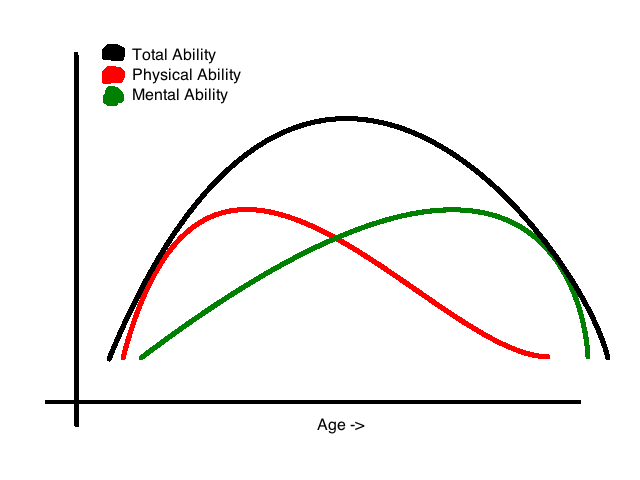
It’s amazing when older athletes can (without enhancement) succeed at the highest levels. I think about it in terms of this graph:

AbilityOk, not the greatest graph, but the point that mental ability matters. The discipline for endless practice, dealing with the temptations of money and fame and the incredible pressure of competition crush the minds of the pretenders.

And this, far more than raw physical ability, is learned. Which means that there’s an element of persistence about the greatest champions that cannot be explained by their talent. This also lets them dodge physical decline.

What’s more, if you believe in progress and science and don’t mind a little wildly unfounded speculation, then an athlete’s mental peak is probably much later than it once was. There could be more Bernard Hopkinses and Dara Torreses in our future.

More from *Thinking Fast and Slow*

Have a look at the graph below. This shows the how our mind is different from math. 

prob

The blue line shows a bell curve with probabilities increasing for events near the average. The red line is how we interpret the likelihood of events given the same data.

Like math, people think the average outcomes are more likely (peak in the middle for both lines), but unlike math, people place a lot of weight on semi-remote probabilities.

To a human, then, all probabilities are approximately uniform (events are equally likely), at least compared to mathematical models. And see the spikes on the tails? That’s availability bias coming into play. The more time we spend thinking about something the more likely it will seem to be in our minds. Extreme events attract attention. So they must be more likely to occur, right?

Now think of black swans, really extreme, improbable events that people are notoriously unable to plan for.

If we look at a list of events and our guts tell us they’re all more or less equally likely to occur, black swans are just items left off the list. Draw attention to them by putting them on the list and, bang, they go from impossible to about as equally likely as all the other ones on the list.

The core lesson here is that humans are bad at small increments of proportionality. Something is either:

  1. ‘really likely’
  2. ‘not so likely’; or,
  3. impossible.

The secret is that ‘really likely’ and ‘not so likely’ are pretty much equally likely.

Link1: Nuclear Potato Cannons; Link2: We Live in the 19th Century

I could like to every single one of the “what if” posts by Randall Munroe:

The official record for fastest manmade object is the Helios 2 probe, which reached about 70 km/s in a close swing around the Sun. But it’s possible the actual holder of that title is a two-ton metal manhole cover.

The cover sat atop a shaft at an underground nuclear test site operated by Los Alamos as part of Operation Plumbbob. When the one-kiloton nuke went off below, the facility effectively became a nuclear potato cannon, giving the cap a gigantic kick. A high-speed camera trained on the lid caught only one frame of it moving upward before it vanished—which means it was moving at a minimum of 66 km/s. The cap was never found.

66 km/s is about six times escape velocity, but contrary to the linked blog’s speculation, it’s unlikely the cap ever reached space.Newton’s impact depth approximation suggests that it was either destroyed completely by impact with the air or slowed and fell back to Earth.

More here.

Same goes for Tyler Cowen, who today excerpts from pieces written in the 19th century. It is *astonishing* how similar the public policy debate then mirrors today’s. As Tyler says: it feels like we’re living in the 19th century.

Turning to insurance for a minute, I often wish I could find a trove of data (or a survey paper!) describing earlier underwriting cycles. There is guaranteed to be a period in the last few hundred years with strong lessons for us today.

Such perspective would be worth big $.

The Anti-Broke

In my business, ‘broking’ is what ‘brokers’ do. It more or less means selling or convincing someone of something. The word ‘broking’, like ‘selling’, can have dark overtones of manipulation (“I’m not trying to broke you, but…”); other times it simply means organizing information and communicating clearly.

Everyone has their style and knowing your style is to be ‘Real’, to be yourself. Nobody feels comfortable buying something from someone who is being fake. A fake demeanor breaks the bond of trust, which is the dearest asset of any salesman. A salesman without trust is a thief.

Anyway, there’s one particular technique that I find myself gravitating towards lately. This style terrifies many in my profession. Some guys get nervous any time a colleague starts to use it.

That style is the Anti-broke.

In essence Anti-broking is to emphasize the negatives of what you are selling. Explain to someone why they might not want to buy. This is heretical stuff. Isn’t the point to get deals done? Why dwell on such counter-productive thought?

You obviously have to be careful about it. Anchoring bias is real and over-emphasizing the negative in someone’s mind might push the benefits out.

But come back to the essence of sales: trust. Anti-broking is about saying “I know where you’re coming from”; it’s about adopting the cynicism of your customers so they don’t have to. It’s comforting.

Eric Barker has an interesting post up about having people buy in to stuff: “The idea of pitching is to begin an engagement with somebody, not necessarily convince them right there”.

Doing a deal with someone is an exhilarating experience and can found lifelong friendships. Inexperienced salesman underestimate how much their customers want to just say “yes!” and seal the deal. Shopping is therapeutic for a reason.

The philosophy of the anti-broke is that if a deal is possible it will probably find itself if there are two genuinely willing, mutually trustworthy parties.

Watch People Pitch

At the Startup Channel. Very cool idea:

Eighty percent of our content will be three-minute elevator pitches for new companies. We have a database of more than 6,000 current business plans (the largest such database in existence) with full financials to draw from and hope to produce at least 2,000 pitches per year. The rest of the content will be contextual: it will inform, explain, educate, and entertain an audience eager to know more about startups and startup culture.

At the heart of The Startup Channel, however, are the pitches, because in addition to being an ad-supported media enterprise, the channel will be what’s essentially the Multiple Listing Service (MLS) for potential startup investments. The JOBS Act, passed last year, allows advertising and solicitation of crowd funding and private placements and someone has to provide a forum for that advertising, which is what we will do. So you can watch the pitch, drill down to the business plan, analyze the financials (we have tools), look for comps, then make your decision. What we don’t do is actually participate in the deal, which would put us under the thumbs of the SEC and FINRA.


How I Spend The Oscars

Grab a beer and witness a thousand comedians feast on awkward interviews and ridiculous clothes at witstream: http://www.witstream.com/.

The ‘stream is at its strongest on the mostly unscripted red carpet and slows down as the ‘real’ show takes over.

Probably the most laughs I get watching tv all year.

__

edit: holy cow does that stream suck. Try Slate. Or google it.

edit2: ok, it’s improving over time.

Tort Reform Is Possible and Worth Bazillions

Jim Lynch turned me onto this paper on the insurance underwriting cycle.*

There’s a neat little graph that caught my eye:

CycleSomething big happened in 1986/1987: the United States economy started shifting serious resources into liability insurance.

In a new paper, Alex Tabarrok describes how this shift toward a more liable society decimated the small aircraft industry: companies could be sued for crash in any plane they had ever produced.

Then, incredibly, unexpectedly, he describes how Congress fixed it:

Our estimates show that the end of manufacturers’ liability for aircraft was associated with a significant (on the order of 13.6 percent) reduction in the probability of an accident. The evidence suggests that modest decreases in the amount and nature of flying were largely responsible. After GARA, for example, aircraft owners and pilots retired older aircraft, took fewer night flights, and invested more in a variety of safety procedures and precautions, such as wearing seat belts and filing flight plans. Minor and major accidents not involving mechanical failure—those more likely to be under the control of the pilot—declined notably.

We complain about the legislative process enough. It’s great to see that it can work for good, too.

As a result of this you’ll see insurance premiums for the aircraft industry fall and that means cheaper planes and cheaper flights. Think back to that graph that shows how insurance surplus has gone from 2-ish% of GDP to 4-ish%. That’s something like $300 billion locked away in low-yielding bonds.

I find it entirely plausible that the underwriting cycle is driven by one-off events. Black Swans if you will. And the big ones seem to make us permanently poorer.

*The paper develops a ‘regime switching’ model and declares it superior to an ‘autoregressive’ model of industry cycles. Without going into too much detail, I don’t really think either are very good at explaining what is going on, I don’t care what the R² score is.

Quote of the Day

I wish there were a macho way to admit you didn’t know something, so people could understand that admitting uncertainty isn’t equivalent to being wishy-washy.

I mean, sometimes I want to bust out and say, “I don’t know that, and neither do you, motherfucker!” but I’m not sure how well that would go over. Some people get touchy about profanity.

That’s Cathy O’Neil, the Mathbabe, whom I am listening to on Econtalk and is now firmly on the blogroll. It’s been a while since I’ve had a new entrant I’ve been so excited about.