Interlude

Not much posting right now because I’m getting absolutely crushed at work. My coursework takes a front seat to the blog, so I’m spending my spare moments on that. Barely even keeping up with the RSS feeds.

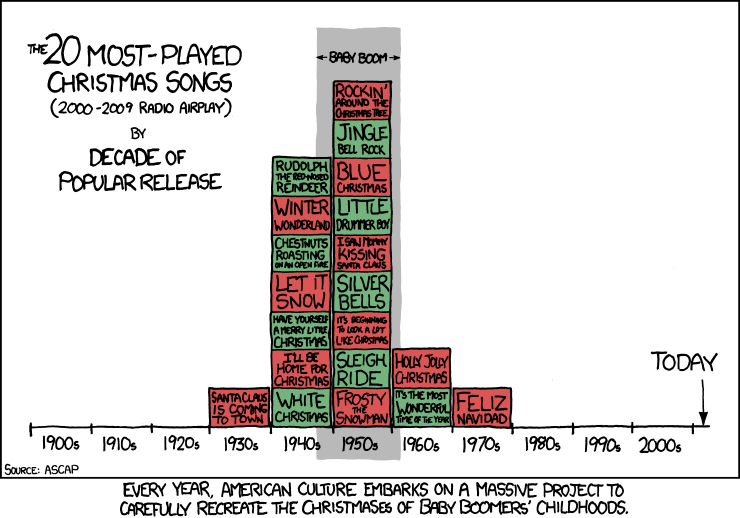
Anyway, here is an awesome offering form xkcd:

Happy Holidays

The Suckers At The Table

Credit rating agencies are always a popular topic when things are blowing up. Why didn’t they foresee this!? What are they good for?! Back in MY DAY, ‘AAA’ meant something!

In my mind, CRAs are little more than public declarations of opinion on assets. In that sense, they have a shared ancestry with sell-side analysts, more formal circulars like the Gartman letter and, yes, even run of the mill journalists.

But apes, chimps and folks like you and me all diverged and so did rating agencies. The interesting question is why and how, right?

I’ve found one good report and one bad report on their history. The key moment when the rating agencies came to be in the sense that Warren Buffett knows them (with an impenetrable competitive advantage) came in the 70s with the advent of the NRSRO.

But the real turning point came in the 30s. You see, in the 30s there was this Great Depression. And everyone figured that this should be the last such instance of massive bank failure, so the government did a whole bunch of stuff, even stuff FDR thought was stupid like, wait for it… deposit insurance:

It would lead to laxity in bank management and carelessness on the part of both banker and depositor. I believe that it would be an impossible drain on the Federal Treasury to make good any such guarantee. For a number of reasons of sound government finance, such plan would be quite dangerous.

Anyway, I say that for fun, but the backlash was coming.

The banks didn’t like the new capital rules and they eventually managed to wiggle themselves a bit of room. This came in the form of capital rules that looked more favorably on ‘safe’ assets (sound familiar?).

But who, pray tell, would deem the assets safe? Well, how about these folks that publish the public circulars rating bonds?

Bang.

Everyone liked the idea. Everyone, that is, except the (if I may take some political liberties) power-mad and incompetent SEC.

(from the Mercatus report above- that’s a right-wing organization by the way)

However, the SEC worried that references to “recognized rating manuals” were too vague and that a “bogus” rating firm might arise that would promise “AAA” ratings to those companies that would suitably reward it and “DDD” ratings to those that would not. If a broker-dealer claimed that those ratings were “recognized,” the SEC might have difficulties challenging this assertion.

To solve this problem, the SEC designated Moody’s, S&P, and Fitch as “Nationally Recognized Statistical Rating Organizations” (NRSROs). In effect, the SEC endorsed the ratings of NRSROs for the determination of the broker-dealers’ capital requirements. Other financial regulators soon followed suit and deemed the SEC-identified NRSROs as the relevant sources of the ratings required for evaluations of the bond portfolios of their regulated financial institutions.

So rating agencies are the creation of regulators and a result of the technocratic inclination to ever-finer engineering of rules and procedures and control. They are collections of 3rd quartile talent (guess who’s in the bottom quartile?) in an industry protected by the government.

Actually, most people that are in the bond business are protected by the government. Hell, anyone who depends on a massive slug of short-term financing to make money gets a free ride these days.

Rating agencies just don’t make as much hay.
Tiiiime to Pivot!

The ‘pivot’ is when a company with lots of human capital and a strong enough culture figures out if it’s done anything interesting yet. Mozilla needs to pivot. Here are some quotes:

From Marco:

Most Firefox users don’t know how the company pays its bills. The majority of its income — about $100 million annually — is from Google, who pays Mozilla for using Google by default in the stock homepage and built-in search box.

And this:

When the original three-year partnership deal was signed in 2008, Chrome was still on the drawing boards. Today, it is Google’s most prominent software product, and it is rapidly replacing Firefox as the alternative browser on every platform.

Uh oh. Would you subsidize your most important competitor?

I wouldn’t, which suggests that Mozilla needs to find some mojo pronto. I fled to Chrome for speed reasons 8 months ago and don’t expect to return.

Awesome Things I’ve Learned Today

Image compression.

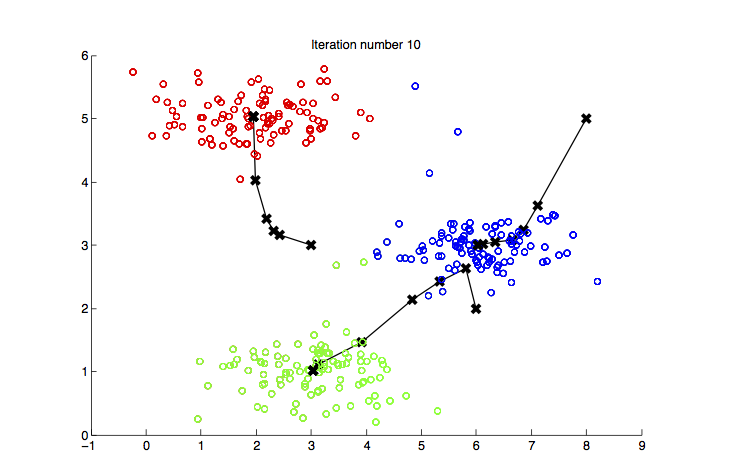
In the Machine Learning class, we just learned the k-means clustering technique. Sounds complicated but, as always, the jargon is harder to learn than the concepts in computer science and math.

The idea here is that you express each color in an image as a combination of red, green and blue. Now you can plot each of the colors on a 3d graph so that similar colors will be plotted near each other. Dark red and light red will all be in the high-red, low green, low blue part of the graph.

Now pick a number of colors that you want to compress the image to. I’ve picked 16.

Nett you randomly drop 16 points into that plot of all the colors used. Each of the colors used will be close (in 3d space) to one of the dropped 16.

Here comes the clever part.

Now you have 16 groups of colors based on their closest random point. Find the mid-point (or average, or whatever you want to call it) of the colors and move the one of 16 to that mid point, then recalculate. Here is an image of it working in 2d space.

Eventually you wind up grouping all of the original colors into ‘likeness’ groups. The midpoint of this likeness group is your new color and the imagine is compressed!

Here’s an imagine of my dog Max I just compressed in this fashion.

Keys To Success

I love great graphs and this is a great graph:

h/t IA.

This reminds me of one of the best posts I’ve ever read:

using intimate knowledge of an industry and the specific pain points within an industry is a perfectly legal unfair advantage for a startup.

Here’s a real-world example of how this advantage manifests. Adriana has been a psychiatrist for 10 years; she understands the ins and outs of that business. During a lull in her practice she got a serendipitous opportunity to shift gears completely and ended up leading software product development teams.  (Turns out that for big-business project management it’s more valuable to be a sensible thinker and counselor than to be an expert in debugging legacy C++ code.)

Now Adriana has an epiphany: Traditional practice-management software for psychiatrists totally sucks; she knows both the pain points and the existing software first-hand. But now she has the vision and ability to design her own software, capitalizing on modern trends (e.g. a web application instead of cumbersome installed applications) and new interpretations of HIPPA regulation (which allows web-based applications to store medical records like patient histories).

Adriana holds a unique position: Expert in the industry, able to “geek out” with her target customer, yet capable of leading a product team. Even if someone else saw Adriana’s product after the fact, it’s almost impossible to find a person — or even assemble a team — who has more integrated knowledge. At best, they could copy. Of course by then Adriana has moved on to version two.

Everyone has awesome information about something. Mix it with other awesome information in a unique way and you’ve got yourself a competitive advantage.

Sovereignty Shall Reassert

I tend to numbly flick through any Euro analysis that chances across my screen, but yesterday I stopped and actually read a James Hamilton post and thought about it for a sec. It’s a good discussion.

The paths are simple: break the Euro or everyone climb into bed with each other and start making out (my metaphor for fiscal integration). Well, I think this isn’t going to work.

Think of this as a voter: would you vote for a head of state that raises taxes to give BILLIONS of dollars to Greece?

Now think of the flipside. Will Greek voters be all happy-clappy that a bunch of Germans are going to tell them how to run the show? Meh, the Germans aren’t so bad, right? Well, Germany ain’t above rigging itself a good deal at others’ expense.

Let me mess with your xenophobia a bit and ask this: would you accept a bailout from China or Russia if they would assert some fiscal control over your government for the next 20 years?

Yeah f#$!ing right.

The conventional view right now is that nothing is going to happen until the Germans wake up and realize shit is being fed through the fan. Tyler pushes back and so do I, but harder.

This sucker is going down.

Today in Useless Aggregates

The economist reproduces one particularly unhelpful graph/table:

I hate this aggregate analysis. Regional variations in most of these countries completely invalidates the analysis. How do you  make sense of the magnitude of the US housing problem with this kind of regional variation?

You don’t, is how. And even the Case-Shiller doesn’t comment on the economic importance of the various cities.

Have a care when drawing conclusions from gigantically rolled-up economic aggregates. They’re way too easy to fudge in favor of bias.

Review: New York Tech Meetup

I went to another NYTM last night and, again, really enjoyed it. Every time I go, I meet a few really interesting people (batting 1.000 so far) and have some stimulating conversations about the presentations.

This month we were treated to another bland lineup of social media webapps, which don’t really excite my interest. Social media webapps seem to have two goals: letting you keep in touch with people you already know (facebook) or suggesting new people for you to meet (no paradigm here, yet, but linkedin is in the ballpark). I saw several variations on both, none of which were particularly gripping. I have a pretty low tolerance for this kind of thing, though.

The enterprise software was a bit more interesting. Big data is a persistent theme. If you can get your hands on a big, novel dataset, you have found yourself at the cutting edge of technology. Better get some crunchers on that, pronto, before someone nicks your lunch. I’m available.

There were two hardware offerings, which I always find the most exciting. One was a 3d printing service, which is one of the most extraordinary recent technological developments.

The other is an almost moving story, to an econo-geek. From the ashes of the Rochester photography industry rises Kogeto, a maker of 1. a 360 degree video camera add-on for the iphone; 2. hardware (woops!) software for editing such video and, 3. a video player that lets you click and drag such video in your browser (or wherever). Impressive.

Once again the presentations are polished, often funny, and almost always flawless. Bravo to all.

Can’t wait for next month!

Uplifting Quote Of The Day

AMR was the last of the major legacy airline companies in the United States to file for Chapter 11. Analysts said that its reluctance to do so earlier had left it less nimble than many of its competitors.

More here.

Deregulation created an industry that looks very little like the one that preceded it. This can only happen through the destruction of the previous regime.

It works.